Phantom Scooter Review: Safety Recalls and Owner Feedback
This post contains affiliate links. As an Amazon Associate, we earn from qualifying purchases.
The Apollo Phantom V1, V2, and 60V electric scooters were recalled by the U.S. Consumer Product Safety Commission (CPSC) in August 2023 due to a faulty A2-70 stainless steel stem bolt that could break and cause falls. For the current V3 model, the Apollo Phantom is a powerful, heavy-duty scooter with a top speed of 41 mph, a 40-mile range, and a 300 lb max load, but it demands rigorous maintenance, most critically, tightening the stem bolt to 40-50 Nm every 500 km with a torque wrench.
That bolt recall isn’t a footnote. It’s the central fact of owning a Phantom from 2021 to 2023. Around 3,900 scooters sold between June 2021 and May 2023 were affected after seven bolt-failure reports led to three injuries. The CPSC’s stance is clear: stop riding immediately. Apollo Scooters’ stance involves sending a free replacement bolt and instructions, implying the scooter can be used after repair. Apollo’s stance is more operational: send a free replacement bolt and instructions, and then maintain it relentlessly. This gap between regulatory stop-orders and manufacturer maintenance schedules is where real ownership lives, or where it gets dangerous, a reality every phantom scooter review must address.
What follows is a breakdown of the Phantom’s performance, the essential maintenance it requires, and the confusing variety of “Phantom” branded scooters you’ll find at Costco. This isn’t about whether it’s fast. It’s about whether you’re willing to treat a 66 lb vehicle with the same mechanical diligence as a motorcycle.
Key Takeaways
- Stop using a recalled Phantom immediately. The CPSC Phantom scooter recall notice mandates it for V1, V2, and 60V models with the A2-70 bolt. Apollo provides a free upgrade kit.
- Torque wrenches are not optional. The stem bolt must be tightened to 40-50 Nm (Newton-meters) every 500 km. Guessing the tightness leads to failure.
- The Phantom V3 is a heavy commuter, not a last-mile toy. At 66 lb with a 300 lb load capacity, it’s built for larger riders and longer distances, but its tubed tires are more puncture-prone than modern tubeless designs.
- “Phantom” does not mean one brand. The Apollo Phantom is distinct from the budget Phantom A10 or PhantomGoGo models sold at retailers like Costco, which share a name but not the performance or price tag.
- Real-world range hinges on hills and weight. The claimed ~40-mile range assumes ideal conditions; expect reduced range with hills, stop-and-go traffic, or a rider near the max load.
The Apollo Phantom V3 Specs That Matter
Forget the marketing superlatives. The Phantom V3’s spec sheet tells you exactly what job it’s built for: carrying a heavy load at high speed over moderate distances, with zero tolerance for neglect. According to the official manual, the Phantom V3 weighs 66 lb (29 kg) and can support a max load of 300 lb (136 kg). That’s not an accident, it’s a signal that this scooter is meant for larger riders or those carrying gear. The dual 1200W motors deliver a top speed of 41 mph (66 km/h), but you’ll only reach that in the “Ludo” mode. The 52V 23.4Ah battery uses 126 individual cells and promises a range of about 40 miles (64 km) under perfect, flat conditions.
Those numbers place it firmly in the high-performance commuter category, well beyond the needs of a college student darting between classes. Compare it to a lighter, simpler Phantom A10 from Costco, and the difference is stark in any phantom scooter review, the A10 is a last-mile tool, while the Apollo Phantom is a vehicle replacement. The IP54 weather rating means it can handle a light spray, not a downpour or puddle. The regenerative braking can recharge the battery up to 10%, a nice perk that slightly extends range during downhill city riding. But here’s the sensory reality: at full throttle, the dual motors produce a high-pitched whine that announces your presence blocks away. It’s not subtle.
The 40-50 Nm Stem Bolt Torque Rule (and Why It’s Non-Negotiable)
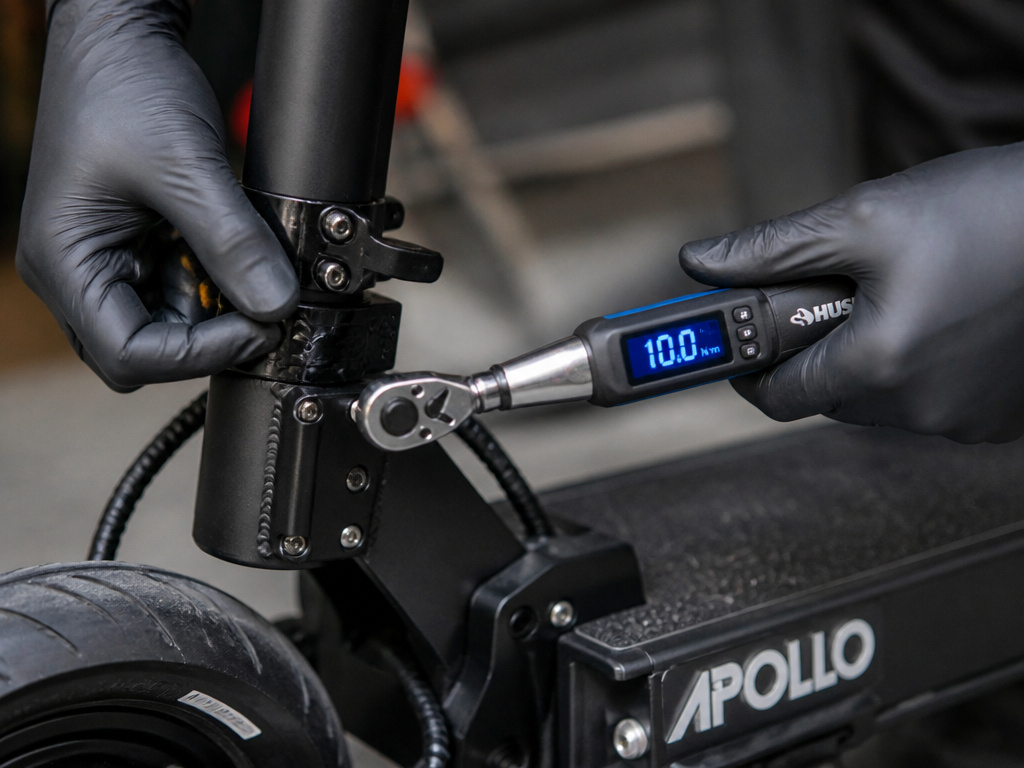
This is where most reviews gloss over the single most important owner task. Apollo’s maintenance guide states you must check the main stem bolt every 500 km. The recall documentation specifies it must be tightened to 40-50 Nm. Not “good and tight,” not “until it feels firm.” 40-50 Nm, measured with a torque wrench.
A torque wrench is the only tool that measures rotational force. Guessing by hand leads to under-tightening (bolt loosens and breaks) or over-tightening (strips threads, bolt breaks). Both end with the front assembly separating at speed.
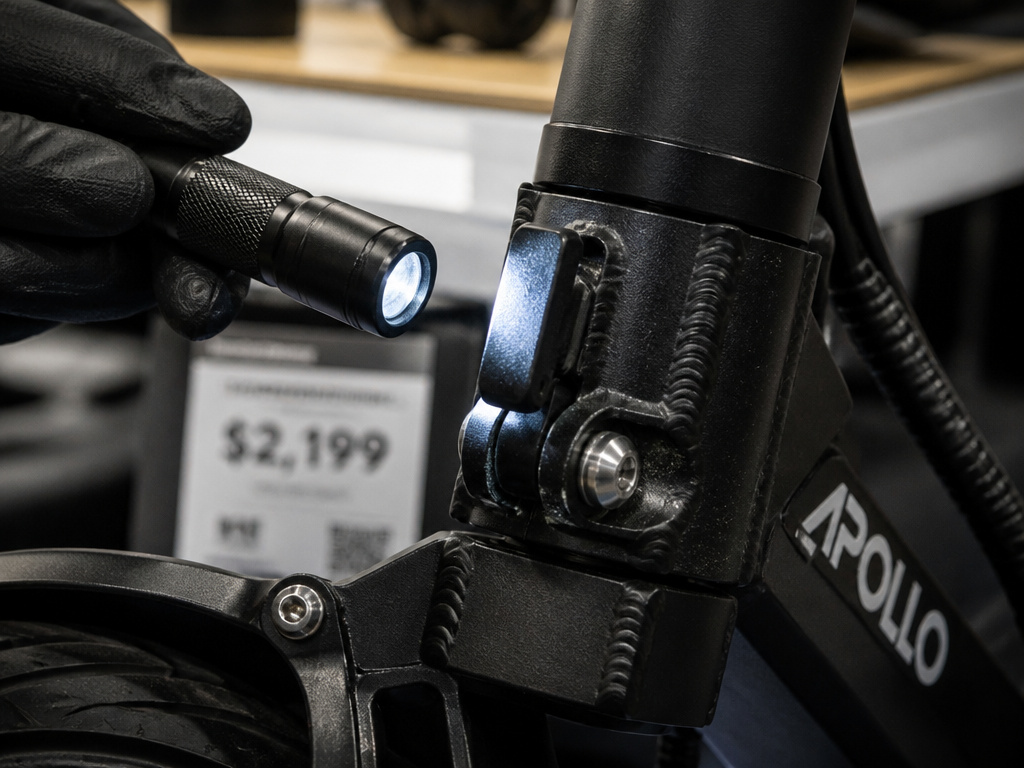
Why does this matter so much? The stem bolt is the single point of failure that connects the entire front wheel, suspension, and steering assembly to the deck. When the original A2-70 bolts on recalled models failed, they resulted in injuries documented by the CPSC. The replacement Grade 12.9 bolt is stronger, but it still vibrates loose. The required 500 km check interval translates to about two weeks of daily commuting for some riders. If that sounds like too much, this isn’t your scooter.
Common mistake: Using a standard hex key or wrench without a torque gauge. You’ll think it’s tight enough. It almost never is. The bolt can work loose over time, and you won’t feel it until the steering develops a dangerous wobble.
| Maintenance Task | Interval (Phantom V3) | Tool Required | Risk If Skipped |
|---|---|---|---|
| Check Tire Pressure | Each ride | Air pump, pressure gauge | Poor handling, pinch flats, reduced range |
| Tighten Wheel Nuts | Every 50 km | Hex key set | Wheel detachment |
| Torque Stem Bolt | Every 500 km | Torque wrench (40-50 Nm) | Stem separation, crash |
| Inspect Suspension | Every 1000 km | Visual check | Loss of damping, unstable ride |
Phantom Brand Confusion: Apollo vs. Costco vs. PhantomGoGo
If you’re looking at a “Phantom scooter,” you need to know which one. There are at least three distinct product lines sharing the name, and confusing them leads to wildly wrong expectations.
The Apollo Phantom is the subject of this review and the recall, a high-power, high-maintenance scooter sold directly by Apollo and specialist retailers for between $2,000 and $2,500. Then there’s the Phantom A10, a “smart” scooter often found at Costco, with a seat, a smaller motor, and a much lower price point. Finally, PhantomGoGo is a separate brand producing budget models like the A8 and A9, also sold at big-box stores. They share a nameplate and nothing else.
This confusion matters because an owner might search for help with their PhantomGoGo electric scooter and stumble into a forum thread from a phantom scooter review about torquing an Apollo Phantom stem bolt to 50 Nm, a procedure that doesn’t apply and could damage their simpler scooter. When researching, always verify the exact model name and manufacturer. The build quality, performance, and safety considerations are worlds apart.
Real-World Riding: Performance vs. Practicality
On smooth pavement, the Phantom V3 accelerates with a shove that can startle new riders. The dual motors pull hard from a stop, and the quadruple spring suspension soaks up bumps decently. But the real world isn’t a test track. For commuting, two specs dominate the experience: weight and tires.
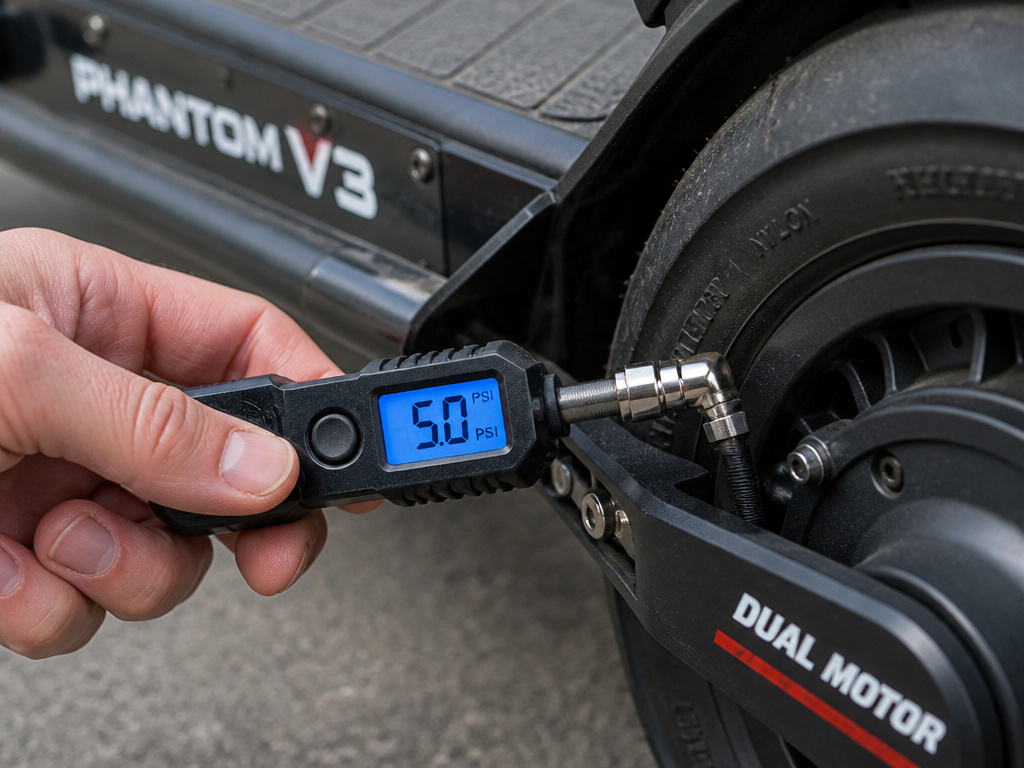
At 66 lb, this isn’t a scooter you casually carry up a flight of stairs or onto a bus. The folding mechanism helps, but it’s still a two-handed lift. The tubed tires, while replaceable, are a known weakness. Owners report more flats compared to modern scooters with tubeless, self-sealing tires. The manual recommends 50 PSI, which you must check every ride for optimal range and to prevent pinch flats. Let the pressure drop below the recommended 50 PSI, and you’ll feel the drag immediately.
Then there’s the hill climb. The dual motors handle moderate inclines well, but the battery drains noticeably faster. That claimed 40-mile range? Expect 20-25 miles if your commute has any real elevation change.
Where this goes sideways: Assuming the top speed is usable daily. The Phantom can hit 41 mph, but most urban roads and bike lanes have lower speed limits. Sustained high-speed riding also drains the battery quickly. And draws constant attention from law enforcement.
For a campus environment, the Phantom V3 is serious overkill. Its weight, power, and maintenance needs are better suited to a suburban commuter replacing a car for sub-10-mile trips. A lighter scooter from Apollo’s own lineup or a competitor might offer a better balance of power and practicality for most riders.
Safety, Recalls, and the Long-Term Ownership Reality
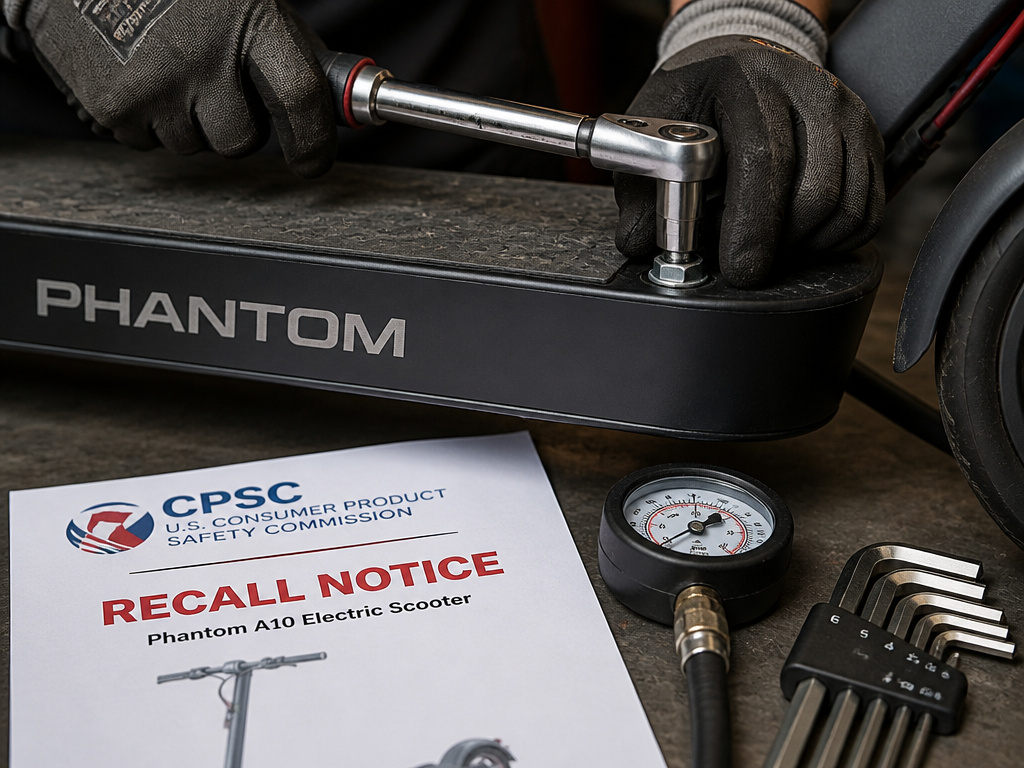
The CPSC recall casts a long shadow. It’s a concrete data point that these machines can fail in a way that causes injury. The remedy is straightforward but burdensome: identify your bolt type, request the free upgrade kit if needed, and commit to a permanent maintenance schedule. Apollo provides the official recall for fall hazard and a detailed retiro oficial de patinetes Phantom in Spanish.
Long-term, owners on forums report two paths. Those who adhere to the maintenance schedule, checking tire pressure, torquing bolts, inspecting suspension, get thousands of miles of reliable service. Those who treat it like a toy encounter problems: loose bolts, flat tires, and eventually, motor or battery issues. The Phantom doesn’t forgive neglect.
This is a scooter for someone who enjoys tinkering as much as riding. If you’re not willing to buy a torque wrench and use it every few weeks, look at brands with simpler designs or better customer support reputations. Some riders, frustrated by Apollo’s past customer service hiccups, have moved to competitors for their high-performance needs.
How much does the Apollo Phantom cost?
The Apollo Phantom V1, V2, and 60V models were sold for between $2,000 and $2,500. This puts it firmly in the premium performance scooter category. When assessing value, potential buyers must weigh this initial investment against the scooter’s capabilities and the required commitment to maintenance. The recall of approximately 3,900 units for a faulty stem bolt, which led to injuries, adds a critical factor to the value equation. A scooter at this price point demands robust construction and reliability, so the existence of a safety recall is a significant consideration for any cost-benefit analysis.
Apollo Phantom battery life and charging
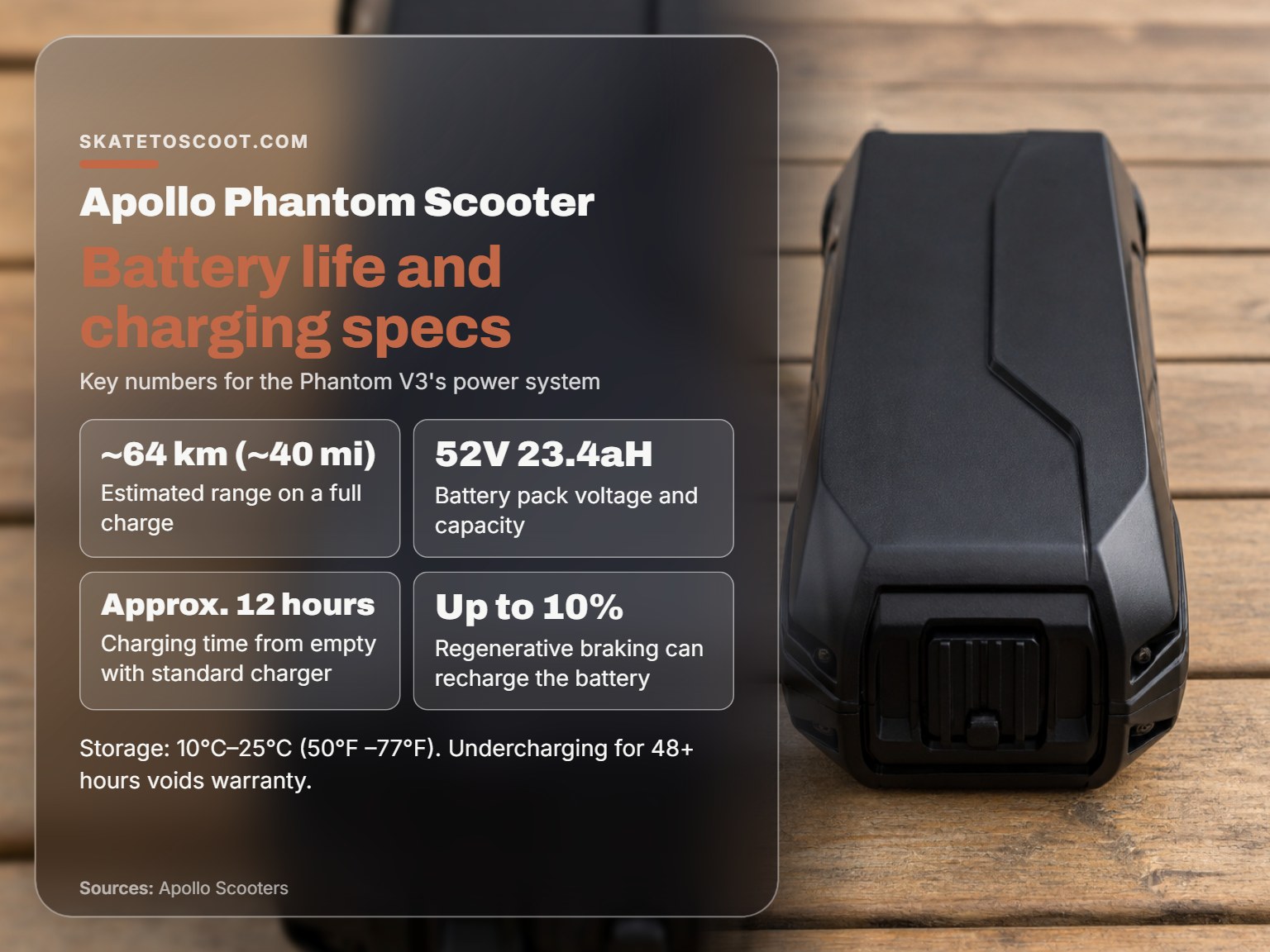
The Phantom V3 uses a 52V 23.4Ah battery pack composed of 126 individual cells, which provides an estimated range of about 40 miles. Charging this large battery from empty with the standard charger takes approximately 12 hours. For long-term health, store the battery in a cool, dry place and avoid leaving it in a deeply discharged state for extended periods, as this can void the warranty. The scooter’s regenerative braking system can recover a small amount of energy back into the battery during rides. Always follow the manufacturer’s specific guidelines for ideal storage charge levels, though sources disagree on the exact percentage (70% vs. 75%), to maximize battery lifespan.
Is the Apollo Phantom easy to carry and fold?
With a net weight of 66 pounds, the Phantom is a substantial machine. Its portability is less about effortless carrying and more about the ability to fold it for storage or transport in a vehicle trunk. The folding mechanism itself is a critical safety point due to the recall on certain models involving the main stem bolt. Owners of recalled scooters must stop using them immediately and obtain a free replacement bolt. For all Phantom owners, regular inspection and proper tightening of this stem bolt, as specified in the maintenance schedule, is absolutely essential for safe folding and unfolding.
Frequently Asked Questions
Is the Apollo Phantom a good scooter?
The Apollo Phantom V3 is a powerful, capable scooter for heavy riders and long commutes, but it’s not “good” in a general sense. Its value hinges on your willingness to perform rigorous, scheduled maintenance, most critically torquing the stem bolt every 500 km. If you neglect that, it becomes a safety hazard.
How fast does a Phantom scooter go?
The Apollo Phantom V3 has a top speed of 41 mph (66 km/h) when its “Ludo” mode is activated. However, the electronically limited gears are much lower: Gear 1 tops out at 3 mph, Gear 2 at 9 mph, and Gear 3 at 12 mph. The cheaper Phantom A10 from Costco has a lower top speed.
What’s the most reliable scooter brand?
There is no single “most reliable” brand across all price points and use cases. Brands like Segway have a reputation for durability in the commuter segment. For high-performance scooters, reliability often depends more on the owner’s maintenance than the brand name. Apollo has had notable quality control issues in the past, which the stem bolt recall highlights.
Who makes Phantom scooters?
The name “Phantom” is used by multiple companies. Apollo Scooters makes the high-end Apollo Phantom. PhantomGoGo is a separate company that makes budget models like the A8 and A10, often sold at Costco. Always check the manufacturer name on the product itself or the sales documentation to know which one you’re getting.
Can I still buy an Apollo Phantom?
Yes, the Apollo Phantom V3 is currently for sale directly from Apollo. The recall affected earlier V1, V2, and 60V models sold between June 2021 and May 2023. New V3 models should come with the stronger Grade 12.9 bolt already installed, but the same 40-50 Nm torque requirement applies.
The Bottom Line
The Apollo Phantom V3 is a tool, not a gadget. It demands respect, a torque wrench, and a schedule. If your riding style is “hop on and go,” this scooter will disappoint you, or worse, fail on you. The recall isn’t a past event; it’s a permanent lesson in the mechanical vigilance required to operate a 41 mph vehicle held together by a single bolt.
For the right rider, someone who needs a 300 lb load capacity, has a flat-ish commute under 20 miles, and doesn’t mind weekly mechanical checks, it’s a powerful option. For everyone else, especially students or casual riders, a lighter, simpler scooter from Apollo’s own lineup or a competitor will provide 95% of the utility with 10% of the hassle. The Phantom’s performance is real. Its price is your time.
