Phantomgogo Electric Scooter Review: A10 vs R1 Specs
This post contains affiliate links. As an Amazon Associate, we earn from qualifying purchases.
Phantomgogo electric scooters are a line of budget-friendly, commuter-focused models sold primarily through retailers like Costco, with the A10 and R1 being the most common. They offer modest performance (15-15.5 mph top speed, 20-28 mile range) suitable for flat urban commutes, but lack suspension and have specific maintenance and safety considerations, including a critical distinction from the recalled Apollo Phantom scooters.
If you’re browsing Costco or Amazon for an affordable electric scooter, the Phantom Gogo name pops up a lot. The promise is straightforward: a simple, portable vehicle for short trips without the hassle of a car. The reality, pulled from owner manuals, forum reports, and official recall notices, is more nuanced. These scooters fill a specific niche, but understanding their limits, from battery care in the cold to the difference between a Phantom Gogo and a recalled Apollo Phantom, is what separates a safe purchase from a frustrating one. Reading a thorough Phantomgogo electric scooter review is essential for that understanding.
What follows is a breakdown of the specs you’ll actually get, the real-world performance you can expect, and the maintenance rules straight from the manufacturer’s manual that most buyers miss.
Key Takeaways
- The Phantom Gogo A10 and R1 are distinct, lower-powered models meant for flat commutes, not the high-performance, recalled Apollo Phantom scooters.
- For battery longevity, charge before it drops below 20% for daily use and avoid storing the scooter with a fully depleted battery, per the official Phantomgogo FAQ.
- The IPX5 water resistance rating only protects against light rain and splashes; submerging the scooter or riding through standing water will cause internal damage.
- Cold temperatures below 50°F (10°C) significantly reduce battery performance and range, a fact confirmed by both the user manual and owner reports.
- Assembly is generally straightforward, but checking all bolt tightness before your first ride is an essential safety step many overlook.
Who Makes Phantom Gogo Scooters and What’s the Apollo Recall?
You see “Phantom” on a scooter and think it’s one brand. It’s not. This confusion is the single biggest safety and buying mistake you can make.
Phantom Gogo is a brand that produces a range of affordable electric scooters and e-bikes, often sold through big-box retailers. Their models, like the A10 and R1, are designed for last-mile commuting with modest motors (400W-450W) and speeds capped around 15 mph.
The Apollo Phantom is a completely different, high-performance scooter from a company called Apollo. Here’s the critical part: the U.S. Consumer Product Safety Commission (CPSC) recalled approximately 3,900 Apollo Phantom V1, V2, and 60V models on August 31, 2023. The recall was issued because a single stem bolt can come loose, causing the front suspension and wheel assembly to separate while riding, posing a fall hazard. The CPSC report notes seven incidents of bolt breakage, resulting in three injuries (bruising, cuts, abrasions). These scooters were sold online from June 2021 through May 2023.
Before you start: The recalled Apollo Phantom is a different, more powerful scooter. Always verify the exact brand and model name (Phantom Gogo vs. Apollo Phantom) before riding or making assumptions about performance or safety.
So, when you read a phantomgogo electric scooter review, you’re looking at a different category of vehicle. Conflating the two because they share “Phantom” in the name is a recipe for misunderstanding what you’re actually buying.
Key Specs and Model Differences: A10 vs R1
Performance on paper sets your expectations. In practice, it determines whether the scooter can handle your specific commute. The two most common Phantom Gogo models serve slightly different riders.
The Phantom Gogo A10 is a standing scooter. According to its official manual, it’s powered by a 400W motor with a top speed of 15 mph and a range of approximately 28 miles. It weighs 38.0 lbs and supports a maximum load of 220 lbs. Its 36.5V/10Ah (365Wh) battery takes about 6 hours to charge, and it carries an IPX5 water resistance rating.
The Phantom Gogo R1 (Commuter) is a seated scooter. Its manual lists a 450W motor, a slightly higher top speed of 15.5 mph, but a shorter range of 20 miles. It’s paradoxically lighter at 35.5 lbs but can support more weight, up to 265 lbs. It uses a 36V/8Ah battery and rolls on 12-inch tires.
| Specification | Phantom Gogo A10 (Standing) | Phantom Gogo R1 Commuter (Seated) |
|---|---|---|
| Motor Power | 400W | 450W |
| Max Speed | 15 mph | 15.5 mph |
| Max Range | ~28 miles | 20 miles |
| Max Load | 220 lbs | 265 lbs |
| Net Weight | 38.0 lbs | 35.5 lbs |
| Battery | 36.5V/10Ah (365Wh) | 36V/8Ah |
| Key Feature | Standing, portable | Includes seat, larger tires |
The choice here isn’t about raw power, both are slow by performance scooter standards. It’s about posture and portability. The A10 is for someone who wants a classic, foldable stand-up scooter. The R1 is for a rider who prefers a seated position for longer comfort, accepting the trade-off of a slightly bulkier folded size (48.5” x 10” x 23” for the R1).
The Phantom Gogo A10 uses a 400W rear hub motor and a 36.5V/10Ah lithium-ion battery to achieve a rated range of 28 miles. Its IPX5 rating denotes protection against water jets from any direction, but not against immersion.
If you’re comparing these to other brands, a phantomgogo electric scooter review provides a wider context on where these specs fall in the market.
Real-World Performance and Ride Quality
Spec sheets promise. The road delivers something else. For Phantom Gogo scooters, the gap between the two is defined by three things: hills, surface quality, and temperature.
First, hills. A 400W or 450W motor provides adequate torque for gentle inclines. On a moderate hill, speed will drop. On a steep hill, you might need to kick-assist or even get off and walk. This isn’t a flaw specific to Phantom Gogo; it’s the physics of small, single-motor commuter scooters. The R1 manual even quantifies its climbing angle at 7.2 degrees. If your commute has a serious incline, this isn’t the right tool.
Second, ride quality. Neither the A10 nor the R1 has any suspension. Both models use air-filled (pneumatic) tires, which absorb small bumps better than solid tires. But you will feel every crack, seam, and pothole directly through the deck and into your feet or seat. This is the most common complaint in owner forums. One Reddit user who returned their A10 after two weeks said, “first bump on the road hurt just about every joint in my body.” The ride is firm and communicative. For smooth bike paths and well-maintained sidewalks, it’s fine. For broken city pavement, it’s punishing.
Third, temperature. The official FAQ warns that cold temperatures below 50°F (10°C) reduce battery performance and lifespan. This isn’t a minor note. In practice, your 28-mile range on the A10 can be significantly reduced on a chilly day. Owners in the Reddit threads specifically noted slower speeds and reduced range after storing scooters in hot car trunks.
The takeaway? These are fair-weather, flat-ground machines. They excel at short, predictable commutes on good pavement. They struggle when the conditions deviate.
Assembly, Setup, and First Ride Checklist
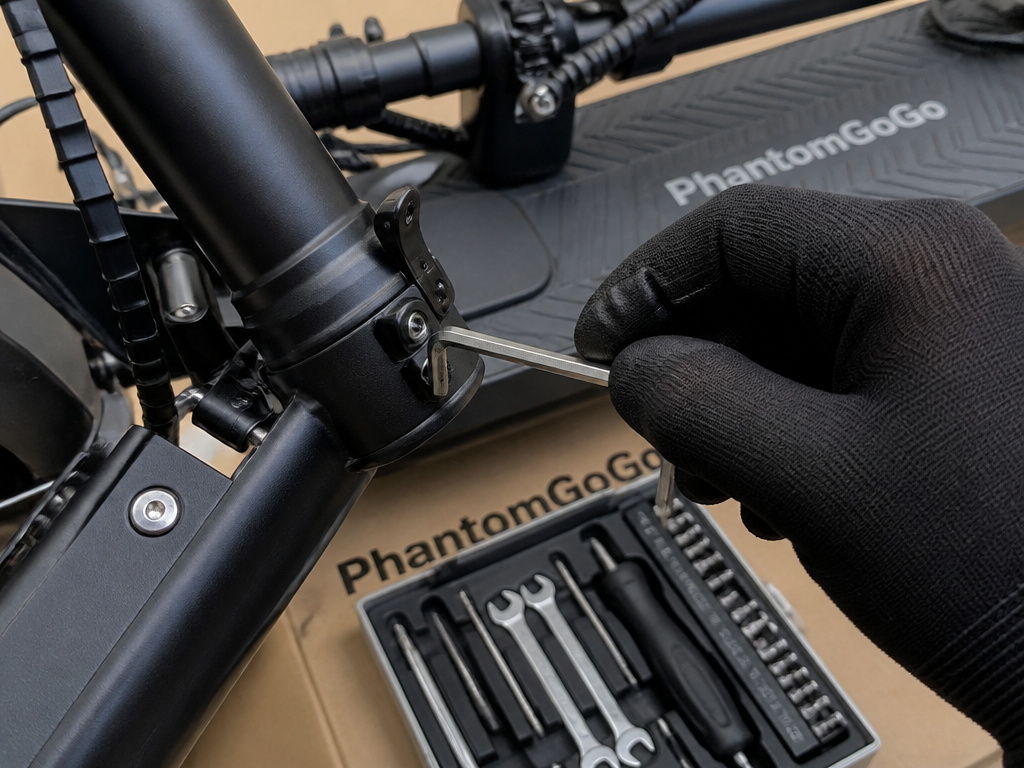
Your scooter arrives in a box. Getting it road-ready is mostly straightforward, but skipping the fine print leads to the most common early failures.
Unbox and lay out all parts. You should have the main deck, handlebar stem, front wheel, tool kit, charger, and maybe a seat for the R1. The stem usually folds down for shipping and needs to be lifted and locked into place. This is where you need to pay attention.
The locking mechanism uses a latch and a quick-release clamp or bolts. The manual will tell you to tighten it securely. Do not just snap it closed and assume it’s fine. Apply the provided tools and ensure it is firmly fastened with no wobble. A loose stem is dangerous and is the direct cause of the Apollo Phantom recall, a different failure mode, but the same principle of a critical joint failing.
Next, inflate the tires. The R1 manual states the default tire pressure for both tires is 36 PSI. The A10 will have a similar spec printed on the tire sidewall. Under-inflated tires increase rolling resistance, killing your range and making the ride feel sluggish. Over-inflated tires make the already harsh ride worse and risk blowouts.
Charge the battery fully before the first ride. Plug in the charger (the R1 uses an AC100-240V/50-60hz unit) and wait for a full charge. The display will indicate a full charge. This initial cycle matters.
Finally, do a static test. Turn on the scooter (usually a press-and-hold power button on the handlebar). Check that the headlight, taillight, and LCD display work. Squeeze the brake levers to ensure they engage and the motor cuts off. Gently twist the throttle to see if the wheel spins freely (lift the scooter off the ground for this).
This pre-flight check catches many assembly issues. It’s boring. It’s also what keeps you from discovering a loose brake cable at your first intersection.
Battery Care and Maintenance That Actually Works
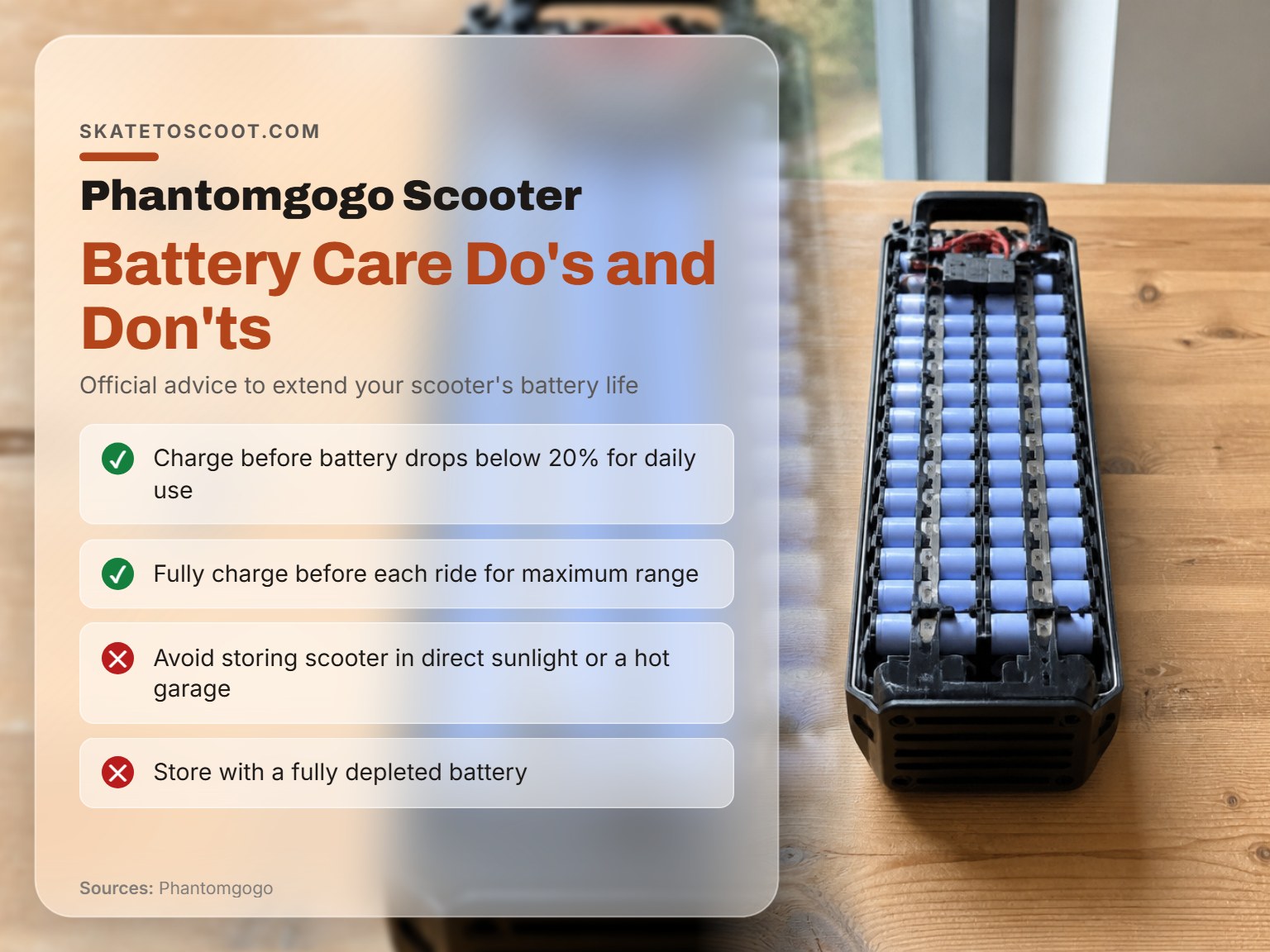
Lithium-ion batteries are the heart of the scooter and the most expensive part to replace. The manufacturer’s FAQ and manual give specific, sometimes contradictory, advice. Following it literally is the difference between a battery that lasts years and one that dies in one season.
Daily Charging: The Phantomgogo FAQ says to charge before the battery drops below 20% for daily use and to fully charge before each ride for maximum range. This seems like a contradiction, but it’s about battery chemistry. Lithium-ion batteries hate being fully drained. Stopping at 20% avoids deep discharge cycles that wear them out. The “full charge before riding” ensures you get all the available capacity for that trip.
Long-Term Storage: Here’s where sources disagree. The A10 User Manual says: “When not in use for more than 30 days, fully charge, store in a cool, dry place, and fully charge every 30 days.” The official Phantomgogo.com FAQ states: “For long-term storage, maintain a 40% charge level.” This is a real conflict. The 40% rule is a modern best practice for lithium-ion health during multi-month storage, while the 100% rule is an older, simpler instruction.
Temperature Rules: Never store the scooter in direct sunlight or a hot garage. The manual explicitly warns that hot temperatures can damage the battery and function. Conversely, the FAQ warns that cold below 50°F (10°C) reduces performance. If you must store it in a cold garage over winter, bring the battery indoors if possible. Cold slows chemical reactions inside the battery, reducing its ability to deliver current. That’s why your range plummets on a winter ride.
Cleaning: This is essential. The FAQ states: “The best way to clean your scooter is to wipe it with a damp cloth. Do not hose it down.” The manual is more dire: “Do not immerse the electric scooter in water as it will cause permanent damage.” IPX5 is not waterproof. It means it can handle a light spray from a nozzle. A garden hose or a pressure washer will force water into the deck, display, and motor, causing corrosion and electrical shorts. A damp cloth and a soft brush for the deck are all you need.
Treat the battery like a pet. Don’t let it starve (full discharge), don’t overfeed it (leave it plugged in at 100% for weeks), and keep it in a comfortable environment. It’s simple, but it’s the thing most people ignore until the scooter suddenly won’t hold a charge.
Warranty, Returns, and Customer Support Reality

A warranty is a promise. The return policy is your escape hatch. Phantom Gogo’s policies are standard for the direct-to-consumer scooter world, but you must follow the rules to the letter.
The warranty covers new products for one year for the original owner, covering manufacturing defects. This means if a weld fails or the motor dies under normal use within a year, they should replace the part. However, the warranty does not cover damage from crashes, modifications, or neglect, like water damage from hosing it down.
The return policy offers a 30-day window for a full refund or exchange when purchased directly from Phantomgogo.com. All scooters must be returned before a refund is issued. This is crucial: you must contact them for a return label to their designated service center. Shipping a scooter back on your own dime to the wrong address will result in fees and delays.
What does this mean for you? Document everything. When you unbox, take photos of the scooter and any parts damage. If an issue arises in the first month, contact support immediately through their official channels and start the return process if needed. The 30-day clock starts ticking the day you receive it.
For issues after 30 days but within the one-year warranty, you’ll be dealing with parts replacement. This often means they ship replacement parts, and you or a local bike shop install them. Be prepared for the warranty service process.
Across the field of electric scooter reviews, this level of support is typical. It’s not hands-holding, but it provides a baseline of protection if you receive a defective unit.
How does Phantom Gogo compare to other scooters?
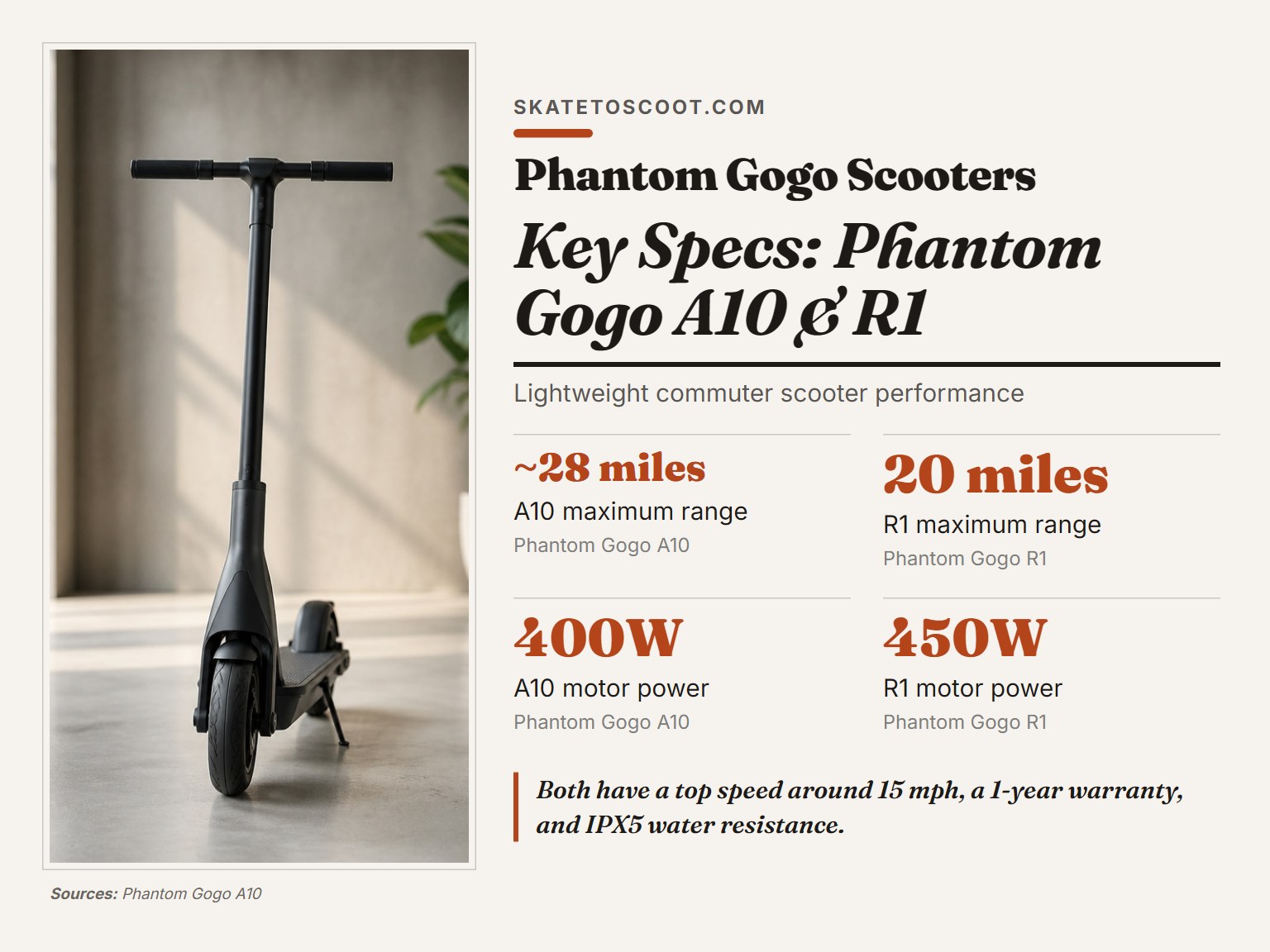
Phantom Gogo models like the A10 and R1 are distinct from many other brands in their class. They are designed as affordable, lightweight commuter scooters with moderate speeds and ranges. For instance, the A10 offers a range of approximately 28 miles, while the R1 provides 20 miles. Their motors are in the 400W to 450W range, suitable for flat urban terrain. A key point of comparison is with the unrelated, high-performance Apollo Phantom scooters, which were recalled in 2023 due to a safety hazard. When comparing scooters, look at the intended use, warranty length, and water resistance ratings to see if they match your daily needs.
Frequently Asked Questions
Is a Phantom scooter good?
It depends on your needs. For a flat, short commute (under 5 miles) on decent pavement, a Phantom Gogo A10 or R1 is a decent, affordable choice. It’s good for what it is: a basic, low-speed commuter scooter. It is not good for hills, off-road use, long distances, or riders seeking speed or a soft ride. The value is in its simplicity and price point at retailers like Costco.
What is the most reliable brand of electric scooter?
There is no single “most reliable” brand across all price points. Brands like Segway (Ninebot) and Niu have strong reputations for build quality and water resistance in the commuter segment. Reliability often comes down to proper maintenance, especially battery care, more than the brand name on the deck. Phantom Gogo scooters have mixed owner reports; some have units lasting years, others report early component failures, which is common among budget scooters.
Who makes Phantom Gogo scooters?
Phantom Gogo is its own brand, distinct from Apollo Scooters. The company designs and imports electric scooters, e-bikes, and electric utility carts, selling them primarily through its website and big-box retail partners. They are not manufactured by the same company that produces the recalled Apollo Phantom models.
How much is a Phantom Gogo electric scooter?
Phantom Gogo scooter prices fluctuate based on model and retailer. The A10 and R1 models are typically priced in the budget to mid-range category for electric scooters. They are sold at retailers like Costco. For the most accurate and current pricing, check the retailer’s website or the official Phantomgogo.com product pages.
Before You Go
Phantom Gogo scooters solve a simple problem: getting a few miles without a car. The A10 and R1 deliver on that basic promise with no frills. You get the speed and range listed in the manual, provided you ride on flat, smooth ground in mild weather.
The real cost isn’t just the price tag. It’s the attention to maintenance. Charge it right, store it inside, clean it with a cloth, and check the bolts. Ignore those steps, and the scooter will become a disappointment within a season.
One final, critical rule: know exactly what you’re buying. The Phantom Gogo A10 is not an Apollo Phantom. Before you ride, double-check the model name and familiarize yourself with the official CPSC Phantom scooter recall notice to avoid any confusion with a recalled, higher-performance machine. Your safety depends on that distinction.
For a deeper look at similar models, you can read our Phantom A10 review or explore the broader Phantom scooter line.
