Can I Bring Roller Skates on a Plane?
This post contains affiliate links. As an Amazon Associate, we earn from qualifying purchases.
You can bring roller skates on a plane. The U.S. TSA permits them in both carry-on and checked bags, but the final decision rests with the screening officer. However, Canadian and Australian rules are stricter, and your specific airline’s baggage policy is the ultimate authority.
That “officer discretion” clause is where most travel headaches start. A rule printed on a government website doesn’t guarantee a smooth passage past the individual agent at your specific checkpoint, especially if you’re flying out of a country with different laws or on a budget airline with strict baggage counts. You might wonder, can I bring roller skates on a plane?
What follows is a breakdown of the three regulatory layers you must navigate: security agency rules, airline policies, and the unwritten etiquette of the checkpoint. This guide explains what to pack where, how to avoid surprise fees, and the one mistake that turns a simple carry-on into a mandatory checked bag.
Key Takeaways
- The TSA allows roller skates in both carry-on and checked luggage, but CATSA (Canada) only permits them in carry-on if the blades or frames are not detachable.
- Skate tools like Allen keys are generally prohibited from carry-on bags by TSA rules, though some anecdotal reports suggest a very small allen key may be allowed at the screening officer’s discretion; the safest choice is to pack them in checked luggage.
- Budget airlines (e.g., WIZZ Air) may charge extra (e.g., £40) if you carry skates separately on a leash, treating them as a second bag under strict one-item policies.
- International rules vary wildly: Australia’s CASA explicitly prohibits ice skates from carry-on as a security risk—a stark contrast to U.S. Policy for roller skates.
- Always remove skates from your bag at security for separate X-ray screening, similar to a laptop, to avoid delays and secondary inspection.
The TSA vs. CATSA vs. CASA Rulebook
The first layer of rules comes from your departure country’s aviation security agency, which is why the can i bring roller skates on a plane question isn’t a global standard. The U.S. Transportation Security Administration (TSA) page for skates is famously permissive. It states skates (ice and roller) are permitted in both carry-on and checked bags. But it ends with a critical line: “The final decision rests with the screening officer.”
Canada’s Canadian Air Transport Security Authority (CATSA) adds a major mechanical condition. Their rules allow ice skates and inline skates in your carry-on only if the blades are not detachable. If the blades or frames can be removed, they must be packed in checked baggage. This turns a simple gear check into a hardware inspection. You need to know your skate’s construction before you pack.
Australia’s Civil Aviation Safety Authority (CASA) takes the hardest line. They list ice skates as a prohibited security item in carry-on baggage, citing the sharp blades. This creates a direct conflict for a traveler flying from the U.S. To Australia—what was fine on your outbound flight could be confiscated on the return.
Where this goes sideways: Assuming TSA rules apply worldwide. A skater flying from Vancouver to Sydney could carry on fixed-blade skates per CATSA, but upon landing, Australian security would prohibit them from carrying those same skates on the return flight. The fix is to check them for the Sydney leg.
Here’s how the three major agencies compare on the core question:
| Security Agency | Country | Roller/Ice Skates in Carry-On? | Key Condition / Note |
|---|---|---|---|
| Transportation Security Administration (TSA) | United States | Permitted | Final decision rests with screening officer. |
| Canadian Air Transport Security Authority (CATSA) | Canada | Permitted only if blades/frames are NOT detachable | If detachable, must be checked. |
| Civil Aviation Safety Authority (CASA) | Australia | Prohibited (Ice skates specifically) | Listed as a security risk in cabin baggage. |
The takeaway is to search for “[Your Departure Country] aviation security skates” before you finalize your packing strategy. Never assume the TSA’s generosity is the global default.
Carry-On: How to Do It Right (And Where It Goes Wrong)
Carrying your skates onboard is the best way to ensure they aren’t lost or damaged by baggage handlers. The TSA process is straightforward, but there are specific steps you can’t skip.
First, you must remove the skates from your bag at the checkpoint. As the TSA notes through outlets like Simple Flying, they need to go through the X-ray machine separately, just like a laptop. Leaving them inside your backpack guarantees a bag search and delays. Place them in a bin, ideally with the wheels facing up so the agent gets a clear image.
Second, forget about bringing your skate tools. The TSA is explicit: tools like screwdrivers or Allen wrenches for adjusting skates are prohibited in carry-on bags. Community reports on Reddit confirm that even a small Y-tool or a skate key can get flagged. One skater noted their extra set of wheels was pulled aside because they “looked pretty weird under the machine.” Pack your tools in checked luggage, or plan to borrow a tool at your destination.
Third, consider how you’re carrying them. Anecdotal advice from frequent flyers is clear: airlines prefer skates stored in a bag. Draping them on a leash over your shoulder might look convenient, but it invites questions about whether they count as a separate item. A dedicated roller skate bag or a simple backpack is the safer, more professional choice.
I learned the leash lesson the hard way watching a student at a check-in counter. They had their skates dangling, looking every bit like a separate piece of luggage. The agent made them stuff the skates into an already-full backpack, crushing their other gear. It was a scramble that could have been avoided with a bag designed for the job.
According to anecdotal traveler advice, a pair of roller skates can weigh between 3 and 5 kg. Add that to a laptop, clothes, and other essentials, and your backpack can easily surpass the common carry-on weight limit many U.S. Airlines enforce. Weigh your packed bag at home.
The Budget Airline Carry-On Trap

Here’s the scenario most guides miss: your skates pass security with no issues, but you get stopped at the gate. This isn’t about security rules; it’s about airline baggage policy, and budget carriers enforce theirs with precision.
A traveler’s report from Slick Willies highlights the risk. They flew WIZZ Air with a backpack and skates on a leash. A traveler’s report from Slick Willies highlights the risk: they were charged an extra £40 by WIZZ Air because the skates counted as a second item. On the return flight from Majorca, the more relaxed gate staff didn’t enforce the rule. The inconsistency is the point—you can’t rely on luck.
The rule from Pack. Check. Fly. Is absolute: Skates must fit within your baggage allowance; wearing or carrying them does not create an extra allowance. If your ticket permits one carry-on bag and one personal item, your skates must fit inside one of those two containers when you compare a can i bring roller skates on a plane scenario. They are not a magical third free item.
| Airline Type | Typical Policy | Risk with Separate Skates | Smart Workaround |
|---|---|---|---|
| Budget (e.g., Ryanair, WIZZ Air, Spirit) | Strict “1 personal item” only. | Skates on a leash likely counted as a bag, incurring a fee (£40-€50). | Use a backpack that fits skates + essentials, or pay for a carry-on bag allowance. |
| Legacy (e.g., Delta, British Airways, Lufthansa) | 1 carry-on + 1 personal item. | Low risk if skates are in a bag that fits under seat. Higher risk if loose. | Treat your skate bag as your personal item and use a small suitcase for clothes. |
| International (e.g., Ethiopian Airlines) | Sports equipment fees may apply. | Skates may incur a special charge (e.g., 80 USD) if not within standard size/weight. | Pre-pay for sports equipment online to avoid higher airport fees. |
Your move is to check your airline’s “sporting equipment” or “special baggage” policy online before you book. If they are strict, the safest path is to use your skate backpack as your personal item and pack a minimal roll-aboard, or simply check a bag.
Packing for Checked Luggage: A Layer of Protection
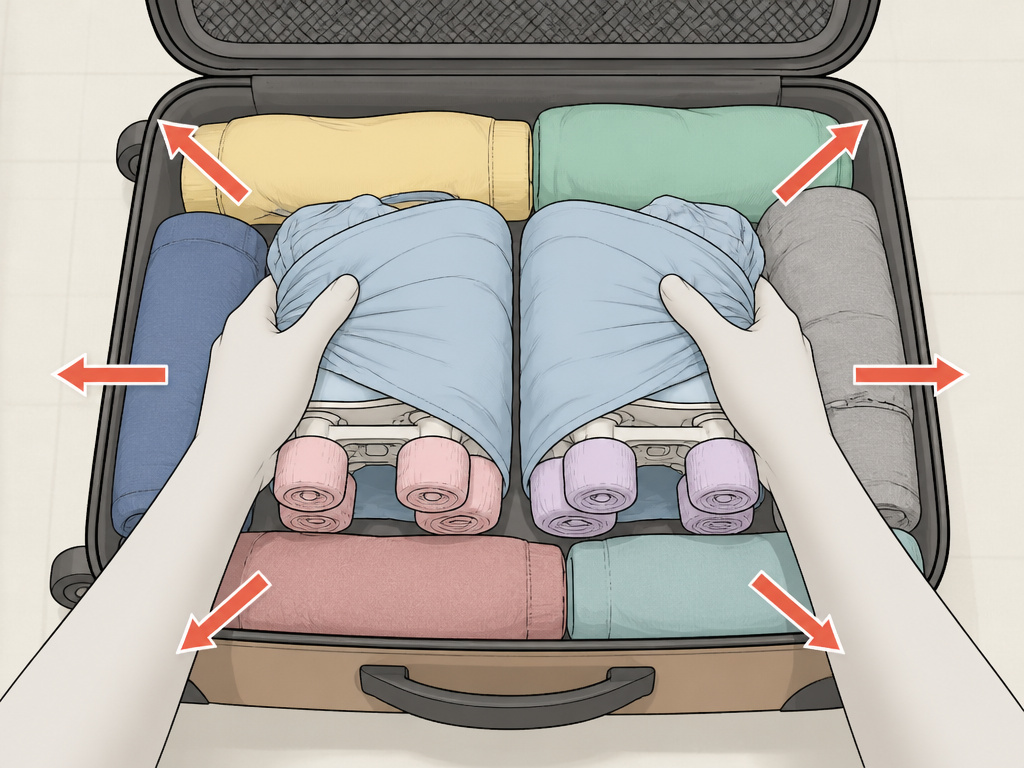
If you decide to check your skates, either by choice or because a rule forces you to, packing shifts from convenience to damage prevention. The goal is to prevent wheels from snapping, boots from being crushed, and to protect other items in your suitcase from scuffs.
Start by securing the wheels. Use rubber wheel covers or simply wrap a thick sock around each set of wheels. This stops them from spinning freely and catching on other items. For the boot, stuff the inside with socks or a small towel to help it hold its shape. Then, wrap each skate individually in a t-shirt or a soft cloth. This creates a buffer against impacts.
Place the wrapped skates at the core of your suitcase, surrounded by softer items like clothing. Avoid packing them near the outer edges or the corners, which take the most punishment during handling. If you have hard-shell luggage, use it.
Common mistake: Throwing loose skates into a half-empty checked bag. The boots bang against each other for the entire journey, scuffing the leather and straining the frame mounts. By the time you land, the action is gritty and a wheel might be bent. Padding isn’t optional.
Remember, if you’re checking a bag specifically for skates, you’re also free to pack your tools. That Allen key set, bearing tool, and spare wheels can all go in there safely. Just be sure to review the TSA prohibited items list for any other restricted tools—items like multi-tools with blades are still forbidden, even in checked luggage on some routes.
International Travel and Connecting Flight Pitfalls
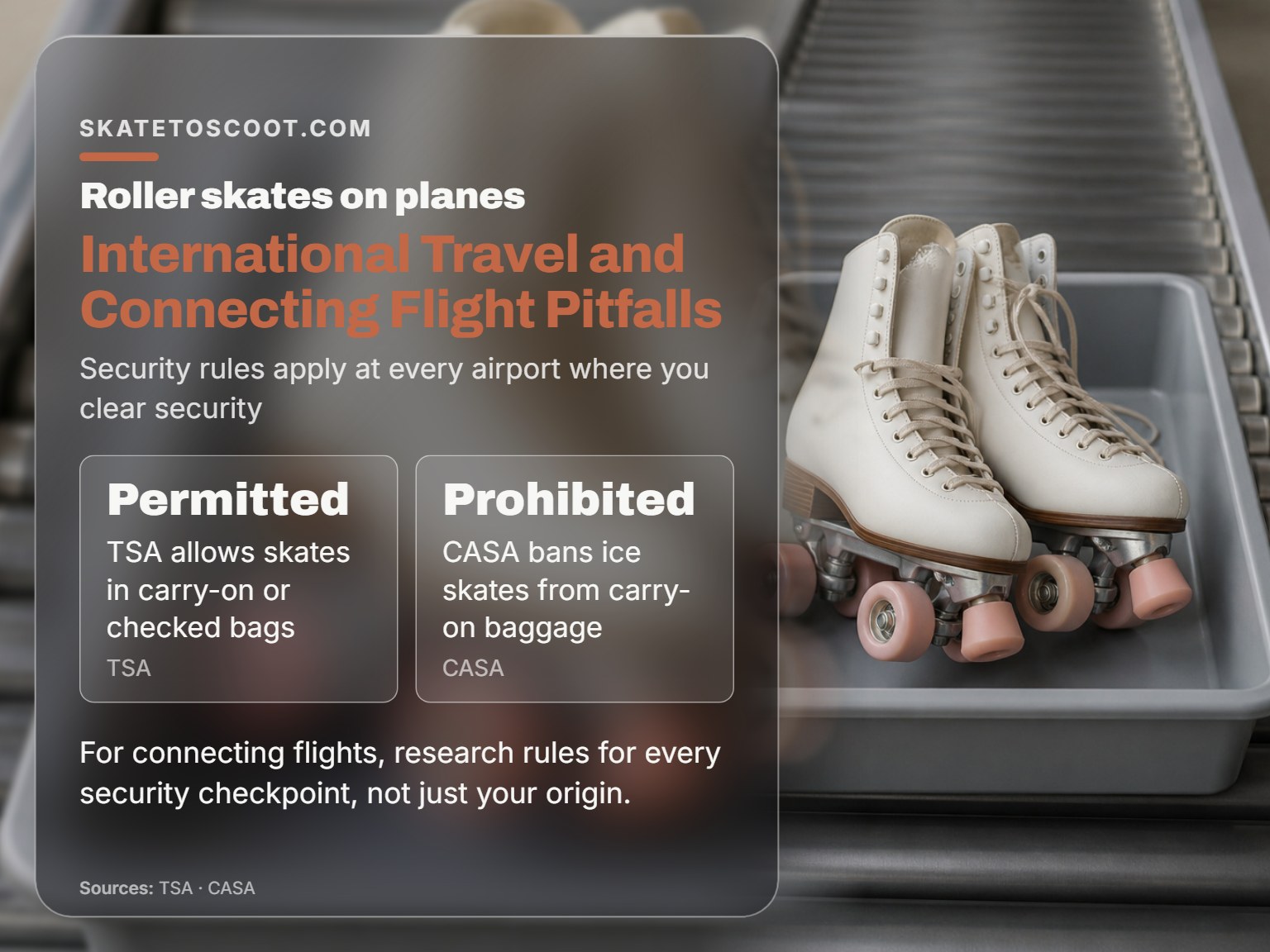
A nonstop domestic flight is one thing. An international itinerary with a connection is where layered regulations create real trip-ending risk. The core problem is that you are subject to the security rules of your departure airport for each leg.
For example, you might fly Los Angeles to Toronto to London. Your skates are fine for the LAX security (TSA rules). In Toronto, you’ll have to clear security again for your London flight. Now, CATSA rules apply. If your inline skates have detachable frames, you must check them for the second leg. If you didn’t plan for this, you’re now trying to check a bag at a transit security checkpoint, which is often impossible.
The reverse is also true. A skater flying from Melbourne to Los Angeles via Sydney cannot carry on their ice skates through Australian security (CASA prohibits it). They must check them from the start. But if they only discover this at the Melbourne checkpoint, they may not have a checked baggage allowance purchased, leading to high last-minute fees.
The rule for connections: Research the security rules for every airport where you will clear security, not just your initial departure point. For a simple transfer where you stay airside (no security re-check), the rules of your origin airport apply all the way through.
This complexity is why a resource like the CASA PackRight guide is invaluable for travelers departing Australia. It removes the guesswork from their specific, strict regulations.
What About Ice Skates and Skateboards?
The rules for roller skates provide a framework, but closely related gear has its own nuances.
Ice Skates: The sharp blade changes everything. While the TSA groups them with roller skates, other agencies do not. CATSA’s detachable-blade rule is written for them. Australia’s CASA prohibition is specifically for ice skates. The packing concern is also different: you should protect the sharp blade and other items in your bag. For a full deep-dive, our guide on ice skates on a plane covers the blade-specific protocols.
Skateboards: The TSA is similarly permissive, allowing them in carry-on or checked bags. However, their bulky shape makes them harder to fit in overhead bins, and airlines are more likely to gate-check them. The principles are the same: check airline size policies, protect the trucks and deck, and be prepared for extra screening. We detail the best practices in our article on skateboard on a plane rules.
The common thread is that wheeled sports equipment is generally allowed, but its shape and components trigger additional scrutiny. Knowing the specifics for your gear type prevents last-minute panic.
Should I clean my skate wheels before flying?
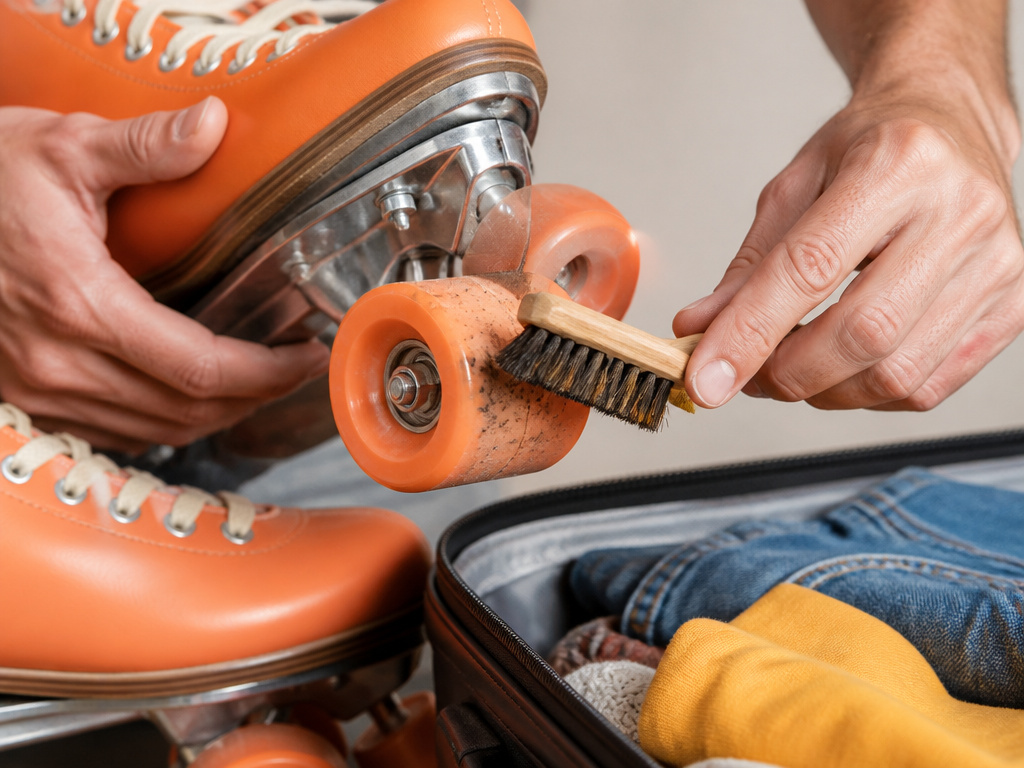
Cleaning your skate wheels before a flight is a smart move for practical reasons. Dirt and debris packed into the wheels can shake loose inside your luggage, potentially staining your clothes or other items. More importantly, a security officer inspecting your bag is more likely to view a clean, well-maintained pair of skates as simple sporting equipment. While no rule explicitly requires it, taking a moment to brush off dirt and secure the wheels so they cannot roll around demonstrates you’ve packed thoughtfully. This can help streamline the screening process, as officers may need to remove your skates from the bag for a closer look.
Can I bring skate tools or spare parts in my carry-on?
Packing tools for your skates requires careful planning. Security agencies are very clear about sharp objects and potential weapons. Tools like screwdrivers or Allen wrenches, even small ones intended for skate maintenance, are generally prohibited in your carry-on luggage. While a screening officer may use discretion for a very small, blunt tool, you should not rely on this. The safest approach is to place any tools, along with spare parts like bearings or axles, securely in your checked baggage. This avoids having the items confiscated at the security checkpoint, which could leave you unable to perform adjustments at your destination.
Frequently Asked Questions
Can I wear my roller skates through the airport or on the plane?
No. Using skates inside an airport is considered a safety hazard and is not allowed by airport authorities. Airlines also will not permit you to wear them on the plane. You must carry them or pack them.
Do roller skates count as a personal item or carry-on?
They count as whichever bag they are inside. If your skates are in your backpack, that backpack is your personal item. If you carry them separately on a leash, many airlines, especially budget ones, may count them as a second item, potentially incurring a fee, though some travelers report they are often not counted.
Can I bring my skate tools in my carry-on?
According to TSA guidelines, tools like screwdrivers and Allen wrenches are prohibited in carry-on bags. Very small allen keys (like the basic tool that comes with skates) might be allowed at the screening officer’s discretion, but it’s a risk. The safe choice is to pack all tools in checked luggage.
What’s the best bag for flying with roller skates?
Dedicated skate backpack with padded compartments is ideal. It protects your skates, organizes your gear, and clearly looks like a single bag to airline staff. It also makes the security process smoother. We’ve reviewed several top options for transporting roller skates that balance protection and airline compliance.
The Bottom Line
Flying with roller skates is absolutely possible, but it requires a three-layer check: security agency rules, airline baggage policy, and the practical reality of the checkpoint. The TSA’s “yes” is just the starting point.
Your action this week: Before your next trip, do this sequence. First, google “[Your departure country] aviation security skates” to find the primary source rule. Second, pull up your airline’s website and search for “sporting equipment” or “special baggage” policy. Third, decide if your skates will fit in your allotted carry-on bag with your other essentials. If the answer to any of these is unclear, checking a bag is the lower-stress path.
The goal isn’t to memorize every regulation. It’s to build a packing strategy that survives the first skeptical glance from a gate agent or security officer. Because the real rule of travel is simple: what’s allowed is what you can convincingly, and correctly, argue is within the rules.
