Can You Rollerblade in an Airport? What the TSA Allows
This post contains affiliate links. As an Amazon Associate, we earn from qualifying purchases.
Official airport regulations from San Francisco International Airport (SFO) and Pittsburgh International Airport (PIT) explicitly prohibit the operation of rollerblades and skates in public terminal areas, though anecdotal reports from skaters describe instances where security did not intervene. However, you can carry your skates through security in your carry-on or checked luggage, as the TSA generally permits them.
That’s the black-and-white answer. The real question isn’t about the rule; it’s about what happens when you’re standing in a half-mile-long terminal corridor with your flight boarding in 20 minutes and a pair of perfectly good wheels in your bag. The rule exists for a reason, but the space between that rule and the security guard who might let it slide is where your actual decision gets made. You might wonder, can you rollerblade in an airport?
What follows is a breakdown of the specific regulations, the TSA’s stance, the very real safety and liability reasons behind the ban, and a clear-eyed look at the enforcement gap that forum stories are built on.
Key Takeaways
- Airport regulations are explicit: Official rules from San Francisco International Airport (SFO) and Pittsburgh International Airport (PIT) prohibit rollerblading in terminals, on sidewalks, and on public roadways on airport property.
- Enforcement is inconsistent: While the rules are clear, anecdotal reports from skaters show security often ignores brief, cautious skating, especially in sparse terminals late at night.
- Medical and law enforcement are exempt: The prohibitions do not apply to wheelchairs or other medically-necessary devices, or to on-duty law enforcement personnel.
- TSA allows skates as carry-on: The Transportation Security Administration generally permits rollerblades in carry-on or checked bags, treating them like other sporting equipment.
- The consequences are real: If enforcement decides to act, you could be ordered to stop and face consequences from airport authorities.
The Official Rule: A Clear Prohibition
Look up the actual rules for any major airport, and you’ll find the same clause buried in their regulations. It’s not a suggestion.
San Francisco International Airport’s Rules and Regulations state that rollerblades and skates “shall not be operated” on public roadways, sidewalks, and within terminal buildings. Pittsburgh International Airport’s rules prohibit “roller skates/blades” in all areas of the Baggage Makeup Area and Passenger Terminals. These aren’t guidelines posted by a nervous manager; they are legally adopted ordinances from the airport authority.
San Francisco International Airport’s rules prohibit the operation of rollerblades/skates on public roadways, sidewalks, and within terminal buildings. The SFO rules exempt wheelchairs or other medically-necessary devices and on-duty law enforcement personnel. PIT rules exempt wheelchairs or other medically-necessary devices.
The logic isn’t hard to follow. Airports are designed for pedestrian flow, not wheeled recreation. The floors are often polished stone or tile, beautiful for rolling, terrifying for stopping when someone steps out from behind a pillar. A collision at skating speed with an elderly traveler or a child could cause serious injury. From the airport’s perspective, it’s a massive liability issue with zero upside.
This stance isn’t unique to airports. The U.S. Code of Federal Regulations, specifically 36 CFR § 1002.20, sets a legal precedent for National Park Service areas, prohibiting skating, skateboarding, and similar devices “except in designated areas.” It frames these activities as incompatible with general public use of walkways. Airports are applying the same principle.
Common mistake: Thinking “no skating” signs are just suggestions. They are backed by the airport’s legal authority to issue fines or trespass violations.
TSA Rules: Getting Your Skates Through Security
Here’s where the news gets better. While the airport property rules are strict, the Transportation Security Administration’s job is to assess security threats, not regulate foot traffic.
The TSA generally allows rollerblades in both carry-on and checked baggage, but this doesn’t answer the separate can you rollerblade in an airport question. They are treated similarly to other sporting goods. You won’t find rollerblades on the TSA’s prohibited items list. The main concern at the checkpoint is the X-ray. The metal frames, wheels, and hardware can look dense and complex on the scanner.
I’ve flown with my aggressive skates a half-dozen times, always in a carry-on backpack. Not once have I been asked to remove them for inspection. The process is simple: place your bag with the skates in a bin, send it through the X-ray, and collect it on the other side. The key is to not give them a reason to look closer. Make sure your bag doesn’t contain other prohibited items that would trigger a hand search.
If an agent does flag your bag, they’ll likely open it, see the skates, and wave you through. It’s a non-issue. This matches reports from skaters on forums who have flown through Portland, St. Louis, and LAX without question.
The part nobody mentions: The TSA’s allowance ends at the checkpoint. They are not granting you permission to skate. Once you’re in the terminal, you’re subject to the airport’s rules, not the TSA’s.
The Enforcement Gap: Rules vs. Reality

This is the friction point. Official documents say one thing; lived experience sometimes says another.
On Reddit and other skating forums, you’ll find plenty of anecdotes from skaters who have briefly laced up in terminals. One user reported skating through the airport after clearing TSA, putting skates back on, and not being bothered by security. Another described skating and even racing teammates in an empty terminal corridor with no issues. The common thread in these stories is low congestion and cautious behavior.
Where this goes sideways: Assuming your experience will match the anecdote. A security officer having a bad day, a manager cracking down after a recent incident, or simply being in a more heavily policed airport can turn a fun shortcut into a major hassle.
The enforcement gap exists because security personnel are focused on genuine threats. A solo skater gliding carefully down a mostly empty concourse isn’t a priority. But that’s discretion, not permission. The moment your skating is deemed disruptive or risky, zooming past gates, near food courts, or in crowded baggage claim, that discretion evaporates.
It also varies wildly by airport. Some, like the one described by a Reddit user, have “very strict no skateboard/rollerblading/rollerskating rules” with signs everywhere, suggesting a past incident led to a zero-tolerance policy. Others may have a more relaxed posture. You cannot know which you’re in until you’re already in it.
Safety, Liability, and Why the Rule Exists
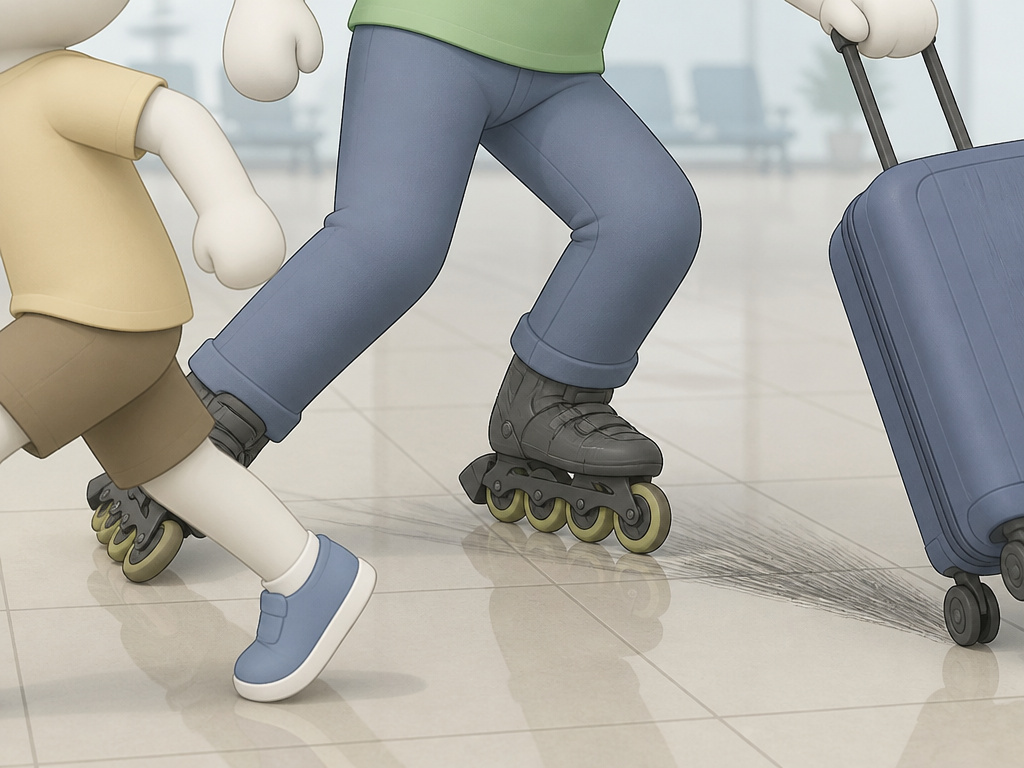
The reason for this rule’s universality is straightforward. It’s not because airport directors hate fun. It’s because a terminal is a terrible skating environment.
The surfaces are designed for walking, not rolling. Spills, dropped luggage, sudden changes in flooring from carpet to slick tile, and masses of distracted people create a minefield. Your stopping distance on inline skates, even with a perfect drag stop, is longer than a pedestrian’s. A child darting out from a gate area gives you maybe a second to react.
From the airport’s legal standpoint, allowing skating is an open invitation for lawsuits. If you fall and injure yourself, you could sue. If you collide with another passenger, they could sue both you and the airport for negligence. The airport’s insurance carriers would have a fit. The ban is a straightforward risk-management decision.
I’ve coached enough beginners to know that even experienced skaters can catch an edge on an unseen seam or be knocked off balance by a rolling suitcase. Introducing those variables into a high-traffic, high-stakes environment like an airport is asking for trouble.
Packing and Carrying Your Skates
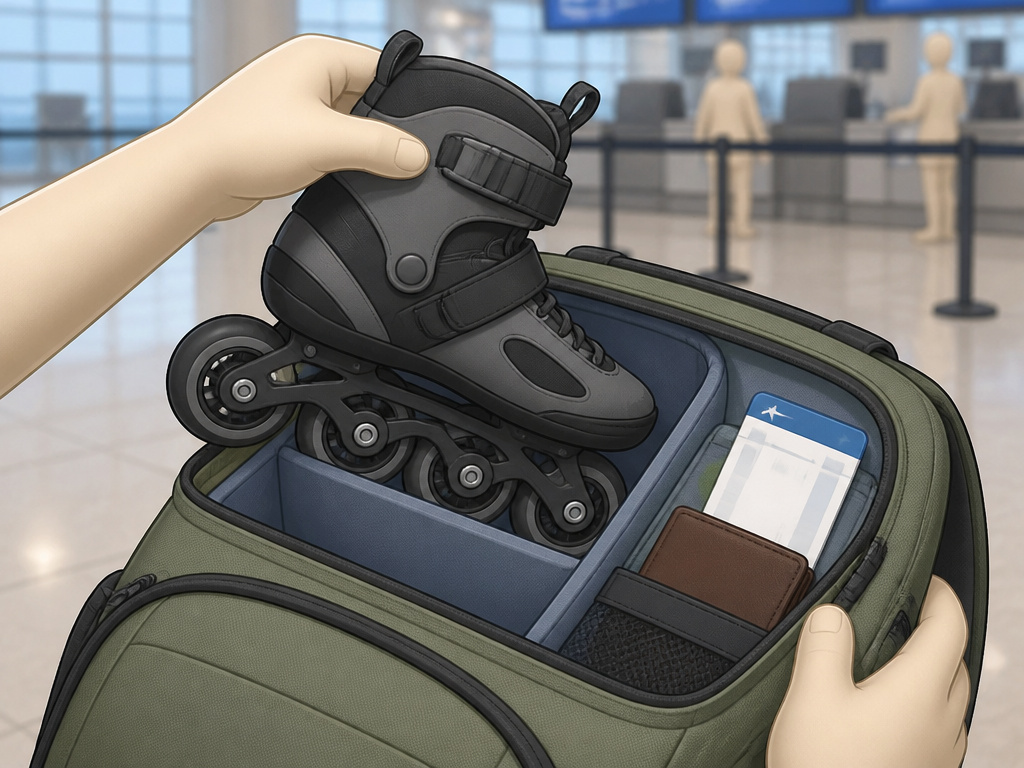
Since skating in the airport is off the table, the practical question becomes how to best transport your skates through the airport. You have two main choices: carry-on or checked baggage.
For carry-on, a dedicated skate bag or a sturdy backpack is your best bet. I use a backpack with a separate compartment that keeps the skates from crushing my other gear. The goal is to make the TSA process as smooth as possible. If your skates have removable frames, taking them off can make the pack more compact and less suspicious on the X-ray. For checked luggage, the priority is protection. Wrap each skate in clothing, use blade guards if you have them, and pack them in the middle of your suitcase surrounded by soft items. The goal is to prevent the hard wheels and frames from getting banged around or damaging other belongings.
Some skaters prefer methods like using a shoulder strap to carry roller skates or by tying them to the outside of a backpack. This is fine for getting to the airport, but once you’re inside, having your hands free is safer and less cumbersome. A carrying method that keeps your hands free also makes you look less like someone about to break the rules.
| Carry Method | Best For | Risk If Skipped |
|---|---|---|
| Carry-on Backpack | Short trips, avoiding checked bag fees | Bag may be heavy; skates can be awkward if bag is overstuffed. |
| Checked Luggage | Long trips, bringing multiple skate setups | Skates can be damaged by baggage handlers if not padded properly. |
| Dedicated Skate Bag | Skaters traveling specifically to skate | May count as your personal item; less space for other travel essentials. |
The choice between carrying roller skates on a plane in your carry-on versus checking them often comes down to how much you trust the airline with your gear. I’ve had wheels cracked in checked luggage before. Now, for anything under a week, they go in my carry-on.
What About Other Wheeled Devices?
You might wonder if the prohibition is specific to skates or applies to other personal transportation. The answer is that it usually casts a wide net.
Airport rules often group rollerblades with skateboards, scooters, and even bicycles in public areas. The same SFO rules that ban skating also have specific regulations for dockless scooters and bikes, requiring them to be parked appropriately or face confiscation. The principle is the same: unregulated personal wheeled transport disrupts pedestrian flow and safety.
However, there are nuanced exceptions buried in the legalese. The SFO rules note that within a tenant’s leased area (like an airline’s private office space), the tenant may set their own policies for parking personal transportation devices. Pittsburgh’s rules allow tenant-owned bicycles for company business within leased areas. This creates a patchwork where the rules might be different airside in secure employee areas versus the public landside terminals. As a traveler, you’re firmly in the “public” category.
This is similar to the logic behind airport skateboard rules or policies for bringing a skateboard on a plane. The device changes, but the core concern, safety and liability in a crowded pedestrian space, does not.
Why airport rules are so inconsistent
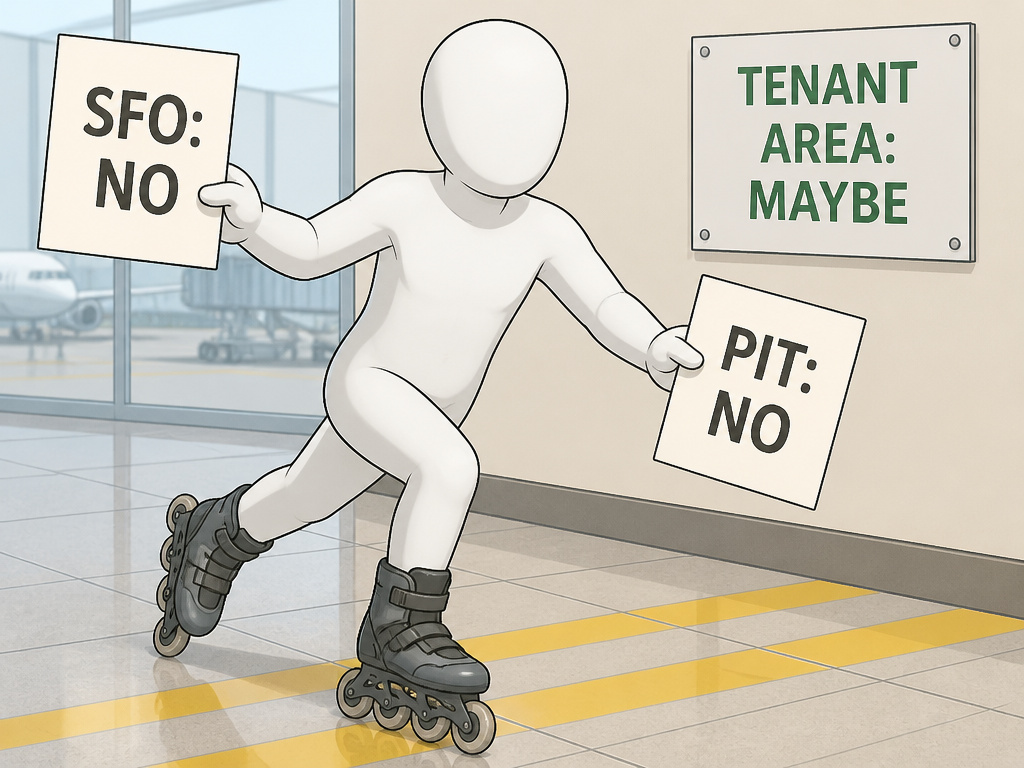
Official regulations from airports like SFO and PIT explicitly prohibit rollerblading in terminals, while anecdotal reports from skaters describe instances where security did not intervene, highlighting a gap between policy and enforcement. Rules can also differ within an airport; a tenant like an airline or shop in a leased area may set its own policies for personal transportation devices. The only consistent advice is to assume a prohibition exists unless you see a designated area.
What to know for international travel
When traveling internationally, the core rule of thumb remains: assume rollerblading is prohibited in airport terminals unless you see clear signage permitting it. Airport authorities worldwide prioritize pedestrian safety and liability, leading to broad bans on activities like skating. While some countries may have national regulations similar to a U.S. Precedent that prohibits skating except in designated areas, the specific enforcement will always be up to the local airport authority and its security staff. Your experience will hinge entirely on the local rules of your departure, arrival, and any connecting airports, which are almost never published for casual traveler reference.
Frequently Asked Questions
Can you wear rollerblades in an airport?
No. Wearing rollerblades in an airport terminal is prohibited by official airport regulations. While you may carry them, operating them (which includes wearing them and rolling) is not allowed in public areas.
Can I bring my roller skates on a plane?
Yes. The TSA allows roller skates in both carry-on and checked luggage. They are not considered prohibited items. Pack them securely to avoid damage and to ensure a smooth security checkpoint experience.
Can you skate at the airport?
No. Skating of any kind, rollerblading, roller skating, or skateboarding, is prohibited in airport passenger terminals, baggage claim areas, and on sidewalks and roadways on airport property for safety and liability reasons.
Can I bring roller skates in my carry-on luggage?
Yes. Roller skates are permitted in carry-on luggage by the TSA. It’s a common way to transport them to avoid potential damage or loss from checked baggage.
The Bottom Line
The official line on can you rollerblade in an airport is unambiguous: do not rollerblade in the airport. The risks, a fine, a trespass order, causing an injury, missing your flight, far outweigh the benefit of saving a few minutes on a long walk.
But the real-world takeaway is about reading the room. If you absolutely must skate for a few feet in a completely empty corridor late at night, you might get away with it. But you are relying on the discretion of an individual security officer whose mood you cannot predict. That’s a gamble with your time and money.
Your safest, smartest move is to pack your skates securely, wear comfortable walking shoes, and save the wheels for the destination. The airport is a conduit, not a skatepark. Treat it that way, and you’ll never have to explain yourself to an angry uniformed officer while your flight’s final boarding call echoes in the distance.
I speak from experience. I’ve seen too many sketers learn the hard way that a little patience at the start of a trip beats a huge headache at the end of it.
