Can You Skateboard in an Airport? The Real Rules
This post contains affiliate links. As an Amazon Associate, we earn from qualifying purchases.
You can bring a skateboard through airport security as a carry-on item per TSA policy, but local airport ordinances, such as those from the Metropolitan Airports Commission and the City of Atlanta, prohibit riding it inside the terminal, with violations carrying legal penalties. A common question is: can you skateboard in an airport?
That’s the short, frustrating answer. The TSA’s permissive checkpoint policy creates the illusion that skateboarding is welcome, while the rules governing the space you’re actually in say the opposite. This mismatch is where travelers get tripped up on the can you skateboard in an airport issue.
What follows is a breakdown of the three layers of rules you need to navigate: federal security policy, binding local laws, and airline-specific carriage rules. We’ll also cover what actually happens if you ride, how to pack your board to avoid gate drama, and the special hell that is traveling with an electric skateboard.
Key Takeaways
- The TSA allows skateboards in carry-on bags, but this only covers the security checkpoint, not riding in the terminal.
- Local airport ordinances, like the Metropolitan Airports Commission Ordinance No. 58, explicitly prohibit skateboarding on terminal property, with violations classified as a misdemeanor.
- For electric skateboards, airline policies like Jetstar’s 100Wh battery limit are critical; batteries over 160Wh are completely prohibited.
- If carry-on is denied, gate-checking your skateboard is a reliable backup, but you must arrive early and use a skate leash or bag.
- Riding your board, even cautiously, risks ejection from the airport and missing your flight, with security response varying wildly by airport and time of day.
The TSA vs. Local Ordinance Conflict
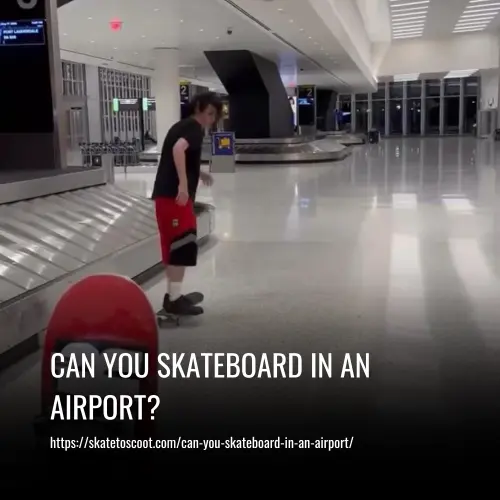
The Transportation Security Administration states clearly: “Skateboards are allowed in carry-on bags.” Please check with your airline for any size or weight restrictions. This is your federal green light for the security line.
The TSA’s policy, last updated in 2017, is a checkpoint regulation. It means the item itself isn’t a security threat. It does not grant permission to operate the device on airport property.
Now, read the Metropolitan Airports Commission Ordinance No. 58. Section 6 states: “Skateboarding and roller skating shall be prohibited: a. Within the airport terminal and in areas adjacent to it. B. On sidewalks; c. On any roadway having a grade of six percent (6%) or more…” This is a local law. Violation is a misdemeanor, and anyone knowingly violating it “may be ejected from the Airport premises.”
The conflict is absolute. The TSA says you can carry it. The airport you’re standing in says you cannot ride it. The local ordinance is the law that applies to your conduct on that property.
What “Prohibited” Actually Means On the Ground
In legal terms, “prohibited” means a banned activity with defined penalties. For airports, the stakes are higher than a park security guard telling you to leave.
| Ordinance / Rule | Prohibition | Penalty for Violation |
|---|---|---|
| Metropolitan Airports Commission Ordinance No. 58 | Skateboarding within terminal, adjacent areas, sidewalks, unsafe roadways. | Misdemeanor, ejection from airport premises. |
| City of Atlanta Ordinance | Operating any PTD (incl. Skateboards) on airport property by non-authorized persons. | Presumed violation of city code; subject to fines/ejection. |
| 36 CFR § 1002.20 (Federal Park Rule) | Using skateboards except in designated areas on NPS land. | Federal citation; establishes regulatory precedent. |
The actual experience on the ground is straightforward. In a quiet terminal at 2 AM, you might cruise for minutes without a glance. During the 7 AM rush at Atlanta Hartsfield-Jackson? You’ll have a security officer on you before you push twice. It’s not just about the rule, it’s about liability. An airport’s primary concern is the safe, predictable flow of pedestrian traffic. A skateboard is an uninsured, unpredictable variable.
Where this goes sideways: You clip a passenger’s ankle or luggage cart. What was a simple ejection now involves airport police, a potential lawsuit, and you absolutely missing your flight. The ordinance is their first and best defense.
I’ve seen this common mistake a hundred times: skaters think the TSA’s carry-on policy implies a permissive riding environment for the can you skateboard in an airport question. It does not. It’s a cargo rule, not a conduct rule.
Electric Skateboards: The Battery Wildcard
Bringing a standard skateboard through security is one challenge. Bringing an electric skateboard is a different game with its own rulebook, dictated not by the airport but by your airline and dangerous goods regulations.
Airlines like Jetstar provide a clear, if strict, framework. Their policy creates distinct rules based on battery watt-hour (Wh) ratings:
- ≤100Wh: Permitted in carry-on and checked baggage.
- 101-160Wh: Requires prior approval via email at least 5 business before your flight.
- >160Wh: Prohibited entirely.
Jetstar also notes that “some airports do not allow skateboards and scooters (including electronic variations) to be taken through security,” and that Jetstar Japan (GK) flights do not allow electric skateboards or electric scooters regardless of battery type.
This isn’t a suggestion. If you show up with a 200Wh battery, they will not let you board. The risk of a lithium-ion fire in the cargo hold is something airlines take extremely seriously.
Your checklist for an e-skate:
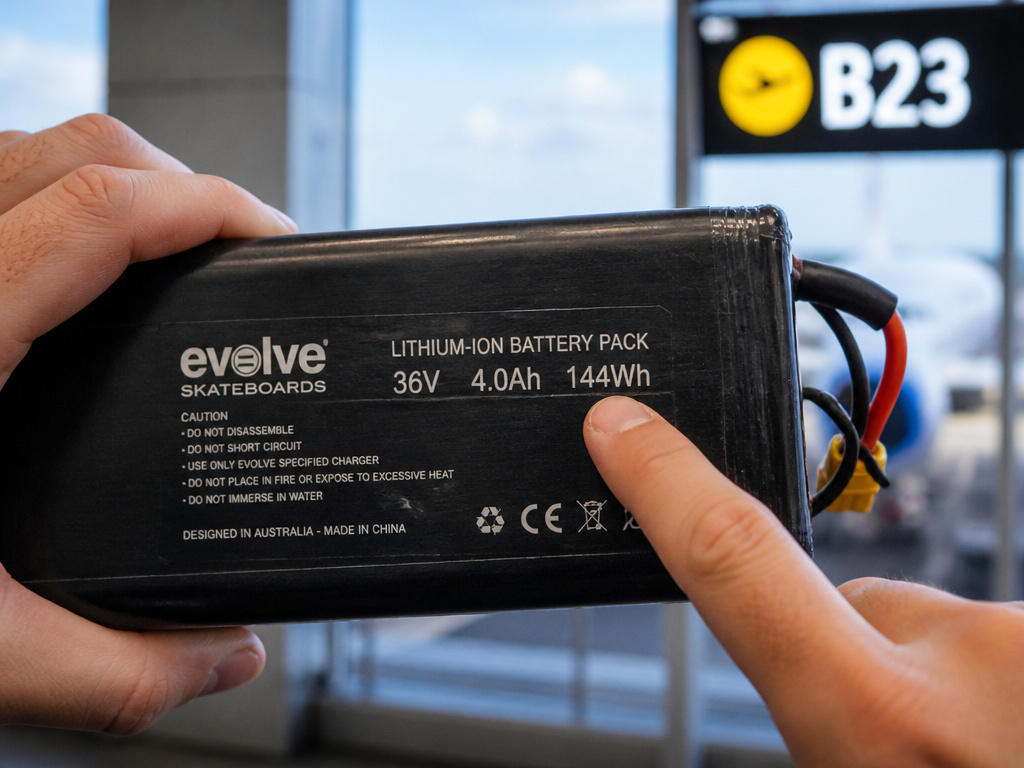
- Find the watt-hour (Wh) rating on your battery. It’s printed on the label.
- If it’s between 101-160Wh, contact your airline for prior approval as required by their policy.
- Pack the board so the battery is protected from short circuits. Tape the contacts.
- Have the battery spec sheet ready on your phone. The gate agent likely won’t know the policy and will call a supervisor.
The process is a hassle, but it’s essential. This is one area where guessing will leave you stranded.
How to Pack and Carry Your Skateboard (The Smart Way)
Assuming you’ve decided to transport, not ride, your board, you need a plan that gets it from your house to the overhead bin with zero drama. The goal is to make your skateboard look like any other piece of luggage to airline staff.
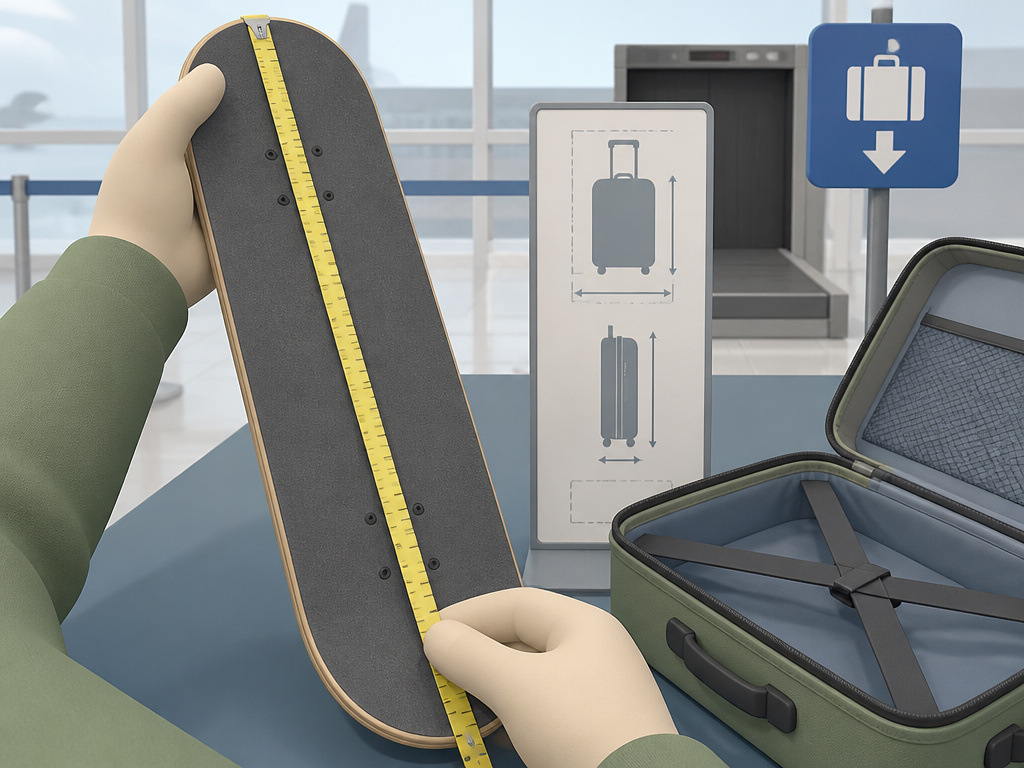
First, know your airline’s size limits. Jetstar, for example, has specific size and weight restrictions for baggage; passengers should check with their airline for any size or weight restrictions. A standard skateboard deck may fit within airline size limits, but a longboard likely will not; always check your specific airline’s size restrictions. Always check your specific airline’s “sporting equipment” or “oversized baggage” page.
The Three Packing Methods, Ranked:
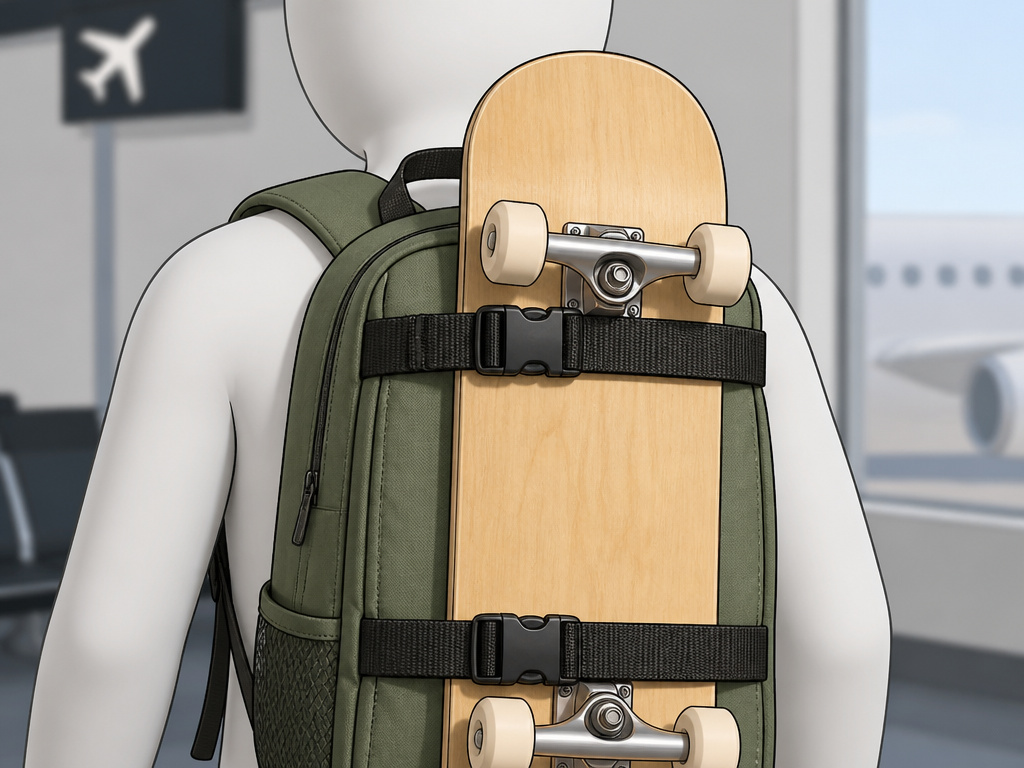
- The Backpack Strap (Best for Carry-On): Use a dedicated skate backpack or a regular backpack with external straps. Strap the deck to the back, wheels out. It becomes a single, manageable item. This is the most common and successful method for flying with a skateboard.
- The Deck-Only Travel (Most Compact): Remove your trucks and wheels with a skate tool. Pack the deck in a suitcase or duffel bag, and put the trucks/wheels in a separate pouch. This eliminates the “oversized” question entirely and is how many pros travel.
- The Padded Bag (For Check-In): If you must check it, use a padded skateboard bag or a snowboard/ski bag. Add clothes for extra padding. Remember, “No single item can weigh more than 32kg” per Jetstar’s policy, but your board is nowhere near that.
Common mistake: Walking up to the gate with a loose, complete skateboard in your hand. It signals “problem” to the agent. Attach it to your bag, and it signals “luggage.”
When you approach the gate, have your backpack with the board strapped on ready. If the agent looks concerned, proactively say, “I have a skateboard strapped to my bag, will that fit in the overhead, or would you like me to gate-check it?” This cooperative approach almost always works in your favor.
When Carry-On Fails: The Gate-Check Procedure
Sometimes, despite your best efforts, the gate agent will say your board can’t go in the cabin. The plane is small, the bins are full, or it’s just their policy that day. Don’t argue. Your backup plan is gate-checking.
Gate-checking is not regular check-in. It means they take your board at the jet bridge, tag it, and you pick it up on the jet bridge at your destination, it doesn’t go to the baggage carousel. It’s gentler on your gear.
Here’s the step-by-step:
- Get a Gate-Check Tag: When the agent denies carry-on, immediately ask, “Can I gate-check it, please?”
- Secure Your Board: If it’s strapped to your backpack, unstrap it. If you have a skate leash, now’s the time to loop it through the trucks and around the deck. You want a handle.
- Leave it at the Jet Bridge: As you board, hand it to the attendant at the aircraft door. They’ll give you a claim ticket.
- Retrieve it on Arrival: Get off the plane and wait right outside the door. An attendant will bring out gate-checked items.
The key is having a way to carry the bare board easily. A loose deck is awkward. A leash or strap turns it into a parcel. This process is far more reliable than hoping a random airline employee will be familiar with their own airline policies for skateboards.
Etiquette, Risk, and the Reality of Riding
Online forums are full of reports like, “I skated through Sea-Tac, no one cared.” Others warn of immediate ejection. Who’s right? Both, depending on context.
Enforcement is inconsistent. A security guard having a slow Tuesday might ignore you. The same guard on a busy Monday morning has a different tolerance. The posted ordinance, however, gives them all the authority they need to stop you instantly.
If you choose to accept the risk and ride, your etiquette dictates the outcome.
- Never skate faster than a fast walk. You’re blending in, not sessioning a spot.
- Give pedestrians a massive berth. Assume everyone will step sideways without looking.
- Dismount before security, ticketing, and any crowded choke point. Carrying your board is invisible; riding it is a provocation.
- The moment any official looks at you twice, stop and carry. Arguing with someone who can eject you is a losing strategy.
The mechanical truth is that airport floors are often smooth marble or polished concrete, ideal for rolling, terrible for stopping if someone jumps in your path. The sudden, sharp screech of a hard wheel stop is a sound that draws every eye, including security’s.
The liability shift is stark. If you’re walking and collide, it’s an accident. If you’re skateboarding, you’re automatically operating a prohibited device negligently. That’s why the safety and liability for skating in airports is a non-starter for airport lawyers.
Frequently Asked Questions
Are skateboards allowed in airports?
Yes, as a carried item. The TSA allows skateboards in carry-on bags. However, operating (riding) a skateboard inside an airport terminal is prohibited by the ordinances of most major airports, including those governed by the Metropolitan Airports Commission and the City of Atlanta.
Is a skateboard allowed on a flight?
Yes, but it is subject to your airline’s carry-on size and weight policies. Most airlines will treat it as a carry-on item or personal item if it fits in the overhead bin or under the seat. Some may require you to gate-check it if the plane is full. Always check your specific airline’s rules for sporting equipment.
Does it cost extra to bring a skateboard on a plane?
Usually, no. If it counts as your one allowed carry-on item and fits in the overhead bin, there is no fee. If you need to check it as baggage, airline baggage fees may apply.
Can I bring an electric skateboard on a plane?
It depends entirely on the battery. Batteries under 100 watt-hours (Wh) are generally permitted in carry-on baggage. Batteries between 101-160Wh require airline pre-approval. Batteries over 160Wh are prohibited on passenger aircraft. You must contact your airline well in advance for approval and follow specific packing rules to prevent short circuits.
Before You Go
The clearest line is this: pack your skateboard, don’t ride it. The convenience of a five-minute cruise isn’t worth the risk of a misdemeanor citation, ejection, or a missed flight. The rules aren’t hidden, they’re in the Metropolitan Airports Commission ordinance and similar local codes.
For packing, strap it to a backpack. For electric boards, know your battery’s watt-hour rating and get airline approval if needed. That’s the process. It’s less fun than imagining a cruise through empty terminals, but it’s the one that gets you and your board to your destination.
If your heart is set on rolling through an airport, your only safe bet is to find one of the rare, explicitly designated areas, like those referenced in the federal skateboard regulation text, 36 CFR 1002.20. Those don’t exist in commercial passenger terminals. So carry it, stash it, and save the riding for the streets outside.
