Where Can I Sell My Skateboard: Pricing and Platform Guide
This post contains affiliate links. As an Amazon Associate, we earn from qualifying purchases.
You can sell your skateboard in six main places: direct buyer services like Zarax, niche skate marketplaces like SKATEZAR and Buy Back Boards, general online platforms like eBay and Facebook Marketplace, local skate shops, social media collector groups, and e-commerce platforms like Shopify if you’re selling multiple boards. The right choice depends on your board’s condition, how fast you need cash, and whether you want to manage the sale yourself.
The difference between these options isn’t just a list, it’s a trade-off between your time and your payout. A direct buyer takes your board off your hands with minimal effort on your part, but you might get less than you would in an open auction. A public marketplace puts you in control of the price and the process, but you’re also on the hook for photos, descriptions, shipping, and haggling. If you’re wondering where can I sell my skateboard, these are the main avenues.
What follows is a breakdown of each path, grounded in how these services actually work. The six-point checklist that gets you a real offer, how to handle damaged boards, and the one mistake that turns a quick sale into a months-long listing are explained.
Key Takeaways
- Direct buyer services like Zarax require a six-point assessment covering deck, trucks, wheels, electric components, damage, and included parts, send details first, never ship the board without confirmation.
- Selling a large collection? List decks individually. Anecdotal reports show a 60-deck lot will sit unsold unless priced very cheaply; selling one by one on eBay or Facebook collector groups yields maximum profit.
- Condition dictates your platform. Damaged or non-working boards may be accepted by direct buyers like Zarax, who state they will consider them depending on the fault; most public marketplaces typically require ‘good condition or better’ or list items ‘for parts’.
- Vintage men’s skate brands like Volcom, Vans, and Quicksilver have a higher sell-through rate on secondary markets, especially from the 80s and 90s, as noted by resellers.
- Always calculate shipping costs before listing. For a single mid-priced board, shipping can cost more than your profit, making local sales via Facebook Marketplace or skate shop credit the smarter move.
The 6-Point Checklist That Gets You Paid
Before you list anywhere, you need to know what you’re selling. A vague description gets you lowball offers or no offers at all. Direct buyer services have formalized this into a checklist.
Zarax’s valuation process requires six specific details: 1) Complete board or component bundle, 2) Deck brand, width and condition, 3) Trucks, wheels and bearings, 4) Electric or conventional design, 5) Chips, cracks and water damage, 6) Charger, tools and original parts. Miss one, and you’re leaving money on the table because the buyer has to assume the worst.
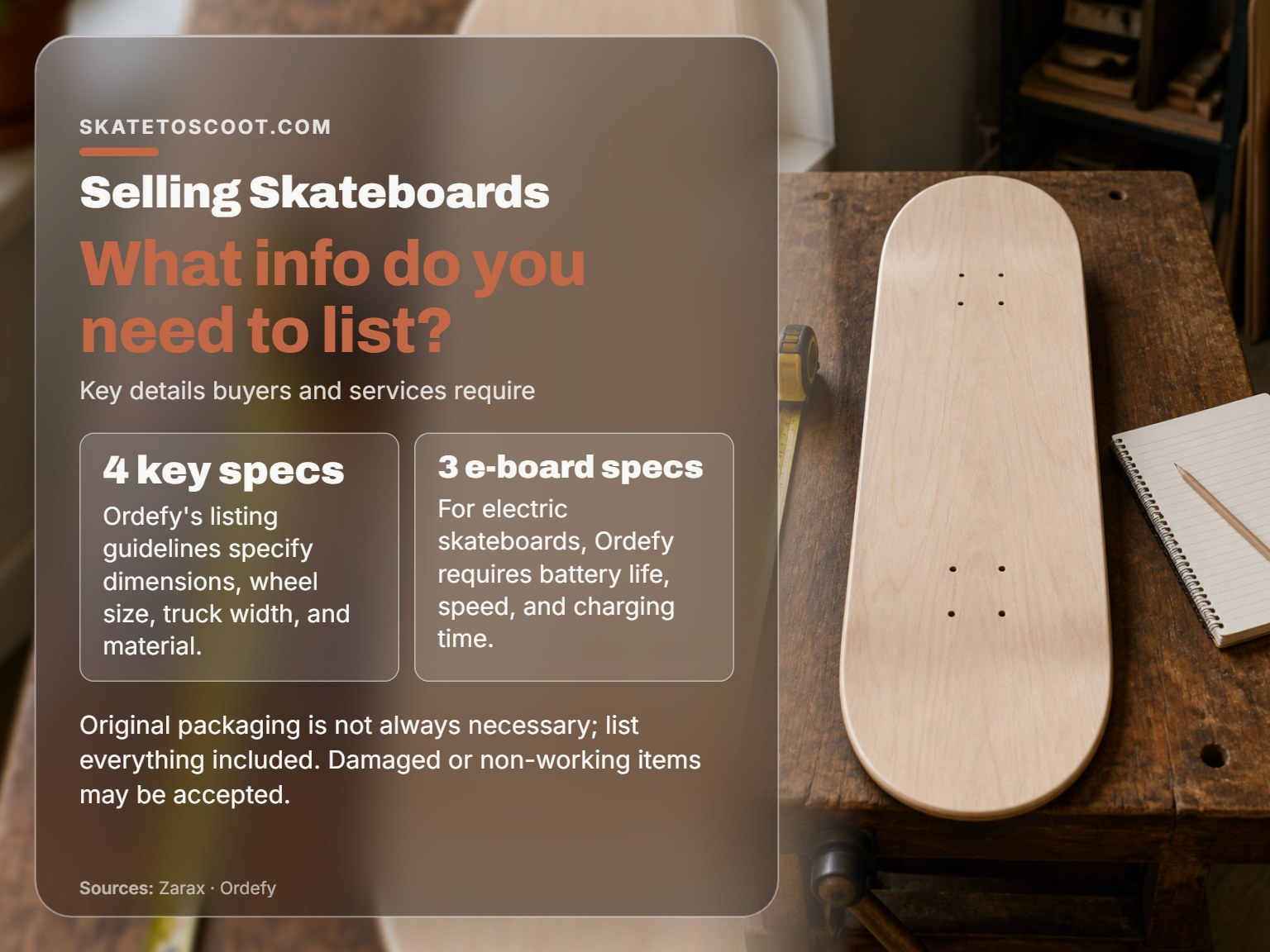
Provide the deck brand, width, trucks, wheel size, and any damage. For electric boards, include battery life and charging time. Original packaging is not mandatory but can provide useful context. This detailed spec list is the minimum a professional buyer needs to make a legitimate cash offer.
This isn’t just for Zarax. This checklist is your foundation for any listing. On a platform like Ordefy, their guidelines ask for the same core specs: deck dimensions, wheel size, truck width, and material. For electric boards, they explicitly want battery life, speed, and charging time. The more you can quantify, the less a buyer has to guess, and the more they’re willing to pay.
Direct Buyer vs. Open Marketplace: Which Fits Your Board?
Your board’s condition and your tolerance for hassle decide this. They are fundamentally different sales models.
The Direct Buyer Path (Zarax Model)
This is a service, not a marketplace. You provide the details from the checklist above. They review them privately and decide if they want to make an offer. There is no public listing, no haggling in comments. If they proceed, they send you a shipping location and instructions. You only ship after this confirmation. Payment comes after they inspect the received board, typically via bank transfer or PayPal.
- Best for: Sellers who want a guaranteed, no-fuss sale. People with damaged items (Zarax explicitly states they may accept non-working boards depending on the fault). Anyone wary of managing online listings, shipping, and payment disputes.
- The catch: The offer might be below what you could fetch in an open auction. You are trading potential profit for convenience and certainty.
The Open Marketplace Path (eBay, Facebook Marketplace, SKATEZAR)
This is the traditional route. You create a public listing with your price, photos, and description. You manage inquiries, negotiate, and arrange shipping or local pickup after a sale. You control the price, but you also shoulder all the risk and work.
- Best for: Sellers with boards in good-to-excellent condition. Vintage or collectible boards where demand sets the price. People willing to invest time to maximize their return.
- The catch: It’s work. You need good photos, a compelling description, and patience. A board can sit for weeks. You’re responsible for shipping costs, which for a single deck can sometimes eclipse the profit.
| Aspect | Direct Buyer (e.g., Zarax) | Open Marketplace (e.g., eBay, SKATEZAR) |
|---|---|---|
| Sales Process | Private assessment, direct offer. | Public listing, seller-managed sale. |
| Condition Flexibility | May accept damaged/non-working items. | Typically requires “good condition or better.” |
| Seller Effort | Low (provide details, ship once). | High (create listing, communicate, ship). |
| Control Over Final Price | Low (buyer’s offer). | High (you set price, negotiate). |
| Speed to Payment | Moderate (after inspection). | Variable (after sale + delivery). |
I lean towards open marketplaces for anything in decent shape because I like controlling the outcome. But for a board that’s been through the wringer or a quick cash need, the direct route removes all headache. You just have to be honest about the wear.
Where to List: A Platform-by-Platform Breakdown
1. Niche Skateboard Marketplaces

These platforms have an audience already looking for gear. They understand skateboard specs, so your listing speaks their language.
- Buy Back Boards: A dedicated multi-sport gear resale marketplace. Their model is “List it • Ship it • Get paid!” They require items in “good condition or better” and promise payment directly to your bank account. They handle a lot of the marketplace logistics.
- SKATEZAR: A location-based, peer-to-peer marketplace just for skateboards. Listings show a board and a map pin (e.g., “skateboard deck 8.0 €30 | Schüttelstraße 95, Wien, Österreich”). Ideal for local sales within a skate community, avoiding shipping altogether.
2. General Online Marketplaces
The big players. Your audience is huge, but so is the competition.
- eBay: The king for vintage and collectible boards. That’s where a Sims Skateboard Screamer 2 from the 80s sold for $250 after being bought for $1.25. The global reach is unmatched, but fees and shipping complexity are real. List with a reserve if you have a minimum price in mind.
- Facebook Marketplace: Best for local, cash-in-hand sales. Zero listing fees. The key is joining specific skateboard deck collector groups. Facebook has tons of them where members trade, sell, and raffle. This targets real enthusiasts, not just casual browsers.
3. Local Physical Stores
- Skate Shops: Some local shops buy used boards outright or offer store credit. The latter is often more generous. It’s perfect if you’re planning to upgrade your gear. Call ahead; not all shops have the space or business model for this.
- Play It Again Sports & Pawn Shops: These are options of last resort for quick cash. You will get a lowball offer because they need to resell at a profit. Only use this if you need money today and can’t wait a week for an online sale.
4. Social Media & Forums
- Instagram & Reddit: Use relevant hashtags (#skateboardsale, #vintagedeck) and post in subreddits like r/skateboardhelp. The audience is niche and engaged. The downside is you’re often coordinating payment and shipping without platform protection. Use PayPal Goods & Services for safety.
Where this goes sideways: Listing a board with a single blurry photo and “skateboard for sale” as the description. In a sea of listings, you become background noise. Take five clear photos, top, bottom, side, trucks/wheels, any damage. Write a description that answers every question from the six-point checklist.
Pricing Your Skateboard: What’s It Really Worth?
Shopify’s research indicates skateboard prices can run anywhere from $50 to thousands of dollars. Where yours lands depends on three levers.
1. Condition is Non-Negotiable
A deck with razor tail, chipped nose, or water damage is a parts board. A complete with worn bearings and flatspotted wheels is a project. Be brutally honest. A buyer will be, and a dispute or return kills the sale. If you have a damaged item a direct buyer might take it, but your price must reflect that.
2. Brand, Rarity & Vintage Status
This is where value spikes. Vintage men’s skateboarding brands like Volcom, Vans, and Quicksilver have a documented higher sell-through rate. A limited-run pro model deck, especially if sealed in its original plastic, is collector bait. Research ended eBay listings for your specific deck graphic to see what it actually sold for, not just what people are asking.
3. Completeness & Upgrades
A complete board sells easier than a deck alone. Aftermarket parts like premium trucks (Independent, Thunder) or wheels (Bones, Spitfire) add value. Include those specs. For electric boards, battery health is the single biggest price factor, state the estimated range per charge.
| Board Profile | Likely Price Range | Best Platform |
|---|---|---|
| Modern Complete, Good Condition | $50 – $150 | Facebook Marketplace, eBay |
| Vintage Collector Deck (Sealed) | $100 – $500+ | eBay, Facebook Collector Groups |
| Electric Board, Good Battery | $300 – $1000+ | eBay, Buy Back Boards |
| Used Deck, Visible Wear | $20 – $60 | Local Skate Shop (for credit), Zarax |
| For Parts/Not Working | $10 – $30 | Zarax (if accepted), Local Pickup Only |
Your pricing research should include checking completed listings on eBay and browsing active posts in Facebook collector groups to gauge the real skateboard price ranges for your specific setup, especially when you compare a where can i sell my skateboard.
Selling Vintage, Collectibles & Large Collections
This is a specialized game. The rules change.
Vintage Boards
Old decks are not really good for actual skateboarding, the wood dries out and loses pop, making them brittle. Their value is purely as collectibles. That Sims Screamer 2 sale proves it. Photograph every detail: the specific graphic, any original stickers, the condition of the concave and tail. Mention the era (80s, 90s, early 2000s). These sell to collectors, not skaters.
Selling a Collection
Here’s the hard truth from a Reddit user trying to sell 60 decks: if you sell as a collection, that lot will sit longer unless it’s priced very cheaply. The market for someone who wants 60 different decks is tiny. Your path to maximum profit is selling board by board. It’s more work, 60 listings, 60 shipments, but you’ll likely double or triple your total take versus a bulk sale. Start with your most valuable pieces first.
Preparing Your Board & Listing for a Fast Sale
Step-by-Step Prep
- Clean It: Wipe down the deck, scrub the grip tape with a grip gum eraser, and clean the wheels and trucks. A clean board looks cared-for.
- Assess Honestly: Note every scratch, chip, and bit of wear. Disclose it all upfront. Surprising a buyer with hidden damage guarantees a bad review or a return.
- Gather Extras: Find the original charger for an electric board, any spare parts, the skate tool. Bundle them. It makes your listing stand out.
- Take Great Photos: Use natural light. Shoot the top, bottom, side profile, a close-up of the trucks/wheels, and a clear shot of any damage. No blurry, dark garage pics.
Writing the Listing
Don’t just say “Skateboard for sale.” Use the six-point checklist as your template. Here’s an example framework:
- Deck: Brand, Model, Width (e.g., Baker 8.25″)
- Trucks: Brand, Size (e.g., Independent 149)
- Wheels: Brand, Size, Hardness (e.g., Bones STF 53mm, 103a)
- Bearings: Brand (e.g., Bones Reds)
- Condition: “Good. Grip tape is fresh, deck has minor scratches, no cracks. Wheels have even wear, no flat spots. Trucks are tight, no axle slop.”
- Includes: Original box, skate tool, extra hardware.
For an electric board, add: Battery life (e.g., “Holds charge for 10 miles”), max speed, and charging time.
This level of detail does two things. It answers every question a serious buyer has, and it filters out the lowballers who only read the title. You attract buyers who know what they’re looking at and are willing to pay for it. This process is similar to the care you’d take when you assemble a longboard, where precision and correct parts matter, even before you ask where can i sell my skateboard.
How do specialized skateboard resale platforms work?
These platforms operate on a direct buyer service model, meaning there is no public advert. You submit a detailed description of your board for a private review. For a proper valuation, you’ll need to provide a complete checklist: specify if it’s a complete board or components, list the deck brand, width, and condition, detail the trucks, wheels, and bearings, state if it’s electric or conventional, note any chips, cracks, or water damage, and list included items like chargers or tools. Damaged items may be accepted depending on the fault. Do not send your board before receiving confirmation and delivery instructions.
What are my payment options: cash, trade, or credit?
Your payment method depends entirely on where you sell. A direct buyer service will typically pay in cash after they receive and verify your board. On general marketplaces, you receive cash from the buyer, but you manage the entire transaction. Trading is common within dedicated collector groups on social platforms, where you swap gear directly. Some specialized resellers might offer store credit instead of cash, which can be useful if you plan to buy new equipment. Consider shipping costs, as they can sometimes outweigh your profit, especially on single-board sales.
Frequently Asked Questions
Where should I sell my skateboard?
For a fast, no-hassle sale, try a direct buyer like Zarax. For maximum profit on a board in good condition, use an open marketplace like eBay or Facebook Marketplace. For local cash today, Facebook Marketplace or a local skate shop offering credit is your best bet.
Can you sell skateboards at a pawn shop?
Yes, but expect a low offer, often 25-40% of what they think they can resell it for. Pawn shops are a liquidity option of last resort. A local skate shop offering store credit may be an alternative if you plan to buy new gear.
How much can I sell a used skateboard for?
Anywhere from $20 to over $500. A used but functional complete from a common brand’s price depends on its condition, brand, and market demand. Vintage collectible decks, limited pro models, and high-end electric boards drive the price into the hundreds. Your final price depends entirely on brand, condition, completeness, and market demand.
Is it worth selling an old skateboard?
Yes, but manage expectations. An old deck that’s been skated hard might only be worth a low amount as a parts board. However, if it’s a vintage board from a sought-after brand like Sims, Santa Cruz, or Powell Peralta from the 80s/90s, it could be a collector’s item with significant value. Research your specific model online first.
What’s the best way to ship a skateboard?
Remove the trucks and wheels from the deck. Wrap the deck in bubble wrap or cardboard. Pack the trucks and wheels separately. Use a sturdy box. Shipping a complete board assembled is possible but far more expensive and risky. Always get a shipping quote before you finalize a price with a buyer to avoid losing money.
The Bottom Line
Selling a skateboard comes down to matching your board’s reality with the right platform. A pristine vintage deck belongs on eBay. A battered but functional complete might be perfect for Zarax. A quick local sale screams Facebook Marketplace.
The one rule that overrides everything: be transparent. Show the scratches, mention the weak battery, note the worn tail. An honest listing builds trust, and trust closes sales. Whether you’re funding your next setup or clearing out the garage, presenting your board accurately is the fastest route to cash in hand.
And if you’re selling to upgrade, remember that a well-maintained board holds value. Simple care, like knowing how to lube skateboard bearings, keeps it running smoothly and makes it more attractive to the next rider. Now, take those photos and get it listed.
