Are Dancing Longboards Good for Cruising?
This post contains affiliate links. As an Amazon Associate, we earn from qualifying purchases.
Yes, you can cruise on a dancing longboard, and many riders do. The long platform (typically 42-48 inches) provides stable footing. The trade-off is efficiency: a dancer’s top-mount design sits you higher off the ground than a drop-through cruiser, so each push requires more effort, and the extra length makes it less portable for daily use.
That extra height represents the distance your foot drops on every push. Over a mile, that adds up to a lot more work. For a casual ride on a smooth boardwalk, you won’t notice. For a ten-mile commute, you’ll feel it in your quads by mile six. A common question is: are dancing longboards good for cruising?
The rest of this guide walks through the specs that make a dancer work for cruising, wheelbase, flex, and wheel size, and where those specs start to fight you when you consider the are dancing longboards good for cruising question. You’ll get a side-by-side look at how a dancer compares to a dedicated cruiser, the simple swaps that make a dancer roll easier, and the one scenario where a dancer is actually the better cruiser.
Key Takeaways
- Dancing longboards excel at stable, smooth cruising on flat, smooth terrain but become less efficient over long distances due to their higher ride height.
- Their extra length and weight make them less portable than shorter cruisers, a real factor if you carry your board between spots.
- You can improve cruising efficiency by adjusting the wheelbase (if possible) and swapping to larger, softer wheels (e.g., 70mm 78A).
- For mixed-use (dancing and distance), boards like the Loaded Tarab II or Zenit Dada offer a versatile middle ground.
- Safety first: A dancing longboard’s stability can inspire overconfidence on hills; always wear a helmet and know your limits.
What Makes a Longboard a “Dancer”?
A dancing longboard is built for a specific job: providing a huge, stable platform for cross-stepping, spins, and footwork while the board is moving. The specs reflect that.
They’re long, 42 to 48 inches, to give you room to move. Most are top-mounted, meaning the deck sits on top of the trucks, which raises the ride height for better control and carving response. They almost always use reverse kingpin trucks at higher angles (50º or more) for quick, nimble turns, which is great for flowing carves but can feel twitchy at high speed. The decks are usually symmetrical with twin kicktails and have a relatively flat profile with subtle concave so your feet can slide around freely.
Think of it like a stage. A dedicated downhill board is a race car cockpit, locking you in. A dancer is a sprung dance floor, giving you space and a little bounce. That design directly shapes how it cruises.
The Core Trade-Off: Stability vs. Push Effort
Here’s the mechanical truth everyone feels but few articles spell out. A dancer’s greatest cruising strength, its long, stable platform, is also its biggest weakness for distance.
A long wheelbase can be incredibly stable. You can stand relaxed, both feet wide, without the board feeling twitchy. It smooths out cracks and pebbles. But that top-mount design puts you higher off the ground (the Loaded Mata Hari’s ride height is about 3.5 inches when standing). Every time you push, your pushing foot has to drop that extra distance and lift back up. Over a hundred pushes, you’ve moved your body weight vertically several extra feet. It’s wasted energy.
A drop-through cruiser, by contrast, can have a ride height under 2 inches. Your push is a short, efficient scoop. Less fatigue, more miles.
Common mistake: Assuming a dancer’s smooth ride means it’s efficient for distance. The smoothness comes from flex and wheel size, but the high platform costs you in push effort on anything longer than a casual few miles.
This is basic physics, and it’s why the are dancing longboards good for cruising debate matters and why the longboard uses for pure distance pushing are dominated by low, drop-through decks.
Dancer vs. Dedicated Cruiser: A Side-by-Side Look
How does this play out on the road? This table breaks it down.
| Aspect | Dancing Longboard | Dedicated Cruiser (e.g., Drop-Through) |
|---|---|---|
| Ride Height | High (~3.5″+) | Low (~2″ or less) |
| Push Effort | Higher — longer leg drop per push | Lower — short, efficient leg motion |
| Stability | High — long wheelbase resists speed wobbles | Moderate — shorter wheelbase can feel livelier |
| Foot Platform | Huge — room to move and adjust stance | Compact — designed for a stationary, efficient stance |
| Best For | Leisurely rides, boardwalks, mixing cruising with footwork | Commuting, covering distance, efficient transportation |
| Carving Feel | Surfier, more drawn-out due to flex and length | Snappier, more direct due to lower center of gravity |
The verdict is that they’re tools for different jobs. Want to meander, practice steps, and enjoy the ride? The dancer wins. Need to get from A to B with minimal sweat? The cruiser is the clear choice. This is a core principle when choosing between best cruising longboards and best dancing longboards.
Tuning a Dancer for Better Cruising
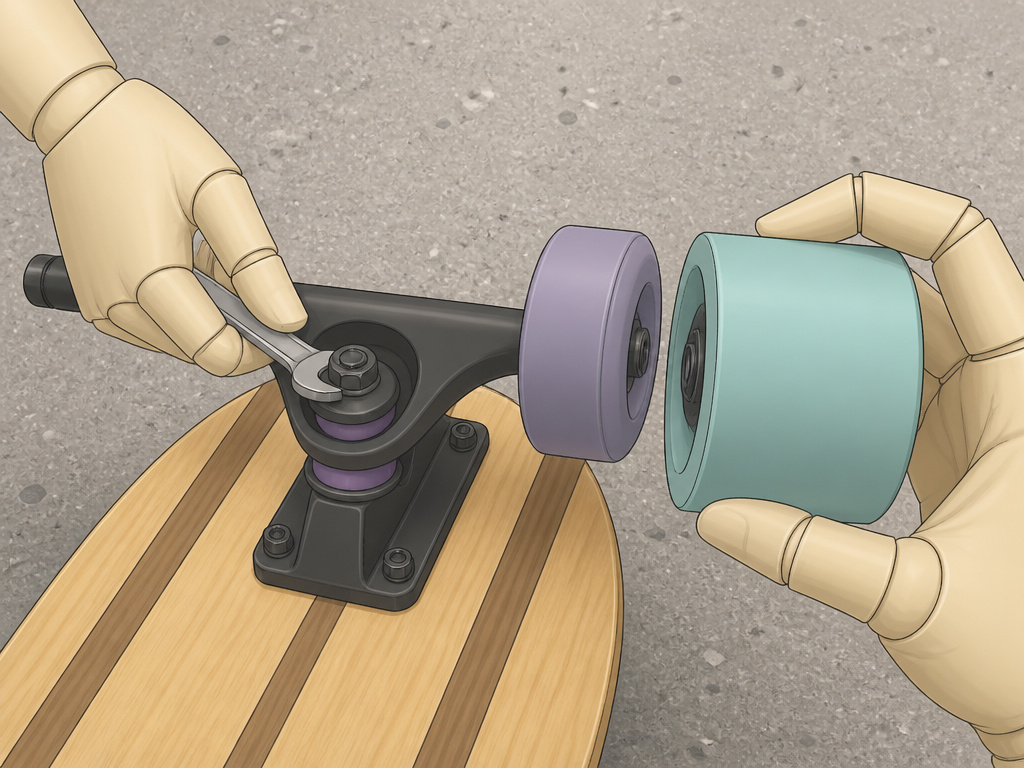
You own a dancer and want it to roll easier. You’re not stuck. A few component swaps can shift its character significantly.
First, look at wheelbase. Some boards, like the Loaded Tarab II, offer two settings (30.5″ and 31.25″). The longer setting provides more stability at speed, which is beneficial for cruising in a straight line. If your board has this option, try the longer setting.
Second, wheels are your biggest lever. The standard 65mm wheels on completes like the Tarab II are a good balance. But if your pavement is rough, stepping up to a 70mm, softer wheel (like 78A durometer) will maintain speed better over cracks and give a plusher ride. The Magneto Bamboo Dancer comes with 70mm 78A Magneto wheels. Just check for wheelbite, the larger wheel contacting the deck when you turn hard.
Where this goes sideways: Installing wheels that are too large without checking clearance. A 75mm wheel might roll forever, but if it bites the deck on a deep carve, you’ll be thrown off before you finish your first mile.
Third, consider bushings. Softer bushings in your reverse kingpin trucks will make the board turn more easily with less lean effort, which can reduce fatigue on long, carving-heavy cruises. It’s a subtle change, but your knees will thank you after an hour.
These tweaks won’t turn a 48-inch dancer into a low-slung commuter. But they will make the miles you do cover more comfortable and efficient, which is the whole point of learning how to cruise on a longboard.
When a Dancer Is the Better Cruiser
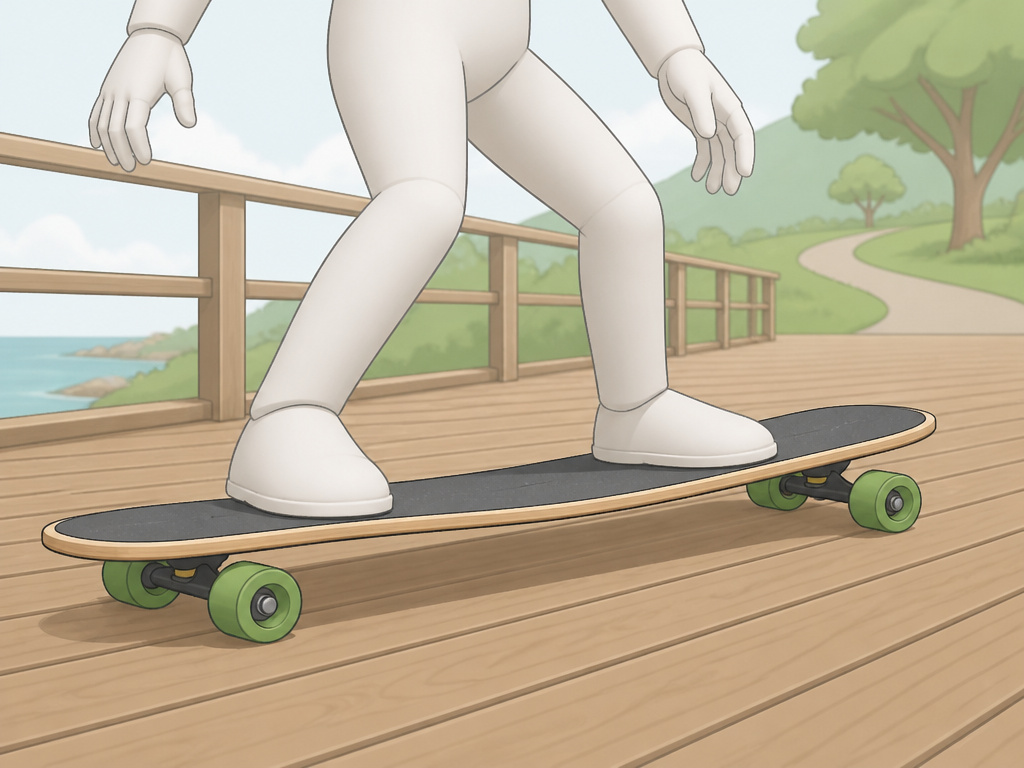
It sounds like I’m down on dancers for cruising. I’m not. There are specific scenarios where their design makes them the superior choice.
The first is mixed-terrain boardwalk cruising. You’re not racing; you’re flowing. The dancer’s flex absorbs the bumps of wooden planks or uneven concrete. The huge platform lets you shift your weight and carve for fun without a kick turn. The board is part of the experience, not just a tool.
The second is the learning curve. If you’re a beginner who wants to eventually dance, starting on a dancer for cruising makes perfect sense. You learn balance on the platform you’ll use later. The stability builds confidence. The basic longboard dancing moves like cross-steps become an extension of your cruising, not a separate skill on a different board.
The third is pure comfort on smooth, flat ground. If your cruising loop is a few miles of pristine bike path with no hills, a dancer’s ride is sublime. You stand upright, soak in the view, and use the board’s natural spring for lazy carves. It’s the difference between driving a sports car and riding in a touring sedan. One is focused on performance; the other is about the journey.
Weight, Portability, and the “Carry Test”
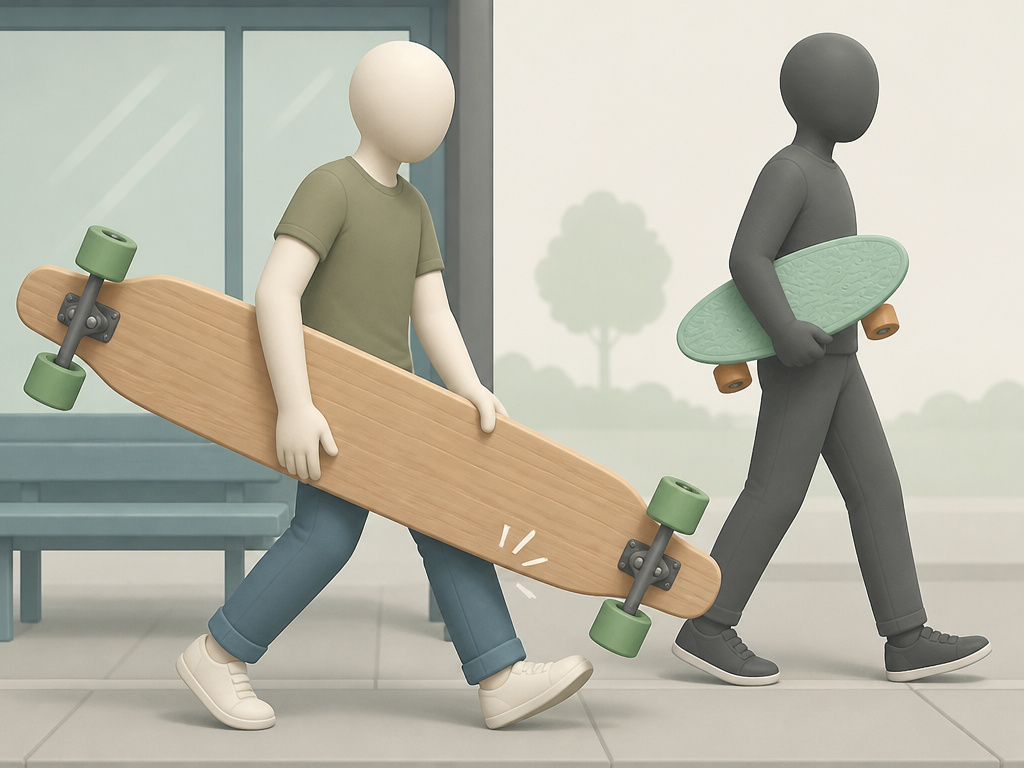
Here’s the practical factor most reviews ignore: getting the board to your cruising spot. A dancer’s length and weight make it a chore to carry.
The Loaded Bhangra V2 deck alone weighs 5.1–5.5 lbs. Adding trucks and wheels (~3.7 lbs) makes for a heavy, 48.5-inch plank. The Zenit Dada deck is lighter at 4.6 lbs, and its length is 41 inches. Compare that to a 32-inch cruiser you can tuck under your arm.
This matters if you walk to the park, take a bus, or have to navigate a crowded campus. Can you comfortably carry this board for ten minutes? If the answer is no, you’ll skate less. It’s a real-world constraint that has nothing to do with performance and everything to do with actually using your gear.
Matching Flex and Wheelbase to Your Ride
Your weight and riding style dictate the ideal setup. Get this wrong, and the board will feel dead or uncontrollable.
Manufacturers provide clear guidelines. Zenit recommends riders above 280 lbs select a Hard Flex for the Dada, and above 250 lbs for the Dino 2.0. Loaded says Flex1 (stiffer) is for riders 170 to 250 lbs, while Flex2 is for 75-200 lbs. Heavier riders on too-soft flex will bottom out, losing energy return and making pushes feel mushy.
Wheelbase is about control. A longer wheelbase (like the Tarab II’s 31.25″ setting) is more stable for straight-line speed. A shorter wheelbase (like the Dada’s adjustable 23.5-25.75″) is more maneuverable for tight turns and freestyle.
Getting the dancing longboard length right is the first step; dialing in flex and wheelbase is what makes it your board.
Are dancing longboards good for beginners?
Dancing is often described as a natural evolution from cruising, which makes a dancing deck a logical next step for a beginner who has mastered the basics. These boards are built for stability on flat ground, with relatively flat decks and subtle concave that offer a confident, predictable feel underfoot. This stable platform can make learning to push, balance, and carve feel more secure. However, their larger size and weight can be less nimble for a complete novice still working on fundamental board control. At the minimum, get yourself a helmet and some knee pads, and maybe some wrist guards when starting out.
What is the recommended board length for dancing and cruising?
Dancing decks are typically between 42 and 48 inches long. This range provides the necessary platform for footwork while remaining manageable for general cruising. A longer board within this range offers a larger platform for dancing tricks. A shorter board will be lighter and more maneuverable. Your choice depends on whether you prioritize the expansive stage for dance steps or a slightly more efficient cruiser.
Frequently Asked Questions
What type of longboard is best for cruising?
For pure, efficient cruising over distance, a drop-through longboard is best. It sits lower to the ground, making pushes easier and reducing fatigue. For cruising that mixes in carving, footwork, or learning to dance, a dancing longboard can be a great, versatile choice.
Are drop-through longboards good for dancing?
Generally, no. The cutouts for the trucks shorten the standing platform, and the lower ride height makes sharp turns harder. While you can learn basic steps, advanced dancing on a drop-through is much harder. Dedicated dancers are almost always top-mounted.
What is the best longboard for cruising long distances?
Look for a long, low board designed for “Long Distance Pumping” (LDP) or pushing. These are often drop-through or even double-drop decks with a focused, efficient setup. A dancing longboard, while smooth, is not optimized for this due to its higher ride height and weight.
Can a beginner use a dancing longboard for cruising?
Yes. A dancer’s stability and smooth ride can be very forgiving for a beginner. Just be mindful of its length when learning to turn and carry it. It’s a fine place to start if your goal includes learning to dance later.
The Bottom Line
A dancing longboard is a versatile and well-rounded cruiser, but it’s a specialized cruiser. It trades some pushing efficiency for a stable, spacious, and fun ride. For short to medium distances on flat ground, especially if you enjoy carving and want the option to dance, it’s an excellent choice.
If your primary goal is covering miles with minimal effort, commuting, fitness, endurance, you’re fighting its design. In that case, a dedicated low cruiser or pump setup will serve you better.
The honest answer is “yes, if.” If your cruising style values experience over efficiency, and if you’re willing to swap some components to match your local pavement, a dancer can be your one-board quiver. Just know the trade-off before you commit. Your legs will know the difference by mile eight.
