Can You Use a Skateboard Helmet for Snowboarding?
This post contains affiliate links. As an Amazon Associate, we earn from qualifying purchases.
You can use a skateboard helmet for snowboarding only if it carries an ASTM F2040 certification label for snow sports. A standard skateboard helmet certified to ASTM F1492 is not approved for snowboarding in Canada and is not recommended by pediatric safety experts, who note that helmets designed specifically for snow sports reduce a child’s risk of head injury by nearly half.
The “only if” clause in that answer is the whole game. It’s not about the shell shape or the brand name on the front; it’s about the specific safety standard printed on the label inside. A helmet can look the part but fail the test. For example, you might ask, can you use a skateboard helmet for snowboarding? The answer depends entirely on that standard.
What follows is a breakdown of the three standards that decide the can you use a skateboard helmet for snowboarding question, the physical and regulatory reasons behind the split, and a practical guide for what to do if you’re a beginner trying to save money on your first trip to the slopes.
Key Takeaways
- The ASTM F2040 standard is the benchmark for snow sports helmets. A skateboard helmet certified only to ASTM F1492 is not designed for the impact profiles or cold temperatures of snowboarding.
- A snowboard helmet sits about one inch above the eyebrows and must fit snugly with your goggles. A skate helmet’s lower profile often creates a gap that exposes your forehead to wind and impacts.
- Health Canada explicitly prohibits selling a skateboard helmet (ASTM F1492) as a ski/snowboard helmet. In the U.S., the CDC allows multi-use helmets only if they carry an ASTM F2040 label.
- Snowboard helmets are designed to withstand more than one very minor hit, while bike helmets are good for only 1 crash according to Seattle Children’s Hospital. The internal foam compression differs, which affects how long the protection lasts.
- For a beginner’s first few lessons, the temporary risk of using a non-certified helmet may be outweighed by the barrier of buying new gear, but the moment you commit to the sport, a certified snowboard helmet is an essential safety upgrade.
The ASTM F2040 vs. F1492 Difference (and Why It Matters)
Here’s an important clarification. This isn’t a marketing distinction. ASTM F2040 and ASTM F1492 are two different engineering documents that specify how a helmet should be tested and what it must withstand.
The ASTM F2040 standard defines performance requirements for helmets used in nonmotorized recreational snow sports. Its impact tests use a flat anvil, a hemispherical anvil, and an edge anvil to simulate hitting packed snow, rounded obstacles, and hard, sharp ridges.
The edge anvil is one of the impact test anvils specified in the ASTM F2040 standard. The ASTM F2040 impact tests include an edge anvil.
Now look at the ASTM F1492 skateboarding helmet standard. Its impact tests use a flat anvil, a cylindrical hazard anvil, and a triangular hazard anvil. That triangular anvil simulates the corner of a concrete ledge or a metal coping—the primary hazards in skateboarding. The ASTM F1492 standard uses different impact anvils, including a triangular hazard anvil, to simulate skateboarding hazards.
The ASTM F2040 snow sports standard requires helmets to be tested in cold conditions, unlike the ASTM F1492 skateboarding standard.
| Standard | Designed For | Key Impact Anvils | Cold-Temperature Testing? |
|---|---|---|---|
| ASTM F2040 | Recreational skiing & snowboarding | Flat, Hemispherical, Edge | Yes (hot, cold, and wet conditioning) |
| ASTM F1492 | Skateboarding & trick roller skating | Flat, Cylindrical, Triangular | No |
| Snell RS-98 / S-98 | Recreational skiing & snowboarding | Specific to Snell protocol | Yes |
The table shows the mismatch.
Where the Experts and Regulators Stand
The guidance here isn’t vague. Authoritative bodies draw clear lines, though they sometimes differ in emphasis.
The CDC’s position on can you use a skateboard helmet for snowboarding is more permissive than that of other major sources. Their Heads Up helmet safety guide states: “Before your child or teen uses a multi-use helmet for snowboarding, make sure the helmet has an ASTM label certifying it for snowboarding.” That’s the “only if” rule. They don’t endorse it, but they provide a conditional path.
Seattle Children’s Hospital is more direct. Their guidance from February 2023 says to “choose a certified helmet made just for snow sports,” listing ASTM F2040, Snell RS-98, or S-98. They don’t mention multi-use options as a recommended path. Their data point is powerful: when child skiers and snowboarders wear properly fitting helmets designed for the sport, they reduce their risk of head injuries by nearly half.
Then there’s the regulator. Health Canada doesn’t debate the nuance. Their published notice states they prohibit the sale of ski/snowboard helmets in Canada that do not conform to CSA Z263.1-14, ASTM F2040-18, Snell RS-98, or EN 1077:2007. They explicitly note: “A skateboard helmet (ASTM F1492) sold as a ski/snowboard helmet would be non-compliant in Canada.” This isn’t advice; it’s a market enforcement rule.
Common mistake: Assuming a “multi-sport” label means certified for snow. Unless it lists ASTM F2040, Snell RS-98, CSA Z263.1, or EN 1077, it’s not a snow sports helmet.
Why the hard line? The data shows the stakes. Health Canada’s assessment references an average of 38 skiing and snowboarding deaths per year during the 2009-10 to 2018-19 seasons, with the majority involving collisions with other skiers, the snow surface, or trees. The helmet is your last layer of defense against that kinetic energy.
The Goggle Gap and Fit Failure
Even if you find a skate helmet with the right certification, the fit for snowboarding is different. This is where first-hand experience screams.
A snowboard helmet is designed to integrate with goggles. The CDC’s fitting guide says the helmet should sit snugly on top of the goggles, with no space between them. The CDC says a snowboard helmet should sit about 1 inch above the eyebrows, while Seattle Children’s Hospital states the front edge should be no more than 1 inch above the eyebrows.
Try that with a typical skate helmet. Most have a lower, rounder profile that sits higher on the head. When you pull on a pair of snow goggles, you’ll likely see a glaring gap above the goggle frame. That gap isn’t just a cold spot.
It’s an impact zone.
In a forward fall, your forehead can strike the snow or ice through that gap, because the helmet’s protective rim is sitting too high. A proper snowboard helmet review will always highlight goggle compatibility as a core feature.
How to Test Goggle Compatibility at Home
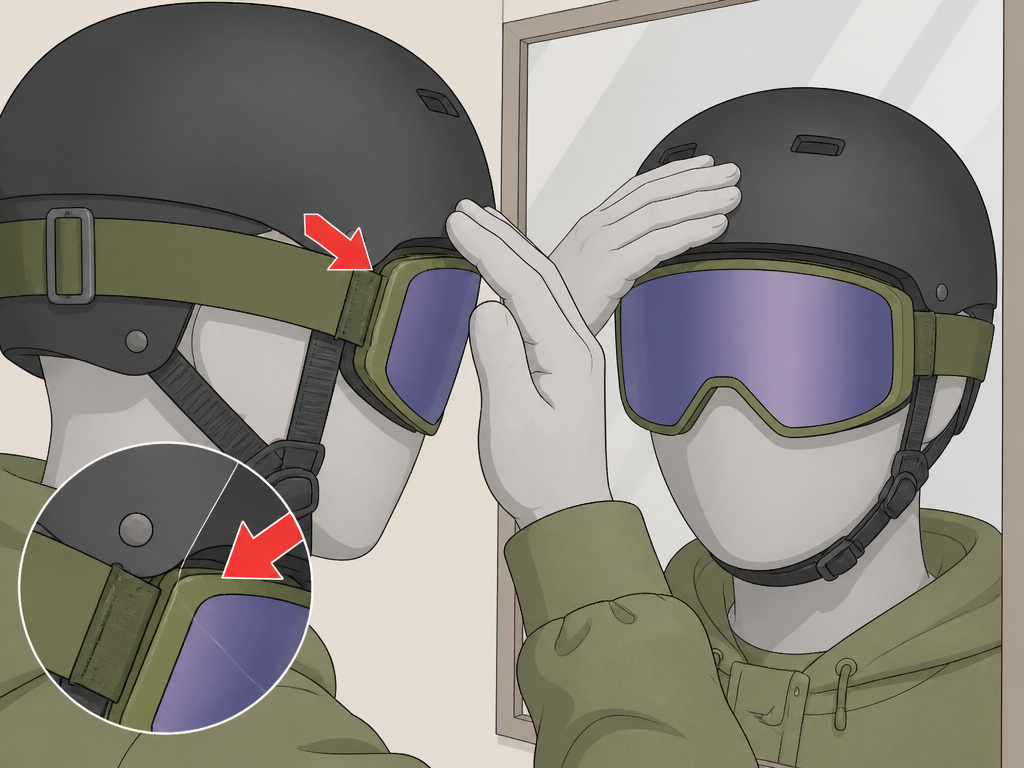
If you’re determined to try your existing helmet, run this test before you travel:
- Put on the helmet and fasten the chin strap.
- Put on your snow goggles.
- Look in a mirror. There should be no visible gap between the top of the goggle frame and the bottom edge of the helmet.
- Tilt your head forward and shake it gently. The goggles should not separate from the helmet.
- Feel along your forehead above the goggles. The helmet’s hard shell should be within an inch of your brow line.
If you fail any of these, the helmet won’t work on the mountain.
Cold, Crashes, and Compromised Foam
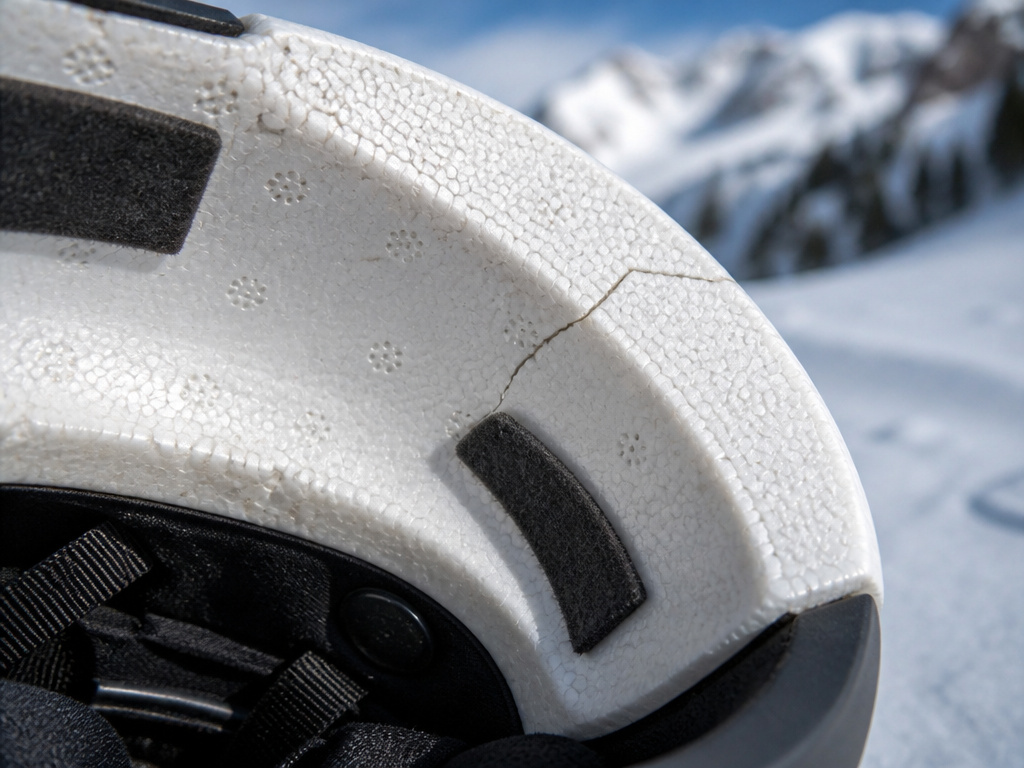
The physical environment introduces two more deal-breakers: temperature and impact history.
Skateboard helmets are not tested for performance in sub-freezing temperatures. The expanded polystyrene (EPS) foam inside can become more brittle when cold. In contrast, the ASTM F2040 snow sports standard requires helmets to be tested hot, cold, and wet.
Then there’s the crash history. The CDC states snowboard helmets are “designed to withstand more than one very minor hit.” But they, along with Seattle Children’s Hospital, mandate replacement after any serious crash. Seattle Children’s Hospital states that bike helmets are “good for only 1 crash.”
Here’s the connection: if you’re using a multi-use helmet you’ve also worn for skateboarding, you need a perfect memory. That minor slam on the skatepark concrete last summer? It counts.
This is why the expert stance is so restrictive. It removes the variable of your memory and replaces it with a simple rule: use a helmet designed and certified for the job.
A Practical Guide for the Cost-Conscious Beginner
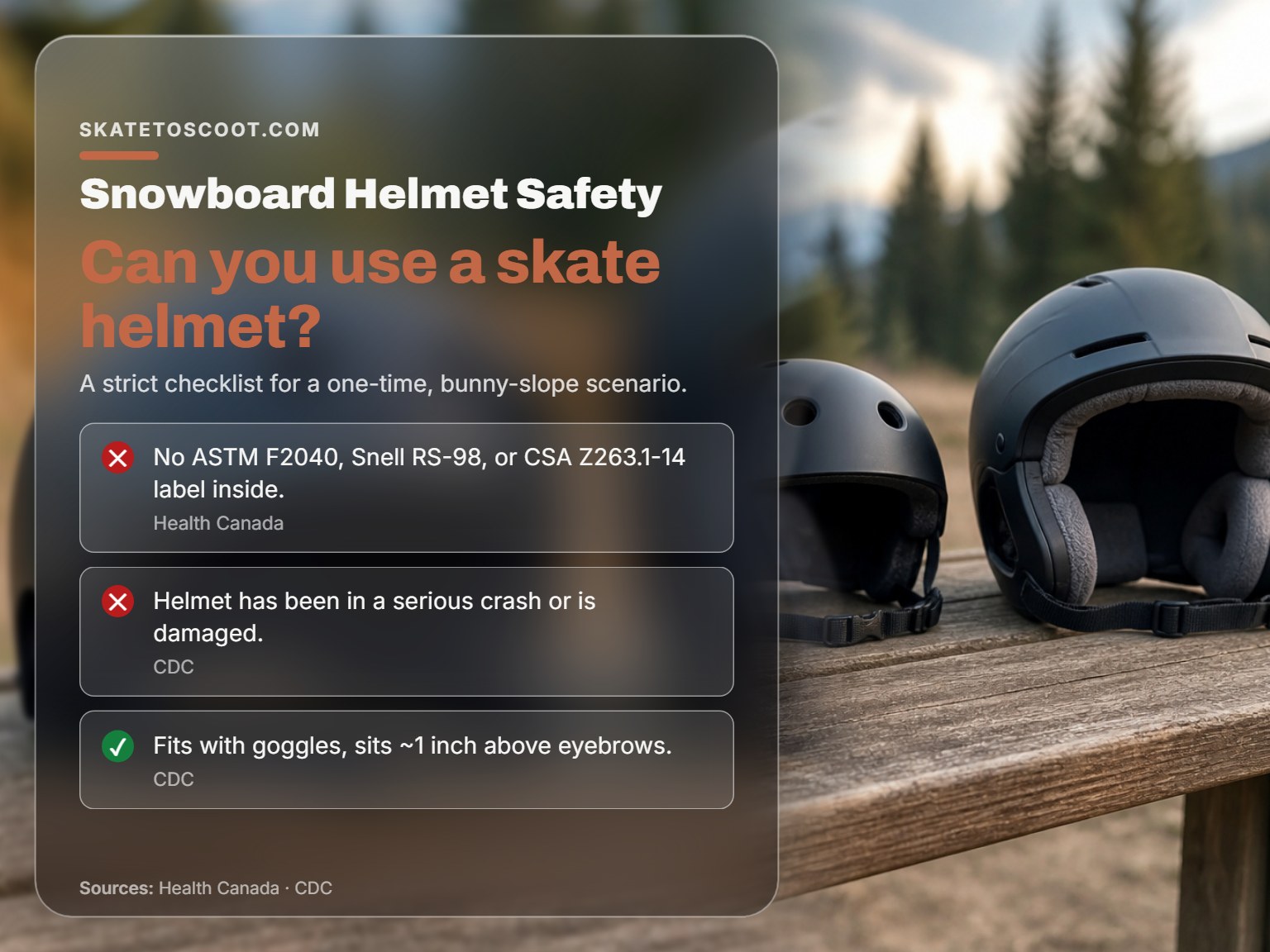
Consider the actual situation. Someone is asking this question because they have a skate helmet and a chance to try snowboarding, but they don’t want to buy a dedicated snowboarding helmet for a single trip. Is there a temporary, calculated-risk path?
Maybe. But you must follow a strict checklist.
- Check the Label: Inside the helmet, find the certification. If it does NOT list ASTM F2040, Snell RS-98, CSA Z263.1, or EN 1077, stop. The answer is no.
- Pass the Goggle Test: Perform the five-step fit test described above. If it fails, stop.
- Assess Crash History: Has this helmet been in any crash, even a minor one? If yes, stop. The foam integrity is unknown.
- Stick to the Bunny Slope: This is for a first-day, lesson-based scenario on gentle, controlled terrain. The moment you progress to real slopes, the risk profile changes.
- Commit to an Upgrade: If you enjoy the sport and plan to go a second time, a certified snowboard helmet is your very next purchase.
For everything else—sledding, ice skating—the guidance relaxes. Seattle Children’s Hospital advises that while there are no helmets designed specifically for these sports, wearing any helmet that meets a known standard (bike, skateboard, or snow sport) is better than no helmet at all.
Cost-saving for beginners/temporary use
The official guidance is clear: a helmet must have a specific label certifying it for snowboarding, such as ASTM F2040, to be considered appropriate. Without that label, it is not certified for the impacts common in snow sports. While a certified snow sport helmet is the recommended choice, Seattle Children’s Hospital notes that for sledding and ice-skating, wearing any helmet that meets a known standard is better than no helmet at all. However, you must replace any helmet after a serious crash. Seattle Children’s Hospital states that bike helmets are good for only 1 crash.
Frequently Asked Questions
Can I wear a skateboard helmet snowboarding?
You can only if the helmet has an ASTM F2040 (or equivalent snow sports) certification label inside. A standard skateboard helmet certified to ASTM F1492 is not designed or tested for the impacts and cold temperatures of snowboarding and is not recommended by safety experts.
Are skateboard helmets safe for skiing?
No, for the same reasons they are not safe for snowboarding. The safety standards (ASTM F2040 for snow sports vs. ASTM F1492 for skateboarding) specify different impact tests and environmental conditions. Skiing involves similar speeds and hazards as snowboarding.
Do I need a specific helmet for snowboarding?
Yes. You need a helmet certified for snow sports, which includes standards like ASTM F2040, Snell RS-98, CSA Z263.1-14, or EN 1077. These helmets are designed for multiple minor impacts, tested for cold-weather performance, and shaped to integrate with snow goggles.
What if my skate helmet has a removable liner and ear pads?
Removable liners and ear pads add warmth, but they don’t change the helmet’s fundamental certification or its shell’s impact protection design. A skate helmet with warm liners is still a skate helmet. The critical factor remains the safety standard printed on the label inside.
Can I use my bike helmet for snowboarding?
No. Bike helmets are designed for a single severe crash, not the multiple minor impacts common in snowboarding. They also lack the insulation, goggle integration, and cold-weather testing of snow sports helmets. Seattle Children’s Hospital explicitly states bike helmets are “good for only 1 crash.”
The Bottom Line
The rule is simpler than the debate: match the helmet’s certification to the sport’s standard.
If your helmet says ASTM F2040, Snell RS-98, CSA Z263.1, or EN 1077, you’re covered for snowboarding. If it only says ASTM F1492 or CPSC (for biking), you are not. The regulatory, environmental, and fit differences are too significant to ignore.
For a beginner testing the waters, the temporary use of a non-conforming helmet might be a calculated risk on the gentlest slope. But the moment snowboarding moves from a “maybe” to a “yes,” your first piece of dedicated snowboarding protective gear should be a properly certified helmet. It’s the foundation upon which every other safety skill is built. Trust the standard, not just the shell.
