Increasing Electric Skateboard Battery Life
This post contains affiliate links. As an Amazon Associate, we earn from qualifying purchases.
Store your electric skateboard battery at 40–50% charge if you won’t ride for over three months, use only the official charger, and avoid leaving it in a hot car or a cold garage. For daily use, Evolve Skateboards advises avoiding regular full discharges and not storing the board fully charged for weeks, while Linky Innovation recommends keeping the battery between 70-90% and avoiding letting it fall below 30%. These habits, drawn directly from manufacturer manuals, can extend a lithium-ion battery’s life toward its rated 700–1000 cycles.
That 40–50% storage rule is specific to lithium-ion chemistry. It contradicts the advice for older boards using sealed lead-acid batteries, which need to be kept topped up. A key strategy for increasing electric skateboard battery life is following the correct storage protocol. The difference isn’t academic, it’s the line between preserving a $400 battery pack and ruining it through well-intentioned neglect.
What follows: the exact voltage cutoffs, temperature ranges, and charging cooldowns from the OEM manuals, a clear comparison of battery chemistries, and the riding adjustments that add real miles per charge.
Key Takeaways
- Store lithium-ion batteries at 40–50% charge for periods over three months; sealed lead-acid (SLA) batteries need to be kept fully charged when not in use.
- Avoid temperature extremes, a hot car can cause permanent cell damage, while a cold garage saps performance and range on your next ride.
- Use only the official manufacturer charger; third-party chargers can mismatch the battery management system’s expected profile and stress cells.
- Plan rides to avoid regular full discharges; frequent 0% cycles accelerate capacity loss noticeably by the 500-cycle mark.
- Let the board cool down after a hard session before plugging in to avoid compounding heat stress during charging.
Why Your Battery’s Chemistry Dictates Everything
The first rule of battery care is knowing what’s inside your deck. Giving lead-acid advice to a lithium-ion owner is like telling someone to oil a bearing that needs to stay dry, you’ll create the problem you’re trying to solve.
Most modern boards, from the Evolve GTR to the Inboard M1, use lithium-ion cells. The manual for the Evolve GTR is explicit: for storage over three months, “STORE IT BETWEEN 40 AND 50%.” Storing it fully charged risks permanent capacity loss, and storing it nearly dead risks the voltage dropping to an unrecoverable level. The charger has a voltage cutoff detection at 42 volts to prevent overcharging, but that doesn’t protect against calendar aging at high charge.
Older or specific utility boards, like the E-Glide AT/GT, use Sealed Lead-Acid (SLA) batteries made by B & B Batteries. Their manual flips the script: “Do not leave them in a partially discharged state. Top off the batteries.” Letting an SLA battery sit half-empty sulfates the plates, which is why the E-Glide guide says to charge overnight if you haven’t ridden in a couple of weeks.
Common mistake: Applying lithium-ion battery care to a board with lead-acid batteries, or vice versa. An SLA battery stored at 50% charge will sulfate and lose capacity within months, while a lithium pack stored at 100% for a season will degrade just as fast.
Here’s the quick-reference table to keep them straight:
| Battery Chemistry | Ideal Storage Charge | Key Risk if Ignored | Typical Cycle Life |
|---|---|---|---|
| Lithium-ion (Li-ion) | 40–50% state of charge | Permanent capacity loss; unrecoverable low voltage | 700–1000 cycles (Evolve), 300–500 cycles (general) |
| Lithium Polymer (LiPo) | 40–50% state of charge | Fire risk if physically damaged; faster degradation | 300–500 cycles |
| Sealed Lead-Acid (SLA) | 100% (Keep topped up) | Plate sulfation, irreversible capacity loss | 300–350 cycles (E-Glide) |
The takeaway is simple. Check your manual first. If you can’t find it, the presence of a heavy, vented battery box usually signals SLA; a slim, integrated pack is almost always lithium.
The 40–50% Rule for Long-Term Storage
That 40–50% figure is based on real chemistry. It’s not a guess. It’s the voltage range where lithium-ion chemistry is most stable, minimizing stress on the cathode. The Evolve GTR manual ties it directly to a timeline: “3 MONTHS OR MORE.”
Forgetting the board in a closet for prolonged storage at full charge is a documented path to reduced range. Evolve’s support notes that by around 500 charge cycles, it’s normal to see reduced range, sometimes a 30–40% loss. Storing at full charge accelerates that timeline.
The practical method is straightforward:
- After your last ride, run the battery down to roughly half. Don’t obsess over the exact percentage; most remotes give you a rough bar reading.
- Store the board at room temperature. A dry basement shelf beats a damp garage corner or an attic that bakes in summer.
- Set a calendar reminder to top up the charge every one to two months. This is the part people skip. The battery will self-discharge slowly, and if it drifts too low, you risk hitting that “unrecoverable voltage” the manual warns about.
I’ve pulled boards out of winter storage that wouldn’t turn on. The owner swore they left it “mostly charged.” The pack had drifted below the BMS’s low-voltage cutoff, a repair that often costs more than a new battery. A single 30-minute top-up in January would have saved it.
This is where a smart charger or a basic timer plug can save you hundreds. Plug in the official charger to top up the storage charge every one to two months, then unplug it. Done.
Temperature Is a Silent Killer
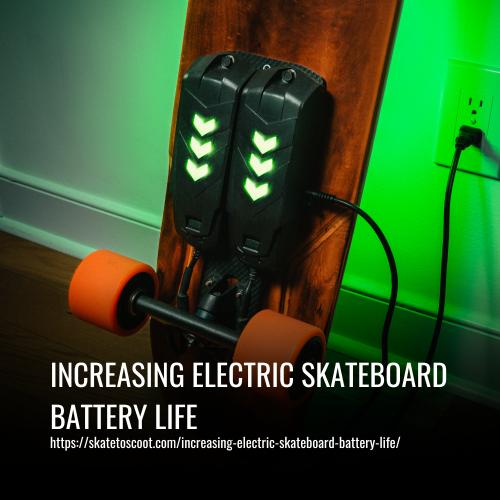
Your battery doesn’t just hate extreme temperatures when you’re riding. It hates them when it’s sitting, powerless to defend itself. The manuals draw a clear line between hot and cold.
Excessive heat, like inside a car on a summer day, “can permanently affect or damage the battery.” The board’s protection software only activates when the system is on. Sitting in a 120°F car trunk, the cells degrade silently. The Inboard M1 manual specifies a storage range of 0-40°C (32-104°F).
Cold temperatures are a different beast. They “will affect battery life and power output, reducing range, top speed, and acceleration.” You’ll feel this on your first cold-weather ride, the board feels sluggish, the remote shows less range. It’s usually temporary, but riding a frozen battery hard can stress it.
Where this goes sideways: Storing a board in an unheated garage over winter, then expecting springtime performance. The cold doesn’t damage it like heat does, but the first few rides will disappoint. Bring the board inside to warm up for a few hours before you head out.
The sweet spot, as noted in third-party guides, is room temperature (68-77°F or 20-25°C). It’s not about pampering the board; it’s about preserving the expensive part you can’t easily replace.
Charging Habits That Add Cycles, Not Subtract Them
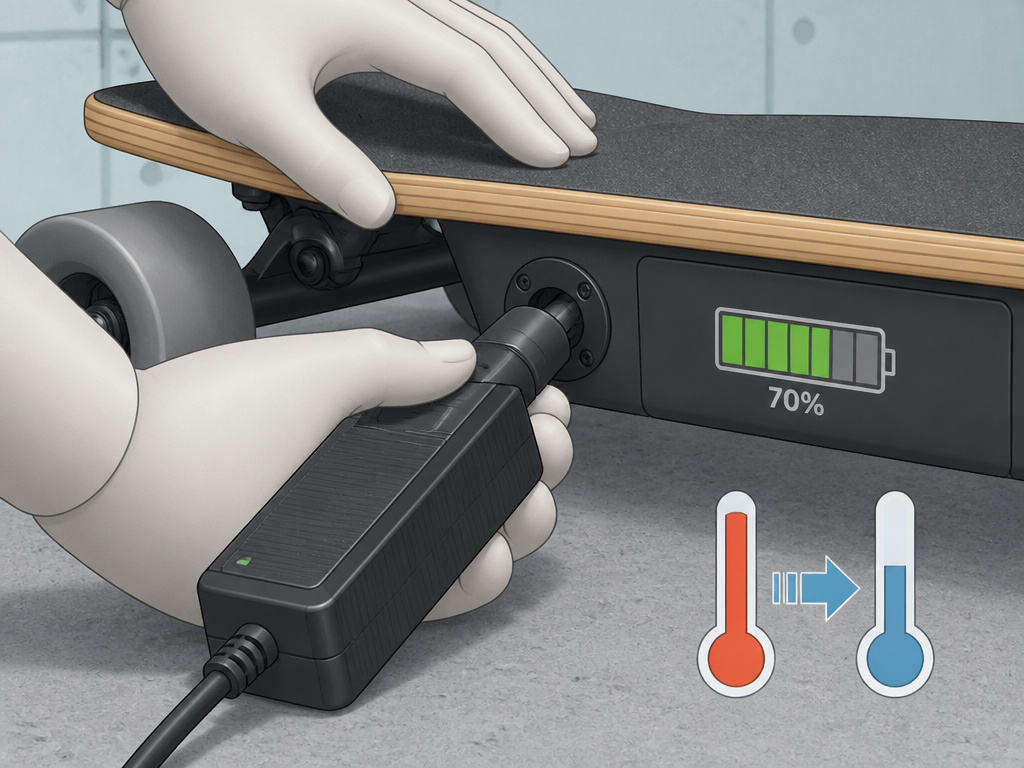
How you plug in matters as much as when. The goal of increasing electric skateboard battery life is to reduce cumulative stress on the cells, which shows up as voltage sag and lost range long before the battery actually fails.
Use only the official Evolve charger. Third-party chargers might fit the port, but they can deliver a different voltage or amperage profile. The board’s Battery Management System (BMS) is calibrated for the OEM charger. Mismatched charging can lead to unbalanced cells, which is a one-way ticket to reduced capacity.
Let the board cool down after a hard session. Pushing up hills on a hot day heats the battery through discharge. Plugging in immediately starts the charge cycle, compounding that heat stress. Wait 15–20 minutes. You’ll hear the cooling fans stop. That’s your cue.
Avoid the 0% to 100% shuffle. The Evolve support article is clear: “Avoid draining it to 0% regularly, it’s fine occasionally, but not all the time.” Similarly, “Don’t leave it fully charged for weeks on end.” The ideal daily maintenance, per some industry guidance, is to keep the battery between 70–90% and recharge before it falls below 30%. This shallow cycling is easier on the chemistry than deep discharges.
For boards with regenerative braking, like the Evolve Diablo Carbon, there’s a clever trick: start a long downhill run with a partially charged pack. This gives the regen system “headroom” to put energy back without overcharging a full battery, which can cause stress.
| Charging Habit | Recommended Practice | Physical Consequence if Ignored |
|---|---|---|
| Charger Source | Use only official OEM charger. | Uneven cell charging, accelerated capacity fade, potential BMS errors. |
| Battery Temperature | Charge at room temp; allow cooldown after riding. | Charging a hot battery increases internal resistance and degrades electrolyte. |
| Depth of Discharge | Avoid regular 0% cycles; recharge above 30%. | Deep discharges strain anode structure, reducing total cycle count. |
| State of Charge for Storage | 40-50% for Li-ion; 100% for SLA. | High voltage storage oxidizes cathode; low voltage storage leads to copper shunts. |
How You Ride Directly Eats Battery Life
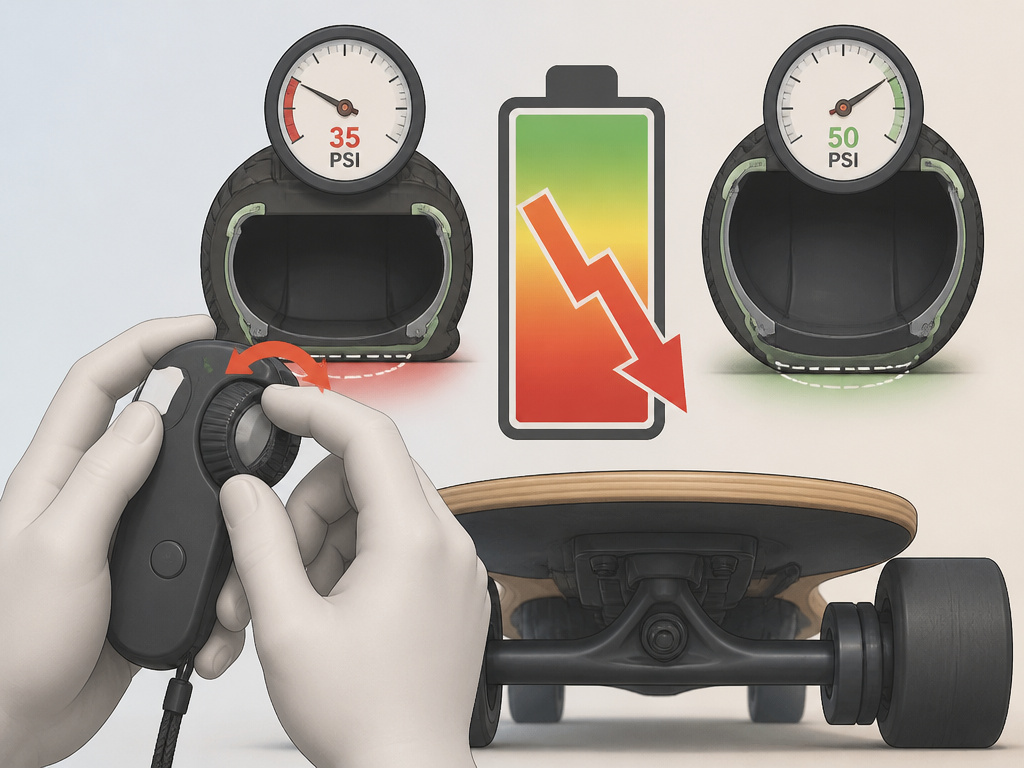
Increasing electric skateboard battery life isn’t just about plugging in correctly. The demands you place on it during a ride determine how many cycles you get before performance drops. This is the “how it’s used” clause in the manuals.
Rider weight and terrain are the biggest variables. Rider weight and terrain are the biggest variables affecting energy consumption. Hills significantly increase energy consumption. The Inboard M1 is rated for a rider up to 280 lbs (127 kg), but pushing that limit on hills will drain the 97 Wh battery quickly. It’s simple physics: more mass and more elevation gain require more energy from the battery.
Riding style is everything. Jackrabbit starts from every stop sign heat the battery and motor. A smooth, steady throttle uses the energy more efficiently. Many boards, like Evolve’s, have an ECO mode for this exact reason, it limits top speed and acceleration to preserve range and reduce cumulative cell stress.
Tire pressure is a sneaky range-killer. The E-Glide manual specifies 50 PSI for maximum range. Running at 35 PSI gives a softer ride but reduces range due to increased rolling resistance. Check your sidewalls and pump up before a long ride.
What most people get wrong: They blame the battery for lost range when the real culprit is under-inflated tires or a new, hillier route. Before you diagnose the battery, check the tire pressure and track your route’s elevation gain.
Your battery is a reservoir. Aggressive riding is like opening the floodgates; smooth, efficient riding is a controlled tap. You get to decide how many rides you get from each refill.
Diagnosing Normal Loss vs. A Failing Battery
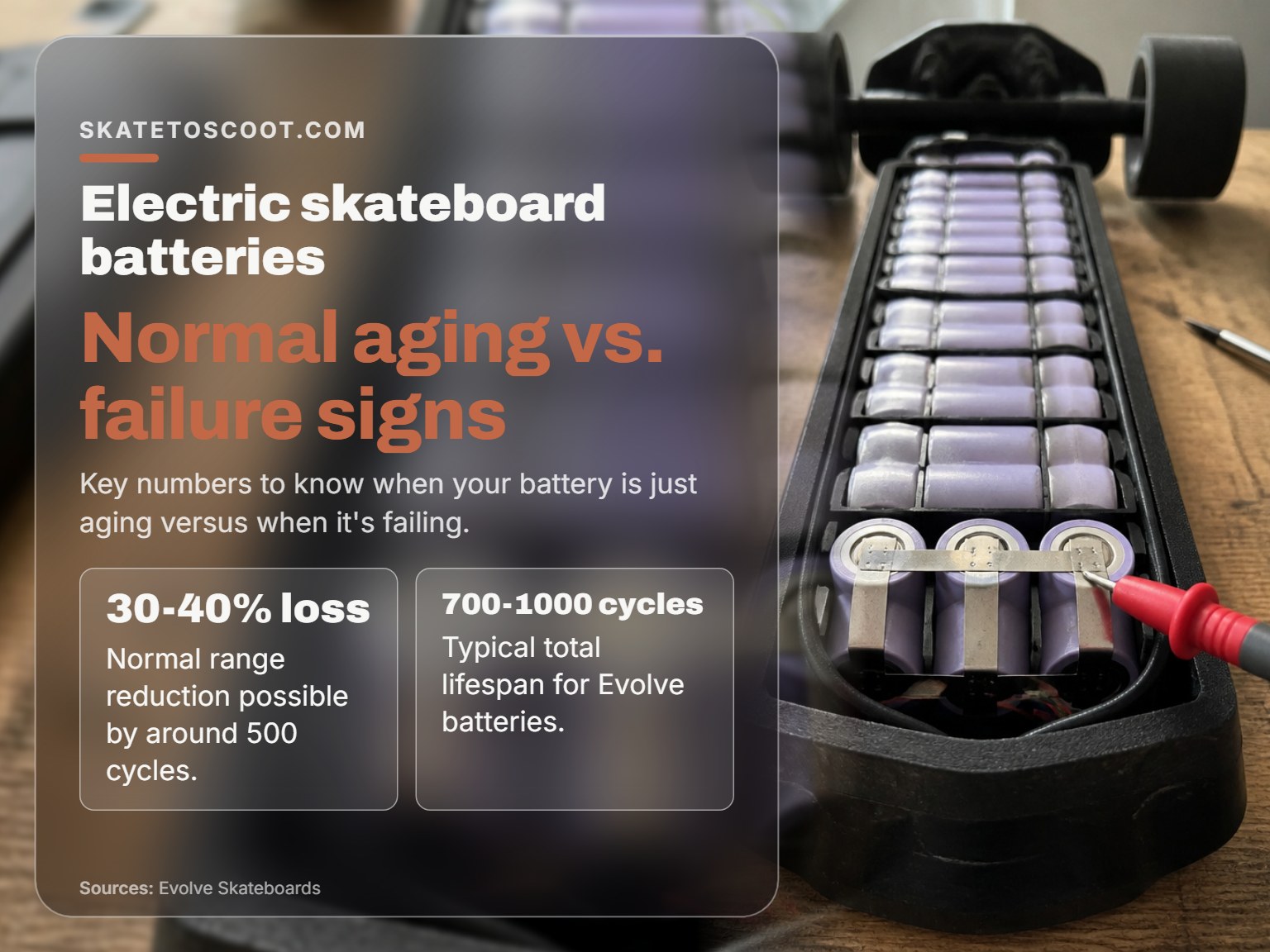
Capacity fade is inevitable. A healthy lithium-ion battery will experience gradual capacity loss over many cycles. Knowing when the loss is normal versus when it signals failure saves you from unnecessary replacement, or a stranded ride.
Normal aging follows a curve. You might not notice anything for the first 200 cycles. Between 300 and 500 cycles, you’ll likely see a gradual reduction. The board feels the same, but the remote shows 20% less range than it did new. This is the natural result of the anode and cathode materials slowly degrading with each charge cycle.
A failing battery shows different symptoms. The range drops suddenly, not gradually. You might get full power for two minutes, then a sudden cut-out, even though the remote shows 50% charge left. This is often a sign of a bad cell or a failing BMS, causing the whole pack to shut down to protect itself. The board might also refuse to charge fully, with the charger light turning green prematurely.
If you suspect failure, the first step is a visual and sensory check. Smell around the battery compartment for a faint, sweet odor, a sign of electrolyte leakage. Feel the battery enclosure after a moderate ride. Is one spot significantly hotter than the rest? That points to a cell imbalance.
For modern boards with app connectivity, like those from Evolve, use the diagnostic tools. They can show individual cell voltages. A spread of more than 0.1V between cells under load is a red flag. When in doubt, contact the manufacturer’s support with your model and symptoms. They’ve seen it all.
Frequently Asked Questions
How long do electric skateboard batteries last?
Evolve board batteries are rated for 700 to 1000 full charge cycles, while other sources cite a general range of 300 to 500 cycles. In real-world years, that’s several seasons of regular riding. Batteries in other brands or general guides are often rated for 300 to 500 cycles before noticeable capacity loss. Your actual mileage depends entirely on charging habits, storage conditions, and riding style.
Is the 20-80 rule good for electric skateboards?
Yes, the principle is sound. Keeping a lithium-ion battery between 20% and 80% charge for daily use minimizes stress compared to full 0-100% cycles. For long-term storage of lithium-ion batteries, Evolve recommends 40-50% charge, while Inboard advises fully charging and recharging at least once a year. Don’t overcomplicate daily riding, just avoid storing it fully charged or completely dead.
Can I use a fast charger all the time?
You can, but you shouldn’t. The 5A fast charger that comes with the Evolve Diablo Carbon Street is convenient, filling the large battery in about 4 hours. However, faster charging generates more heat and slightly accelerates wear. For overnight or between rides, a slower charge is gentler on the cells. Use the fast charger when you need it, not by default.
Does regenerative braking save battery life?
Regenerative braking primarily extends your per-charge range by recapturing some energy. Its effect on long-term battery lifespan is nuanced. Well-managed regen (like starting a downhill with a partially charged pack) is fine. Aggressive regen into a nearly full battery can cause stress. The main longevity gains still come from proper charging and storage.
How do I store my electric skateboard over winter?
For lithium-ion boards: Charge to 40-50%, store in a dry, room-temperature place (like a closet, not a garage), and top up the charge back to 40-50% every 4-6 weeks. For older SLA boards: Charge to 100% and top up every month to prevent sulfation. Always use the official charger for this maintenance topping.
The Bottom Line
Extending your electric skateboard’s battery life isn’t about secret tricks. It’s about following the specific, often boring, rules printed in the manual. The difference between a pack that lasts 300 cycles and one that reaches 800 is a series of small, consistent choices.
Store it right. Charge it smart. Ride it smoothly.
If you take away one action, make it this: find your board’s manual online tonight. Read the battery care section. Your model might have a specific voltage cutoff or temperature limit that changes the game. Everything else, the gentle acceleration, the tire pressure checks, the cool-down periods, supports that core directive. Your battery is the most expensive part of your board. Treat it like the precision instrument it is, not a disposable battery pack.
