Hover 1 Scooter Review: Is It Worth It?
This post contains affiliate links. As an Amazon Associate, we earn from qualifying purchases.
A Hover 1 scooter review must separate tested performance from marketing claims, weigh the impact of three major recalls, and navigate a strict, non-transferable warranty. The Journey Max offers surprising hill-climb power for its price, but the brand’s history of safety recalls and documented support issues means you buy for the specs, not the long-term safety net.
The specs tell one story. The Consumer Product Safety Commission (CPSC) tells another. You can get a dual-motor scooter that climbs a 31.5% grade for under $600, or you can buy into a product line where specific models have been recalled for brake failure, fire, and runaway software. The choice involves matching the scooter’s proven capabilities to your tolerance for risk and your willingness to be your own mechanic.
What follows is a breakdown of the numbers that matter, the recalls you cannot ignore, and the warranty fine print that decides what happens when something goes wrong. This serves as a map.
Key Takeaways
- The Hover-1 Journey Max delivers verified performance with dual 700W motors, a tested 20.4-mile range, and a hill-climb rating that beats scooters costing twice as much.
- Three separate recalls affect the Dynamo (brake failure), Helix (fire), and Superfly (runaway motor) models, check serial numbers against CPSC notices before riding.
- The manufacturer’s warranty is non-transferable, voids completely for water exposure, and limits Hover-1’s total liability to your original purchase price.
- Customer support requires documented proof (receipts, photos, sometimes severed cables) for claims, and RMAs must ship within a strict 14-day window.
- For a budget-conscious rider who accepts the risk profile and can perform basic maintenance, certain Hover-1 models offer value; for everyone else, the support hurdles are a deal-breaker.
The Hover-1 Performance Question: How Fast, How Far?
Most budget scooter reviews talk about claimed specs. A thorough Hover 1 scooter review, however, reveals the Hover-1 Journey Max has something better: instrument-tested results from an independent reviewer. That changes the conversation from marketing to mechanics.
The Journey Max uses dual 700W motors. In a factory-limited setting, it hits a tested top speed of 18 mph. Press the power button five times, and the top speed increases to 20.7 mph. Acceleration from a standstill to 20 mph takes 6.6 seconds. Those numbers aren’t just good for the price; they beat scooters that cost hundreds more, as shown in our Swagtron vs Hover-1 comparison. The hill-climb claim is where it gets serious. The Hover-1 Journey Max hill climb is rated for a 20% incline. In testing, it conquered a 31.5% gradient hill. For under $600, that kind of torque is rare.
A third-party review by Electric Scooter Guide recorded a 20.4-mile tested range for the Hover-1 Journey Max in its factory speed setting, with a braking distance of 14.9 feet from 15 mph using its combined regen and rear mechanical disc system.
Range depends on how you ride. That 20.4-mile figure assumes the 18 mph speed cap. If you disable the speed cap and ride at full throttle uphill with a heavier rider, the range will be lower. The Hover-1 Journey Max braking system includes regen brakes and a rear mechanical disc. It can feel grabby, especially with the regenerative braking, but it stops the scooter effectively. The lack of suspension means you feel every crack in the pavement, a trade-off for keeping the cost down.
This is the Hover-1 sweet spot. When a specific model like the Journey Max gets into the hands of a rigorous tester, the numbers hold up. The problem is that this level of verification isn’t available for every model in the lineup. You’re trusting the spec sheet, and a detailed Hover 1 scooter review of the recall history shows that sheet can miss critical flaws.
The Recalls You Cannot Afford to Miss
Performance means nothing if the scooter fails in a way that injures you. Hover-1, under its parent company DGL Group, has three active recalls listed with the CPSC. These are brake failures, fires, and uncontrolled acceleration.
The most recent is for the Hover-1 Dynamo. The CPSC announced the recall on July 25, 2024. The e-scooter’s brakes can fail, posing a crash hazard. DGL Group received 22 reports of brake failure, resulting in 7 injuries including abrasions, contusions, a dislocated shoulder, fractured teeth, and lacerations. The recall covers scooters with serial numbers where the 7th and 8th characters are “WY”. The remedy is a full refund, but it requires owners to submit a photo of the serial number and a photo of the severed motor cable.
| Recalled Model | Hazard | Injuries / Damage | Serial Number Identifier | Announcement Date |
|---|---|---|---|---|
| Hover-1 Dynamo | Brake Failure | 22 reports, 7 injuries | 7th & 8th chars are “WY” | July 25, 2024 |
| Hover-1 Helix | Fire | 3 fire reports, 5 smoke inhalation reports, ~$25k property damage | Contains “15914”, “19203”, or “19988” as fifth code | December 21, 2023 |
| Hover-1 Superfly (H1-SPFY) | Software Malfunction (Runaway Motor) | 29 reports, 4 minor injuries | Begins with “SPFY-BLK-GO-2008”, “2009”, or “2010” | August 25, 2022 |
The Hover-1 Helix hoverboard recall is for a fire hazard; see our Hover-1 hoverboard review for more details. DGL received 3 reports of fire, linked to 5 reports of smoke inhalation symptoms (headaches, nausea, coughs) and about $25,000 in property damage. The affected units have specific serial number codes.
The Hover-1 Superfly hoverboard recall involves a software malfunction that causes continued motor assistance without rider input, a known issue in broader hoverboard reviews. The firm received 29 reports of this, leading to 4 minor injuries.
Where this goes sideways: Assuming a scooter is safe because it’s new in the box. These recalls cover units sold between 2020 and 2022, and they remain in circulation on the secondary market. Failing to check the serial number against the official CPSC recall announcement before riding is the first mistake.
The process for the Dynamo recall is instructive. It’s not a simple return. You must provide photographic evidence of destruction. A recall isn’t just a warning; it’s a specific procedure with a proof-of-compliance step that many owners might balk at or get wrong.
Build Quality and Real-World Reliability
Beyond the recalled models, what should a new buyer expect? The Journey Max earned a reliability score of 8.4. The construction is often compared to the Xiaomi M365, which is a benchmark for solid, basic design. But a score is an estimate. Real-world owner reports fill in the gaps.
On forums, the complaints follow a pattern. Tires are a common pain point. The Hover-1 Journey Max uses 8.5-inch air-filled tubed tires. Owners report flats soon after purchase, sometimes from just sitting. One Reddit user mentioned a front inner tube failing with a loud pop while the scooter was parked, not ridden. Another described a rear tire going out within three months of light use. The fix isn’t complex, but it’s an immediate, messy maintenance task many beginners aren’t ready for.
The stem latch is another cited issue. Several Journey Max owners report the folding stem becoming loose and developing a persistent squeak, even after repeated tightening. This isn’t a deal-breaker, but it’s a noise and feel that undermines the solid first impression. For a product competing on value, these recurring niggles matter. They point to component-level cost-cutting, the tires, the latch mechanism, where the savings are most visible to the owner.
Then there are the stories of DOA (Dead On Arrival) units, particularly for models like the Alpha. Owners report scooters that simply won’t power on out of the box. Support often traces this to batteries that have self-discharged during long storage, sometimes to an irrecoverable point (a reset procedure may help). This isn’t unique to Hover-1, but its prevalence in user reports suggests quality control at the distribution or warehousing stage is inconsistent.
The Warranty: A Masterclass in Limitations
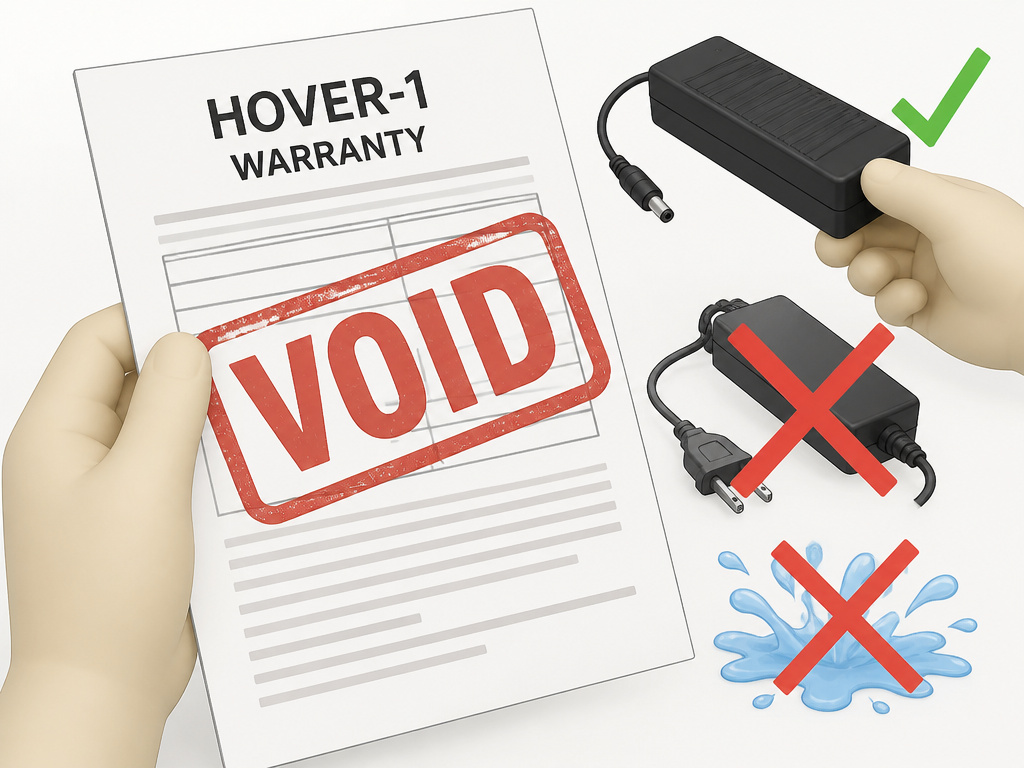
If something goes wrong, you turn to the warranty. Hover-1’s terms, as published on its support page for the Engine model, are a case study in managed expectations. Reading them is as important as reading the performance specs.
First, the warranty is non-transferable. It applies only to the original purchaser who bought from an authorized retailer. Buy a used Hover-1 scooter, and you have no warranty. The warranty also only applies to products sold in the Contiguous U.S.
Second, the list of actions that void the warranty is broad and absolute:
- Using any charger other than a genuine Hover-1 charger voids the warranty “and is a serious fire hazard.”
- Exposure to water, moisture, mud, dirt, or debris voids the warranty. The support page for the Hover-1 Engine states it cannot get wet, as exposure creates a fire hazard and voids the warranty.
- Any repairs or modifications performed without written consent from Hover-1 void the warranty.
The process itself is gatekept. You must contact the service center online. They may require photos or videos to diagnose. You must provide a receipt. If they issue an RMA (Return Material Authorization), the package must be shipped within 14 days or it will be refused. Finally, Hover-1’s total liability under the warranty will not exceed the amount you actually paid for the product.
Think about that last point. If your $600 scooter fails and causes $5,000 in property damage, Hover-1’s maximum responsibility, as stated, is $600. This isn’t unusual for consumer electronics, but it’s a stark reminder that the financial risk doesn’t end at the purchase price.
Customer Service and Support: The Documented Struggle
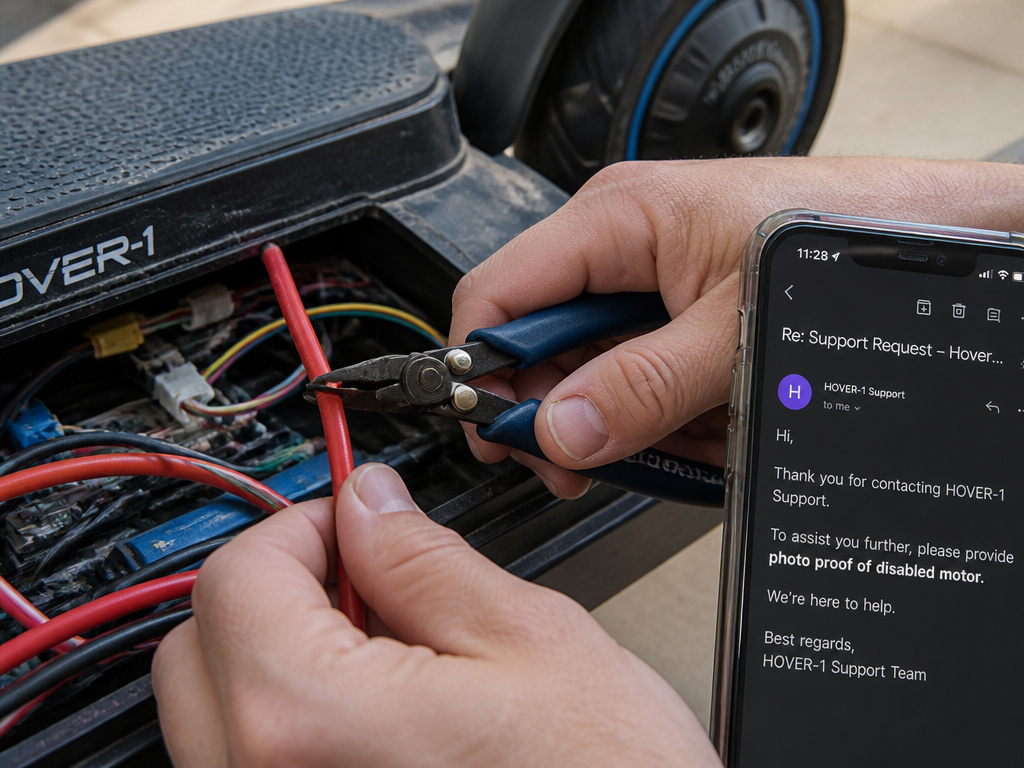
The warranty terms set the stage. The support experience, as documented by owners on consumer sites, is the play. The pattern is consistent: a high barrier to entry, a demand for specific proof, and slow resolution.
One verified complaint describes a hoverboard that arrived non-working. Support instructed the owner to open the unit, cut internal wires to disable it, and send photos as proof before a replacement would be sent. The owner complied. The replacement unit also failed. The request for a refund was denied. The owner was left with no working product and no money.
Another owner needed a replacement latching mechanism for a Hover-1 Boss scooter. The website offered no way to speak to a representative or order the part. The request dead-ended. These stories aren’t outliers; they form a pattern on complaint aggregators where Hover-1 holds a 1.5-star rating.
The Dynamo recall procedure, requiring a photo of the severed motor cable, fits this pattern perfectly. It’s a support process designed to prevent fraud and ensure compliance, but it places the burden of proof and a somewhat destructive task squarely on the consumer. For many, it’s a hurdle too high.
Hover-1 Scooter Review: Who Is It For?
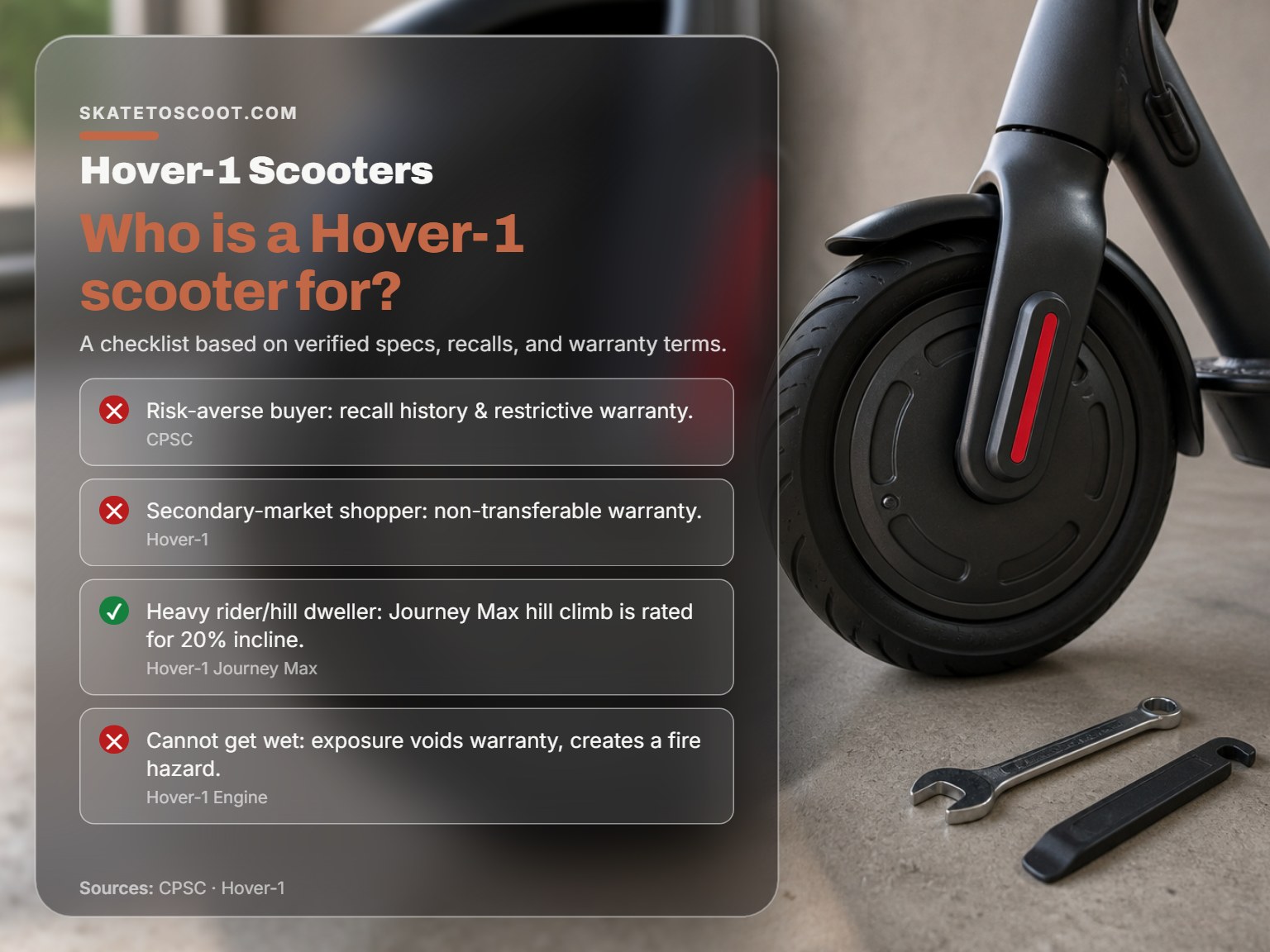
So, after the specs, the recalls, the warranty, and the support stories, who should actually buy a Hover-1 scooter?
We’ll use a simple table to break it down. This involves matching a product’s reality to a user’s profile.
| Rider Profile | Good Fit For Hover-1? | Why | Model to Consider |
|---|---|---|---|
| Budget-First Beginner | Maybe | The price is right, but be prepared for potential early maintenance (tires) and a strict warranty. A working unit gets you riding. | Journey Max (if hill climb needed), Alpha (for flat terrain) |
| Heavy Rider or Hill Dweller | Yes (with caveats) | The Journey Max’s verified hill-climb performance is unmatched in its price bracket. This is Hover-1’s strongest value proposition. | Journey Max |
| Risk-Averse Buyer | No | The recall history and restrictive warranty terms introduce more variables than a safety-focused buyer will tolerate. | Look elsewhere |
| Tinkerer / Self-Reliant Owner | Yes | If you can fix a flat tire, tighten a squeaky stem, and troubleshoot basic electronics, you can mitigate Hover-1’s common weak points and extract its value. | Any model, avoiding recalled serial numbers |
| Secondary-Market Shopper | No | The non-transferable warranty means you’re buying a scooter with zero manufacturer support. Any pre-existing issue is yours to solve. | None |
The math is simple. You trade lower upfront cost for higher long-term responsibility. The Journey Max proves Hover-1 can engineer a capable machine. The company’s operational framework, its warranty, its support, assumes you will bear the cost and effort of that responsibility.
Frequently Asked Questions
Is Hover-1 a good scooter brand?
Hover-1 produces scooters with solid performance for the price, as evidenced by the Journey Max. However, the brand is marked by multiple safety recalls, a restrictive non-transferable warranty, and documented customer support challenges. It’s a brand for specs and price if you are a capable, self-reliant owner. It’s a poor choice if you expect hassle-free manufacturer support.
How fast do Hover-1 scooters go?
Speed varies by model. The Journey Max has a tested top speed of 18 mph (factory setting) and can reach 20.7 mph with a mode change. More basic single-motor models like the Alpha have lower top speeds. Always refer to independent reviews for verified speeds, as manufacturer claims can be optimistic.
How many miles can a Hover-1 scooter last?
Range depends on model, rider weight, terrain, and speed. The Journey Max achieved 20.4 miles in a controlled test at its limited speed. Real-world range, especially for smaller battery models, will often be less than the advertised maximum.
What Hover-1 scooters are recalled?
Three models are under active CPSC recall: the Hover-1 Dynamo (brake failure), the Hover-1 Helix (fire hazard), and the Hover-1 Superfly hoverboard (software malfunction causing runaway motor). Each recall applies only to specific serial number ranges. You must check your scooter’s serial number against the official CPSC notices.
Can you ride a Hover-1 scooter in the rain?
No. The manufacturer’s warranty explicitly voids coverage for exposure to water, moisture, mud, dirt, or debris. For the Engine model, the support page states riding it wet “creates a fire hazard” and is “non-repairable.” Hover-1 scooters are not water-resistant and should be kept completely dry.
The Bottom Line
Here is the one-sentence answer most people want: The Hover-1 Journey Max offers strong performance for its price, and buying any Hover-1 product is a calculated risk based on its recall history and warranty terms.
You don’t buy a Hover-1 scooter for a carefree ownership experience. You buy it because you want the hill-climb power of the Journey Max and you’re willing to become your own support department. You accept that a flat tire is a when, not an if. You read the warranty and understand that a puddle voids it. You check the serial number twice against recall lists.
For a specific buyer, the budget-aware tinkerer who values torque over tranquility, it’s a justifiable deal. For everyone else, the math doesn’t work. The value is in the metal and the motors, not in the safety net behind it. Choose accordingly.
