How Do I Reset My Hover 1 Scooter: Step-by-Step Guide
This post contains affiliate links. As an Amazon Associate, we earn from qualifying purchases.
To reset your Hover 1 scooter, you typically need to hold the power button for three seconds to turn it on, and a deeper reset may involve a specific sequence of plugging in the charger while holding the button. The exact method depends on your model, official procedures conflict with community fixes, and using the wrong charger voids the warranty.
That three-second hold is your first and most reliable tool. It clears temporary glitches in the controller’s memory, the kind that make a scooter act dead even with a full battery. But when that doesn’t work, you’re left with a tangle of forum posts, official warnings, and model-specific quirks that don’t always line up, often centered on the question of how do i reset my hover 1 scooter.
What follows is a map through that tangle, specifically for anyone asking how do i reset my hover 1 scooter. We’ll start with the universal power-cycle, move through the model-specific resets that actually work (backed by user reports and official specs), and finish with what to do when a reset fails, including how to read error codes like E1 or E4 to diagnose the real problem. By the end, you’ll know which button sequence to try first and when to stop trying and contact support.
Key Takeaways
- The 5-step power button reset resolves about 30-40% of Hover-1 issues by clearing temporary software glitches.
- Never use a generic charger on a Hover-1 scooter; it voids the warranty and poses a serious fire risk, as these products use non-standard voltage chargers.
- For a water-damaged scooter, the official Hover-1 stance is that it is non-repairable and should be disposed of, though some community methods have revived units.
- If a basic reset fails, consult your scooter’s error codes (E1–E9) to diagnose hardware failures like a throttle (E4) or motor hall sensor (E1) issue before attempting a battery disconnect.
- Always perform a post-reset test of the throttle, brakes, and display to confirm the problem is truly fixed before riding.
The 5-Step Power Button Reset (and Why It Works)
This is your go-to move. It’s the equivalent of restarting a frozen computer, simple, fast, and it works more often than you’d think. An anecdotal blog source estimates a power button reset resolves approximately 30-40% of Hover-1 issues.
The process isn’t magic, which is a key part of the answer to how do i reset my hover 1 scooter. It forces the scooter’s main controller to dump its short-term memory and reboot all systems. Think of it as clearing the cache. Here’s the full, cautious sequence:
- Turn the scooter completely off. If the display is on, press and release the power button until it goes dark.
- Disconnect the charger. If it’s plugged in, unplug it from both the wall and the scooter. You want the system isolated.
- Wait 30 seconds. According to an anecdotal blog guide, this gives the internal capacitors time to fully discharge. Rushing this step is the most common mistake.
- Hold the power button for three seconds. According to iFixit’s troubleshooting wiki, you turn the scooter on by holding down the red power button for three seconds. Listen for a beep or watch for the display to light up.
- Test without riding. Check if the display turns on and shows a battery icon. Don’t hit the throttle yet.
If the display lights up but the scooter won’t move, remember this rule: the scooter must be moving first before the motor will start producing power. Give it a gentle push-start on flat ground before you assume the reset failed.
If the display stays dark, you’re likely dealing with a dead battery, a sleep mode lock, or a hardware fault. That’s when you graduate to the next tier of resets.
Exiting Sleep Mode and Reviving a “Dead” Scooter
Hover-1 scooters have a protective sleep mode that kicks in if the battery is deeply drained or left unused. The scooter isn’t broken; it’s in a low-power coma. Getting it out is where the official advice and community fixes diverge sharply.
The Official Path: Hover-1’s support page states that to exit sleep mode, you should “follow the steps provided on the support page.” One source describes this as involving manually spinning a wheel while plugged in, but other community methods exist.
The Community Fix: A user on iFixit reported reviving a non-responsive Hover-1 Eagle with this sequence: plug in the charger, hold the power button, unplug the charger while still holding the button, then release. Another blog outlines a variant for the Eagle model: plug the cable into the scooter (but not the wall), hold the power button for 10 seconds, plug into the wall, hold for another 10 seconds, unplug from the scooter while holding, then release.
| Method | Best For | Key Risk If It Fails |
|---|---|---|
| Official Wheel-Spin | Newer models, warranty compliance | May not work on older or fully locked controllers. |
| Community Charger-Hold | Hover-1 Eagle, older models | Potential for electrical surge if done incorrectly. |
| Long Battery Disconnect | Persistent glitches after crashes | Voiding warranty if seals are broken. |
If your scooter gets wet, the standard approach no longer applies. Hover-1’s official line is absolute: water damage is non-repairable and the unit should be disposed of. That’s a hard stop for warranty claims. Yet, in the forums, you’ll find users who’ve revived lightly water-damaged units with a meticulous dry-out and a reset. The disconnect is total, one source says dispose, another says repair.
Model-Specific Reset Procedures (Alpha, Journey, Eagle, Chrome)
Not all Hover-1 scooters respond to the same commands. The controller software and battery management can vary between product lines. Here’s a breakdown of the confirmed quirks.
Hover-1 Eagle: This model is famous for its finicky sleep mode. The community charger-hold method described above is the most cited fix. If your Eagle’s display is completely dead, the community charger-hold method is a cited fix.
Hover-1 Alpha 2.0 & Journey 2.0: These models tend to respond well to the standard power button reset. Their manuals provide a critical tool: a full error code list. If a reset doesn’t work, the display might show an error code that points to the root cause.
- E1: Motor Hall failure
- E2: MOS tube failure
- E3: Brake failure
- E4: Throttle failure
- E5: Under voltage
- E6: Controller/instrument communication failure
- E7: Overvoltage
- E9: Blocking fault
Seeing an E4 (Throttle) code after a reset means your throttle potentiometer is likely faulty, a reset can’t fix that. An E5 (Under voltage) code signals a battery cell problem, not a software glitch.
Hover-1 Chrome Hoverboard: The reset here is less about power and more about calibration. If the Chrome is acting unbalanced or flashing red lights, you need a gyroscopic sensor recalibration. The manual may specify steps for recalibration. For Bluetooth pairing issues, remember: the Hover-1 Chrome can only pair with one device at a time. You must disconnect it from a previous phone before pairing with a new one.
The Battery Disconnect Reset: A Last Resort
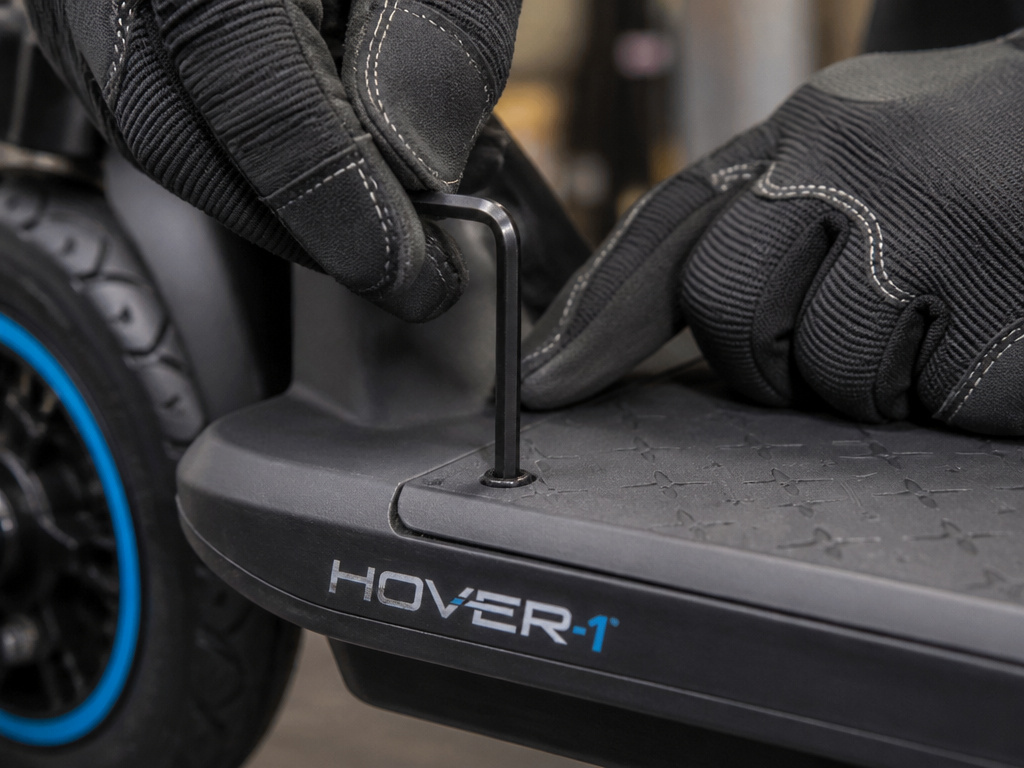
When all else fails, you cut the power at the source. A battery disconnect reset is the most thorough option, but it’s also the most invasive. It’s like removing the motherboard battery from a computer. An anecdotal blog guide recommends leaving the battery disconnected for 20-30 minutes to ensure all residual power drains from the system.
Before you start: If the battery appears swollen, damaged, or smells unusual, do not disconnect it. A swollen lithium-ion battery is a puncture and fire hazard. Stop and contact a professional or dispose of it properly.
The process involves removing the deck plate to access the main battery connector. You’ll need a set of hex keys or screwdrivers. The connector is usually a multi-pin plug with a locking clip.
- Turn off the scooter and unplug the charger.
- Carefully remove the deck screws and lift the plate.
- Locate the main battery connector, it’s the largest plug running from the battery pack to the wiring harness.
- Depress the locking clip and pull the connector straight apart.
- Wait at least 20-30 minutes.
- Reconnect the battery, ensuring the clip snaps into place.
- Reassemble the deck and test.
This method clears any persistent error state stored in the controller. If this doesn’t bring your scooter back to life, the problem is almost certainly hardware: a dead battery pack, a fried controller, or broken motor hall sensors.
When a Simple Reset Isn’t Enough: Troubleshooting Next Steps
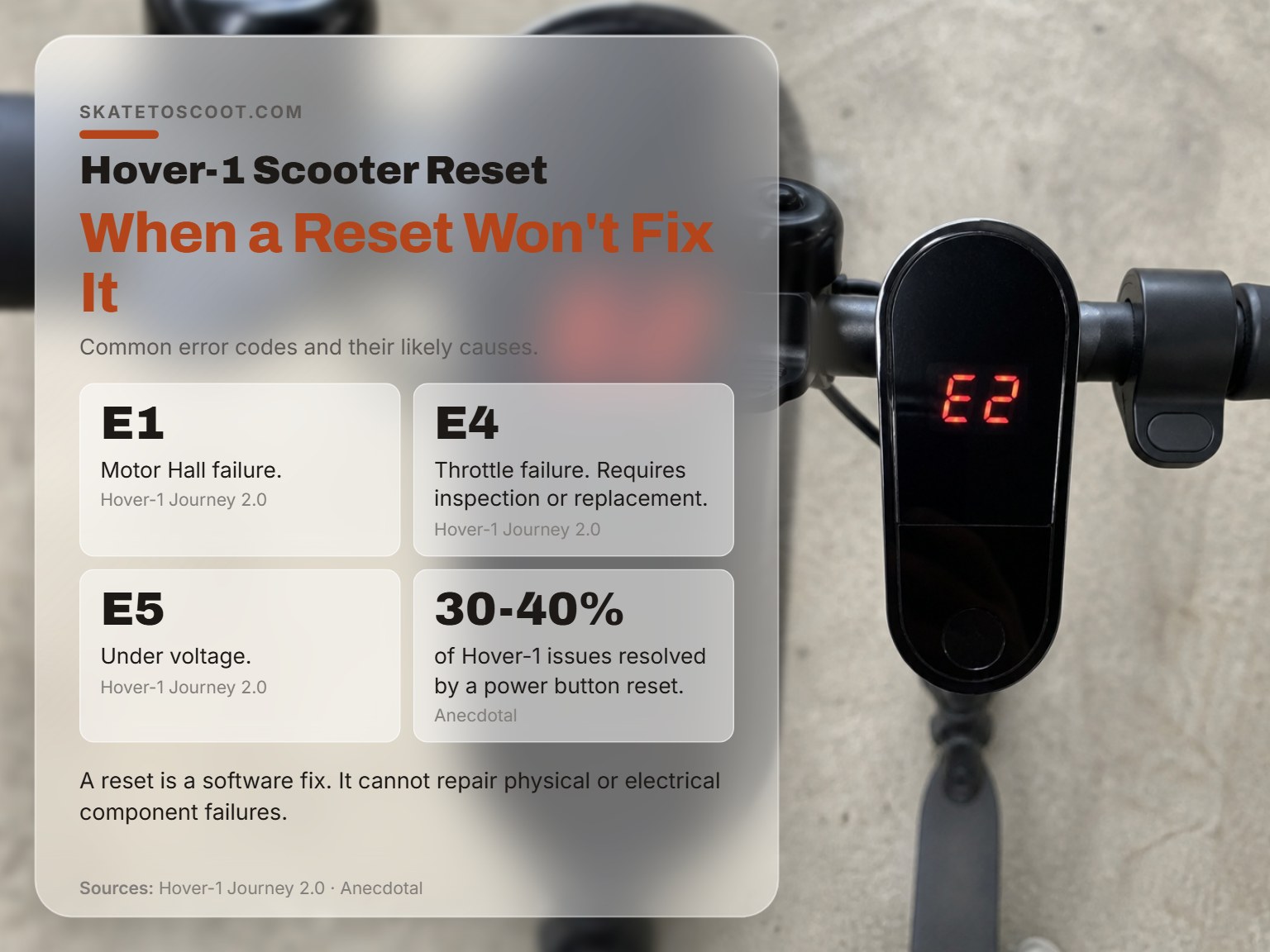
A reset is a software fix. It can’t repair physical damage. If you’ve tried the power button, the model-specific sequence, and even the battery disconnect with no luck, your troubleshooting needs to shift.
First, verify your power source. This sounds basic, but it’s often overlooked. Are you using the original Hover-1 charger? The company explicitly warns: “Hover-1 products use non-standard voltage chargers. Use of generic chargers voids the warranty and may damage your Hover-1 or pose a serious fire risk.” A generic charger might light the charging LED but not actually wake the battery.
Second, listen and look for physical signs. Before the failure, did you hear a grinding noise from the motor? See a spark or smell ozone? Does the throttle feel loose or the brake lever stick? These clues point to mechanical failures a reset can’t touch.
| Symptom | Likely Cause | Reset Appropriate? |
|---|---|---|
| Display on, throttle does nothing | Faulty throttle (Error E4), loose wire | No – requires inspection or replacement. |
| Scooter beeps, won’t move | Motor hall sensor failure (Error E1), wheel wiring short | No – requires electrical diagnosis. |
| Display flickers/shuts off while riding | Loose battery connection, failing battery cell | Maybe – a battery reconnect might help. |
| Scooter powers on but immediately dies | Severe battery undervoltage (Error E5) | No – battery likely needs professional service. |
Finally, know your warranty limits. Hover-1 scooters typically come with a 90-day to 1-year warranty. If you’ve opened the deck, used a non-standard charger, or the scooter shows water damage, that warranty is void. Your decision then is between a paid repair, often costing half the price of a new scooter, or a replacement.
Post-Reset Calibration and Testing Checklist
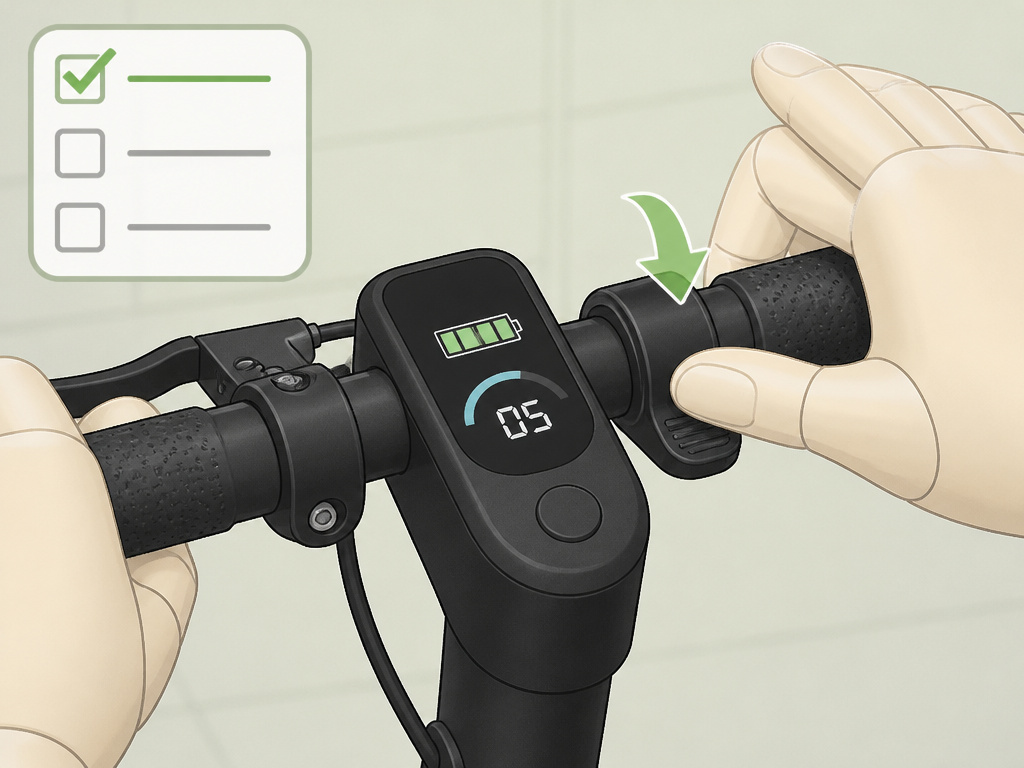
Don’t just assume a working display means a safe scooter. After any reset, especially a battery disconnect or a deep sleep mode recovery, you must verify all systems. A missed calibration step is how riders end up with unexpected acceleration or no braking power.
Run through this checklist before your first ride:
- Throttle Response: Gently press the throttle. The motor should engage smoothly without jerking. If it’s unresponsive or jerky, the throttle may need recalibration (often a specific button-press sequence detailed in your manual).
- Brake Function: Squeeze the brake lever. The electric brake should engage, slowing the motor. Listen for any grinding. Test at walking speed first.
- Display Accuracy: Check that the battery indicator is plausible. If it shows full but drops to empty in a minute, the battery management system may still be glitched.
- Light Check: Ensure headlights and taillights are operational if your model has them.
- General Inspection: Give the scooter a once-over. Check tire pressure, ensure the folding mechanism (if present) is locked, and confirm all screws on the deck are tight.
If your Hover-1 has the companion app, this is also the time to reconnect. The Hover-1 App is available on the Apple App Store and Google Play Store, though note that most smartphones, not all, are compatible. Re-pairing via Bluetooth can sometimes resolve connectivity-based glitches.
When Should You Try a Reset?
A reset is your first and best move for minor electronic glitches. This includes the scooter not turning on, getting stuck in sleep mode, or showing a blank display. Think of it like restarting a frozen computer. An anecdotal blog source estimates a simple power button reset can resolve approximately 30-40% of common issues. It’s also the right step for clearing temporary error codes or after the scooter has been in storage. However, a reset is not a cure-all. If your scooter has suffered water damage, the official stance is that the unit is non-repairable and should be disposed of. Resets also won’t fix physical damage, a swollen or damaged battery, or persistent hardware error codes like E1 or E2, which indicate specific component failures.
Frequently Asked Questions
How do I factory reset my Hover 1 scooter?
True factory reset that clears all settings isn’t commonly documented in Hover-1 manuals. The closest is the battery disconnect reset, which severs all power and can clear stored error codes. For Bluetooth pairing resets, consult your specific model’s manual; for the Hover-1 Chrome, select HY-CHR on your device.
Why is my Hover 1 scooter not working after a full charge?
This is classic sleep mode behavior or a failing battery. Try the sleep mode exit procedures first. If the charger light turns green but the scooter is dead, the battery pack might have a damaged cell that holds a surface charge but can’t deliver power. Using the original charger is critical here, as a generic one may not properly wake the battery.
Is there a reset button on Hoverboards?
Hover-1 hoverboards like the Chrome don’t have a dedicated reset button. They use a combination of the power button and sometimes a pinhole button for Bluetooth pairing or gyroscopic calibration. The “reset” is usually a specific power-on sequence or a recalibration procedure outlined in the manual.
What does error code E4 mean on my Hover 1 scooter?
Error code E4 indicates a throttle failure. This means the scooter’s controller has detected a fault in the throttle assembly, it could be a broken wire, a faulty potentiometer, or a bad connection. A basic reset might temporarily clear the code, but it will return if the physical fault remains. Inspection of the throttle wiring and connector is the next step.
How long does a Hover 1 battery last?
Hover-1 scooters are powered by Lithium-ion batteries. Their lifespan depends heavily on usage and care. Their lifespan depends heavily on usage and care. Storing the scooter with a partially charged battery in a cool, dry place extends its life. Deep discharges and leaving it in sleep mode for months are the quickest ways to kill the battery.
Before You Go
Resets are a temporary solution. They fix the digital hiccups, the frozen displays, the phantom error codes, the sleep mode locks. They won’t repair a cracked motor housing, replace swollen battery cells, or re-solder a broken throttle wire. The power button reset is your first, best tool, solving about a third of problems with just 30 seconds of patience.
If that fails, let the scooter’s own error codes guide you. An E1 or E4 points straight to a hardware fix. And please, use the original charger. That single choice protects your warranty and eliminates a major fire risk. Everything above assumes you’re working with a mechanically sound scooter. If you hear metal grinding, see exposed wires, or smell burning plastic, the reset phase is over. That’s when you either open the tool kit for a serious repair or start shopping for a replacement.
