X Pro 150cc Scooter Review: Owner Insights & Specs
This post contains affiliate links. As an Amazon Associate, we earn from qualifying purchases.
An X Pro 150cc scooter is a budget-friendly, Chinese-built moped powered by a ubiquitous 150cc GY6 engine and CVT transmission, offering basic transportation with a significant caveat: its reliability hinges entirely on assembly quality and the owner’s willingness to perform immediate and ongoing maintenance.
Think of it less as a finished product and more as a project kit with wheels. As any good x pro 150cc scooter review will note, the scooter you receive is a collection of globally sourced parts, the same GY6 engine used in countless clones, bolted together with varying degrees of care. Your experience depends less on the “X-Pro” badge and more on what you do in the first 100 miles.
What follows is a breakdown of the specific models (Bali, Fiji, Tank), the hard data from manuals and owners, and the real-world trade-offs you make for the price. This guide focuses on knowing exactly what you’re getting into, which problems will almost certainly appear, and how to fix them before they strand you, rather than on the personal decision of whether you should buy one.
Key Takeaways
- Change the oil immediately upon delivery. Owners and the manual disagree on break-in procedure, but the consensus from the community is that the factory-fill “shipping oil” is inadequate; skipping this step risks accelerated engine wear.
- Expect a 300-mile pre-delivery inspection (PDI) to be mandatory, not optional. The X-PRO manual specifies an initial inspection after the first 300 kilometers (186 miles).
- Top speed is a debate between spec sheets and reality. While some listings advertise “35+ mph,” multiple owner reports and one Reddit user with a direct-from-factory bike claim 60 mph (95 km/h) is achievable out of the box, highlighting inconsistent marketing.
- Long-term ownership requires sourcing GY6 engine parts. The 150cc GY6 motor is the industry standard for clones; its ubosity is a double-edged sword, meaning parts are cheap and plentiful, but you’ll be the one finding and installing them.
- Title and registration can be a state-by-state nightmare. An owner in Pennsylvania reported “getting a proper title is impossible,” requiring a workaround via Vermont; never assume a scooter advertised as “street legal” is actually registerable in your specific locality.
What Exactly Are You Buying with an X-Pro 150cc?
You’re not buying a Honda. You’re buying access to a platform. The core of every X-Pro 150cc scooter, be it the Bali, Fiji, or Tank, is the same air-cooled, four-stroke, 150cc GY6 engine coupled to an automatic CVT transmission. This is the same powerplant used in a thousand other Chinese scooters, go-karts, and small vehicles. Its virtue is its commonality. Every mechanic who works on small engines has seen one, and every online parts store carries gaskets, pistons, and belts for it.
The X-Pro brand essentially chooses a style of bodywork, selects a wheel size (10-inch for the Bali, 12-inch or 13-inch for others), and bolts it onto this standard GY6 chassis. According to the official X-PRO support page, “assembly of our vehicle requires some skill” and “tuning up and maintenance require mechanical knowledge.” That’s the manufacturer telling you, upfront, that you are the final quality control inspector.
The first month or first 1000km is the wear-in period for the engine and components. . X-PRO Owner’s Manual
This manual guidance is your framework. The break-in period is for the engine and components. Issues like loose components and electrical problems are failures owners report early on.
X-Pro 150cc Model Lineup & Key Specs
While they share the GY6 heart, the models differ in looks and stance. Your choice affects comfort and practicality more than performance.
| Model | Key Feature | Wheel Size | Best For |
|---|---|---|---|
| Bali (MC-N030) | Classic “Zuma” style, most common | 10-inch | City commuting, lower seat height |
| Fiji | Sportier look, larger wheels | 13-inch aluminum | Better pothole absorption, taller riders |
| Tank | Rugged, utilitarian appearance | 12-inch aluminum | Off-pavement confidence, unique style |
| Solara / Lanai | Modern LED lighting packages | 10-inch / 12-inch | Night riding, increased visibility |
The listed specs for the popular Bali model (MC-N030) provide a concrete baseline:
- Engine: 150cc 4-stroke, air-cooled
- Max Power: 7.91 HP @ 7000 RPM
- Transmission: Automatic CVT
- Fuel Capacity: 6.2±0.2 Liters
- Front Brake: Disc (Ø226mm)
- Rear Brake: Drum
- Tire Size: 100/80-10
- Spark Plug: CR6HSA
These are the numbers you can trust from the retailer. The rest of your ownership experience will be defined by how well those components were installed.
What Are the Common Problems Reported by X-Pro 150cc Owners?
The issues are the predictable results of mass assembly with minimal final checking. Owners report them on predictable timelines, which is useful information.
Where this goes sideways: Electrical connections from the factory. One X20 owner found the “battery that came with it was marked the opposite way. Red was negative Black was positive.” This isn’t a design flaw, it’s an assembly error that can fry your charging system if you don’t catch it before connecting cables.
Let’s categorize the headaches by when they typically show up:
Immediate (0-300 miles):
- Loose or Misadjusted Components: Toolbox lids falling off, shock absorber bolts hand-tight, brake cables binding.
- Electrical Gremlins: Bulbs not seated in sockets, loose ground wires causing intermittent operation, reverse-polarity battery markings.
- Fluid Leaks: Loose oil drain plugs or overfilled crankcases.
Short-Term (First 6 months / ~500 miles):
- Stalling & Rough Idle: Often related to the factory CVT tuning or a tight valve clearance, frequently reported during break-in. Many owners note it smooths out after several hundred miles.
- Center Stand Failure: A specific report on a Bali model noted the center kickstand weld failed “after about 6 months” of use.
- Fastener Loosening: Nuts and bolts may need retightening.
Longer-Term (Ownership Durability):
These depend entirely on your maintenance. The GY6 engine is a common design. Expect to replace wear items like drive belts, CVT rollers, and brake pads as part of maintenance. This is the trade-off for the initial purchase price. You save money upfront and spend it later, part by part.
The scooter’s manual is blunt about modifications: “A modified motorcycle will not be covered by warranty.” More importantly, it states modification “will affect its structure or performance, and cause poor engine operation or exhaust noise.” If you modify the engine, understand you’re voiding the warranty and affecting its performance, which requires mechanical knowledge.
How Does Real-World Performance Match the Claims?
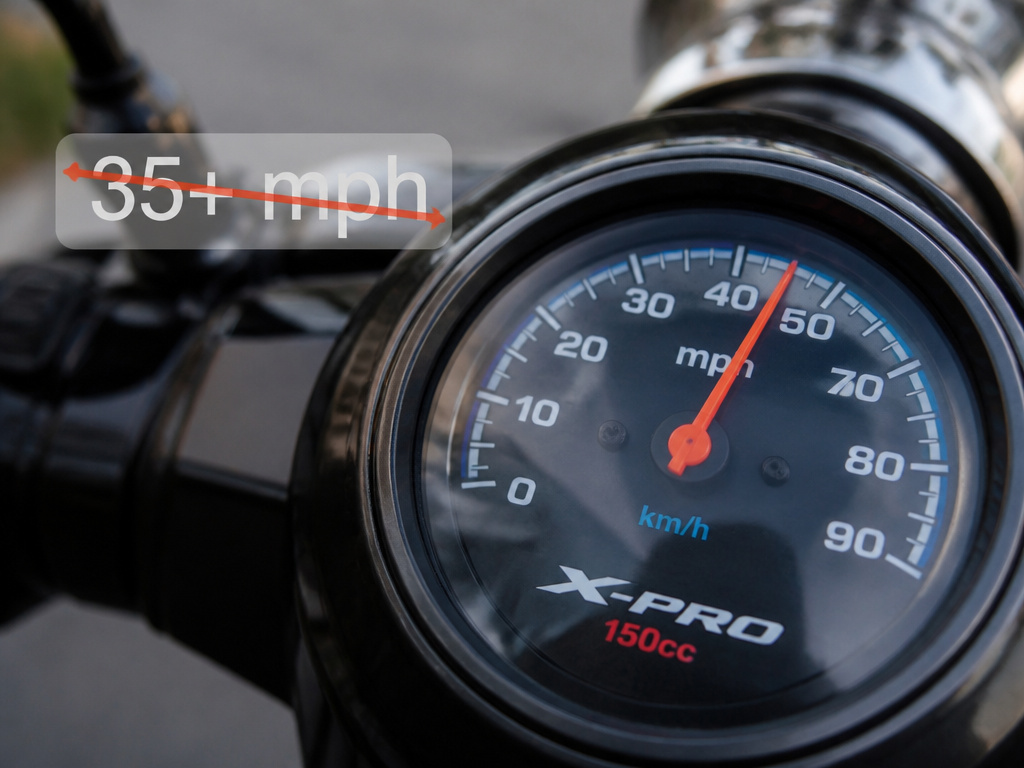
This is where the community data clashes with the marketing copy.
Speed: The most glaring discrepancy is top speed. While Amazon listings and some ads conservatively claim “35+ mph,” that’s not the whole story. A Reddit user who purchased a similar model directly from the Chinese factory stated, “It’ll do around 95km/h or 60mph right out of the box; the Amazon listing is somewhat wrong.” Your actual speed will depend on your weight, local terrain, and whether the CVT has been restricted.
Fuel Economy: Official MPG figures are scarce, but the GY6 engine in a light scooter is famously efficient. Owners of similar 150cc clones report high fuel economy, though official MPG figures are scarce. Your mileage will vary with your right wrist, but fuel cost will be a negligible part of your ownership.
Reliability vs. Japanese Brands: This isn’t a comparison. A Honda ADV150 or Yamaha Zuma 125 is a finished, refined product backed by a dealer network. The X-Pro is a kit. The Honda will likely run for thousands of miles with only oil changes. The X-Pro can run for thousands of miles, but only if you actively maintain it, tightening, adjusting, and replacing parts as they wear. It’s the difference between owning a pet and owning a project car. Both can bring joy, but only one demands weekly attention.
The Owner’s Manual: Your First and Best Upgrade
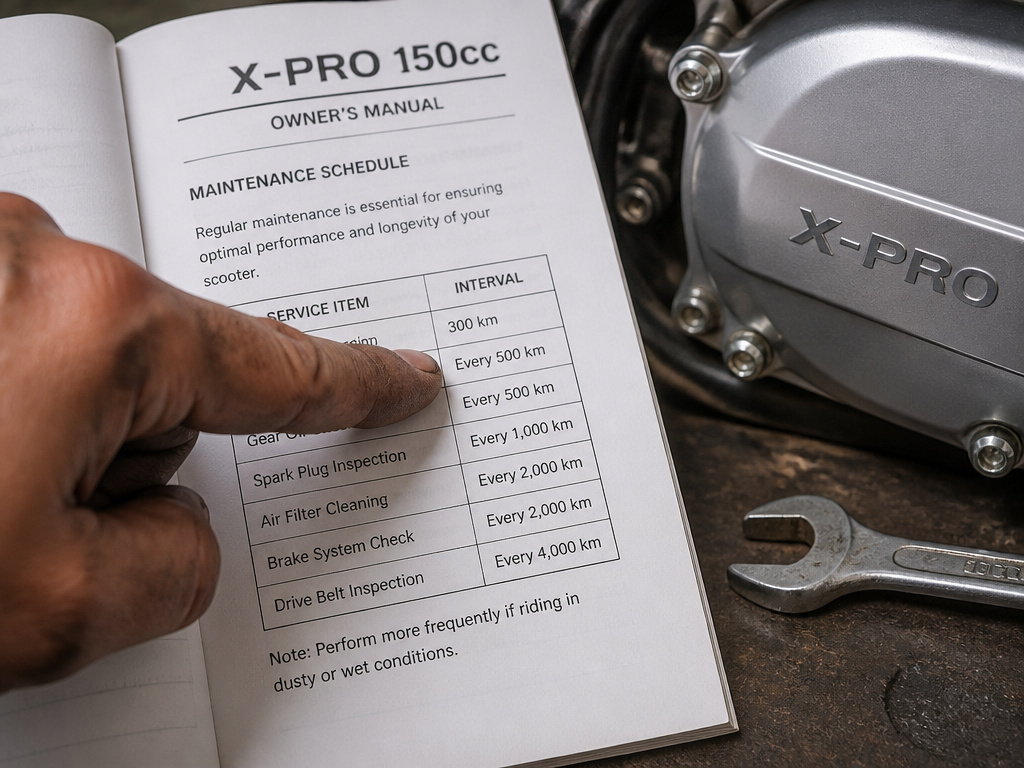
The provided X-PRO manual is your primary tool. It contains the only factory-approved maintenance schedule and critical safety warnings that are easy to ignore until you need them.
The manual mandates two key inspection intervals that most buyers overlook:
- Initial Inspection: After the first 300 km (186 miles).
- Periodic Inspection: Every 1000 km (621 miles) thereafter.
It also spells out non-negotiable safety rules that read like they were written by someone who has seen the aftermath of corners cut:
- “Always remove the key and be sure to take the key away with you after locking the steering handle.”
- “After running, the exhaust pipe is very hot, select a location to park your motorcycle to avoid others getting burned.”
- “If any problem [is] founded during routine inspection, correct the problem before using the motorcycle again.”
Common mistake: Assuming the scooter is ready to ride straight from the crate. The manual mandates a first inspection after 300 km as part of the wear-in period. Skipping this step means you inherit all their loose bolts and misadjustments.
Furthermore, the manual strongly advises using “SYM Genuine Spare Parts” for any repair to “ensure its long service life.” In practice, this means finding a reliable source for GY6-compatible parts, as genuine SYM parts for this clone might be scarce. This leads directly to the single most important factor for long-term ownership.
Parts, Maintenance, and the GY6 Ecosystem
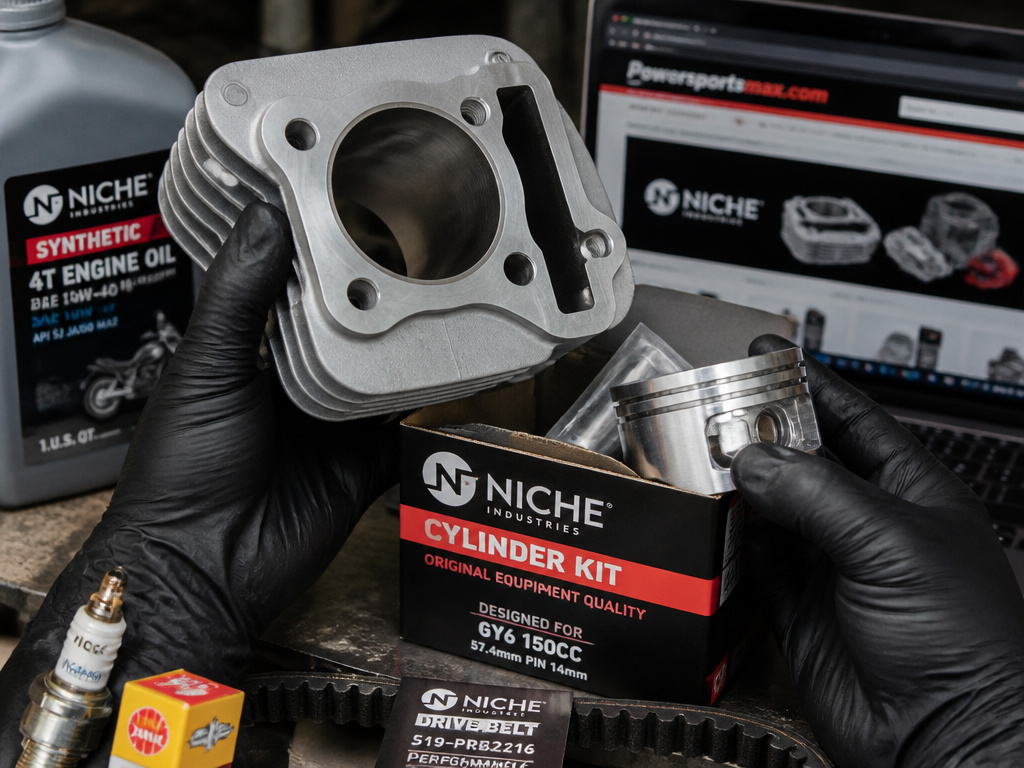
Your scooter’s longevity is tied to a global aftermarket. The 150cc GY6 engine is the Honda Civic of the scooter world: dirt cheap, dead simple, and parts are everywhere. This is the X-Pro’s greatest strength and its most important concept to grasp.
What you need to source yourself:
- Engine/Transmission: Pistons, cylinders, gaskets, drive belts, CVT rollers, all standard GY6 fare.
- Consumables: The CR6HSA spark plug, appropriate engine oil, brake pads, and tires (100/80-10 for the Bali).
- Electrical: Batteries (note the disagreement between sources: the X-PRO Bali MC-N030 listing states 12V/7Ah, while the X-PRO Manual states 12V 6Ah)., stators, CDI boxes.
Where owners disagree:
The community doesn’t always align with the manual. Two prime examples:
- Oil Change: The manual describes a break-in period. An owner review insists on changing the oil “immediately upon receiving it” due to “shipping oil,” a practice born from hard experience.
- Fuel Octane: An owner report states “must use 93 octane,” but no official manufacturer octane specification was found in the provided sources.
Sites like Powersportsmax.com and XPROUSA.com are your primary parts hubs. Your ability to navigate these sites, cross-reference part numbers, and wait for shipping will determine your downtime. This is the core ownership experience.
How Does the X-Pro 150cc Compare to Other Budget Scooters?
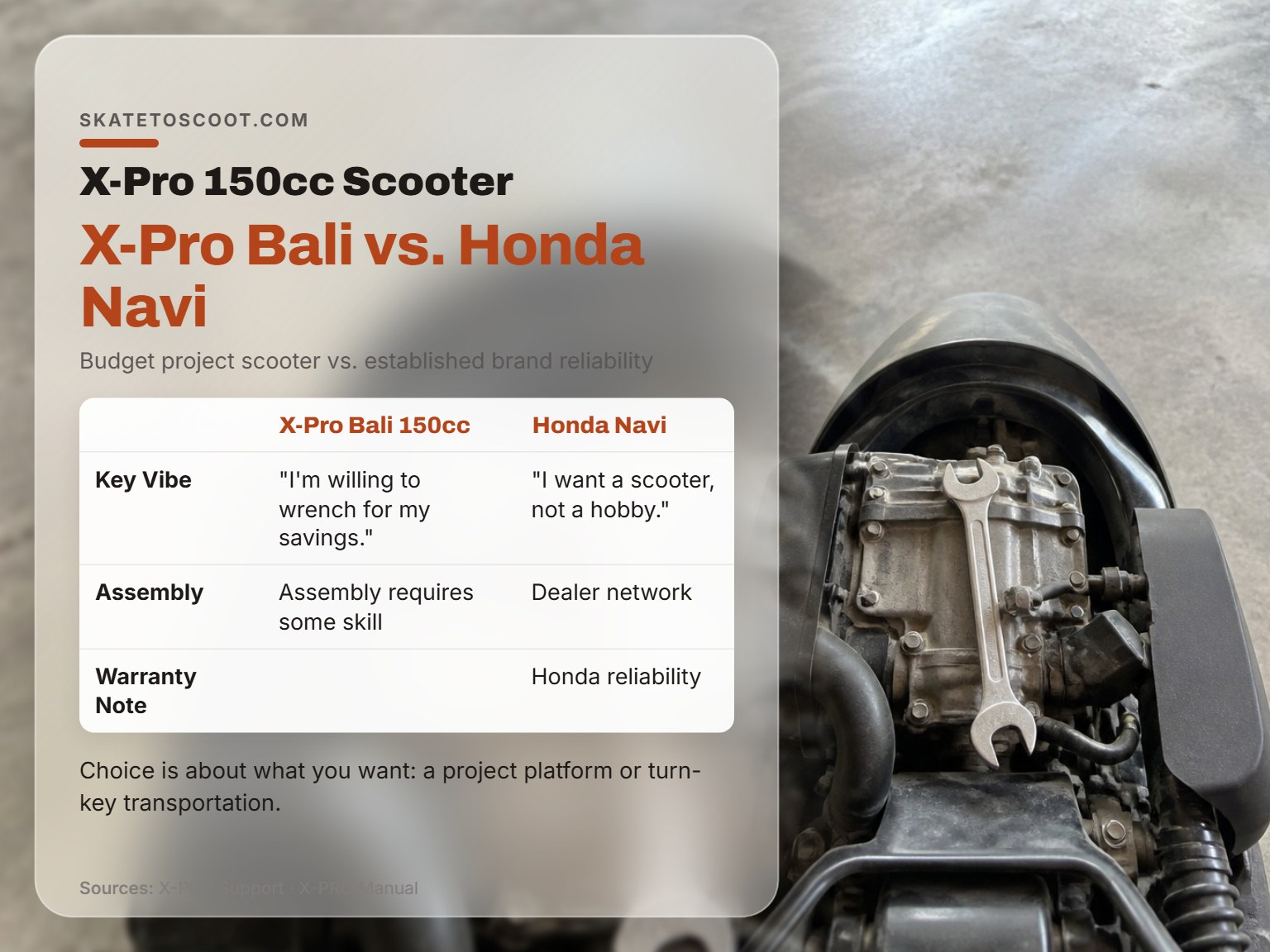
It’s useful to see where the X-Pro sits among its peers. It’s not alone in this space.
| Scooter | Engine | Key Differentiator | Owner Vibe |
|---|---|---|---|
| X-Pro Bali 150cc | 150cc GY6 clone | Lowest upfront cost, pure project basis | “I’m willing to wrench for my savings.” |
| IceBear 150cc | 150cc GY6 clone | Often similar pricing, different styling | Direct competitor; same engine, different plastic. |
| Italica 150cc | 150cc GY6 clone | Sometimes better final assembly | Marginally better reputation for being rideable out-of-box. |
| Honda Navi | 110cc Honda | Actual Honda reliability & dealer network | “I want a scooter, not a hobby.” Pricier, but turn-key. |
The choice isn’t about which is objectively “best.” It’s about what you want from the purchase. If you enjoy mechanical tinkering and view the scooter as a platform to learn on, the X-Pro and its GY6 siblings like the Phantom scooter or Yume scooter are compelling. If you want transportation that simply works, save longer and buy Japanese, or explore performance scooters from established brands.
Maintenance requirements vs. Japanese brands
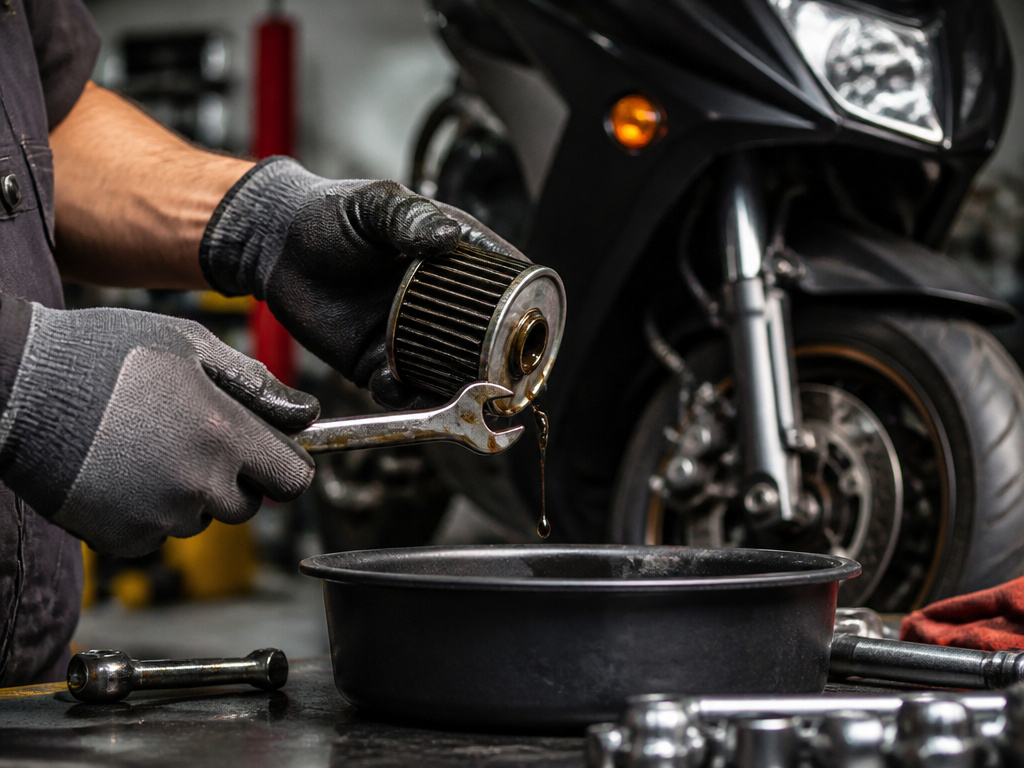
Expect a more involved ownership experience compared to a Japanese scooter. The manual calls for an initial inspection after the first 300 kilometers and periodic checks every 1000 kilometers. Owner reports strongly advise changing the oil immediately upon delivery, and the first month or 1000km is considered a critical wear-in period for the engine. The manufacturer states that tuning and maintenance require mechanical knowledge and recommends hiring a professional if you lack those skills. While parts for the common GY6 engine are widely available, the onus for consistent, meticulous upkeep falls squarely on you, not a built-for-decades factory standard.
Frequently Asked Questions
Are X Pro scooters any good?
They can be, but “good” is defined by your expectations and skill. They are good as inexpensive, simple transportation if you are willing to be your own mechanic. They are not good as carefree, reliable appliances. Your satisfaction will be directly proportional to the time you spend checking bolts, changing fluids, and ordering replacement parts.
How fast does an XPro 150cc go?
Real-world owner reports consistently exceed the conservative “35+ mph” marketing. A Reddit user with a direct-from-factory model reported 60 mph (95 km/h). Most owners find a comfortable cruising speed between 45 and 55 mph, which is adequate for most city and secondary-road use.
Is X Pro a reliable brand?
The brand itself is just an importer. Reliability comes from the ubiquitous GY6 engine design and, more critically, from you. The scooter will be as reliable as your maintenance and your diligence in correcting its factory assembly flaws. There are no secret quality differences between an X-Pro, an IceBear, or an Italica, they all use the same core components from the same Chinese industrial pools.
What is the best 150cc scooter to buy?
There is no universal “best.” For a beginner who doesn’t want to wrench, a used Honda or Yamaha is the safest bet. For a tinkerer on a tight budget, an X-Pro 150cc offers the lowest cost of entry into motorized two-wheel travel. Before diving into any single model, reading a specific x pro 150cc scooter review alongside broader scooter reviews can provide valuable context on the entire market.
Before You Go
A thorough x pro 150cc scooter review reveals a known quantity with documented failure points and a well-mapped path to decent service life. The question it asks isn’t “Can it work?” but “Are you willing to make it work?”
If your answer is yes, start with the manual’s 300-kilometer inspection list. Change the oil with appropriate engine oil. Go over every fastener with a wrench. Assume every electrical connection is loose. That first afternoon of work is the down payment on every mile that follows. The scooter won’t thank you, but it also won’t leave you stranded next week.
If that sounds like a chore, walk away. The money you save upfront will be spent on frustration and towing bills. This is a scooter for people who understand that the real price tag includes their own time and effort. For the right person, that’s not a downside, it’s the whole point.
