Can You Bring Ice Skates on a Plane?
This post contains affiliate links. As an Amazon Associate, we earn from qualifying purchases.
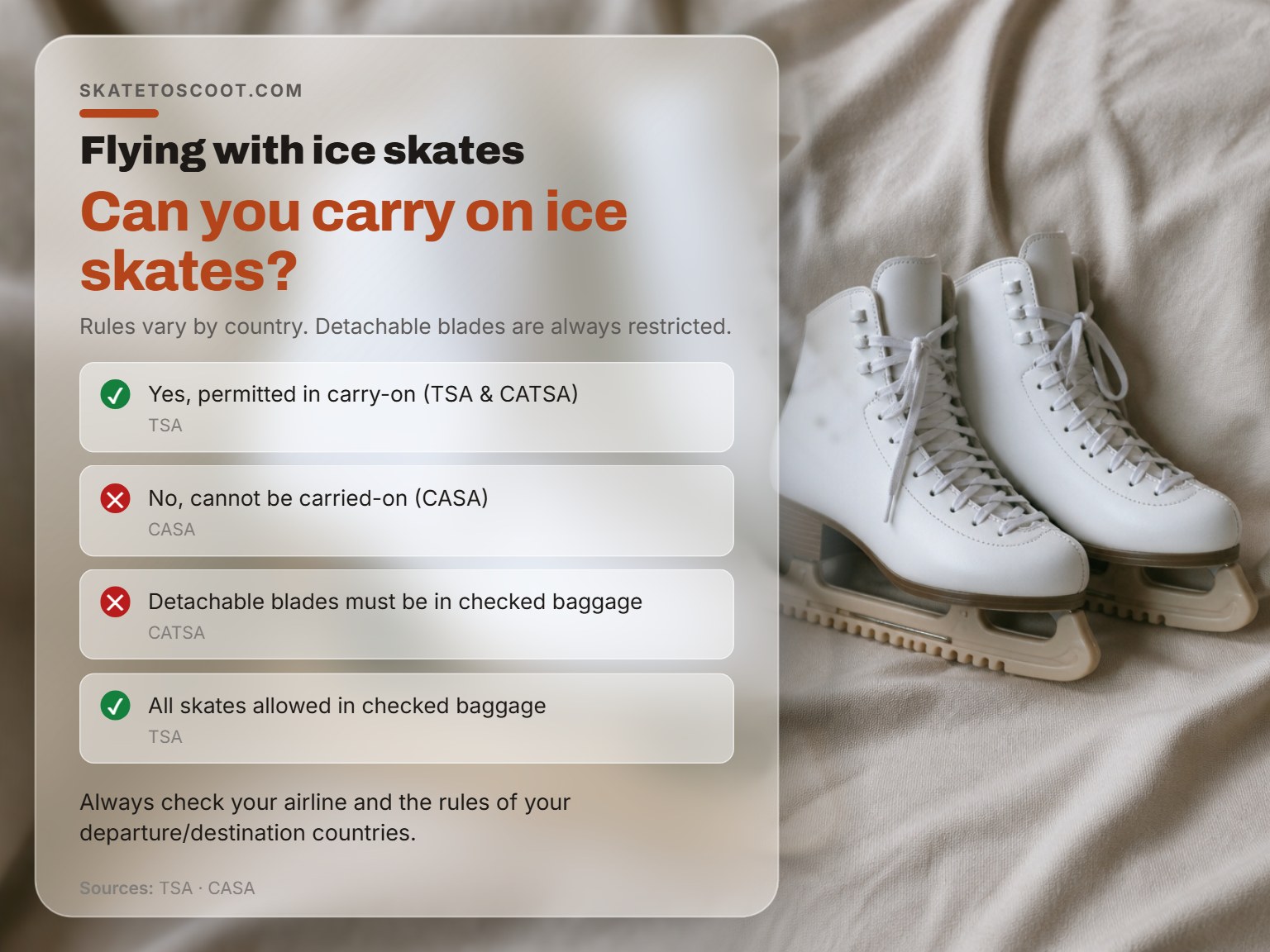
Yes, you can bring ice skates on a plane in both your carry-on and checked luggage, according to the TSA (U.S.) and CATSA (Canada). The Civil Aviation Safety Authority (CASA) of Australia bans them from carry-on entirely. The final decision always rests with the security officer, and your specific airline’s rules can change everything.
The difference between a smooth trip and a last-minute gate check depends on matching three things: the security agency of your departure country, the design of your skate, and the fine print on your airline’s sporting equipment policy. A single connecting flight through Sydney with a pair of detachable-blade skates can turn a simple rule into a significant rebooking ordeal. Before you pack, you must ask, can you bring ice skates on a plane?
What follows: the official country-by-country rules, the one packing mistake that guarantees a secondary inspection, and a direct comparison of how major airlines handle your skates. By the end, you’ll know exactly where to put them and what to say at the counter.
Key Takeaways
- The TSA (U.S.) and CATSA (Canada) allow ice skates in carry-on and checked bags, but detachable blades must be checked.
- CASA (Australia) bans ice skates from carry-on entirely, classifying them as a security item, they must go in checked luggage.
- Always check your specific airline’s sporting equipment policy; carriers like Ryanair may charge fees or require advance notice, even if security allows carry-on.
- Pack with hard blade guards and be prepared to remove skates from your bag at security for a separate X-ray, this is the standard procedure that speeds things up.
- For international trips with connections, pack for the strictest rule on your itinerary, not your departure point, to avoid confiscation mid-journey.
The TSA, CATSA, and CASA Rules: A Country-by-Country Breakdown
You can’t just look up “TSA rules” and call it a day. Where your flight originates, and any countries you transit through, dictates the rulebook you’re playing by. This is a jurisdictional fact.
The U.S. Transportation Security Administration (TSA) lists skates as permitted in both carry-on and checked bags on its official “What Can I Bring?” page. The Canadian Air Transport Security Authority (CATSA) also permits ice skates in carry-on and checked baggage, but with specific conditions regarding detachable blades. The Civil Aviation Safety Authority (CASA) of Australia, however, lists ice skates under “Can’t be carried-on” in its PackRight dangerous goods guide.
The official TSA skate carry-on rules state skates are permitted, but the page includes a critical disclaimer: “The final decision rests with the TSA officer on whether an item is allowed through the checkpoint.” This isn’t a get-out-of-jail-free card for security; it’s a reminder that individual discretion based on the specific item and situation is the final law.
Here’s the breakdown in a single table. This is what you should screenshot or print.
| Security Agency | Carry-On Allowed? | Checked Baggage Allowed? | Critical Caveat |
|---|---|---|---|
| TSA (United States) | Yes | Yes | Officer has final discretion. |
| CATSA (Canada) | Yes | Yes | Skates with detachable blades must be checked. Loose blades are prohibited in carry-on. |
| CASA (Australia) | No | Yes | Ice skates are classified as a “Security item” and are not permitted in the cabin. |
CATSA’s guidance on detachable blades is critical. One CATSA source states skates with detachable blades ‘should be packed in checked baggage,’ while another says they are allowed in carry-on only if blades are not detachable. It further states that “Skate blades that are not attached to ice skates are not permitted in carry-on.” If you’re flying with detached blades, separating them for transport risks having them confiscated at the checkpoint under CATSA rules. They must be securely attached to the boot.
Carry-On vs. Checked Luggage: The Real Trade-Offs
Most guides present this as a simple choice. It’s not. Your decision here dictates your entire travel day’s risk and convenience profile.
Choosing Carry-On:
- Pro: Your skates never leave your sight. This is the single biggest advantage for anyone traveling with high-end, custom-fitted, or competition skates. The risk of loss, damage from rough handling, or theft is virtually zero.
- Pro: You skip the baggage claim. Walk off the plane and straight to your event or hotel.
- Con: You must manage them through the airport. This means hauling them to the gate, fitting them in the overhead bin (more on size later), and dealing with the security process, which always involves taking them out of your bag.
- Con: You are subject to the strictest interpretation of the rules by the officer you get. The final decision rests with the security officer, who could deny carry-on despite the published rules.
Choosing Checked Luggage:
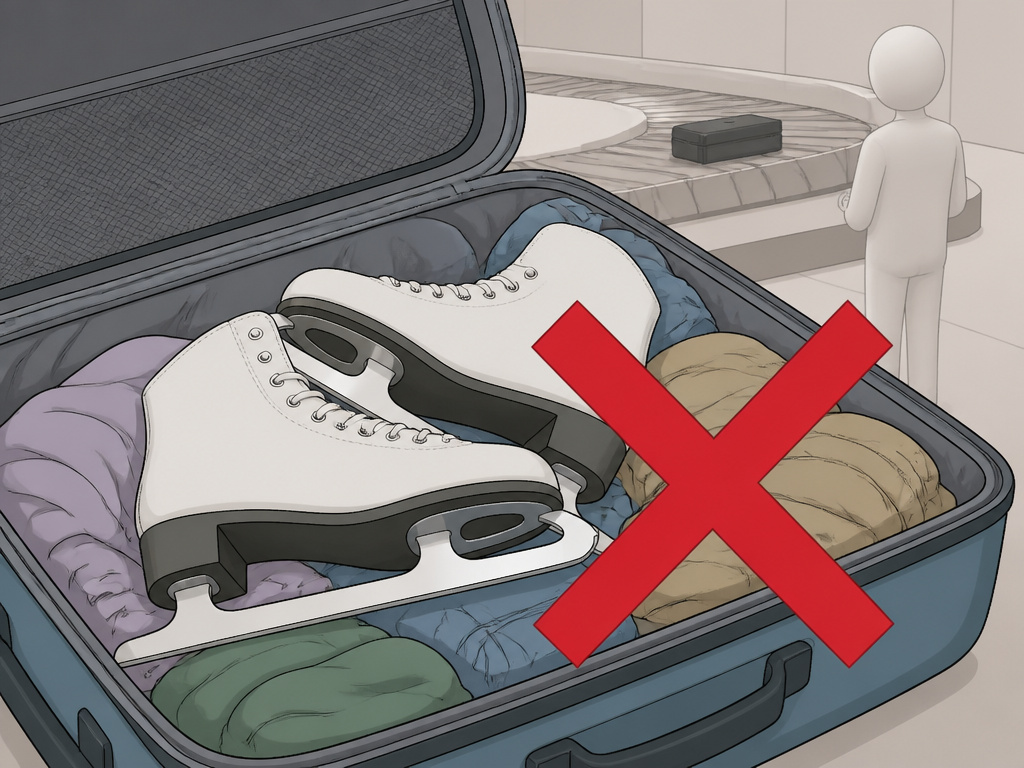
- Pro: Hands-free travel through the terminal. This is a major relief on a long travel day with other gear.
- Pro: No security screening hassle for the skates themselves.
- Con: You surrender control. Baggage systems are not gentle. Without proper packing, you risk broken blades, bent stanchions, or scuffed boots.
- Con: The risk of loss or delay. If your checked bag doesn’t make the connection, your skates don’t either. For a competition, this is a catastrophic outcome.
Where this goes sideways: Assuming “checked” means “safe.” Without proper packing, blades can damage luggage and its contents. The baggage system is a series of conveyor belts, drops, and stacks. Pack for impact and abrasion.
The clearest signal for choosing checked? If your skates have detachable blades and you’re flying from or through Canada (CATSA), you have no choice, they must be checked. For everyone else, the choice hinges on the value of your gear versus the hassle of carrying it.
Navigating Airline Policies: The Override Button
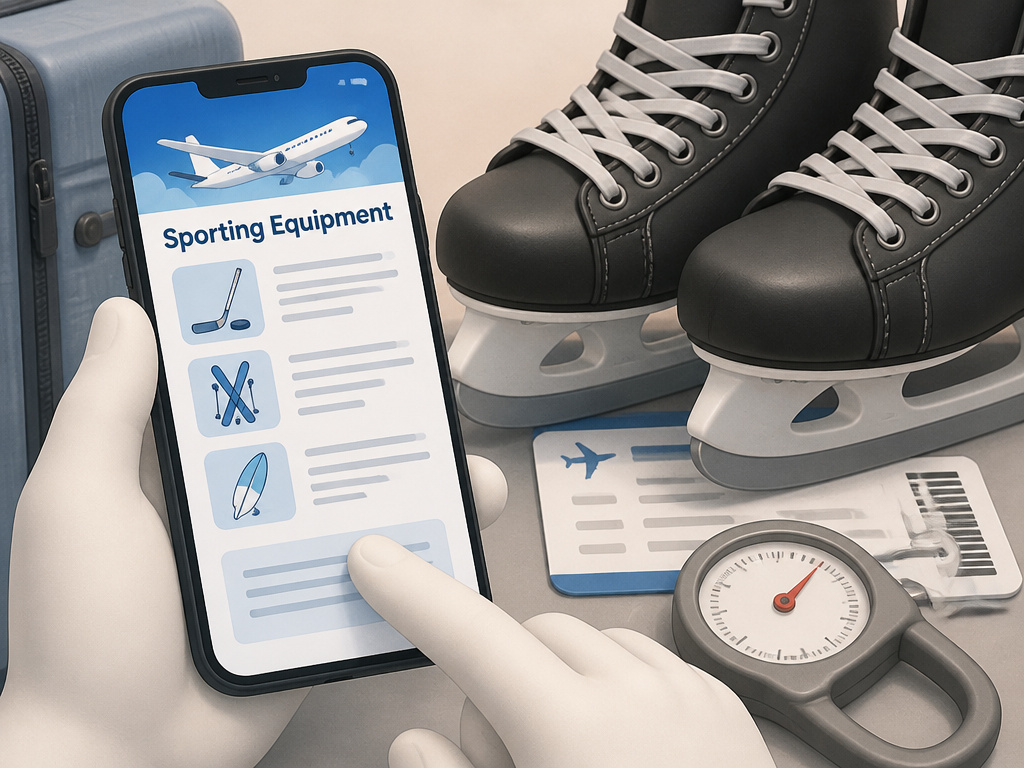
Security says you can carry it on. The airline can still say no. Their contract of carriage, the fine print you agree to when you buy a ticket, always supersedes the security agency’s guidelines for what is allowed on the aircraft.
Airlines are concerned with cabin safety, space, and weight. A pair of skates in a bulky bag might not fit under the seat or in a full overhead bin. Some airlines have specific policies classifying skates as “sporting equipment” with its own set of rules.
| Airline | General Policy on Skates | Key Considerations & Potential Fees |
|---|---|---|
| Delta, United, American | Typically treated as a standard bag if within size/weight limits. | May count toward your free checked bag allowance. If carried on, must fit in the overhead bin. Oversize/overweight fees apply. |
| JetBlue, Southwest | Similar to major carriers; considered regular baggage. | Southwest’s two free checked bags include skates if packed properly. JetBlue may charge for any checked bag on basic fares. |
| Ryanair, other European Low-Cost Carriers | Often classified as “special sports equipment.” | This is critical: Ryanair and similar airlines usually require advance notice and may charge a fee (e.g., €/£ 40-60) for sporting equipment, even if you plan to carry it on. Failure to pre-book can result in higher fees or refusal. |
The process is simple but mandatory: before you pack, visit your airline’s website and search for “sporting equipment,” “special items,” or the phrase can you bring ice skates on a plane in their baggage policy section. Look for any mention of advance notification, size restrictions, or fees. A five-minute search can save you a fifty-dollar surprise at the check-in counter.
This diligence is just as important as understanding TSA and skateboards or when you compare a can you bring ice skates on a plane query to airline rules for electric scooters. The principle is identical: the airline’s operational rules are the final layer of permission.
Packing Tips That Actually Work
Packing is a damage-mitigation protocol. The goal is to protect your investment and move through security with zero delays.
- Use Hard Blade Guards. This is essential. Soft cloth guards slip off. Hard plastic or rubber guards sheath the entire blade, preventing cuts to your bag, other items, or a security officer’s hands. They also protect the blade’s edge from getting nicked. Skip this, and you’re asking for trouble.
- Clean and Dry Your Skates. Dirt and moisture accelerate corrosion on the steel blades. Wipe them down thoroughly before packing. A security officer is less likely to hassle with a clean, well-maintained piece of equipment than a muddy, rusty one.
- Pack Them in the Middle of Your Bag. If checking them, wrap the guarded skates in a towel or soft clothing. Place them in the center of your suitcase, surrounded by softer items. This buffers them from the inevitable impacts against the hard shell of the luggage.
- Use a Dedicated Skate Bag. A well-padded bag for ice skates is designed for this. It has separate compartments, often with blade sleeves, and carries the skates vertically. This is far superior to jamming them into a standard roller bag. For carry-on, ensure the bag meets your airline’s underseat or overhead dimensions.
- For Detachable Blades, Secure Them Tightly. If you must travel with detached blades (e.g., for a sharpening service at your destination), they must be in your checked luggage per CATSA rules. Pack them in a sturdy, sealed container like a hard plastic blade case, and surround that with padding. Loose blades rattling in a suitcase are a red flag.
The Security Checkpoint: A Step-by-Step Walkthrough
Knowing the rule is one thing. Knowing the dance is another. Here’s exactly what to expect when you bring skates through security, based on the standard procedure at U.S. And Canadian airports.
Before You Arrive: Have your skates in an easy-to-access part of your carry-on bag or in a separate bag you can place directly in a bin. Don’t bury them under three layers of electronics and toiletries.
At the X-Ray Belt:
- Take your skates out. Just like you would a laptop or liquids bag, you need to place your skates in a separate bin. This gives the TSA or CATSA officer a clear, unobstructed view.
- Place the bin with skates on the conveyor. I usually put the blade guards on and place them blade-side-down. There’s no official rule on orientation, but this feels deliberate and safe.
- Send your bag through separately. Your backpack or roller bag goes in another bin.
What the Officer Is Looking For: The X-ray operator needs to see that the item is indeed a skate and not a prohibited sharp object disguised as one. The clear silhouette of the boot and blade is usually enough. However, if the image is cluttered (because you left them in a bag full of wires and tools), they will flag the bag for a physical inspection.
After the X-Ray: Most of the time, you collect your bins and proceed. If your bag is flagged, an officer will open it, likely put on gloves, and physically inspect the skates. They may swab them for explosive residue, a standard, non-destructive procedure. Stay calm, answer their questions directly, and you’ll be on your way in under two minutes.
The entire process mirrors what happens with other sports equipment. The rhythm for flying with roller skates is similar.
Special Considerations and Edge Cases
The basic rules cover 80% of trips. The other 20% will cost you time, money, or both if you’re not ready.
International Travel with Connections: This is the most complex scenario. Your skates must comply with the rules of every security authority on your journey. If you fly Toronto (CATSA) -> Los Angeles (TSA) -> Sydney (CASA), you must pack for the strictest rule: CASA’s no-carry-on policy. Even though you start in Canada where carry-on is allowed, you would be forced to check them in Sydney on your layover, which may not be possible. The safe bet is to check them from the very beginning in Toronto.
Valuable or Custom Skates: For valuable or custom skates, standard baggage insurance may have low limits. Consider additional insurance for high-value items. Document your skates with photos and serial numbers before you travel.
Traveling with Other Skate Types: The rules differ slightly.
- Roller/Inline Skates: Generally treated the same as ice skates by TSA and CATSA. However, CATSA’s detachable blade rule doesn’t apply. The concern shifts to the hardness and potential weaponization of the wheels, but they are typically allowed.
- Figure Skates vs. Hockey Skates: No distinction is made by security agencies. The blade length and shape don’t change the classification.
Remember, the system is designed for the average case. Your unique situation, like traveling with a mobility scooter on a plane or other medical equipment, means you have to be your own best advocate. Know the rules, have them bookmarked on your phone, and communicate clearly with airline and security staff.
Should I print the TSA rules to show at security?
Carrying a printed copy of the official TSA rules for ice skates can be a smart move. While the TSA website clearly states skates are permitted in carry-on bags, the final decision always rests with the officer at the checkpoint. Having the rule on hand provides a clear reference point if you encounter an agent who is unsure or unfamiliar with this specific item. This is particularly useful because rules can vary by country, and showing the official U.S. Regulation can help clarify your situation. It turns a potential debate into a simple verification, potentially saving you time and hassle during the screening process.
Frequently Asked Questions
Can you take ice skates as a carry-on an airplane?
In the United States (TSA) and Canada (CATSA), yes, you can carry ice skates onto the plane, but CATSA advises that skates with detachable blades should be checked, and loose blades are not permitted in carry-on. In Australia (CASA), ice skates are not permitted in carry-on luggage and must be placed in checked baggage. Your airline’s own size and policy restrictions also apply.
How should I pack ice skates for a flight?
Use hard blade guards, clean and dry the skates first, and pack them in the center of your luggage surrounded by soft items like clothing. For carry-on, a dedicated, padded skate bag that fits overhead bin dimensions is ideal. For checked bags, ensure the guarded blades cannot puncture the suitcase lining.
Are ice skates allowed on all airlines?
While security agencies may allow them, individual airlines have final say. Most major U.S. Carriers (Delta, United, American) treat them as standard baggage. Many low-cost carriers, especially in Europe (e.g., Ryanair), classify them as sporting equipment which often requires advance booking and an additional fee.
What about flying with roller skates or rollerblades?
The TSA and CATSA generally permit roller skates in both carry-on and checked baggage. They are not subject to the “detachable blade” rule that applies to ice skates in Canada. However, you should still check your specific airline’s policy, as size and weight restrictions apply.
Can I bring my ice skates on a plane if I have a connecting flight in another country?
You must comply with the rules of the strictest security agency on your itinerary. If your connection is in a country like Australia that bans carry-on ice skates, you must pack them in your checked luggage from your origin airport, even if your first flight’s security rules would have allowed carry-on.
The Bottom Line
Here’s the one rule that reframes all the others: pack for the most restrictive point in your journey, not the most convenient. If any leg of your trip involves CASA rules (Australia), your skates are checked baggage, full stop.
Print or screenshot the country-specific rule table from section one. Look up your airline’s sporting equipment policy online before you finish packing. Put on the hard blade guards, every time.
That’s the difference between walking to your gate and sprinting back to the check-in counter. The system works if you know how it works. Your job is to know it better than the person at the desk expects you to.
