Can You Use Skateboard Wheels on Roller Skates?
This post contains affiliate links. As an Amazon Associate, we earn from qualifying purchases.
Yes, you can use skateboard wheels on roller skates, but only if three things line up: your skate’s axle is 8mm, the wheel’s physical width fits between your trucks without rubbing, and the wheel’s hub is designed to sit flush on a roller skate axle. Most modern setups share an 8mm axle, but the wrong width or hub design will cause the wheel to jam, wobble, or simply not fit.
That answer is the starting line, not the finish. The real question is whether you should swap them, and what you’re trading away for that bit of customization or cost savings. This isn’t about defying physics; it’s about matching parts that were engineered for different kinds of motion, so a common question is: can you use skateboard wheels on roller skates?
What follows is a walkthrough of the three specs that decide compatibility when you compare a can you use skateboard wheels on roller skates scenario, the performance changes you’ll feel instantly, and the one safety check you cannot skip. By the end, you’ll know exactly how to measure your setup and decide if the swap is a clever hack or a fast track to a wasted session.
Key Takeaways
- The axle diameter is the gatekeeper. Most modern skates and boards use an 8mm axle (a “608” series bearing), but high-end plates like Labeda Proline or Sure-Grip Power-Trac use a 7mm axle (“627” bearing), they are not cross-compatible.
- Wheel width is the most common failure point. Skateboard wheels are often 45mm wide, while sources disagree on an ideal width for roller skate wheels: Freedaresport.com suggests 32mm, Rollerfit.com.au calls 31mm standard, and Roller Skate Nation notes a range from 27mm to 42mm. Wheels significantly wider than the typical roller skate range (27mm to 42mm) likely won’t fit without grinding your kingpins or trucks.
- Hub design changes everything. Skateboard wheels are center-set (bearings sit in the middle); roller skate wheels are side-set (bearings on the side). A center-set wheel on a skate axle can sit crooked, creating slop and unpredictable roll.
- Hardness (durometer) is a performance spec, not a fit spec. You can mount a 101A park wheel, but skating it on rough asphalt will vibrate your fillings loose. Match the hardness to your surface: for outdoors, sources recommend softer wheels (Roller Skate Nation suggests 78A-82A, Freedaresport.com suggests 78A-85A).
- Never reuse a wheel locknut more than twice. The nylon locking teeth wear down, and a loose nut is how a wheel falls off mid-stride. It’s a cheap part, replace it.
The 3-Part Compatibility Checklist
Before you even think about unscrewing a nut, run through this list. Missing one item here means the wheel won’t mount safely, or it will fail in a way that could dump you on the ground.
1. Axle Diameter: 8mm vs. 7mm
This is the essential starting point for the question of using skateboard wheels on roller skates. Roller Skate Nation notes that most current roller skates are manufactured with an 8mm axle. This corresponds to a “608” series bearing. If your bearing is stamped “608,” you have an 8mm system.
A bearing stamped “608” indicates an 8mm inner diameter. A 5/16″ wheel nut also indicates an 8mm axle/bearing.. Roller Skate Nation
However, some high-end roller skate plates, like the Labeda Proline, Sure-Grip Power-Trac, Sure-Grip Snyder, and Roll Line, still use a 7mm axle. This uses a “627” series bearing (stamped “627”) and a 9/32″ nut. An 8mm skateboard wheel will not fit on a 7mm axle, and forcing it will strip the bearing seat.
How to check: Look at your current bearings. The number is laser-etched on the shield. No bearings handy? The nut size is a dead giveaway. A skinny 9/32″ wrench fits a 7mm system; a wider 5/16″ wrench fits 8mm.
2. Physical Width & Clearance
Here’s where most attempts fail. Skateboard wheels are built for a different stance. Freedaresport.com, a skate shop blog, states that skateboard wheels at 45mm width offer necessary support for skateboarding’s dynamic movements. Meanwhile, Freedaresport.com states the ideal width for a roller skate wheel is 32mm, while Rollerfit.com.au calls 31mm standard and Roller Skate Nation notes a range from 27mm to 42mm. Rollerfit.com.au calls 31mm “a pretty standard width.”
| Wheel Type | Typical Width | Will It Fit a Standard Skate Truck? |
|---|---|---|
| Skateboard Wheel | 42mm – 45mm+ | Unlikely. Will rub kingpins or truck hanger. |
| Roller Skate Wheel | 27mm – 42mm (31-32mm avg.) | Yes. Designed for this clearance. |
| Aggressive/Park Skate Wheel | 34mm – 38mm | Maybe. Check kingpin clearance on tight trucks. |
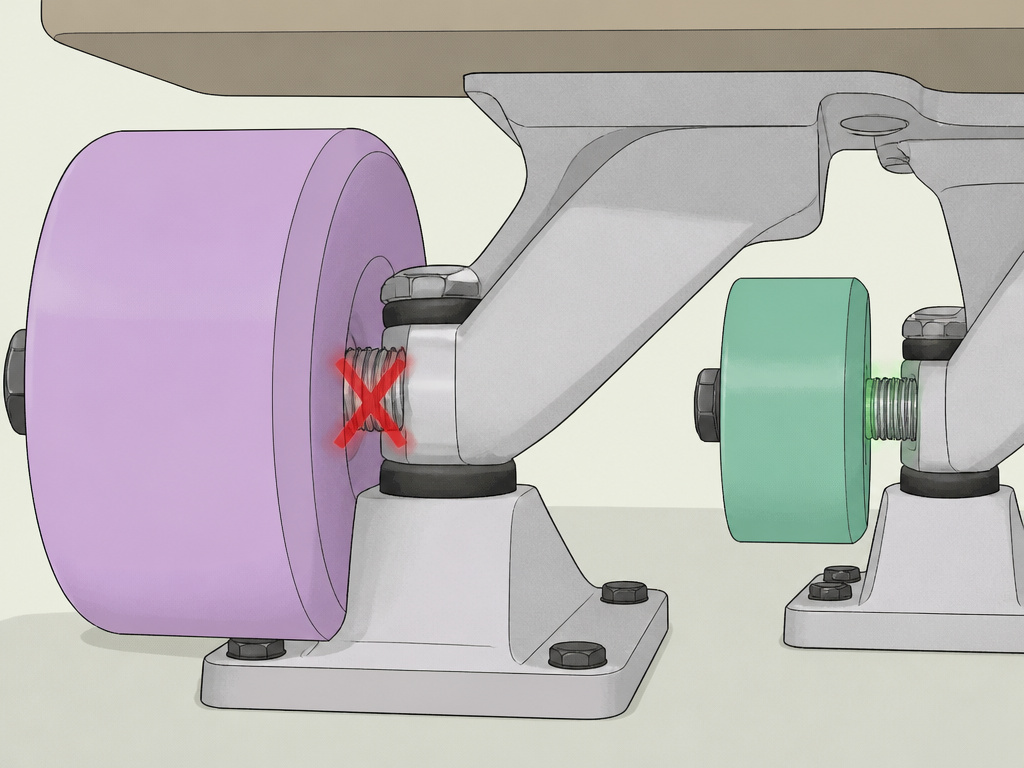
Where this goes sideways: Mounting a 45mm skateboard wheel on a standard skate truck. The wheel will press against the kingpin bolt or the truck hanger itself, causing immediate drag and a hard stop. You’ll feel the resistance on the first push.
The other clearance issue is height. Rollerfit.com.au warns that when using smaller-diameter wheels (e.g., sub-57mm), the long kingpins on some roller skate plates may contact the ground. So, a short, wide skateboard wheel can fail in two directions.
3. Hub Design: Center-Set vs. Side-Set
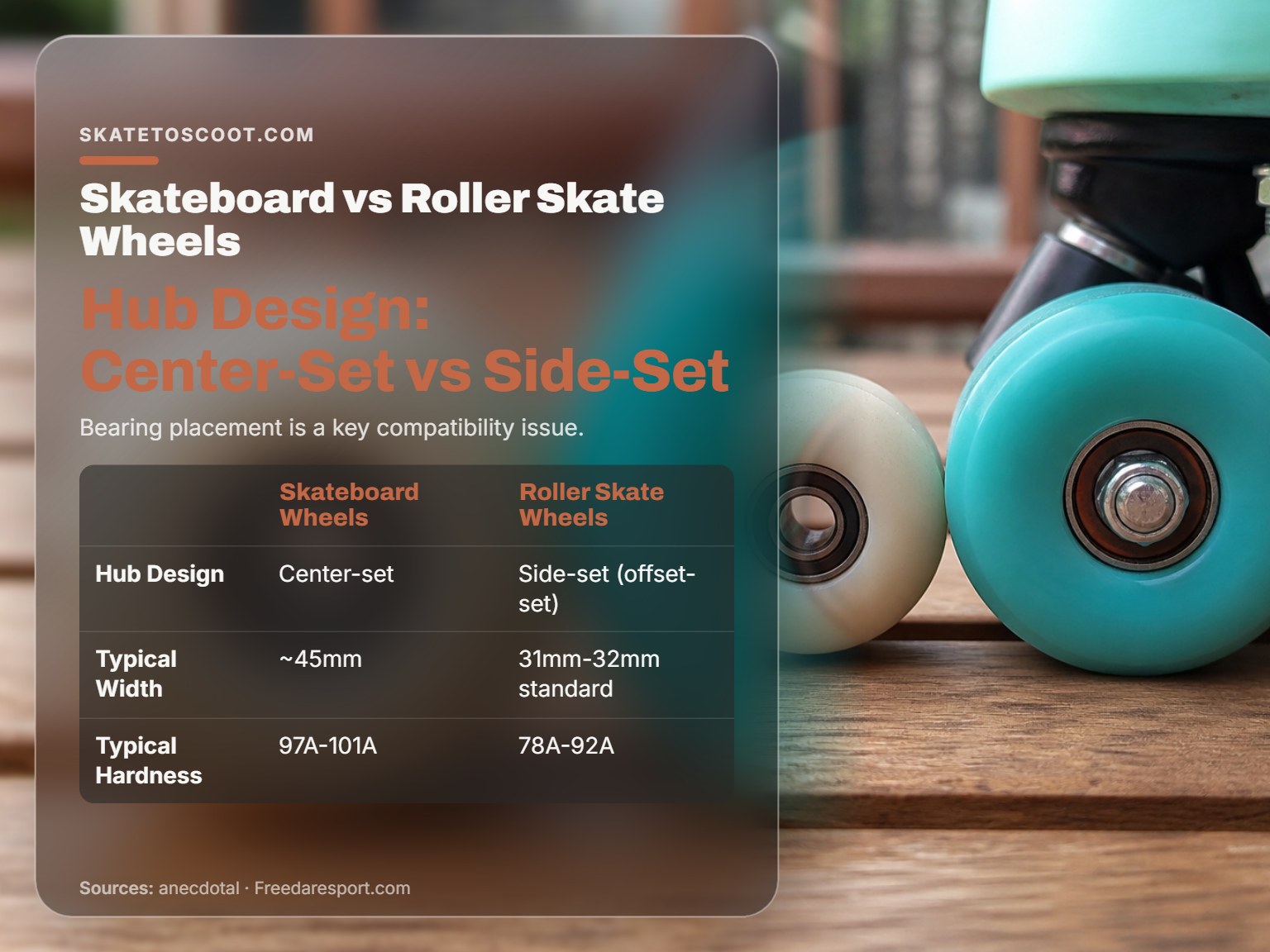
This is the invisible deal-breaker. As Reddit users quickly point out, skateboard wheels are center-set, the bearings sit in the exact middle of the wheel’s core. Roller skate wheels are side-set (or offset-set), the bearings are positioned toward one side.
Why does this matter? A center-set wheel placed on a roller skate axle will not sit flush against the truck’s inner face. It can wobble laterally on the axle, creating “slop.” This feels vague, reduces energy transfer, and, in a hard carve, can cause the wheel to tilt and lose grip unpredictably. It’s not a matter of tightness; it’s a matter of engineering.
The Performance Trade-Offs (If They Fit)
For example, you might find a skateboard wheel that meets all three checks, such as a narrower, classic-shaped cruiser wheel. Mounting it is only half the battle. Now you have to skate on it. The differences aren’t subtle.
Grip, Slide, and Vibration
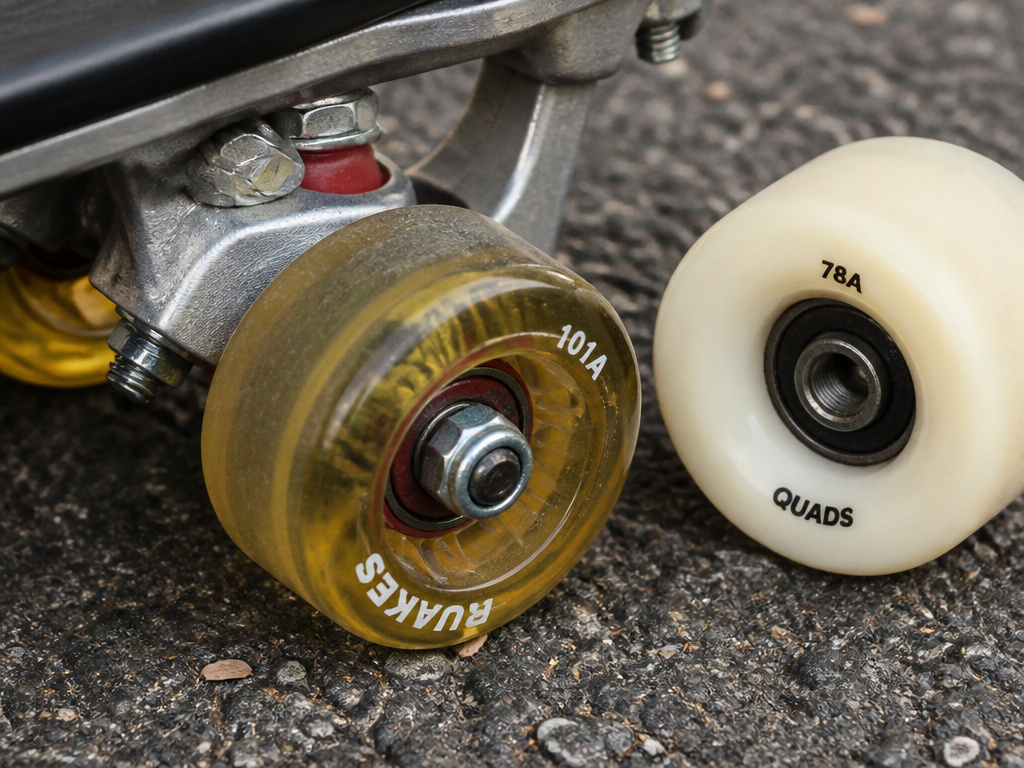
Wheel hardness, or durometer, is measured on the A scale. Lower numbers are softer and grippier; higher numbers are harder and slipperier. Rollerblade USA notes its inline skate wheels typically use urethane with a durometer between 82A and 85A.
Skateboard wheels for skate parks are often much harder. Freedaresport.com recommends 99A to 101A for skate park skating. Put a 101A wheel on a roller skate and take it onto a rough bike path: every pebble, crack, and seam transmits a sharp buzz straight to your ankles and knees. You lose the vibration-dampening that softer, purpose-built outdoor wheels provide.
Conversely, take a soft 78A roller skate wheel and try to slide or power-slide on smooth concrete. It will grip like glue, making certain park or dance moves frustratingly difficult. The hardness isn’t wrong; it’s mismatched to the surface.
Speed, Maneuverability, and Feel
Wheel diameter and contact patch (the amount of urethane touching the ground) change your skate’s personality. A larger wheel will roll faster and maintain speed better but will be slower to accelerate and turn. A smaller wheel will feel quicker to start and more agile for tight turns but will top out at a lower speed.
Skateboard wheels often have a rounded, “full” profile, creating a larger contact patch even at the same width. This can make your skates feel more stable in a straight line but less responsive during edge changes, a critical component for roller dance or derby moves.
I used to believe bigger wheels were always better because they roll faster. Then I realized that for park skating, smaller wheels give the quick, tight maneuvering you actually need. Matching wheel size to the terrain beats chasing a single ideal.
The Step-by-Step Test Fit
Don’t buy wheels online hoping they’ll fit. Do this first with a wheel you already own or can borrow.
- Remove one wheel from your skate. Use the correct wrench (5/16″ for 8mm, 9/32″ for 7mm). Keep the axle nut, washers, and bearings together.
- Try the skateboard wheel on the axle, without the truck. Slide it on. Does the bearing seat fully?
- Check side-to-side wobble. If the wheel slides easily but has lateral play, the hub design is incompatible.
- Mount the wheel on the truck, finger-tight. Do not tighten the nut yet. Spin the wheel. Does it clear the kingpin and truck hanger with sufficient space all around? If it rubs, even slightly, it’s a no-go.
- Test under load. Put the skate on, stand on it, and gently shift your weight to the outside edge. Does the wheel or truck contact your boot? This is “wheel bite” on a skateboard, and on skates it can cause a sudden, jarring stop.
If your test wheel passes all five steps, you have a rare compatible pair. For most people, it fails at step 3 or 4.
When It Makes Sense (And When It Doesn’t)
This is a conditional answer based on your goal.
Consider it if:
- You have wide, “wide-body” or park-specific skate trucks designed for extra clearance.
- You’re skating exclusively on ultra-smooth skatepark concrete and want a specific hard durometer (95A-101A) that’s easier to find in skateboard shapes.
- You’re experimenting with a very specific look or feel and accept the performance compromises.
Avoid it and buy proper skate wheels if:
- You’re a beginner. Unpredictable equipment masks your progress and teaches bad habits.
- You skate outdoors on asphalt or concrete. You need the shock absorption of softer urethane (78A-85A).
- You do rhythm, dance, or artistic skating. The wrong wheel profile will hinder your edge control and spins.
- Your primary goal is saving money. A set of roller skate wheels starts at a comparable price to skateboard wheels. The risk of buying incompatible wheels wastes more cash.
For a systematic look at choosing the right tool for the job, our best roller skate wheels guide breaks down options by discipline.
The One Safety Rule You Cannot Bend
Roller Skate Nation’s guide includes a specific, often-overlooked warning: “It is recommended that wheel locknuts not be used more than two times.”
The nylon insert inside the locknut that keeps it from vibrating loose wears down with each removal. A reused, worn locknut can back off its threads mid-skate. The result is a sudden, catastrophic detachment of the wheel. At speed, that’s a guaranteed fall. They are the cheapest part of your setup. Replace them.
General answer: No, they are not designed for it
Sources disagree on compatibility due to width: Freedaresport.com suggests wheels wider than 32mm won’t fit, while Rollerfit.com.au states you can use skateboard wheels if your truck axles can take the width. Skateboard wheels are built for a different purpose and have key design differences. They are typically much wider, with widths around 45mm compared to the typical roller skate wheel width range of 27mm to 42mm. This extra width can cause the wheels to rub against the skate plate or even the ground. Skateboard wheels also often have a center-set bearing placement, which can change your skate’s geometry and stability in ways it wasn’t designed for. Using wheels not meant for your skates can lead to poor performance and a safety risk.
Frequently Asked Questions
Are skateboard wheels compatible with roller skates?
They can be, but compatibility is the exception, not the rule. It requires a perfect match of axle diameter (8mm), physical width (under ~35mm for most skates), and hub design. Most attempts fail on width or hub compatibility, leading to wheels that rub, wobble, or simply won’t mount.
Can I put any wheels on my roller skates?
No. Your skates’ axle size (7mm or 8mm) is the first filter. Beyond that, the wheel must physically fit within the space between your trucks and boot without interference. Always perform a test fit before riding, and understand that even a physically compatible wheel may perform poorly if its durometer and profile are wrong for your skating style.
Are skateboard wheels different from roller skate wheels?
Yes, in three key ways. Hub design: Skateboard wheels are typically center-set; roller skate wheels are side-set. Width: Skateboard wheels are often wider (42mm-45mm+). Profile & Purpose: They are engineered for different kinds of motion, skateboard wheels for pops, slides, and park transitions; roller skate wheels for edge control, sustained rolls, and dance maneuvers.
What about using rollerblade/inline skate wheels?
This introduces another hurdle. Many inline skate wheels have a plastic bearing spacer molded inside the core, designed for a different frame pin system. This spacer often must be drilled or punched out to fit on a standard 8mm axle, which is a destructive, one-way modification. It’s rarely worth the effort compared to buying correct wheels.
Before You Go
The takeaway is that mixing parts is a precision task, not a casual swap. For every skater who makes a hybrid setup work, there are ten who waste an afternoon only to remount their original wheels.
If you’re determined to try, treat it like a science experiment: measure twice, test fit once, and skate the result cautiously in a controlled, flat area first. But for consistent, predictable performance, especially when learning, nothing beats a wheel designed from the hub out for the skate it’s attached to. Your focus should be on your technique, not on compensating for your gear.
For skating on pavement, your choice of outdoor wheels is the single biggest factor in comfort and control. That’s where your money and research time are best spent.
