How Should Roller Skates Fit: The 3-Step Standing Check
This post contains affiliate links. As an Amazon Associate, we earn from qualifying purchases.
Roller skates should fit snug and secure, like a ski or snowboard boot, not like shoes. Your toes should just feather the front without being crushed, and your heel must not lift when you pull your foot forward. As Nerd Roller Skates advises, a thumb’s width of space is too large, and any slip means the boot is too big. Break-in softens the boot to your shape; it does not make a boot a different size.
That “snug like a ski boot” line is the standard advice, but it’s where most new skaters get tripped up. A beginner hears “snug” and thinks “uncomfortable,” so they buy a size up. An advanced skater hears “snug” and cranks the laces until their toes go numb, thinking that’s control. The real fit is a specific, measurable state between those two mistakes, a locked-in feel that translates your movement directly to the wheels. Understanding how should roller skates fit is key to achieving this.
What follows is a breakdown of that feel, central to how should roller skates fit: how to measure it standing still, why your skill level changes the acceptable snugness, and the one brand-specific rule that overrides all generic advice. We’ll also cover how to fix a near-miss fit with lacing and when to walk away from a size that just doesn’t work.
Key Takeaways
- A proper fit means your toes just feather the front of the boot when standing, any crush or a thumb’s width of space is wrong.
- Heel lift is the deal-breaker. If you can pull your heel up with the skate laced, the boot is too big, period.
- Break-in is for comfort, not size. Leather boots soften over a week to a month, but synthetic materials like vinyl barely change.
- For kids, you can leave a little wiggle room at the toe for growth, but not so much that they slide around uncontrollably.
- Never size up for width. If you have wide feet, look for a model built wider; extra length puts your wheelbase in the wrong place and kills control.
The Core Philosophy: Skates Are Tools, Not Shoes
Forget everything you know about shoe shopping. You buy shoes for all-day comfort and room to flex. You buy skates for precise control and energy transfer. The Nerd Roller Skates guide puts it bluntly: your feet need to bend through your stride in your shoes, while your feet should not slip around in your skates.
A loose skate isn’t just annoying; it’s dangerous. Your foot slides, you over-grip with your toes to compensate, and you lose the direct connection to the plate and wheels. That’s when a simple turn becomes a wobbly mess or a stumble. A performance fit feels restrictive at first because you’re not used to something holding your foot that firmly. Your brain needs to learn that the skate is now a part of your body.
A skate boot should fit more like a pair of ski or snowboard boots than a pair of runners. Beginners are often uncomfortable with tight fitting skates, while advanced skaters usually need a more precise fit.
This is the essential starting point for the question of how roller skates should fit. If your skates feel like comfortable sneakers right out of the box, they are almost certainly too big.
The 3-Step Standing Fit Check
You don’t need to skate to know if a boot fits. Do these three checks while standing on a carpet or wearing skate guards.
1. The Toe Feather Test
Lace the skate up snugly. Stand up straight with your weight evenly distributed. Your longest toe should just barely touch the front lining of the boot. You should feel it there, a light pressure, but it shouldn’t be curled, jammed, or painful. Now, bend your knees into a slight skating crouch. Your heel should settle back, and that toe pressure should vanish. If your toe is still jammed hard when you’re crouched, the boot is too short.
Where this goes sideways: Buying a size up because your toe touches when standing straight. The crouch test is what matters for skating posture. If the touch disappears when you bend your knees, the length is correct.
2. The Heel Lift Test
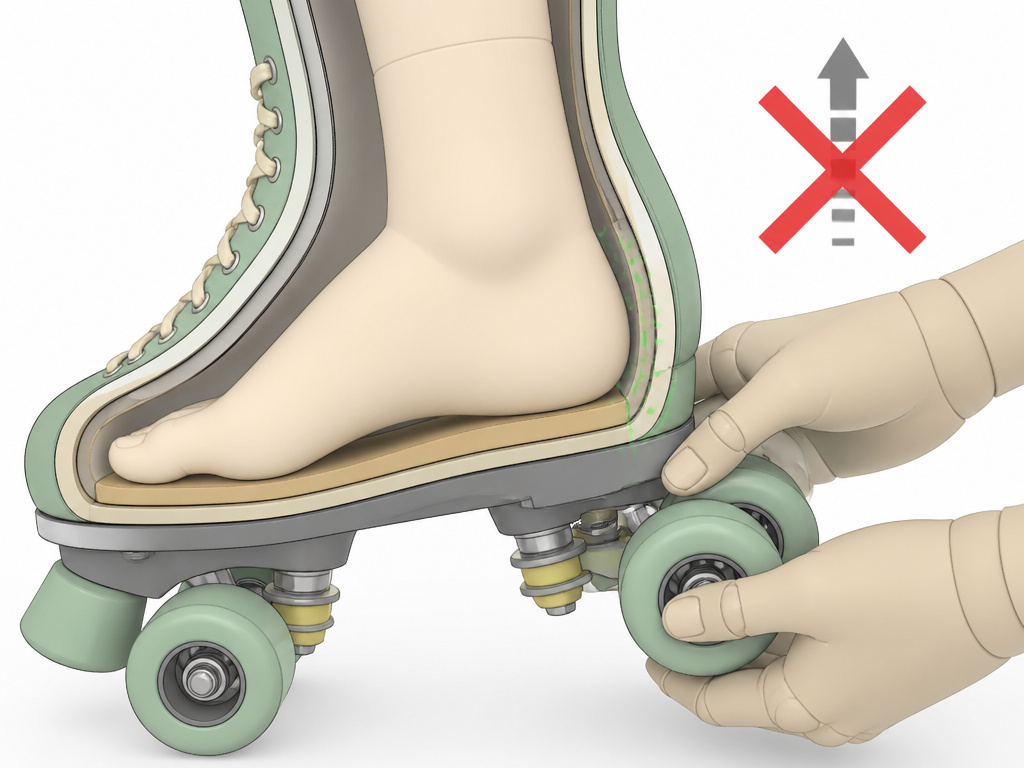
This is the most important check. With the skate laced, hold the back wheel firmly and try to pull your foot straight up and out of the boot. Your heel should not move. At all. If you feel it slide upward, even a little, the boot is too big. Another method: push your foot all the way forward in the boot. Can you fit a finger down the back and touch the bottom? If so, that’s a size too big.
3. The Width and Volume Check
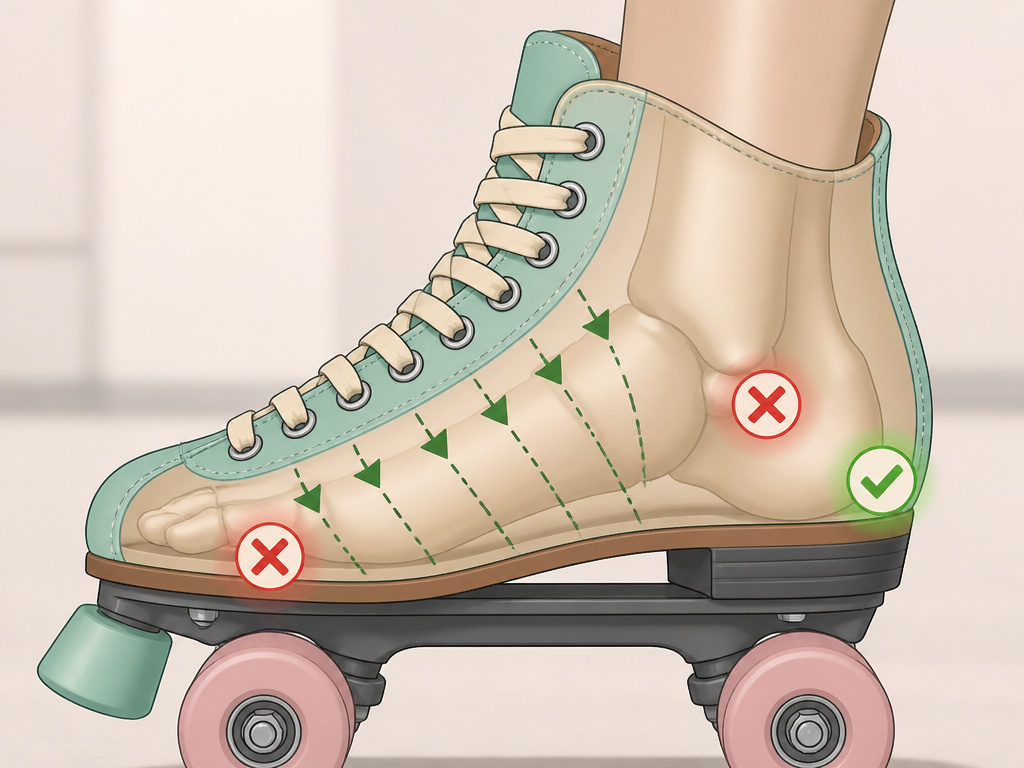
Your foot should feel held, not squeezed. You shouldn’t feel sharp pressure points on the sides of your forefoot or your ankle bones. Some even pressure across the top of your foot from the laces is normal. If you have wide feet and the length is right but the sides are tight, don’t size up. Look for a model that fits wider. As the Nerd Roller Skates guide advises, people buy shoes larger for width, but for skates, you should find a model that fits wider to avoid excess length.
How Your Skill Level Changes the “Snug” Rule
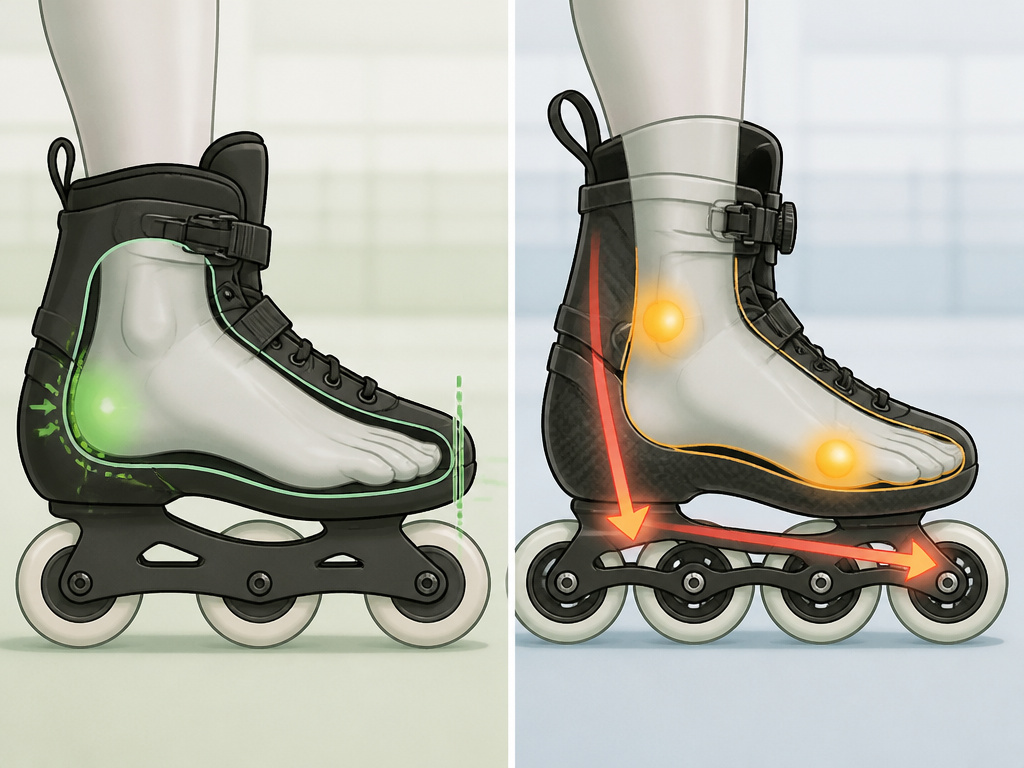
The ideal pressure map inside the boot isn’t static. It changes with your experience.
Beginners are often shocked by the locked-in sensation. It’s unfamiliar, and the instinct is to retreat to a roomier, shoe-like fit. Beginners can sometimes get away with a fit that’s slightly less than perfect, because they aren’t pushing the equipment to its limits. Their focus is on balance and basic strides, not razor-edge power transfer.
Advanced skaters need that 100% precise fit. When you’re jumping, spinning, or doing edge work, a millimeter of slip costs control and increases injury risk. An advanced skater will tolerate more initial discomfort, knowing the boot will mold to their exact foot shape. They also understand that a perfect fit might require aftermarket insoles or specific lacing patterns, which is a fine-tuning step beginners shouldn’t worry about yet.
| Skater Level | Focus | Acceptable Fit Tolerance | Break-In Priority |
|---|---|---|---|
| Beginner | Balance, basic movement | Can be slightly less than perfect, but zero heel lift is mandatory. | Medium. Comfort matters to keep skating fun. |
| Intermediate | Learning tricks, building speed | Needs to be precise. Any slip is now a noticeable problem. | High. Investing break-in time pays off in performance. |
| Advanced | Max power transfer, complex maneuvers | Must be exact. Often involves custom molding, orthotics, or pro fitting. | Critical. The boot must become a second skin. |
Breaking In vs. Sizing: What Actually Changes
This is the most misunderstood part of the process. Break-in is not magic.
Leather and suede boots will soften and conform. The ankle collar and the sides around your forefoot will give a little. Hard pressure points can recede. As Nerd Roller Skates notes, break-in can take anywhere from a week to over a month depending on how often you skate. This process makes a properly sized boot comfortable; it does not make a too-large boot fit.
Synthetic boots (vinyl, some polymers) are a different story. The Nerd Roller Skates guide is clear: most synthetic or vinyl boots do not break in. The interior lining and cushion might compact slightly, but the shell itself stays rigid. What you feel on day one is very close to what you’ll feel on day one hundred. This is why getting the size right upfront is critical for synthetic models.
Break in should be for working the boots to fit your feet, not to make them a different size. If a boot is too long or too wide, no amount of breaking in will fix it.
When Heat Molding is an Option (And When It’s a Fire Hazard)
Some high-end boots, like those from Bont, offer heat molding for a custom fit. This is a powerful tool, but it comes with critical, model-specific rules that, if ignored, will ruin your skates.
According to Bont, their Carbon Boots require oven heat molding at 85°C/185°F for 15-20 minutes. You check every 5 minutes by gently squeezing the back of the boot. If it’s not pliable, you put it back. Bont advises allowing approximately 5-10 minutes for the boots to cool on your feet.
Now, the critical warnings straight from Bont:
- Bont Vaypor VII and Slipstream models are prohibited from oven heat molding. You must use localized spot heating with a heat gun on the carbon shell only, avoiding the mounting blocks.
- Bont Fiberglass boots DO NOT go in the oven and require a different process.
See the pattern? “Heat molding” is not one thing. The community is full of anecdotes about people heating boots longer (25-30+ minutes) to get a better mold, which differs from Bont’s “check every 5 minutes to avoid overheating” protocol. Following forum advice over the OEM manual is a sure way to void your warranty and melt important structural components.
Fine-Tuning the Fit: Laces, Socks, and Insoles
If your skates pass the basic fit checks but still don’t feel perfect, you have options before you return them.
Strategic Lacing is your first and best tool. Heel slipping? Use a “lock lace” by running the lace through the second-to-top eyelet twice before tying. Pressure on the top of your foot? Skip an eyelet over that area. Wide forefoot? Lace in a parallel pattern instead of crossing over. A proper lace length is key here; roller skate laces that are too short won’t allow for these techniques.
Socks and Insoles can take up small amounts of volume. If you have a tiny amount of heel lift, a thicker skate sock might fill the gap. For a boot that’s slightly too roomy overall, a performance insole can lift your foot and take up space. This is a popular trick, especially for kids where you might buy a size with a little growth room, using skate insoles to take up space. Remember, these are fine-tuning adjustments for a nearly correct fit, not solutions for a boot that’s a full size off.
Special Case: Fitting Kids for Roller Skates
The rules shift slightly for children. Growth is a factor, but safety and control are still paramount. The Nerd Roller Skates guide offers the clearest directive: For kids skates, you can leave a little wiggle room at the toe, but you don’t want the skates to be so big that they are sliding around in their boots with no control.
You can leave a little wiggle room at the toe for growth, but not so much that they slide around uncontrollably. But the heel must still be locked. If they are sliding around inside the boot, they cannot learn proper balance or pushing technique. It’s frustrating and unsafe. It’s better to buy a slightly snugger skate they’ll use now and upgrade in a year than a huge skate they’ll struggle with and hate.
How do I properly try on roller skates?
Start by lacing the boots tightly for a snug and secure fit. Stand in them and take your time to feel how they settle. Your toes should just feather the end of the boot without feeling crushed; there should be no slip back and forth or significant heel lift. Perform a simple test: hold the back wheel and pull your foot forward as if trying to pull out of the skate. If your heel slides up, the boot is too big. Remember that skates should fit more like ski boots than runners, offering a precise, locked-in feel where your foot does not slide around inside.
Frequently Asked Questions
Should roller skates fit tight or loose?
They should fit snug and secure, like a ski boot. “Tight” implies painful constriction; “loose” implies dangerous slippage. Snug is the target: no movement, but no cutting off circulation.
How do I tell if my skates are too small?
Your toes are painfully curled or jammed against the front even when you bend your knees. You feel intense pressure points on the sides or top of your foot that don’t ease up after a few minutes of wearing them. Numbness is a sure sign they’re too small.
Is it better for roller skates to be too big or too small?
Neither. Both are bad. Too big means no control and a high risk of blisters from friction. Too small means pain, numbness, and potential injury. Always aim for the correct size. Sources disagree: some skaters prefer a slightly tighter fit that will stretch, while others prefer a little loose over too tight for long-session comfort.
How should I size my roller skates?
Ignore your shoe size. Measure the length of your bare foot in centimeters or inches. Use the specific brand’s size chart for the model you want. Brands differ wildly, a Riedell size 7 is not the same as a Bont size 7. When in doubt between two sizes, lean toward the smaller one if it passes the toe feather and heel lift tests.
Can I use insoles to make big skates fit?
Insoles can help take up a small amount of volume, but they cannot fix a boot that is too long. If your heel lifts or your foot slides forward, an insole won’t solve that. They are for fine-tuning width or arch support, not for correcting length.
Before You Go
Here is the reality: the perfect fit feels weird at first. You’re not used to your foot being held that firmly. The trick is to distinguish between “weird and new” and “wrong and harmful.”
Trust the tests, not just your initial impression. The heel lift test doesn’t lie. If your heel stays put and your toes just graze the front when standing, you’ve hit the target. Everything else, the slight pressure, the unfamiliar stiffness, is what breaking in is for. That process can take a month of regular skating for leather boots. Synthetic boots won’t give much.
If you’re stuck between sizes and the smaller one passes the basic checks, go with it. A little initial snugness in a material that will give is better than a guaranteed slop that will never go away. And if you have wide feet, start your search with known wider models. Sizing up for width is the most common mistake, and it puts every other part of your fit in the wrong place, whether for inline skates or quads. Get the length right first, then solve for width. Your control depends on it.
