Is It Easier to Ice Skate or Roller Skate?
This post contains affiliate links. As an Amazon Associate, we earn from qualifying purchases.
For a complete beginner, roller skating, specifically on quad skates, offers more initial physical stability and a more forgiving learning curve for fundamental balance. However, a 1991 kinematic study found the athletic motions of on-ice power skating and off-ice rollerblade skating to be “similar from both a practical standpoint, and from a basic statistical perspective,” meaning skills transfer well once you’re moving. The real differentiator is the surface: ice’s low friction changes everything about control and falling.
That last point isn’t just theoretical. It flips the script on which one is “easier” based on what you mean, and many people ask, is it easier to ice skate or roller skate? If easier means standing up without wobbling, quads win. If easier means gliding with less effort once you’re proficient, ice has an edge. And if easier means a lower risk of a specific, serious injury, the data points clearly to one over the other.
What follows is a breakdown of three lenses: the biomechanics of balance and propulsion, the starkly different injury patterns revealed by a 20-year study, and the practical realities of your first day on wheels versus blades. By the end, you’ll know exactly which starting point matches your goals and your tolerance for a unique kind of slippage.
Key Takeaways
- Roller skating, particularly on quads, provides more inherent stability for a standing beginner due to a wider wheelbase, according to the SkateHut article, while the Lucky Skates blog argues inline skating’s longer frame offers stability for forward motion. Ice skating demands immediate ankle strength to manage a single, slippery blade.
- Skills transfer between the disciplines is high for athletic motion, per a 1991 kinematic study, but the low friction of ice drastically alters fall dynamics, leading to a higher rate of head strikes compared to roller skating.
- Injury profiles are distinct: ice skating sends over 34% of injuries to the head/face/neck, while roller and inline skating see about 50% of injuries to the shoulder/arm/elbow/wrist.
- Your first skate type choice should hinge on your priority: quads for stable first steps, inline skates for easier forward motion and less wheel clipping, or ice skates if you have access to a maintained rink and understand the friction trade-off.
- Protective gear strategy must differ: on ice, a 2006 study proposes developing wrist guards with a non-slip palm as a solution superior to standard helmets, but also notes that full hockey-style helmets with facemasks would be most effective for protection.
The Core Biomechanical Difference: Friction
Forget blades versus wheels for a second. The real story is under your feet. Ice is a low-friction surface. Pavement, wood, or concrete, the typical homes for roller skates, are high-friction surfaces. This single variable changes the physics of every single movement.
On ice, the blade glides. Push sideways against the ice with the edge of your blade, and you propel yourself forward. It’s efficient. A 1991 study in the International Society of Biomechanics in Sports conference proceedings compared on-ice power skating to off-ice rollerblade skating and found the kinematics “similar from both a practical standpoint, and from a basic statistical perspective.” The trained hockey players in the study moved in fundamentally the same way. The athletic motion transfers.
But that efficient glide is a double-edged sword. It means your foot can slide out from under you with minimal provocation. On pavement, your wheels grip. That grip gives you more control over stopping and starting, but it also requires more muscular effort to initiate and maintain momentum. The initial “shove” to get rolling on quads or inlines is more pronounced than the subtle shift of weight needed to glide on ice.
A 2006 video analysis of pediatric skating falls in the British Journal of Sports Medicine identified the low friction of ice as the key differentiator altering fall dynamics, making protective strategies that work on pavement less effective.
This is the sensory reality check. On your first day on ice, you’ll feel a disconcerting lack of connection to the ground. On your first day on roller skates, you’ll feel planted, maybe even stuck, until you learn to overcome that grip with a committed push. Neither is inherently easier; they demand different kinds of trust in your equipment.
Standing Balance: Wheels vs. Blade
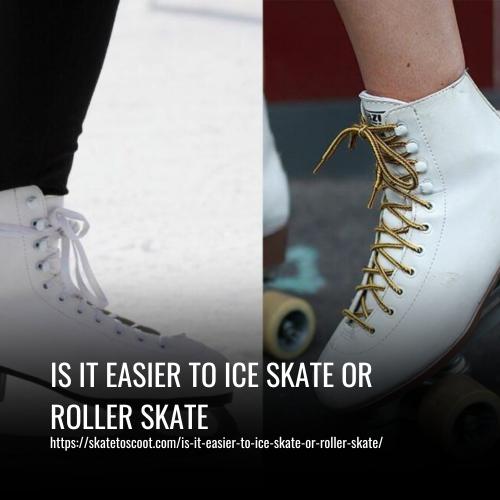
Before you even move, you have to stand. Here, the design of the skate dictates the challenge.
- Quad Roller Skates: Two axles (trucks) with two wheels each create a stable, rectangular footprint. This offers what the SkateHut article calls “more initial stability” and “more lateral stability than a single thin blade.” Your ankle can wobble a bit, and the skate platform will resist tipping. This is why many absolute beginners feel more confident standing in quads.
- Inline Skates (Rollerblades): The wheels are in a single line. This longer frame, as noted by the Lucky Skates blog, “makes them very stable and less prone to wheel clipping” than quads for forward motion. But for static balance, you’re balancing on a narrow line. It requires active ankle strength to keep from rolling onto your inner or outer edges.
- Ice skates: You are balancing on a thin, sharpened steel blade. There is no wheelbase. Your ankle must be strong enough to keep the blade perfectly upright. Rental skates often have a stiff boot to compensate, locking your ankle in place. If that boot fits poorly or the blade is dull (a common rink problem), you’re fighting a losing battle from the start.
Where this goes sideways: Assuming a dull ice skate blade is normal. An unsharpened blade won’t bite into the ice, making it feel like you’re standing on a butter knife on a marble floor, impossible to control. A sharp blade provides a crucial “grip” on the ice for pushing off and stopping.
The Injury Profiles Tell a Different Story
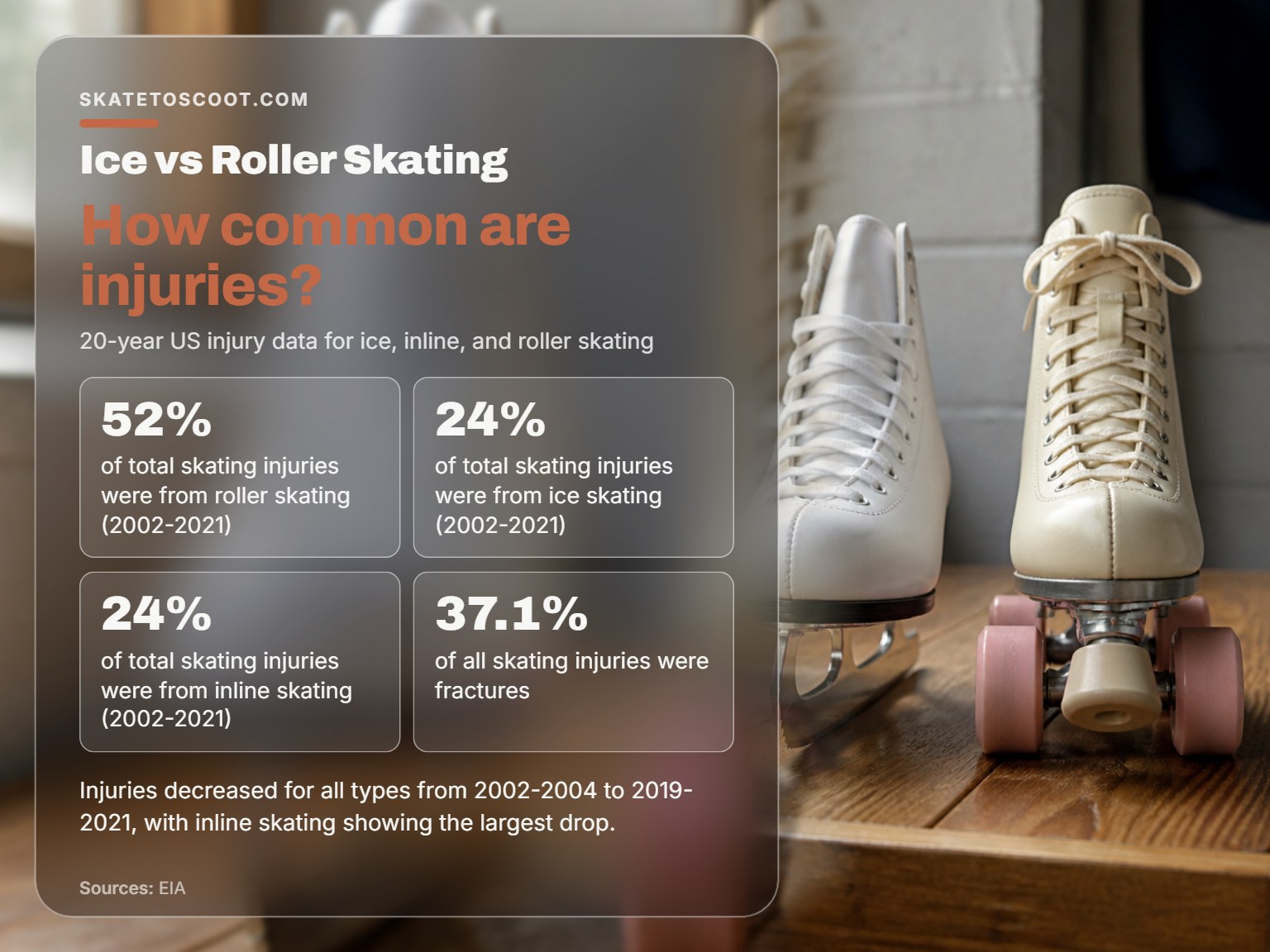
Here’s where the is it easier to ice skate or roller skate question gets a hard, numerical answer from a different angle: risk. A 2023 epidemiological study estimated 1,656,746 skating-related injuries nationally from 2002 to 2021. The breakdown alone is revealing: 24% from ice skating, 24% from inline skating, and 52% from roller skating.
But the type and location of injuries were starkly different.
| Skating Type | Most Common Injury Location | Percentage of Injuries | Most Common Injury Type |
|---|---|---|---|
| Ice Skating | Head/Face/Neck | 34.5% | Fracture (37.1% overall) |
| Inline Skating | Shoulder/Arm/Elbow/Wrist | 53.0% | Fracture (37.1% overall) |
| Roller Skating | Shoulder/Arm/Elbow/Wrist | 49.9% | Fracture (37.1% overall) |
The data shows that for ice skating injuries, 34.5% were to the head/face/neck, a higher proportion than the upper extremity focus of roller and inline skating injuries. Why? It goes back to friction and falling. The same 2006 video analysis found that while over 90% of skaters in both groups tried to break their falls with their arms, a greater proportion of ice-skating falls resulted in the child striking the head on the skating surface (13.0%) than did roller/inline skating falls (3.0%).
On pavement, your hands often catch you. On ice, your hands slide out, and your head keeps traveling downward. This is a certain physical consequence.
What This Means for Protective Gear
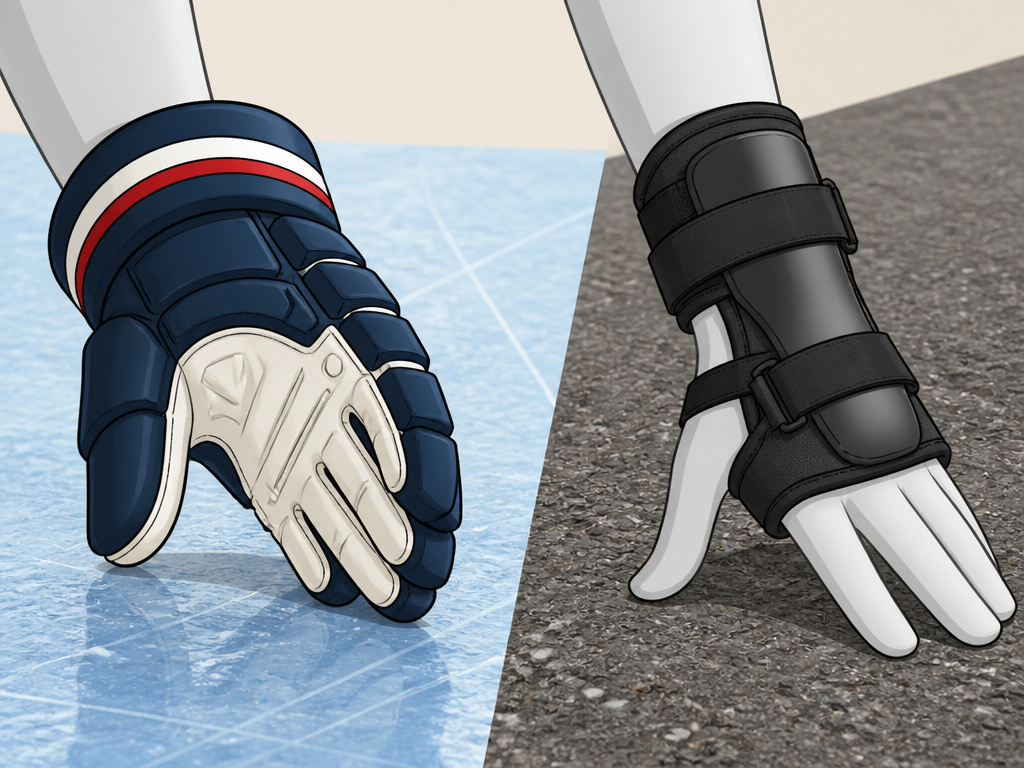
The standard “helmet and pads” kit needs a tactical adjustment based on surface.
- For Ice Skating: The 2006 study authors made a provocative proposal. Instead of focusing solely on helmets (which they noted would need to be full hockey-style with facemasks to adequately protect against forward falls), they suggested developing “wrist guards with a non-slip palm.” The goal: prevent the hand from sliding on ice during a fall attempt, thereby stopping the head’s trajectory. Until those exist, a helmet is non-optional, and you should be hyper-aware that putting your hands down might not save you.
- For Roller/Inline Skating: Wrist guards are your most important piece of gear, full stop. With over 50% of injuries targeting the upper extremities, protecting your wrists and forearms is the single best mitigation. A helmet is still critical, but the mechanics of a typical fall make wrist guards the first line of defense.
The epidemiological study also found that fractures were the most common injury across all three types. For roller skating fractures, 68.2% occurred in the upper extremity. That’s not a minor sprain; that’s a broken bone. The gear is not optional decoration.
Skill Transfer and the Learning Curve
“If I learn one, will the other be easy?” This is a top question in forums, often stemming from the core is it easier to ice skate or roller skate debate. The kinematic study suggests the answer is yes, for the gross motor patterns. The balance and push of a speed skater on ice closely mirrors that of a rollerblader on pavement. Many aggressive inline skaters transition to ice hockey with relative ease because the stride, crossovers, and edge control concepts are analogous.
But the devil is in the details, or more specifically, in the edges and the stops.
- Stopping: This is the biggest day-one differentiator. Most quad skates have a toe stop on the front. You stop by pushing this rubber plug into the ground. Most inline skates have a heel brake. You stop by lifting your toe and pressing the brake pad down behind you. Ice skates have no external brake. You stop by using a “snowplow” (pushing the blades into a V-shape to create friction) or a hockey stop (a sharp, sideways scrape of the blades). The ice stop techniques require precise edge control and feel completely foreign to a roller skater.
- Edges: On ice, you steer and turn by leaning onto the inside or outside edge of your blade. On roller skates, you turn by leaning your body and/or manipulating the skate’s trucks (the pivot mechanism). The feeling of “biting” into the ice with an edge is unique to blade sports.
Common mistake: Trying to use your roller skate stopping technique on ice. Slamming a toe stop down on ice will launch you forward onto your face. The muscle memory does not transfer here, you must learn a new system.
So, does skill transfer? Yes, for general balance, posture, and forward propulsion. No, for the critical survival skills of stopping and advanced maneuvering. You’ll have a head start, but you’re not starting from zero.
Quad vs. Inline vs. Ice: A First-Day Scenario
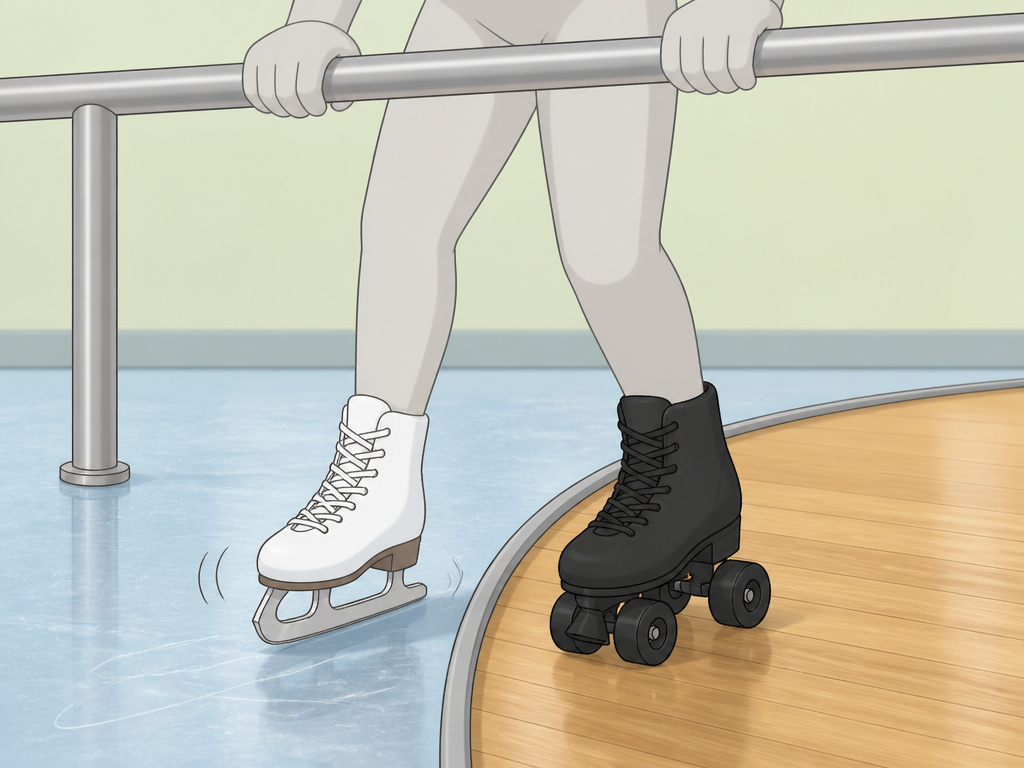
Here is a specific example. Imagine your first hour at a roller rink versus an ice rink.
At the Roller Rink (on Quad Skates):
You lace up, stand, and grip the wall. The skates feel clunky but stable. You can stand without holding on, albeit with a wide stance. To move, you need to commit to a “V” walk or a deliberate push. It feels like work. You might trip over your own wheels (“wheel clipping”) if your feet get too close. Falling hurts, it’s a hard impact on joints. But getting up is straightforward; you just get to your knees and stand.
At the Roller Rink (on Inline Skates):
Standing up is the first challenge. You feel like you’re going to roll backwards. You need to find your “neutral” balance point. Once moving, the longer frame feels more stable in a straight line than quads. The heel brake is intuitive for many. The learning curve feels steeper at the very start but can smooth out quickly for forward motion.
At the Ice Rink:
You step onto the ice. A wave of instability hits, it’s slippery. You shuffle, unwilling to lift your feet. A slight lean and you’re gliding without meaning to. Control feels elusive. Falling is a sudden, sliding affair. It can be harder to get up because your feet slip as you try to plant them. The cold is a factor. The sound of blades is everywhere. The sensory experience is more intense and, for many, more intimidating.
The time to learn roller skating for basic laps around a rink might be shorter than the time to learn ice skating to the same comfort level, simply because the margin for error on ice is smaller from minute one.
Making Your Choice: Which Should You Try First?
This isn’t a cop-out “it depends” answer. It’s a decision tree based on your personal variables.
Choose Quad Roller Skating first if:
- Your primary goal is to feel stable and secure while learning the very basics of rolling.
- You have access to a smooth, flat surface (tennis court, empty parking lot, roller rink).
- You are particularly concerned about ankle strength or have weak ankles.
- You like the aesthetic and culture of classic roller skating.
Choose Inline Skating first if:
- You want to cover distance, skate on trails, or are interested in hockey or speed skating.
- You find the idea of wheel clipping frustrating and want a smoother forward roll.
- You have some baseline leg and ankle strength from other sports.
- You plan to eventually try ice skating, as the stride transfer is more direct.
Choose Ice Skating first if:
- You have consistent access to a well-maintained ice rink with sharp rental skates (or can buy your own).
- You are drawn to the unique sensation of gliding and the culture of ice sports.
- You understand and accept the different risk profile and will wear appropriate gear.
- Your end goal is to play ice hockey or figure skate.
Your gear choice matters too. Don’t fight bad equipment. For ice, read our guide on best beginner ice skates. For wheels, start with our picks for the best beginner roller skates or the best outdoor roller skates if you’ll be on pavement.
Frequently Asked Questions
Do roller skating skills translate to ice skates?
Yes, but with a major caveat. The fundamental posture, balance, and pushing motion show a high degree of transfer, as shown in a biomechanical study of roller vs ice skating. However, the techniques for stopping, turning, and using edges are completely different due to the low-friction ice surface. A roller skater will have a head start on basic gliding but must learn a new set of survival skills.
Which is harder on your body: ice skating or roller skating?
They stress the body differently. Ice skating is lower impact on joints due to the gliding motion but places unique demands on ankle stabilizers and the hip adductors (inner thighs) for pushing. Roller skating is higher impact from wheel vibration and falls but builds strong quadriceps and calves. The comparative injury rates study shows ice skating leads to more head/neck injuries, while roller skating leads to more upper limb fractures.
I rollerblade. Will ice skating be easy?
You will have a significant advantage over a non-skater. The inline skating stride is the closest terrestrial analog to the ice skating stride. You’ll understand the concept of pushing sideways to go forward. The disorientation will come from the slipperiness, the lack of a heel brake, and the feeling of the blade edges. Your learning curve will be steep but short.
Are quad skates or inline skates better for learning to ice skate?
Inline skates are biomechanically closer. The single-line wheelbase and forward-oriented posture mimic the ice skating stance more accurately than the wider quad stance. However, any skating experience improves your overall balance and comfort on a slippery surface, so time on quads is still beneficial. The debate between roller skates vs rollerblades for overall ease is its own discussion.
What is the most important safety tip for a beginner ice skater?
Understand that falling on ice is different. Your instinct to put your hands down will often result in them sliding out, leaving your head vulnerable. Bend your knees and try to fall onto your side or buttock, keeping your head up. And wear a helmet, specifically one designed for multi-impacts, like a hockey helmet, if you’re serious about it. The video analysis of skating falls provides the stark evidence for why this matters.
The Bottom Line
The question “which is easier?” defaults to roller skating, if by easier we mean a lower barrier to standing upright and a more forgiving surface when you fall. The data on injury location is too clear to ignore.
But “easier” is a trap. Ice skating offers an unparalleled efficiency of motion that can feel liberating once you’re past the initial slip-and-slide phase. The skills you build on either surface are valuable and transferable in surprising ways, as the research on physiological comparison of skating types confirms.
So don’t choose based on a vague notion of difficulty. Choose based on your reality. Do you have a smooth path outside your door? Start with roller skates for beginners. Is there a well-kept rink nearby and does the glide intrigue you? Grab a pair of recreational ice skates and accept the unique challenge. Your first goal isn’t to be good; it’s to be safe. Master the fall, then the stop, then everything else follows. Now go try it.
