How to Measure Longboard Wheelbase: Axle-to-Axle Method
This post contains affiliate links. As an Amazon Associate, we earn from qualifying purchases.
To measure a longboard wheelbase correctly, you need two numbers: the industry-standard deck wheelbase (distance between the inner truck mounting holes) and the true, functional wheelbase (axle-to-axle distance). The deck measurement is for comparing specs; the true wheelbase, which accounts for truck geometry, is what actually determines your board’s turning radius and stability.
That axle-to-axle gap is where your board’s personality lives. It’s the single most important mechanical spec you can measure, and knowing how to measure longboard wheelbase is key because getting it wrong is why one rider’s “stable” deck feels like a shopping cart to another.
What follows: the step-by-step way to find both numbers, why they’re different, and a breakdown of how a 2-inch change in wheelbase can flip a board from a downhill bomber to a surfskate. By the end, you’ll be able to look at any deck’s spec sheet and predict exactly how it will ride.
Key Takeaways
- Measure axle-to-axle for the true, functional wheelbase that affects ride; use the inner mounting holes only for comparing deck specs.
- A shorter wheelbase offers sharp turns and agility but less high-speed stability; a longer wheelbase provides wider, more stable turns ideal for downhill.
- Your truck type and bushing height directly change your effective wheelbase — Reverse Kingpin (RKP) axles sit closer to the deck center than Traditional Kingpin (TKP) axles.
- For a balanced, all-around setup capable of commuting, slides, and mild downhill, aim for a 15-16 inch deck wheelbase.
- Always check your stance width against your wheelbase; your front foot should never be ahead of the front truck’s axle.
How to Measure True Wheelbase (Axle-to-Axle)
Forget what the deck sticker says for a minute. The number that dictates how your board actually handles is the distance from the center of the front axle to the center of the rear axle. This is your true wheelbase.
Here’s how to find it. You’ll need a flat surface, your board, and a tape measure.
- Position the board: Place your longboard upside down on a stable, level surface so the wheels are pointing up.
- Find the axle center: On each truck, locate the solid metal rod (the axle) that the wheels spin on. Locate the very center point of the axle between the two wheels.
- Measure: Stretch your tape measure from the center point of the front axle to the center point of the rear axle. Keep the tape straight and parallel to the deck’s length.
- Read the number: The measurement in inches or centimeters is your true wheelbase.
This 50–60 word, third-person, pronoun-free blockquote covers the specific technical method for obtaining the functionally correct wheelbase measurement, distinct from the commercial deck specification.
The part nobody mentions: Your tape measure will bow if you try to span it in the air. Let the board’s weight hold it flat. And don’t measure from the wheel edges—axle center to axle center is the only consistent reference point. A difference of half an inch here changes the feel.
Why does this matter more than the deck’s listed wheelbase? Truck geometry. The axles on Reverse Kingpin (RKP) trucks are set closer to the board’s center than on Traditional Kingpin (TKP) trucks. A rider report notes that Surfrodz INDeeSZ trucks can add about 3 inches to a deck’s stated wheelbase. Your true wheelbase is the axle-to-axle distance, which is influenced by the deck’s mounting hole distance and the truck’s specific offset.
The Industry Standard: Deck Wheelbase (Mounting Holes)
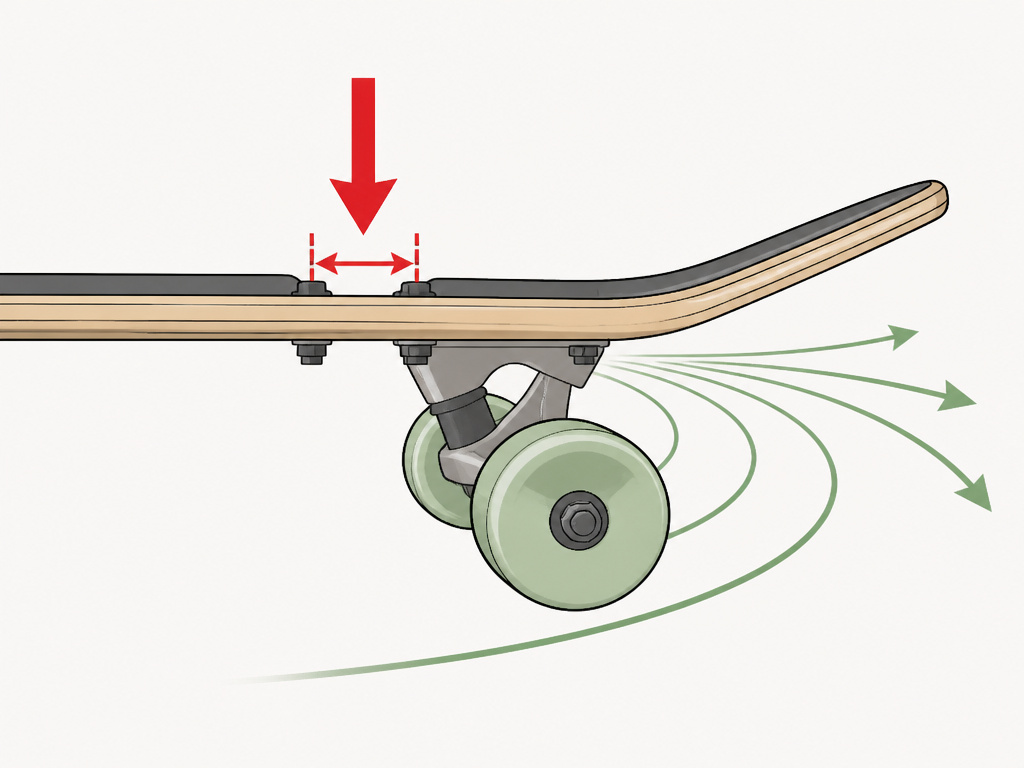
While the axle measurement is king for riding, the skateboarding industry uses a different ruler. Shops and manufacturers almost universally list wheelbase as the distance between the inner truck mounting holes on the deck.
To find it:
- Turn the board over to expose the underside.
- Identify the two sets of four holes where the trucks attach.
- Measure from the inside edge of the front set of holes (the two rearmost holes of the front truck mount) to the inside edge of the rear set (the two foremost holes of the rear truck mount).
This standard exists for a practical, if frustrating, reason: consistency. It’s easier for a company to print “WB: 15.5” on a box than to account for every possible truck model’s offset. When you’re comparing decks online or in a shop, this is the number you’re meant to use.
Common mistake: Using the deck’s wheelbase number to predict how a complete board will ride. That number ignores your trucks, which is like guessing a car’s wheelbase without knowing the axle placement.
The gap between these two definitions is where new riders get lost, which is why learning how to measure longboard wheelbase is crucial. You buy a deck with a 20″ wheelbase, slap on some RKPs with a long offset, and suddenly you’re riding a 23″ true wheelbase. It feels completely different than you expected. This is why learning to assemble a longboard with an eye on truck specs is a required second step.
Why Wheelbase Length Changes Everything
Wheelbase is the lever arm for your turns. Shorter levers are easier to move quickly; longer levers resist movement but offer more control.
Think of it this way. Stand with your feet wide apart—that’s a long wheelbase. You’re stable, but pivoting quickly is hard. Now stand with your feet close together—a short wheelbase. You can spin fast, but a slight shove knocks you over. The same physics apply to your trucks pivoting around the kingpin.
A shorter true wheelbase gives you:
- A tighter turning radius.
- Quicker, more responsive steering.
- Less stability, especially at speed.
- More “pop” and force for street-style tricks.
A longer true wheelbase gives you:
- A wider, more gradual turning arc.
- Increased stability, particularly for downhill.
- A smoother, less twitchy ride.
- More space for foot placement, beneficial for dancing or long-distance pushing.
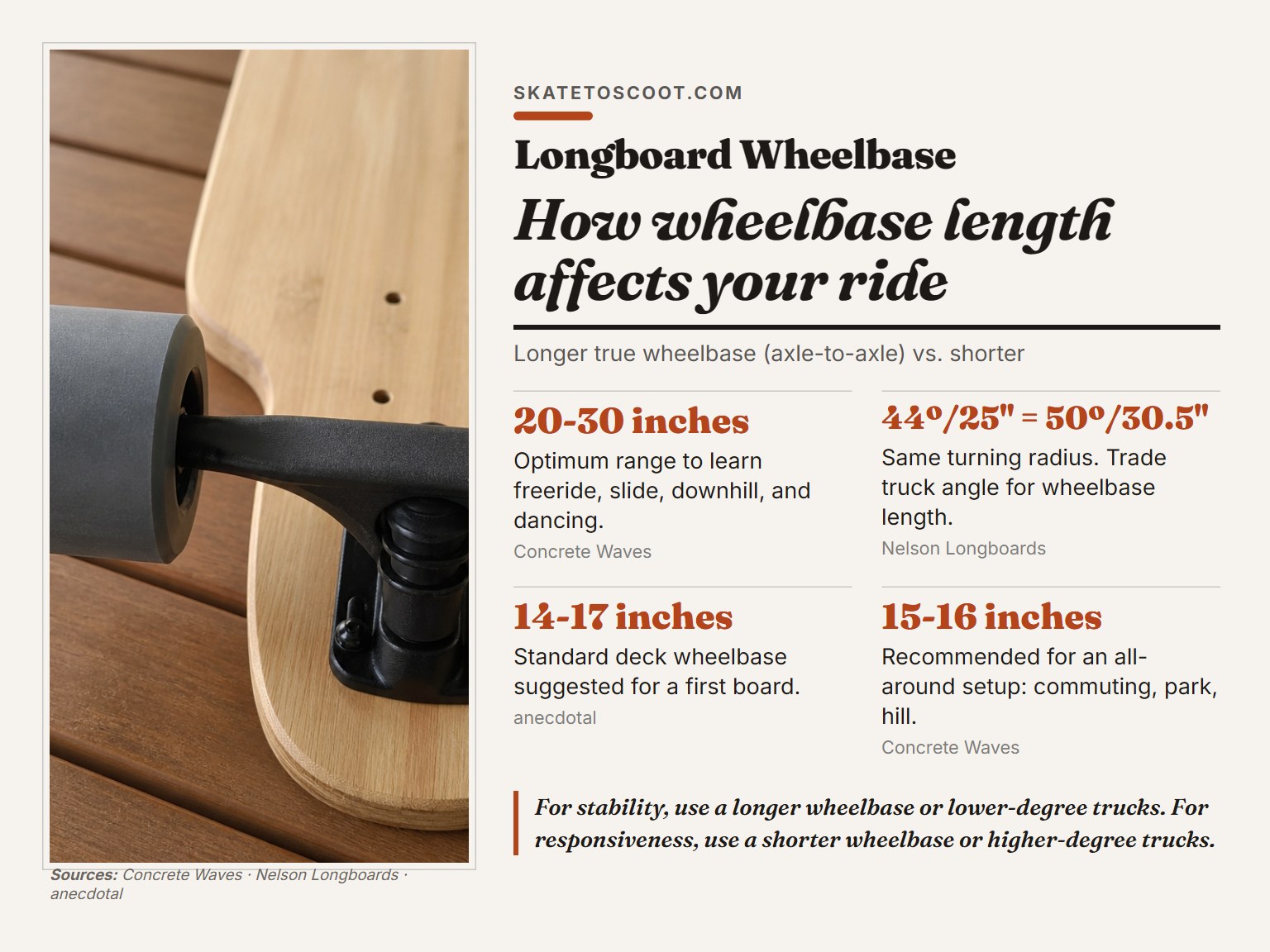
The engineering is precise. Nelson Longboards demonstrated that 44° Caliber trucks on a 25″ wheelbase have the exact same turning characteristics as 50° Calibers on a 30.5″ wheelbase. You can trade truck angle for wheelbase length to dial in the same feel. For a more responsive ride, use a shorter wheelbase or higher-degree trucks. For stability, use a longer wheelbase or lower-degree trucks.
This relationship is why your longboard size conversation always circles back to the how to measure longboard wheelbase question. The deck length itself is less important than where your feet go relative to the axles.
Wheelbase Ranges and Riding Styles
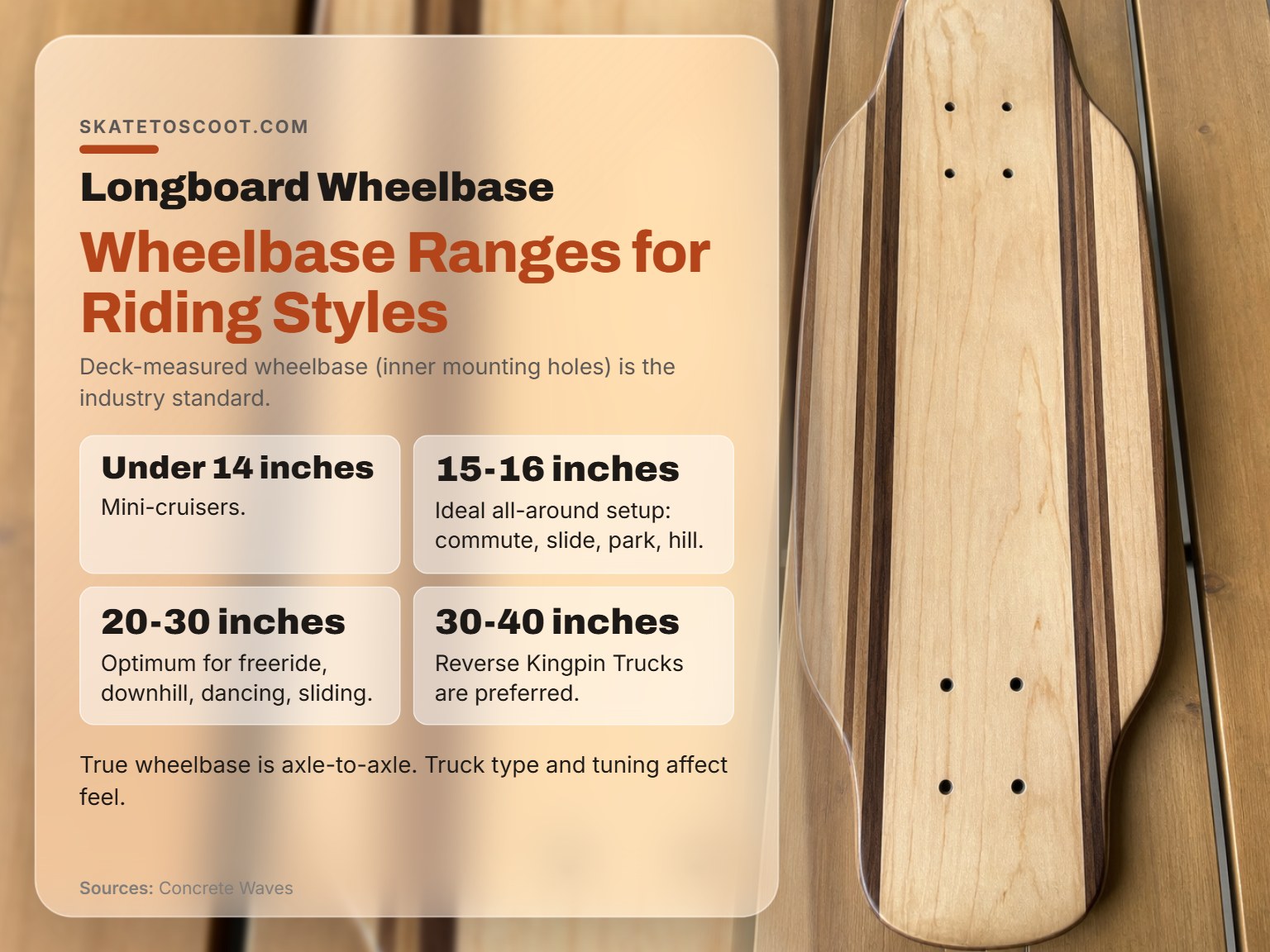
Not all wheelbases are created equal. Your riding style dictates the sweet spot. The numbers below refer to the deck-measured wheelbase (mounting holes), as that’s what you’ll find on spec sheets.
| Deck Wheelbase Range | Typical Riding Style | Key Characteristic | Truck Recommendation |
|---|---|---|---|
| Under 14 inches | Mini-cruisers, small commuters | Sharp, quick turns; less stable. | Traditional Kingpin (TKP) |
| 14 – 16 inches | Street skating, technical flip tricks, all-around cruising | Balanced agility and stability. | TKP for street, RKP for hybrid |
| 15 – 16 inches | All-around hybrid (commuting, slides, park, mild downhill) | The “do everything” range recommended for versatility. | RKP or specific TKP |
| 16 – 20 inches | Hybrid longboarding, freeride, surfskates | Longboard feel with some street trick capability. | RKP preferred |
| 20 – 30 inches | Freeride, downhill, dancing, sliding | The optimum range for stability at speed and slide control. | Reverse Kingpin (RKP) |
| 30 – 40 inches | Downhill racing, long-distance pumping (LDP) | Maximum stability for high speeds; requires precise truck tuning. | Reverse Kingpin (RKP) required |
Concrete Waves specifically calls out the 15-16 inch range as the ideal all-around wheelbase for a rider who wants to commute, slide, do flip tricks, hit the skatepark, and bomb a hill on one setup. That’s a powerful default if you’re after a single quiver-killer.
Where this gets contentious is downhill. The sources don’t fully agree. Concrete Waves lists 20-30 inches as optimum. Yet, real riders push the limits lower. One reports riding a 24″ wheelbase Wolfshark with 50-degree Bear precision trucks at speeds up to 95 km/h. Another did the famous Maryhill run on an 18″ wheelbase mini. Your skill level and truck setup let you cheat these ranges.
Where this goes sideways: Choosing a wheelbase based solely on a pro’s setup. Their 24″ downhill rocket is tuned with precision trucks and years of muscle memory. Your first board should match your stance, not their highlight reel.
If you’re configuring a deck for a specific discipline, look for models with adjustable wheelbase patterns. Brands like Lush Longboards drill multiple mounting hole sets so you can set a deck up with a “super-short responsive wheelbase” for freeride spins or a “long wheelbase Downhill/Freeride” setup on the same board.
How Your Setup Alters Wheelbase
Your deck’s spec sheet is just the starting point. Three key components actively change your effective wheelbase:
- Truck Type & Offset: This is the big one. RKP truck axles sit closer to the board’s center than TKP axles. If you take a deck measured at 20″ and swap truck types, your true axle-to-axle distance will change based on the specific truck’s offset. Reverse Kingpin (RKP) truck axles are generally placed closer to the board’s center than Traditional Kingpin (TKP) truck axles. Always factor in truck geometry when planning a build.
- Bushing Height: It sounds minor, but it’s a direct mechanical intervention. Taller bushings wedge the truck, effectively lengthening the wheelbase. Shorter bushings do the opposite. Changing your bushings for feel can accidentally tweak your wheelbase geometry.
- Adjustable Mounting: Many decks offer multiple mounting options. Moving your trucks to a different set of holes is the most direct way to experiment with wheelbase. This is a fundamental step when you learn how to install longboard trucks—you’re not just bolting them on, you’re choosing a riding mode.
The Cal Poly skateboard truck study on Ackermann steering geometry formalizes this relationship. The truck’s pivot point, axle location, and kingpin angle all interact with the wheelbase to create your final turning radius. It’s not a single variable.
Here’s the practical takeaway: when you’re tweaking your setup and something feels “off,” check your true wheelbase. Did a new truck change the offset? Did you crank down on taller bushings? That half-inch shift you didn’t measure is probably the culprit.
Matching Wheelbase to Your Stance and Height
A spec sheet can’t tell you if a board will feel comfortable. Your body decides that. The most common question I get is, “What size longboard for my height?” The better question is about your natural stance width.
Here’s a field test. Stand in your relaxed, athletic stance, as if you were about to roll. Have a friend measure the distance from the inside of your back foot to the inside of your front foot. That’s your stance width.
Your ideal deck wheelbase should be close to this stance width. Your ideal deck wheelbase should be close to your stance width. A wheelbase much shorter than your stance forces your feet too close together, making you crouch awkwardly. A wheelbase much longer forces you to stretch, killing your power for turning or pushing.
Easy to miss: Surfskate and waterborne adapters often have a built-in setback. A rider notes that YOW Meraki trucks have about a 2-inch setback, meaning your effective wheelbase is shorter than the deck measurement. Your front foot ends up further back relative to the axle.
An anecdotal rider suggests that for a first board, a standard deck wheelbase of 14-17 inches would be comfortable for an 18″ stance. It accommodates an average 18″ stance comfortably because your back foot sits inside the rear truck. Your longboard size for height is less about the deck length and more about matching this wheelbase-to-stance ratio. A taller rider with a longer stride might simply prefer a deck with multiple mounting options to fine-tune this fit.
How Truck Geometry Affects Your True Wheelbase
The distance between your deck’s mounting holes is just a starting point. Your true wheelbase, measured axle-to-axle, is what you actually ride. Different truck types shift this measurement. Reverse kingpin trucks generally place their axles closer to the board’s center compared to traditional kingpin trucks, effectively shortening the true wheelbase for the same deck. Specific truck models can add several inches to the deck’s stated measurement. Even your bushing height changes things; taller bushings wedge the truck and lengthen the wheelbase, while shorter bushings shorten it.
How Wheelbase Changes Your Board’s Feel
Wheelbase directly controls force and responsiveness. A shorter wheelbase gives you a more responsive ride, making the board quicker to turn and easier to kick out for slides. This setup is ideal for mixing spins and flips into a run. Lush Longboards states longer wheelbases create a sliddier, more predictable feel during slides, while other sources note a smaller wheelbase can provide an easier time kicking out slides. For a more responsive ride, you use a shorter wheelbase or higher degree trucks. For stability, you use a longer wheelbase or lower degree trucks. These combinations let you fine-tune the board’s handling to match your style.
Using Decks with Adjustable Wheelbases
Many longboard decks come with multiple sets of mounting holes, giving you an adjustable wheelbase. This allows you to experiment with the board’s feel without buying new gear. Moving your trucks to the innermost holes creates the shortest possible wheelbase for a quick, responsive ride suited for technical slides and tricks. Mounting them in the outermost holes maximizes the wheelbase for superior stability at high speeds, ideal for downhill. An adjustable deck is a practical way to find your preferred setup or adapt one board for different types of riding.
Frequently Asked Questions
What is the difference between wheelbase and deck length?
Deck length is the total tip-to-tail measurement of the board. Wheelbase is the functional distance between your wheels (axle-to-axle) that governs handling. A longer deck can have a short wheelbase if the trucks are mounted close together, and vice-versa. When choosing a board, prioritize the wheelbase spec over the overall length.
Can I change my longboard’s wheelbase?
Yes, in several ways. The most direct method is using a deck with multiple mounting hole patterns, allowing you to mount trucks in different positions. You can also alter it indirectly by changing truck types (RKP vs. TKP), using different bushings (taller or shorter), or adding angled riser pads that modify the truck geometry.
Is a shorter or longer wheelbase better for beginners?
Concrete Waves suggests a wheelbase of 20-30 inches is optimum for stability to learn disciplines like downhill and freeride, while anecdotal rider advice for a first board recommends a standard deck wheelbase closer to 14-17 inches to match an average stance. A very short wheelbase can be twitchy and feel uncontrollable until you develop precise foot and weight control.
How does wheelbase affect speed?
Wheelbase itself doesn’t directly affect top speed, but it dramatically affects stability at speed. A longer wheelbase resists speed wobbles and provides a stable platform for high-speed downhill runs. A shorter wheelbase may feel nervous and unstable as you go faster, limiting your confidence and effective speed.
Where can I find my deck’s wheelbase spec?
Check the manufacturer’s website or the product listing where you bought the deck. It’s often listed as “WB” in the specifications. If you can’t find it, use the industry standard method: measure the distance between the inner mounting holes for the front and rear trucks on the underside of the deck.
The Bottom Line
Measure axle-to-axle. That’s the number that matters every time you lean into a turn. The deck’s listed wheelbase is a useful comparison tool, but it’s the starting line, not the finish.
If you’re holding a tape measure right now, here’s your first action: check the true wheelbase of your current board. Then, see how far your front foot is from the front axle. If your toes are past it, you’re inviting instability. Move your foot back.
All the math and ranges are guidelines, not prison walls. The rider who did Maryhill on an 18″ mini proved that. But guidelines exist for a reason—they keep you from spending months fighting a setup that’s fundamentally wrong for your goals. Start with a wheelbase that matches your stance and your intended style. You can always drill new holes later.
