Interesting Facts About Hoverboards
This post contains affiliate links. As an Amazon Associate, we earn from qualifying purchases.
A hoverboard is a two-wheeled, self-balancing electric scooter popularized by the 1989 film Back to the Future Part II. The devices sold from 2015 onward sparked a global safety crisis, leading to a recall of roughly 501,000 units, and the creation of the UL 2272 electrical safety standard to mitigate risks.
The gap between the cinematic fantasy and the physical reality is where the real story and the interesting facts about hoverboards live. A product hailed as the future of personal transport became a case study in supply-chain safety, consumer protection, and the limits of voluntary standards, following its initial release (see our overview of when hoverboards came out).
What follows is a breakdown of the numbers you haven’t seen, the bans you might have missed, and the one certification mark that separates a novelty from a nominally safe device, all central to the interesting facts about hoverboards. We’ll start with the spark that nearly burned the whole trend down.
Key Takeaways
- The UL 2272 safety standard is the critical certification for fire safety, but the CPSC explicitly states it cannot guarantee a hoverboard won’t catch fire, while UL presents it as a system-level solution developed in response to fires.
- From 2017 through 2022, the CPSC recorded 18 fatalities linked to hoverboards, with 13 of those deaths resulting from just six separate fire incidents.
- A 2016 recall of approximately 501,000 units was triggered by at least 99 incident reports of batteries overheating, sparking, or exploding.
- 67% of all hoverboard injuries from 2017-2022 occurred in children aged 5 to 14, according to CPSC demographic data.
- More than 60 airlines and over 20 U.S. Colleges instituted complete bans on hoverboards in the mid-2010s due to fire risks.
The Bans That Grounded the Hype
The first sign that hoverboards were more than just tricky to ride came from the places that wouldn’t allow them. Before most parents had even heard of a “Swagway,” transportation authorities were pulling them off the grid.
More than 60 separate airlines, including every major U.S. Carrier, banned them outright from both carry-on and checked luggage. New York City’s Metropolitan Transit Authority barred them from all subways and buses. Over 20 colleges and universities enacted complete or partial bans on campus. This wasn’t a reaction to clumsy riders, it was a preemptive strike against the risk of a lithium-ion battery fire in an enclosed, crowded space.
Where this goes sideways: Storing or charging a hoverboard near anything flammable. The CPSC is aware of more than $4 million in property damage related to hoverboards, a figure that doesn’t account for the human cost.
The regulatory response was a direct reflection of the incident data. From December 1, 2015, through February 17, 2016, the CPSC received notices of 52 separate fires directly linked to hoverboards, resulting in more than $2 million in property damage, according to a UL whitepaper citing CPSC data. The fuse was lit, and the recall that followed was one of the largest coordinated consumer product actions of the decade.
How They Actually Work (and Where They Fail)
First, we should clarify. The name “hoverboard” is a marketing misdirection, a nod to science fiction. The real technology is a blend of gyroscopes, accelerometers, and electric motors, as detailed in our guide on how hoverboards work. Your lean is read by sensors, which tell the motors in each wheel how fast to spin to keep you upright and move you forward. The power comes from a battery pack stuffed with cylindrical lithium-ion cells, usually the 18650 size.
This is where the engineering problem lives. In many early, cheaper models, these cells were packed tightly together with minimal spacing or protective material between them. CPSC-funded testing with the Naval Surface Warfare Center found these commercial packs were susceptible to “cell-to-cell propagation.”
Here’s the mechanism: if one cell goes into thermal runaway, overheating to the point of venting flame or exploding, it can dump enough energy into the adjacent cells to trigger them as well. The result isn’t just a dead battery; it’s a cascading fire that can engulf the whole unit in seconds. This specific failure mode was a core reason for the catastrophic fires that defined the hoverboard’s early reputation.
The 2016 Recall: By the Numbers
On July 6, 2016, the U.S. Consumer Product Safety Commission announced a massive coordinated recall. Ten firms were involved, and the scale was staggering.
| Company / Brand | Units Recalled | Primary Model(s) |
|---|---|---|
| Swagway LLC | 267,000 | Swagway X1 |
| Keenford Ltd. | 84,000 | iMoto |
| Hoverboard LLC | 70,000 | Powerboard |
| Razor USA LLC | 28,000 | Hovertrax |
| Hype Wireless | 25,000 | Hype Roam |
| Digital Gadgets LLC | 16,000 | Hover-Way (Model # HWSBB601-R) |
| PTX Performance | 4,900 | Airwalk Self Balancing Electric Scooter |
| Overstock.com | 4,300 | All brands sold |
| Boscov’s | 1,300 | Orbit |
| Yuka Clothing | 800 | Wheeli, 2Wheelz, etc. |
The trigger was at least 99 incident reports of battery packs “overheating, sparking, smoking, catching fire and/or exploding.” This action pulled brands like the Swagway X1 and Razor Hovertrax out of homes and off store shelves.
Common mistake: Assuming a “UL-compliant battery” means a safe hoverboard. The UL 2272 standard covers the entire electrical system of the unit. A certified charger or battery pack alone does not mean the assembled product meets the standard.
The recall notice also highlighted a critical marketplace shift. At the CPSC’s request, Alibaba Group began requiring certifications from testing agencies for hoverboards listed by third-party sellers on its platforms. This was a direct attempt to stem the tide of non-compliant units flooding the global market from unregulated manufacturers.
UL 2272: The Standard That Changed the Game (Mostly)
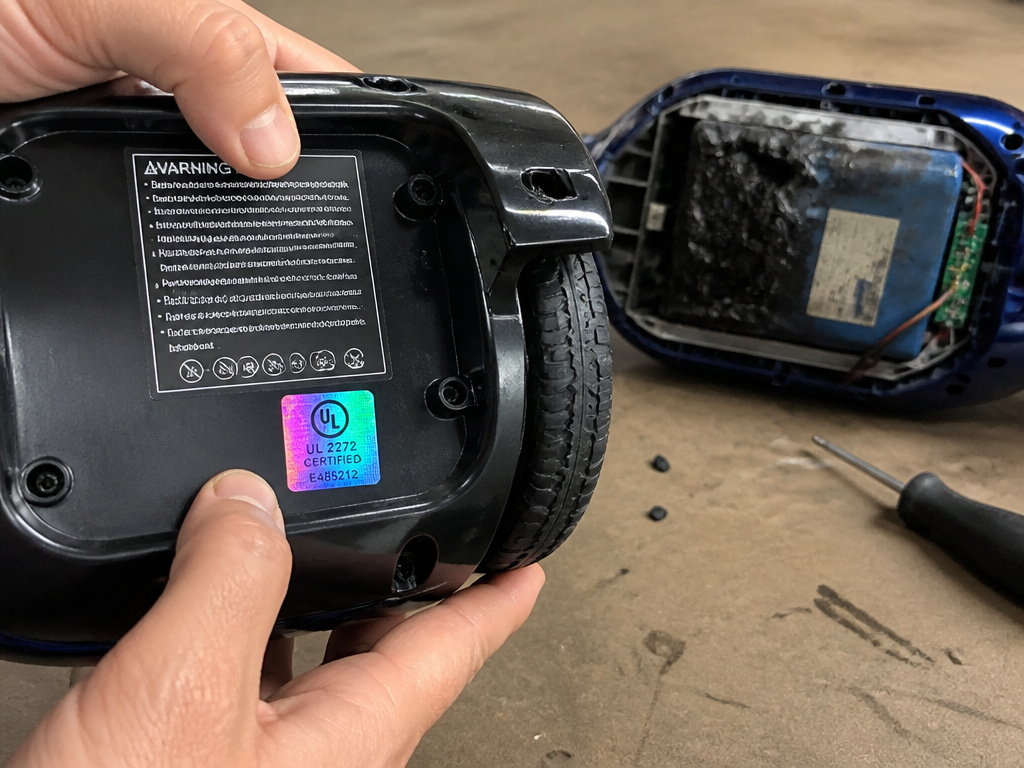
In response to the fire crisis, the UL 2272 safety standard was developed and became the benchmark. It’s a system-level evaluation, testing the entire hoverboard, not just its parts, for electrical, mechanical, and environmental safety. If you’re buying new, this is the label you must look for: a holographic certification mark on the bottom of the board.
But here’s the part most articles gloss over. The CPSC hoverboard safety alert states it plainly: “even UL 2272 compliance cannot guarantee that a hoverboard will not overheat or catch fire.”
Think of it as a seatbelt, not a forcefield. The standard drastically improves the odds by addressing known failure points in construction and battery management system design. However, it cannot eliminate risk entirely, especially from physical damage, improper use, or charging with a non-supplied charger.
The CPSC’s own guidance is blunt: if you bought your hoverboard before January 29, 2016, it is not UL 2272 compliant. They advise buying only from reputable sources and avoiding kiosks, secondhand sellers, or online retailers who cannot provide proof of compliance.
Injury Statistics: Who Gets Hurt and How
Beyond the fires, hoverboards have a significant injury profile. The data paints a clear picture of who is most at risk.
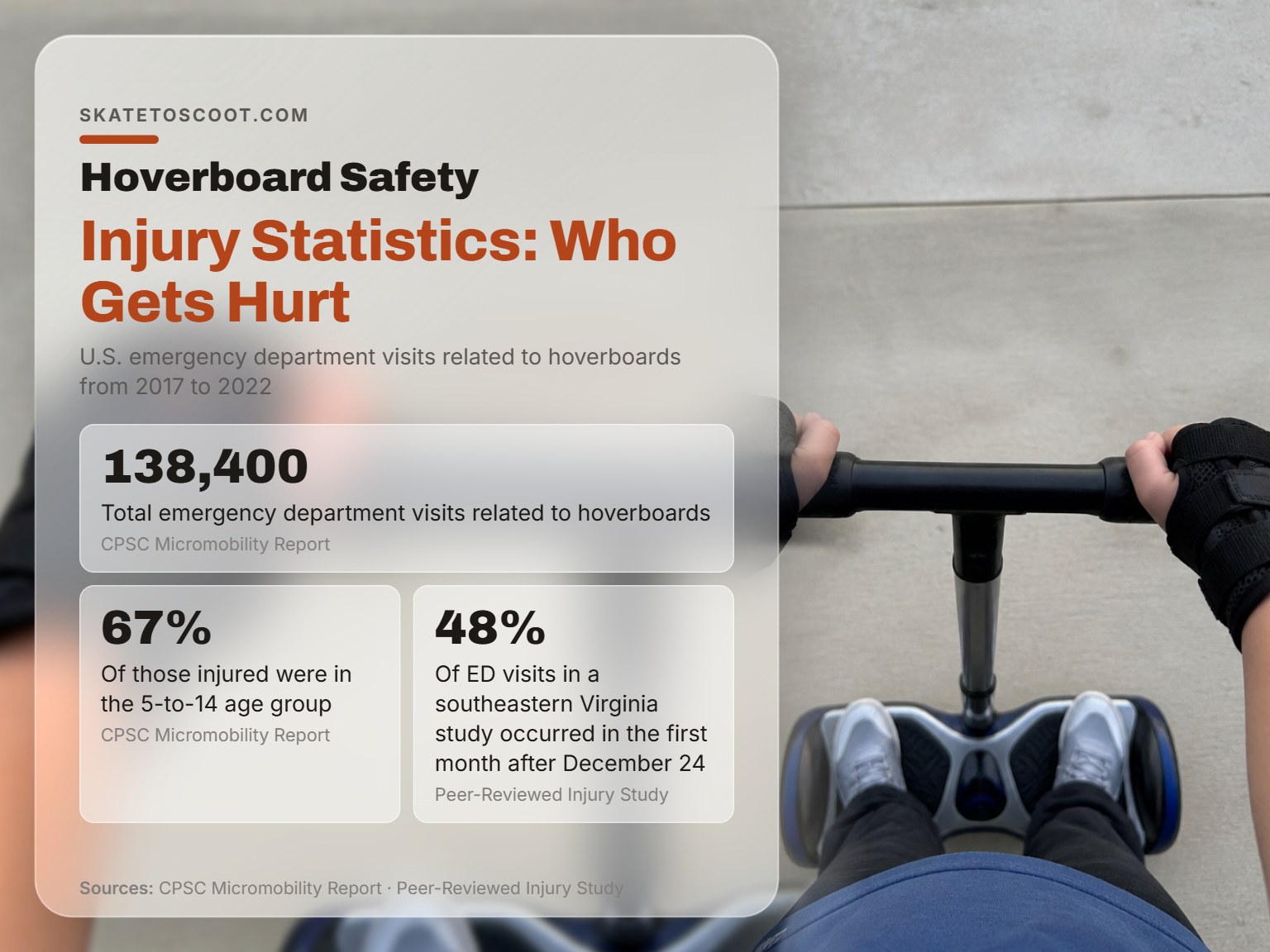
From 2017 through 2022, the CPSC estimates there were 138,400 emergency department visits related to hoverboards. The demographic breakdown is striking: 67% of those injured were in the 5-to-14 age group. This aligns with the product’s marketing and gift-giving appeal to younger riders.
A earlier, peer-reviewed study of 10 emergency departments in southeastern Virginia identified 83 hoverboard-related injury patients between December 2015 and June 2016. It found that almost 48% of all ED visits occurred in the first month after December 24, and 14% of patients were injured while using a friend’s or family member’s board, suggesting inexperience played a major role.
The types of injuries follow the physics of falling from a standing height onto outstretched hands. Fractures to the wrist, forearm, and elbow are common. This is why the fundamentals, wearing a helmet and wrist guards, aren’t just good advice; they’re a direct response to the most likely outcomes of a crash.
The Pop-Culture Legacy vs. Reality
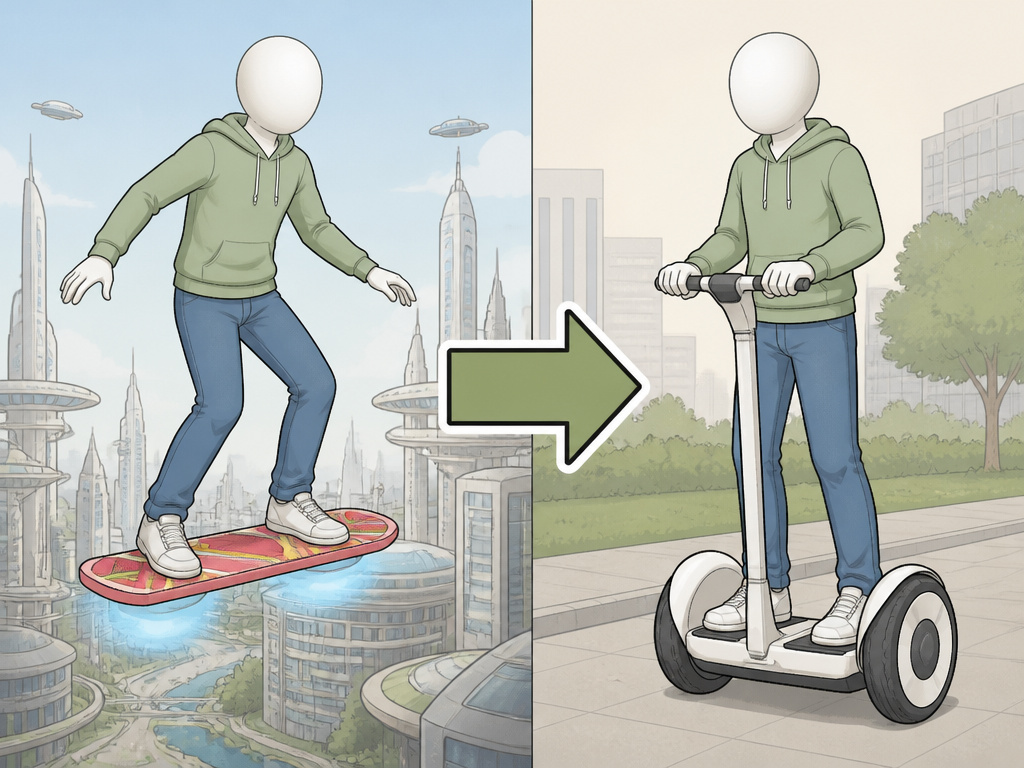
No discussion of hoverboard facts is complete without acknowledging the Back to the Future effect. The film franchise created the iconic image of a levitating skateboard, seeding a desire that the 2015 products could never fulfill. The name stuck, despite the glaring absence of any actual hovering.
This cultural debt created a marketing whirlwind. Celebrity endorsements and social media posts made them a must-have holiday item, fueling the sale of an estimated 2.5 million units in the U.S. By 2016. By 2016 coincided with the safety crisis we’ve outlined.
The part nobody mentions: The “hoverboard” you can buy today is a direct descendant of the self-balancing technology pioneered by Shane Chen’s Hovertrax, not the fictional grav-board from the movies. It solved a balance problem, not a gravity problem.
The legacy today is a matured, albeit niche, product category with various models available (learn about the different types of hoverboards). The wild-west days are over, replaced by stricter import controls, a clear safety standard, and a more measured public perception. They are tools for short-distance commuting or recreation, not cultural phenomena.
Are there real hovering hoverboards?
True levitating hoverboards, like those seen in science fiction, remain experimental and are not commercially available consumer products. These prototypes, often developed by companies or research groups, operate on different principles than the wheeled, self-balancing scooters commonly called hoverboards. They are typically confined to controlled demonstrations and are not something you can buy for personal use. For the average rider, the so-called hoverboard is a ground-based, battery-powered device with wheels. When considering a purchase, focus on the safety and certification of the actual products on the market, not the futuristic concept.
How fast and far can hoverboards go?
Official data on hoverboard injuries and fires provides a stark picture of their risks, rather than their performance specs. From 2017 through 2022, there were an estimated 138,400 emergency department visits related to hoverboard use. The majority of these injuries, 67%, occurred in children between the ages of 5 and 14. A separate study in southeastern Virginia found that almost half of all hoverboard-related ED visits in their area occurred in the first month after Christmas. While speed and range vary by model, the consistent data shows these devices pose a significant risk of falls and collisions, especially for younger riders.
Can you use a hoverboard indoors and outdoors?
Using a hoverboard comes with significant safety considerations that extend beyond wheel size or terrain. The primary hazard is fire. From 2017 through 2022, safety investigators looked into 166 hoverboard incidents, and 139 of them were specifically fire hazards. These fires have led to tragic outcomes, including fatalities. Authorities recommend never charging a hoverboard unattended, especially overnight, and keeping it away from anything flammable while charging or even storing it. Many institutions have banned them entirely; over 60 airlines and more than 20 colleges and universities prohibit hoverboards due to fire risks, regardless of where you intend to ride.
Frequently Asked Questions
What are some interesting facts about hoverboards?
The most compelling facts are the hard numbers behind their safety saga: the recall of 501,000 units, the 18 fatalities recorded by the CPSC from 2017-2022, and the creation of the UL 2272 standard in direct response to fire incidents. Their widespread ban by airlines and transit authorities is also a unique chapter in consumer product history.
What was the first hoverboard ever made?
Why did hoverboards get banned?
Hoverboards were banned primarily due to fire risk. Airlines, public transit systems, and universities prohibited them because their lithium-ion battery packs were prone to overheating and causing fires, a severe hazard in enclosed public spaces. These bans were a direct reaction to the CPSC’s published incident data.
Should a 7 year old have a hoverboard?
The CPSC injury data shows that 67% of hoverboard injuries from 2017-2022 were in the 5-to-14 age group. While not illegal, it highlights a significant risk. If a child uses one, it must be a UL 2272 compliant model, and they must wear full safety gear, helmet, wrist guards, knee and elbow pads, and be supervised in a safe, traffic-free area.
The Bottom Line
The story of the hoverboard is a masterclass in what happens when hype, technology, and consumer safety collide at high speed. The interesting facts aren’t just about celebrity riders or movie references; they’re in the regulatory paper trail and the sobering statistics.
If you remember one point, remember this: UL 2272 compliance is the essential starting point, not a guarantee of absolute safety. It represents the hard-won minimum standard born from real tragedy. The device you glide on today stands on the scorched ground of its own problematic history. Understanding that history is the only way to make a truly informed choice about riding one, or buying one for someone you care about.
