iScooter i10 Max Review: Performance and Battery Life
This post contains affiliate links. As an Amazon Associate, we earn from qualifying purchases.
While the manufacturer claims a 28 mph top speed and 50-60 mile range, real-world results vary; GPS-verified top speeds often hover around 25 mph, and range depends heavily on rider weight, speed mode, and terrain. Its dual suspension and 10-inch pneumatic tires provide decent comfort, but the IP54 rating only protects against light splashes, not wet-road riding.
That gap between advertised specs and real-world results is where most iscooter i10 max review articles stop. They list the numbers from the website and call it a day. The actual questions an owner needs answered are about the stuff that happens after the first week: how the motor handles a steep hill with a full load, what the “E9” error code flashing on the display actually means, and whether that “waterproof” claim holds up when you hit a puddle.
This iscooter i10 max review breaks down the i10 Max from the ground up, using the official specs, the EU variant manual for comparison, and real owner reports from hundreds of miles of use. This review explains the performance you can expect, the important build quality details, and the common issues, from tire wear to error codes, that the marketing page doesn’t mention.
Key Takeaways
- The 28 mph top speed is a best-case scenario; real-world GPS speeds are closer to 25 mph, especially for riders near the 264 lb max load.
- Advertised 50-60 mile range is measured under ideal lab conditions (70kg rider, 15 km/h, flat road). A 170 lb rider using sport mode will see 30-35 miles.
- The IP54 water resistance rating means the scooter can handle light rain and splashes, but riding through puddles or on wet roads risks water ingress and voids the warranty.
- Front and rear suspension softens small bumps effectively, but the front shocks can bottom out frequently for riders over 170 lbs, according to owner reports.
- Error codes like E4 (Accelerator Fault) and E9 (Motor Overheating) are common; knowing what they mean and how to reset the scooter can save a long walk home.
Performance & Speed: Does It Hit 28 MPH?
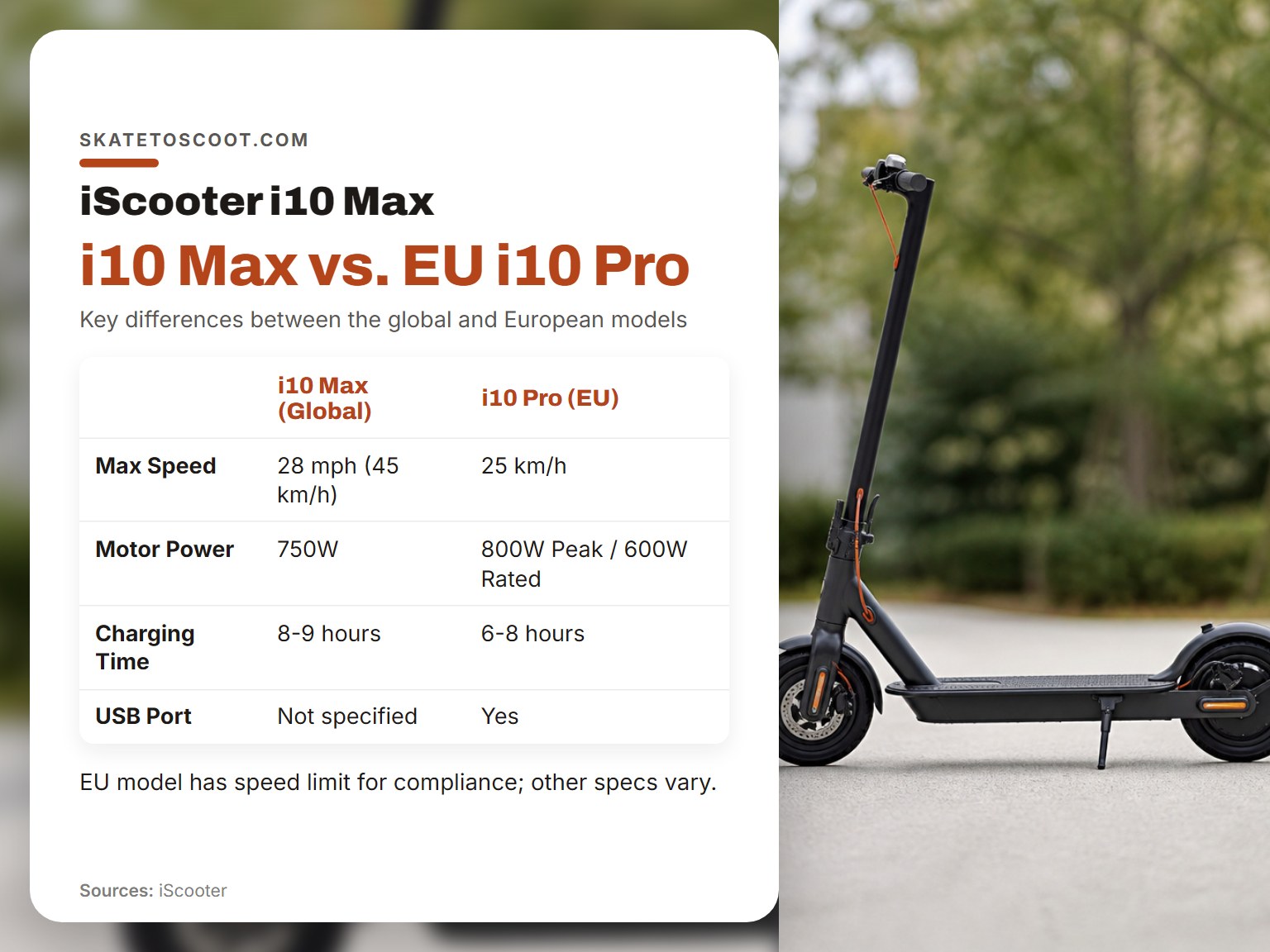
The global/US spec sheet says 28 mph (45 km/h), while the EU i10 Pro variant manual lists a maximum speed of 25 km/h. My first ride on a flat stretch with a full charge showed 28 on the display. My GPS said 25. That three-mile-per-hour difference is the story of this scooter.
The 750W rear hub motor provides strong initial acceleration. The power is delivered through a thumb throttle. Where the speed claim meets reality is under load or on an incline. The motor will maintain speed on gentle slopes, but on a steep hill, you’ll watch the number on the display drop. A rider at the max load of 264 lbs will feel this even more.
The official range of 50-60 miles is measured under a strict lab condition: full charge, 70 kg (154 lb) load, 24°C (75°F), on a flat road with no wind, at a steady 15 km/h (9.3 mph). Any deviation from this perfect scenario cuts range.
This isn’t a criticism, it’s physics. The takeaway is to temper your expectations. If your commute involves hills, headwinds, or you like to use the faster speed modes, your real-world range will be substantially lower. For a 170 lb rider mixing eco and sport modes, a realistic expectation is 30-35 miles per charge. That’s still plenty for most urban commutes, but it’s not the 60-mile fantasy the marketing can imply.
Hill Climbing Performance
The scooter handles moderate inclines reasonably well, often maintaining near-top speed. However, truly steep hills will cause a significant slowdown. This is a single-motor scooter, not a dual-motor off-road beast. For city use with occasional overpasses, it’s adequate. If your daily route is exceptionally hilly, you might want to look at more powerful models in the iScooter lineup, like the iScooter iX7 Pro.
Battery Life & Charging: The Real-World Math
The i10 Max packs a 48V 15.6Ah battery, which iScooter claims is good for 8-9 hours of recharge time from empty. The EU variant manual for the i10 Pro lists a 6-8 hour charge time for a similar 48V 15Ah pack, illustrating a point of variation between the models.
The more important note is in the manual itself: the scooter cannot be turned on while charging. This is a safety interlock to prevent damage. The charger will automatically cut off when the battery is full, but the manual still warns against leaving it plugged in for more than 24 hours at a time.
Range Expectations vs. Reality
Let’s put the official range claim to the test with some real variables:
- Rider Weight: Add 50 lbs over the test weight, and range drops.
- Speed: Cruise at 25 mph instead of 9 mph, and range plummets.
- Terrain: Hills consume battery power aggressively.
- Temperature: The operating range is 32-104°F (0-40°C). Riding in cold weather reduces battery efficiency.
A Reddit owner with the EU version reported getting about 60 km (37 miles) on a charge while using a speed limiter set to 25 km/h (15 mph). Another owner of the standard iScooter i10 estimated 20 miles of real range. The Max has a larger battery, but the principle is the same: your mileage will vary, widely.
| Factor | Ideal Test Condition | Real-World Impact |
|---|---|---|
| Rider Weight | 154 lbs (70 kg) | Heavier rider = reduced range & slower acceleration |
| Speed | 9.3 mph (15 km/h) | Faster travel = exponentially higher energy use |
| Terrain | Perfectly flat road | Hills & rough pavement can cut range by 30-40% |
| Temperature | 75°F (24°C) | Cold weather (<50°F/10°C) significantly reduces capacity |
Build Quality & Portability: The 47-Pound Commuter
Unfolded, the i10 Max measures approximately 46.8 inches long by 20.8 inches wide by 48.8 inches high. Folded, it shrinks to approximately 46.8″ L x 20.8″ W x 21.6″ H. At 46.7 lbs (21.2 kg), it’s not light, but the folding mechanism is simple and robust, a single latch secures the stem to the rear fender. It’s portable enough to carry up a few stairs or load into a car trunk, but you wouldn’t want to carry it a mile.
The frame is a sturdy aluminum alloy. The deck is covered in a grippy, rubberized material that provides excellent footing. The handlebars are fixed (not foldable) and covered in foam grips. Everything feels solid during assembly and regular use. The finish is good, though some owners note minor cosmetic inconsistencies, nothing that affects function.
The Suspension & Tire Reality
The scooter has front and rear double shock absorbers and 10-inch pneumatic (air-filled) tires. This combo is effective at smoothing out sidewalk cracks, pavement seams, and minor road imperfections. The ride is noticeably more comfortable than scooters with only solid tires or no suspension.
However, several owners around 170 lbs have reported that the front suspension bottoms out too easily on larger bumps or potholes. The rear suspension is generally praised as being better tuned. The pneumatic tires are a double-edged sword: they provide great cushioning and traction but are susceptible to punctures. Keeping them properly inflated to the rated PSI is crucial for both range and flat prevention.
The Braking System: EBAS & Disc
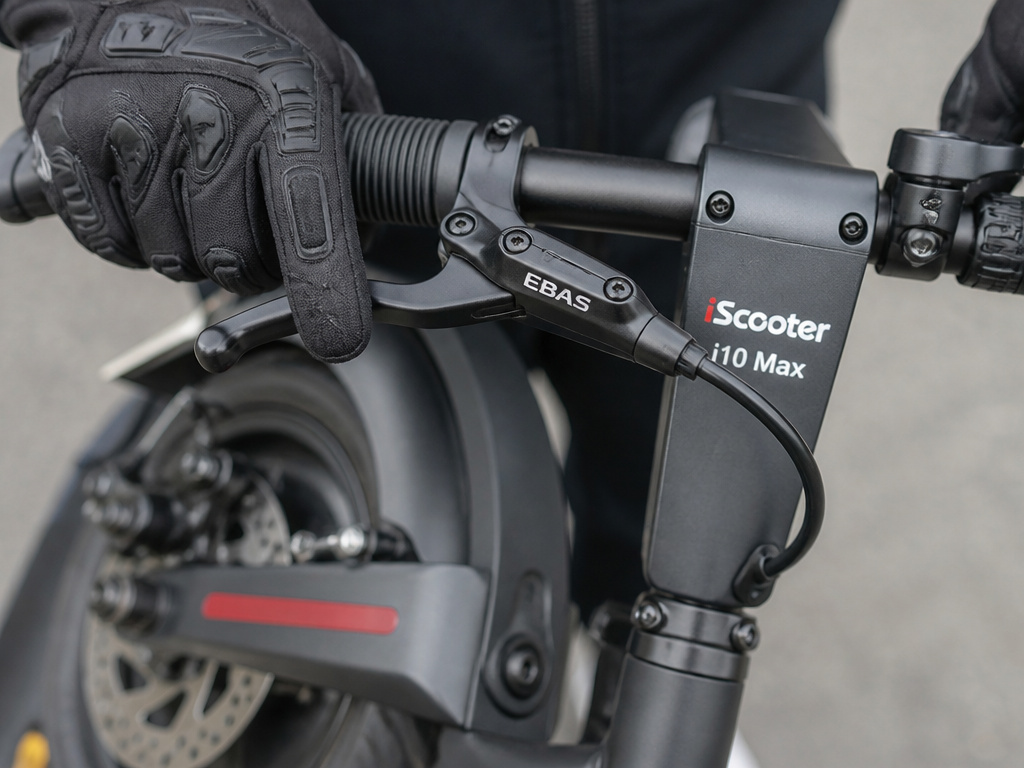
Safety is where the i10 Max makes a good impression with its dual braking system. It uses a dual braking system: an EBAS (Electronic Braking Assist System) on the front wheel and a mechanical disc brake on the rear.
The EBAS system is an electronic braking assist system on the front wheel. More importantly, it provides strong, predictable stopping power. Many owners find they use the EBAS lever on the left handlebar for most of their braking, only reaching for the rear disc brake for sudden stops or steep descents. The rear disc brake is a standard, cable-actuated caliper, it works well and is easy to maintain.
Common mistake: Riding with the brake levers even slightly engaged. This creates constant drag, overheats the motor and controller, and can trigger error codes like E5 (Brake Lever Fault) or E9 (Motor Overheating).
The brakes are one of the scooter’s strong points. They inspire confidence, which is essential for urban riding where sudden stops are a fact of life. Just be sure to check the cable tension and pad wear periodically, as you would with any mechanical brake.
Smart Features & App: How Useful Is It?
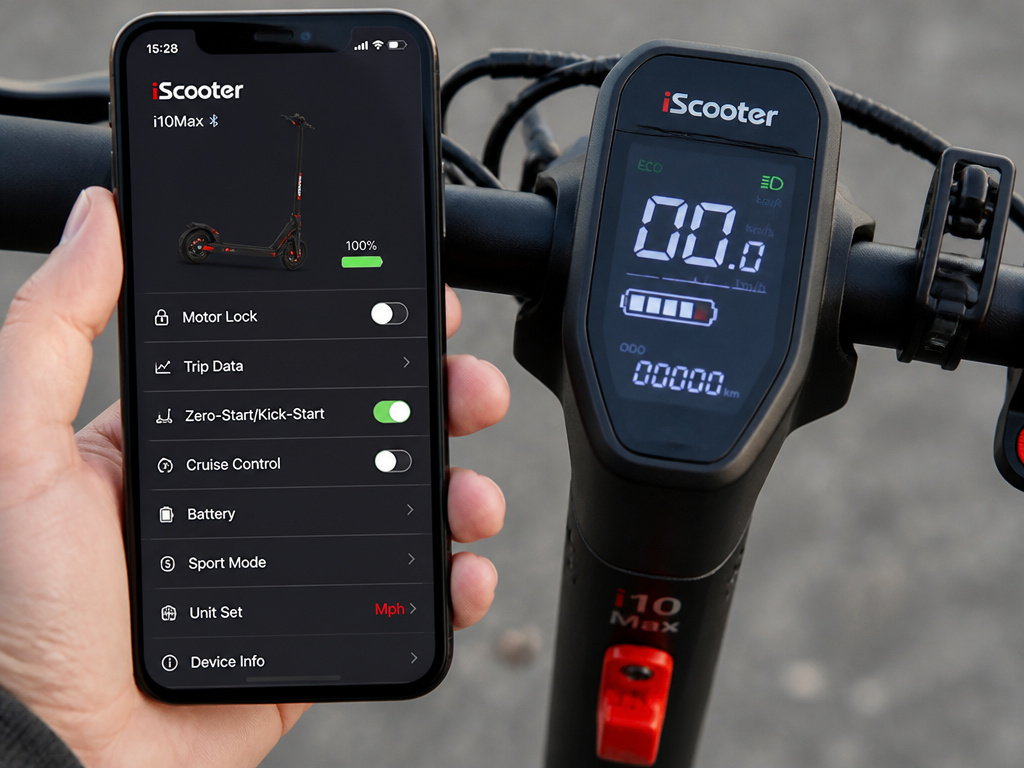
The i10 Max has a multi-functional LED display mounted centrally on the handlebars. It shows speed, battery level (in 5 bars), speed mode, and if connected, Bluetooth status. It’s bright and readable in direct sunlight. The controls around it let you toggle the headlight, change speed modes, and activate cruise control.
The cruise control is a genuine quality-of-life feature for longer, straight-line rides. Hold a steady speed for a few seconds, and the scooter will lock it in until you brake or throttle again.
The iScooter App
The scooter pairs with the iScooter App (iOS/Android). Its functionality is fairly basic but useful:
- Lock the scooter (a motor lock that prevents wheel spin).
- View trip metrics (distance, average speed).
- Check real-time battery voltage (more accurate than the 5-bar display).
- Adjust acceleration sensitivity and startup mode (zero-start vs. Kick-start).
- Update firmware (rarely).
The app works reliably, but it’s not essential for daily use. The most valuable setting for new riders is switching to “zero-start,” which allows you to accelerate from a standstill without kicking off. Some owners who encountered error codes thought their motor was broken until they realized they’d accidentally switched this setting off in the app.
Common Issues & What the Manual Says
No scooter is perfect, and the i10 Max has a few known pain points. The good news is that iScooter documents many of them right in the manual with specific error codes.
Error Codes You Might See
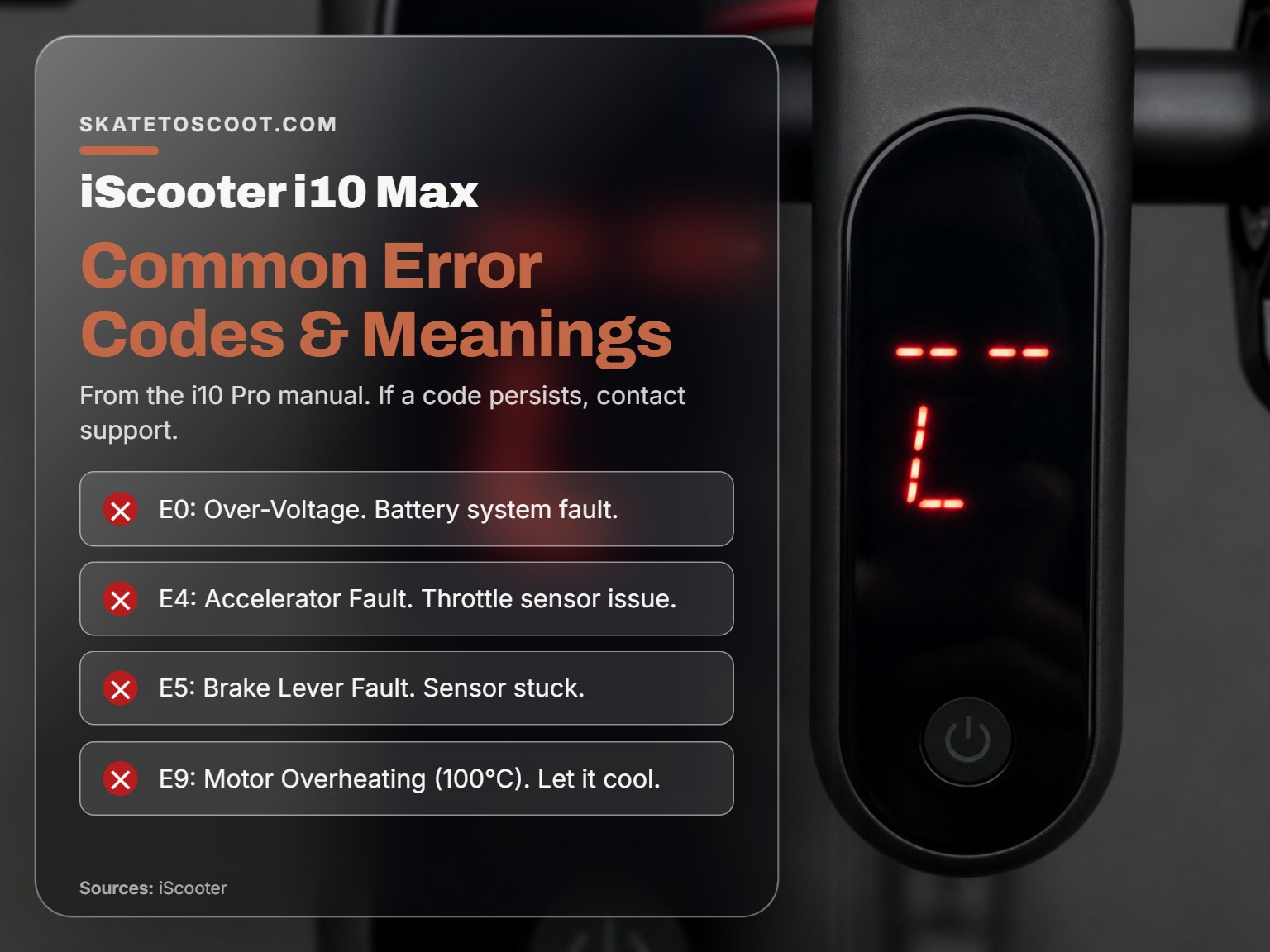
The display will flash a code like “E4” if it detects a fault. Here’s what the most common ones mean, straight from the i10 Pro manual:
- E0: Over-Voltage. A problem with the battery management system.
- E4: Accelerator Fault. The throttle sensor or its wiring has an issue.
- E5: Brake Lever Fault. A brake lever sensor is stuck or malfunctioning.
- E9: Motor Overheating (100°C). The motor temperature sensor has tripped. Let it cool down.
If you see these, the first step is to power the scooter off completely, wait 30 seconds, and turn it back on. If the code persists, you’ll need to contact iScooter support. These codes are actually helpful, they tell you exactly what the scooter thinks is wrong, which is better than a generic “no power” situation.
Tire Wear & Parts
The stock tires have been cited by some owners as wearing down quickly. Replacement tires are available, but iScooter’s own parts store can be expensive. Many owners source compatible 10-inch pneumatic tires from third-party sellers for a fraction of the cost. The i10/i10pro series parts page lists official parts like controllers, brake discs, and chargers if you need a guaranteed fit.
IP54 Water Resistance: A Strict Warning
The scooter is rated IP54. This means it’s protected against limited dust ingress and water splashes from any direction. It is not waterproof or submersible.
The manual advises caution with water. The IP54 rating means it is protected against water splashes, but riding in heavy rain or through puddles risks water ingress and potential damage. Water can enter through the deck seams, the charging port, or even be kicked up by the wheels into the motor compartment. If water damage occurs, it’s not covered. This is a crucial point that many buyers miss when they see “waterproof” in marketing copy.
i10 Max vs. I10 Pro: What’s the Difference?
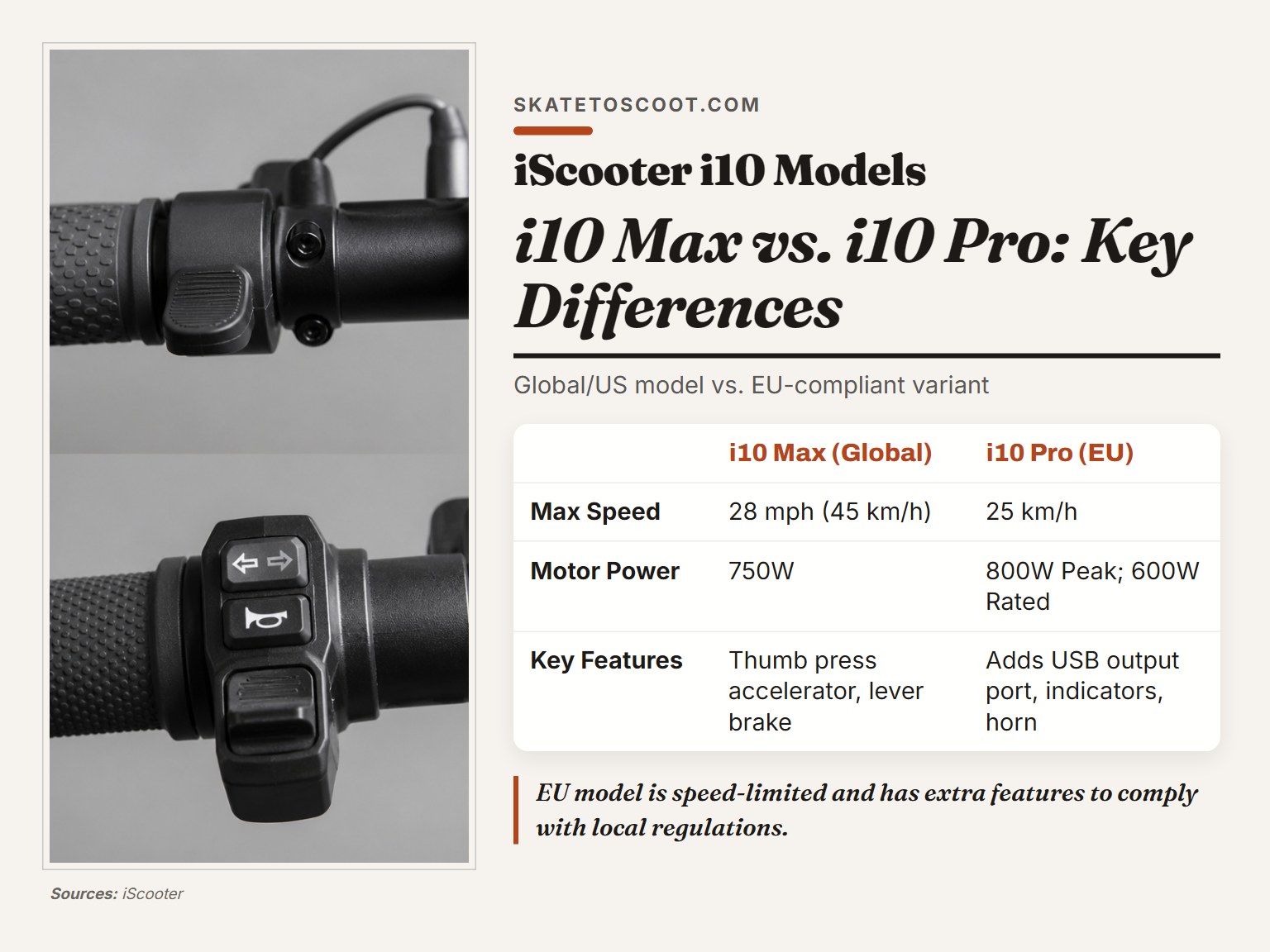
Confusion often arises between the i10 Max and the i10 Pro (the EU variant). They look almost identical, but key specs differ to comply with regional regulations, primarily in the European Union.
| Specification | i10 Max (Global/US) | i10 Pro (EU Variant) |
|---|---|---|
| Net Weight | 46.7 lbs (21.2 kg) | 53.9 lbs (24.45 kg) |
| Key Features | Thumb throttle, lever brake | Adds USB output port, indicator switch, horn switch |
The EU model is speed-limited to 25 km/h to comply with local laws for unlicensed vehicles. It also includes a USB port for charging devices and physical switches for turn signals (indicators) and a horn. If you’re comparing a iscooter i10 max review and see different specs, you’re likely looking at different regional models.
How It Compares to Other iScooter Models
The i10 Max sits in the middle of iScooter’s range. It’s more capable than the lighter iScooter i9 but not as rugged or powerful as the off-road-focused iScooter iX4. Here’s a quick positioning:
- i9 Series: Lighter, less powerful, often single suspension. A cheaper alternative for shorter trips.
- i10 Max: The balanced commuter. Good speed, good range, decent suspension.
- i12/i14: Often heavier-duty, sometimes with seating options, aimed at longer-distance comfort.
- iX Series: Built for tougher terrain with stronger motors, more suspension travel, and knobby tires.
For the average city commuter who wants a bit of extra power and comfort over the base models, the i10 Max hits a sensible sweet spot.
What is the weight limit for the iScooter i10 Max?
The iScooter i10 Max has a maximum rider load of 264 pounds (120 kilograms). This specification is consistent across both the global i10 Max and the EU i10 Pro variant. It’s a practical limit that directly impacts performance. If you’re riding at or near this capacity, expect the scooter’s acceleration and hill-climbing ability to be noticeably reduced compared to a lighter rider. The advertised range is based on a standard test load of 154 pounds (70 kg), so heavier riders will see less range. Always factor in the weight of any gear or cargo you’re carrying.
Frequently Asked Questions
Is the iScooter i10 Max a good scooter?
For the price, yes. It offers strong performance (750W motor, ~25 mph real speed), a range of 50-60 miles for city commuting, and important features like dual suspension and dual brakes. It’s a solid choice if your commute is under 10 miles each way and you have a place to store and charge it. Just be aware of its limits with water, steep hills, and its actual weight.
How fast does the iScooter i10 Max go?
The manufacturer claims 28 mph (45 km/h). In real-world testing, actual top speed is often lower than the maximum claimed speed. The speed is affected by rider weight, battery charge, tire pressure, and terrain. It’s fast enough for most city and suburban needs.
Is iScooter a reliable brand?
IScooter has been around since 2015 and has a large user base. They offer a standard 12-month warranty. Reliability reports are mixed, as with most budget-to-mid-range scooter brands. Some owners have thousands of trouble-free miles, while others report issues like flat tires, error codes, or component failures within the first few months.
Which brand is better, Hiboy or iScooter?
There’s no single “better” brand; it depends on the specific model and your needs. Hiboy is also known for budget-friendly scooters. A direct comparison should be based on the specific specifications of each model. You should compare specific models (like the Hiboy S2 Pro vs. The iScooter i10 Max) on the specs that matter most to you: motor power, battery capacity, suspension, and portability.
Before You Go
The iScooter i10 Max is a competent machine that delivers most of what it promises, just not always to the exact number on the box. It’s a 25 mph scooter, not 28. It’s a 35-mile range scooter for most, not 60. That doesn’t make it bad, it makes it real.
If your needs align with that reality, a daily commuter under 15 miles, on decent pavement, stored indoors, it’s a strong contender. The suspension and brakes are genuinely good. Just respect its limits: keep it dry, check the tire pressure weekly, and listen for any unusual sounds.
For riders who need more water resistance, more hill-climbing power, or a lighter package, other models in the iScooter lineup, like the iScooter i14 or the iScooter i12, might be a better fit. But for the core urban commuter, the i10 Max gets the job done without asking for a premium price. Just buy a helmet and a tire repair kit along with it.
