What Are Different Longboard Shapes for: A Practical Guide
This post contains affiliate links. As an Amazon Associate, we earn from qualifying purchases.
Different longboard shapes are for specific styles of riding. A pintail is the classic cruiser, a drop-through adds stability for speed, and a drop-down is a rigid platform for downhill racing. The shape dictates your center of gravity, stability, and how the board responds to your weight, making it the single most important factor in matching a board to your goals.
That connection between shape and performance isn’t just marketing. It’s physics. A lower deck is more stable at speed but less agile. A kicktail allows you to hop curbs. The right concave locks your feet in for a slide. To understand what are different longboard shapes for, consider that picking the wrong shape for your intended riding style is the fastest way to turn a fun session into a frustrating fight for control.
What follows is a breakdown of the seven core longboard shapes, the riding disciplines they’re built for, and the one or two models that define each category, answering what are different longboard shapes for. We’ll also cover how deck shape interacts with trucks and wheels, and the common mistakes that send new riders down the wrong path.
Key Takeaways
- The pintail is the best beginner shape because its wide, stable platform and forgiving nature suit casual cruising and carving.
- For high-speed stability, drop-through and drop-down decks lower your center of gravity; drop-downs are rigid for racing, while some drop-throughs retain slight flex for freeride.
- A kicktail adds utility for urban riding, allowing you to lift the nose over obstacles and make sharper turns, bridging the gap between a longboard and a street skateboard.
- Deck shape alone doesn’t guarantee performance; matching your wheels and trucks is critical, square-lipped wheels grip for downhill, round-lipped wheels slide easier for freeride.
- Wheelbite, when wheels contact the deck during a turn, is a real hazard with top-mounted decks; look for wheel wells, cut-outs, or the right truck/wheel combo to prevent it.
The Pintail: The All-Rounder
The pintail is the shape you picture when someone says “longboard.” Its wide, leaf-like design tapers to a point at the tail, offering a generous standing platform. This wide base is why sources like Longboards USA and Yocaher call it a great, even perfect, board for beginners. The stability is inherent. You have room to move your feet around as you learn, and the typically mild concave won’t lock you into an aggressive stance before you’re ready.
The pintail is arguably the most well-rounded type of longboard and is generally considered the best board style for new riders, offering a stable, forgiving platform for learning to push, carve, and cruise.
Its origins are literally in surf culture, early longboarders cut down surfboards and added trucks. That heritage shows in its carving feel. A Yocaher pintail, for example, uses its shape and ground wheel wells to enter turns with a surfy flow, making it ideal for relaxed carving on bike paths or campus commutes. The trade-off is a lack of a kicktail, so hopping curbs or doing any sort of trick that requires lifting the nose is off the table. For a pure, straightforward riding experience focused on motion rather than technicality, the pintail is the default.
The Kicktail: Urban Utility Added
Take a pintail, but slice off the pointed tail and add a slightly raised, angled end. You now have a kicktail. This simple modification changes the board’s entire character. That raised tail lets you manually lift the front wheels to hop a curb, navigate cracks, or make a sharper turn by using the tail. It’s a bridge between the flowing feel of a longboard and the utilitarian design of a street skateboard.
Brands like Yocaher highlight this versatility, noting their kicktail longboards are “great for beginners and expert carvers alike.” The kicktail doesn’t sacrifice the stable cruising platform of a pintail, but it adds a layer of practical control for navigating real-world obstacles. If your ride involves sidewalks, street furniture, or unpredictable pavement, the kicktail is the feature that keeps you rolling without having to step off and pick up your board. It’s the difference between a board that’s just for riding and a board that’s for navigating.
Drop-Through vs. Drop-Down: A Side-by-Side
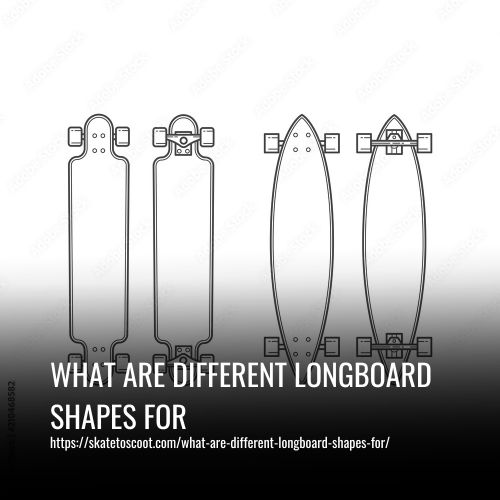
This is where longboard design gets serious about speed and stability. Both styles lower your standing platform closer to the ground, which dramatically increases stability by lowering your center of gravity. But they achieve it differently, and that difference matters.
A drop-through deck has cutouts where the trucks are mounted. The baseplate sits on top of the deck, so the axles and wheels hang below it. This drops you closer to the pavement. According to Titus, this configuration “stabilizes steering at high speeds.” The deck itself can still have some flex, which the Titus guide notes is beneficial for freeriding as it “dampens vibrations at high speeds.” Retrospec calls drop-throughs the “best all-around style” for mixing hill bombing, sliding, and cruising.
A drop-down deck takes it further. The entire standing platform is pressed or bent downward between the truck mounts, creating a literal well for your feet. The trucks are typically top-mounted. This creates an even lower center of gravity. Retrospec states drop-down decks have a deck that “doesn’t flex at all. It’s completely rigid,” making them the “top choice for steep downhill, sliding, and advanced freeriding.” The Yocaher lowrider is a hybrid example, combining a drop-down platform with drop-through truck mounting.
| Feature | Drop-Through Deck | Drop-Down Deck |
|---|---|---|
| How it lowers you | Trucks mounted through cutouts in the deck. | Standing platform is pressed down between the trucks. |
| Typical Flex | Can have slight to medium flex. | Very stiff to completely rigid. |
| Best For | High-speed stability, freeride, versatile all-around use. | Maximum stability for downhill racing and advanced sliding. |
| Beginner-Friendly? | Mixed opinions: Longboards USA cautions; others see it as versatile. | Generally not recommended for first-time downhill riders. |
Where this goes sideways: Choosing a rigid drop-down for your first attempt at downhill. The stability is so pronounced it’s easy to reach terrifying speeds before you have the skill to control them. Retrospec advises newer downhill riders to “start with a drop-through” to get the hang of things first.
The takeaway? If you want to go fast and are learning to slide, a drop-through offers a more forgiving, versatile feel. If your goal is purely to race downhill and you already have the skill, the uncompromising stability of a drop-down is the tool for the job.
The Fishtail and Other Directional Shapes
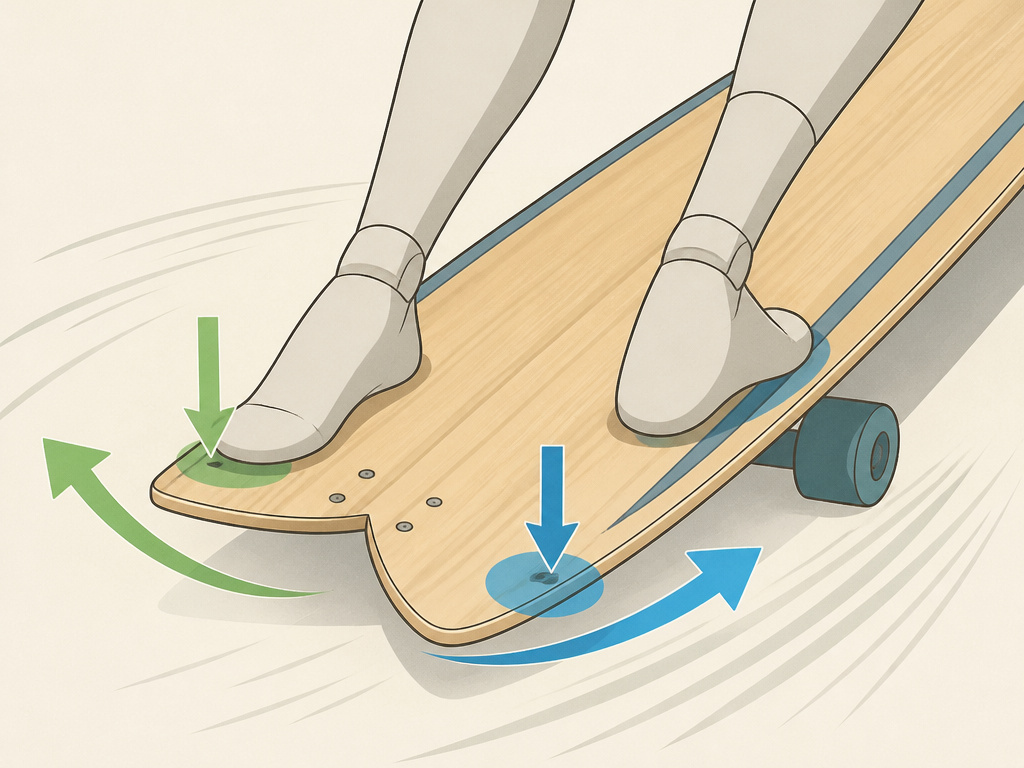
Some shapes are designed to be ridden primarily in one direction. The fishtail is a classic example. It looks like a pintail that’s been split at the end, creating a forked, fish-like tail. This shape is about carving. The split tail allows for deeper, more controlled leans on your heelside and toeside carves, giving a very surfy feel. Yocaher notes their fishtail is a “great shape for riders used to carving, but who are looking to get into freeride longboarding.” It provides more control and a better feel than a pintail for starting slides, while still being approachable.
Other directional shapes include dedicated downhill boards that often omit any nose or tail to focus purely on a wide, concave platform for tucking and gripping corners. These are specialized tools, not daily drivers.
Symmetrical & Hybrid Shapes: Freestyle and Versatility
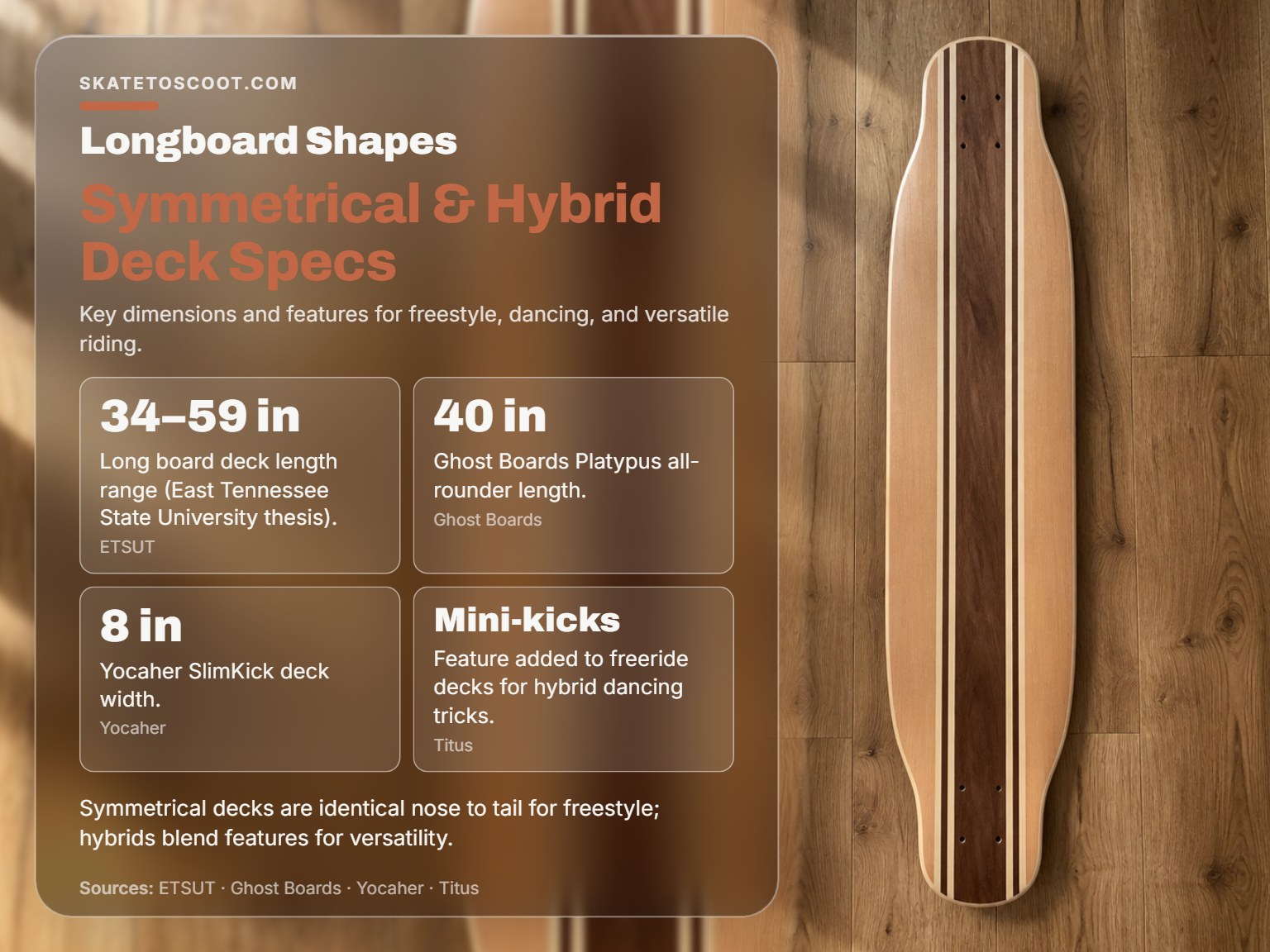
Not all longboards have a defined front and back. Symmetrical (or twin-tip) decks are identical from nose to tail. This is essential for disciplines like freestyle and dancing, where you’re constantly switching your stance and riding direction. The board behaves the same way no matter which way you’re facing.
Then there are hybrids. The Ghost Boards Platypus shape is what they call “bi-directional”, distinct from symmetrical, where the board “can roll with either end facing forward without needing correction for a 180 spin.” This is a nuance for technical freestyle. Many modern decks also blend features. Titus points out that many freeride decks include “mini-kicks to make them versatile enough to be used as hybrids for dancing tricks,” and downhill decks often “incorporate additional features from the freeride sector.” This overlap means you can often find a deck that excels at your primary discipline but allows you to try another.
How Other Components Complete the Setup
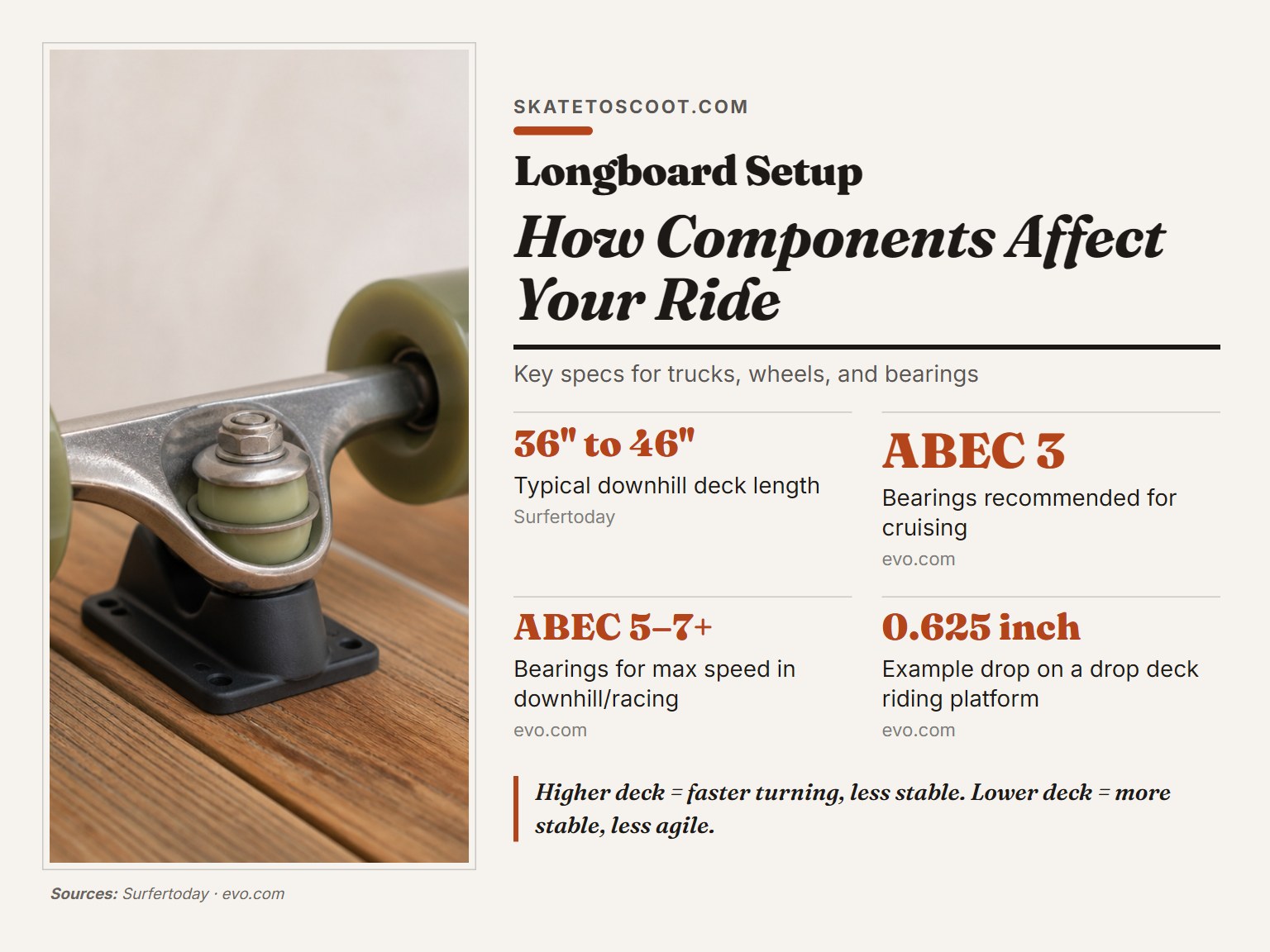
The deck shape is the foundation for answering what are different longboard shapes for, but your trucks and wheels determine how that foundation performs.
Truck Height & Geometry: The deck’s relationship to the trucks is defined by its shape. A top-mounted deck (like a standard pintail) sits higher, making it more nimble and easier to turn sharply, but less stable. A drop-through or drop-down lowers the deck, increasing stability. Your truck’s kingpin angle also affects turniness versus stability, a topic for another guide, but one that interacts directly with your deck choice.
Wheels Are Non-Negotiable: The evo.com guide breaks this down cleanly. Round-lipped wheels are easier to slide on, making them the choice for freeride and freestyle. Square-lipped wheels provide more grip through turns, which is why they’re “recommended for new longboarders or for bombing hills and railing corners as fast as possible.” Matching a grippy square lip to a stable drop-down deck is a classic downhill setup. Putting soft, round-lipped wheels on that same deck would make it feel unpredictable at high speed.
Bearings and ABEC Ratings: While debated in the community, the general guideline from evo.com is a useful starting point: ABEC 3 bearings are good for cruising, ABEC 5 for freeride, and ABEC 5–7+ for maximum speed in downhill and racing. A high-speed bearing in a casual cruiser is overkill, but a low-speed bearing in a race setup will create drag.
Common mistake: Pairing a top-mounted deck with large, soft wheels and loose trucks without checking for wheelbite. The board will feel fun and carvy until you lean into a turn and the wheel jams against the deck, throwing you off. Always check clearance.
Matching Shape to Riding Style and Rider
Let’s get practical. How do you translate all this into a decision? Your intended use is the primary filter, but your physical size matters too.
For Cruising & Carving (Beginners start here):
- Best Shapes: Pintail, Kicktail.
- Why: Stable, predictable, forgiving. The pintail is the pure cruiser; the kicktail adds urban practicality. A shorter deck is great for tight spaces and portability.
- Component Pairing: Softer wheels (for smooth ride), standard trucks, ABEC 3-5 bearings.
For Freeride & Sliding:
- Best Shapes: Drop-through, directional shapes like a fishtail, symmetrical decks with concave.
- Why: You need a lower platform for stability during slides, and pronounced concave to lock your feet in. A slight flex, as Titus notes, can dampen vibrations.
- Component Pairing: Round-lipped wheels (for easier slide initiation), precise trucks, ABEC 5+ bearings.
For Downhill & Speed:
- Best Shapes: Drop-down, stiff drop-through, specialized directional downhill decks.
- Why: Maximum stability and a low center of gravity are critical. Decks are very wide for a solid platform, and stiff to prevent energy loss. As Titus states, they are “racing machines.”
- Component Pairing: Square-lipped wheels (for grip), stable reverse kingpin trucks, ABEC 5–7+ bearings.
For Freestyle & Dancing:
- Best Shapes: Symmetrical decks, hybrids with mini-kicks.
- Why: The board must perform identically in both directions. A kicktail or nose is needed for many tricks.
- Component Pairing: Smaller, harder wheels for trick responsiveness, versatile trucks.
When considering your longboard size, remember that a taller rider might feel cramped on a very short deck, affecting their stance and control. The deck’s width also matters, a narrower deck is more maneuverable, while a wide downhill deck offers more foot space for control.
What is a cruiser longboard shape?
A cruiser shape is designed for comfortable, everyday riding on streets and paths. These boards prioritize a smooth, stable ride for getting around. Attractive shapes like pintails are often preferred for this purpose, as are shorter decks that include a kicktail. The kicktail adds versatility for navigating sidewalks and making quick turns. This combination of a stable platform and maneuverability makes cruiser shapes excellent for relaxed transportation and casual carving.
What is a double drop longboard shape?
A double drop, or drop-down, shape features a deck that is lowered closer to the ground both through a dropped riding platform and a drop-through truck mounting. This creates an exceptionally low center of gravity, which provides more stability at high speeds and makes pushing easier. This design is a top choice for steep downhill riding and advanced freeriding. Because these boards are easy to jet into high speeds, newer downhill riders are often advised to start with a different drop style.
Frequently Asked Questions
What is the most versatile longboard shape?
The drop-through is a strong contender for most versatile. It lowers your center of gravity for stability at speed, works for freeride and sliding, and is still capable for aggressive cruising. As Retrospec puts it, it’s the best all-around style for “general hill bombing, sliding, and cruising all-in-one.” For pure beginners, the pintail’s simplicity is hard to beat.
Can I do tricks on a pintail longboard?
You can do basic slides and carves, but technical tricks that require a kicktail (like ollies, shuv-its, or any manual) are essentially impossible on a traditional pintail. Its design is for rolling, not popping. If trick potential is a goal, start with a deck that has a kicktail.
Is a drop-through or drop-down better for beginners?
For a true beginner focused on cruising, many sources recommend a pintail or kicktail for simplicity, though opinions vary on drop-throughs; Longboards USA cautions they might not be suitable for beginners, while Retrospec presents them as a versatile all-around style. If a beginner is determined to learn downhill, some sources advise starting with a drop-through over a drop-down, though opinions vary on drop-through suitability for beginners. The drop-through offers increased stability without the extreme, rigid feel of a drop-down, which can be overly intimidating and easy to over-speed on.
How important is deck flex?
It depends entirely on your riding. For downhill and high-speed precision, minimal flex is key for a stable, direct feel. For freeride and cruising, a slight flex can absorb road vibrations, making for a smoother, more comfortable ride, especially over longer distances or rough pavement.
What prevents wheelbite on a longboard?
Wheelbite occurs when your deck touches the wheels during a deep turn, causing a sudden stop. Deck shapes combat this with wheel wells (indentations sanded into the deck), cut-outs (large sections removed around the wheel), or by using riser pads between the deck and truck to increase the gap. When you are choosing a longboard, checking the wheel clearance for your chosen truck and wheel combo is a crucial final step.
Before You Go
The shape of your longboard isn’t an aesthetic choice; it’s a functional one that dictates its common longboarding purposes. A pintail won’t magically become a downhill racer, and a drop-down will feel like overkill on a boardwalk cruise. The most expensive mistake is buying a deck designed for a discipline you don’t practice.
Start by honestly assessing what you’ll do with the board 80% of the time. Let that dictate your primary shape. Then, ensure your trucks and wheels are chosen to complement, not contradict, that deck’s design. A cohesive setup feels like the deck, trucks, and wheels work together as a single system. Finally, remember that while this guide and the complete longboarding guide on our site cover the rules, the best board is still the one that makes you want to ride it. These principles exist to narrow your search to the tools that will help, not hinder, that feeling.
