Are Longboard and Skateboard Bearings the Same?
This post contains affiliate links. As an Amazon Associate, we earn from qualifying purchases.
Longboard and skateboard bearings are physically the same standardized size, the 608 bearing, measuring 8mm inner diameter, 22mm outer diameter, and 7mm width, and will fit interchangeably in any modern skateboard or longboard wheel. The real differences come from how riding style, board design, and maintenance needs shape which bearing features, like built-in spacers, shield type, and lubrication, are worth your money.
That physical interchangeability is the starting point, not the finish line. A bearing that spins freely on a workbench tells you nothing about how it handles the side loads of a hard longboard carve or the repeated impacts of street skating, which is why people often ask, are longboard and skateboard bearings the same? The choice between a basic set and a premium one isn’t about fit; it’s about matching the bearing’s construction to the forces your board actually sees.
What follows: the one exception to the size rule you must check, the truth about ABEC ratings straight from bearing engineers, and a direct comparison of the two main bearing architectures, traditional versus built-in, and which one wins for cruising, downhill, or park skating.
Key Takeaways
- The universal 608 bearing size has standard dimensions of 8mm inner diameter, 22mm outer diameter, and 7mm width.
- ABEC ratings are an industrial tolerance standard not designed for skateboarding; a bearing’s construction and lubrication matter far more for real-world performance.
- Built-in bearings (like Zealous or Loaded Jehu) are the default choice for longboarding because they integrate spacers, simplifying maintenance and improving durability under side loads.
- Ceramic bearings are roughly 30% harder than steel, but provide no meaningful speed increase for skaters, as most friction is caused by the grease and dust shields.
- Where sources disagree: The manual for the S+S Sportartikel GmbH longboard states ‘you should never take the bearings apart!’, while other sources and community guides are built on taking them apart for cleaning and lubrication.
The Universal 608 Bearing: The Physical Answer
Look at any bearing from a modern skateboard or longboard. The numbers stamped on the shield, if any, are marketing. The real spec is in the dimensions: 8mm inner diameter, 22mm outer diameter, 7mm width. This is the 608 standard.
The ’60’ in 608 denotes the production series and the ‘8’ denotes the 8mm inner diameter. This metric size is the established standard for skate wheels, confirmed by bearing manufacturers like Powerslide.
This means a bearing from a skinny street skateboard wheel will slide onto the axle of a massive longboard truck, and vice versa. Skateboard bearings are sold in sets of eight. This interchangeability is why most “skateboard bearing” packs don’t distinguish between board types. The physical answer to the are longboard and skateboard bearings the same question is yes.
But here’s the part that trips people up. Compatibility isn’t performance. A bearing can fit perfectly yet be utterly wrong for how you ride. The 608 standard ensures it seats on the axle; everything else about its design decides if it lasts a season or dies in a month.
When “The Same Size” Isn’t True: The 10mm Axle Exception
The 608 rule has one hard exception. Some specialized longboard trucks, particularly older models or certain precision trucks built for downhill racing, use a 10mm axle diameter. A standard 8mm-inner-diameter bearing physically cannot fit on it.
You won’t encounter this often. It’s mostly found in custom builds and high-speed setups where riders are chasing every possible advantage in stiffness and stability. If you’re buying a complete board or standard replacement trucks, you’re getting 8mm axles.
How do you check? Before buying bearings for an older or custom board, measure the truck axle with a set of calipers. If it reads 10mm, you need to search specifically for 10mm inner diameter bearings. This is the only time the answer to are longboard and skateboard bearings the same flips to a definitive no.
Steel vs. Ceramic: The Material Truth

You have two real material choices: steel and ceramic. The hype around ceramics is intense, but the facts from material guides are straightforward.
Quality steel bearings use a chrome steel alloy like AISI 51200. The chromium increases surface hardness and fights rust. They’re the default for a reason: proven, affordable, and when maintained, incredibly durable. The bearing materials debate often overlooks that a well-made steel bearing is a high-performance component.
Ceramic bearings, specifically hybrid ceramics with steel races and ceramic balls, offer two advantages. The ceramic balls are roughly 30% harder than steel and are impervious to rust. This can mean a longer lifespan in wet conditions or for riders who neglect maintenance.
But do they make you faster? Multiple technical guides, like the one from Ghost Boards, state clearly: ceramic bearings do not provide a meaningful increase in speed, nor any real reduction in friction. The grease inside the bearing and the drag from the dust shields are the primary sources of resistance, not the ball material. The extra cost buys you longevity and corrosion resistance, not free speed.
| Material | Best For | Key Consideration |
|---|---|---|
| Steel (AISI 51200) | All riders, especially value-focused skaters | Performance hinges on quality of steel and lubrication. |
| Hybrid Ceramic | Wet climates, riders who rarely maintain gear | Higher cost; no speed gain, but excellent corrosion resistance. |
ABEC Ratings: The Industrial Standard That Doesn’t Apply
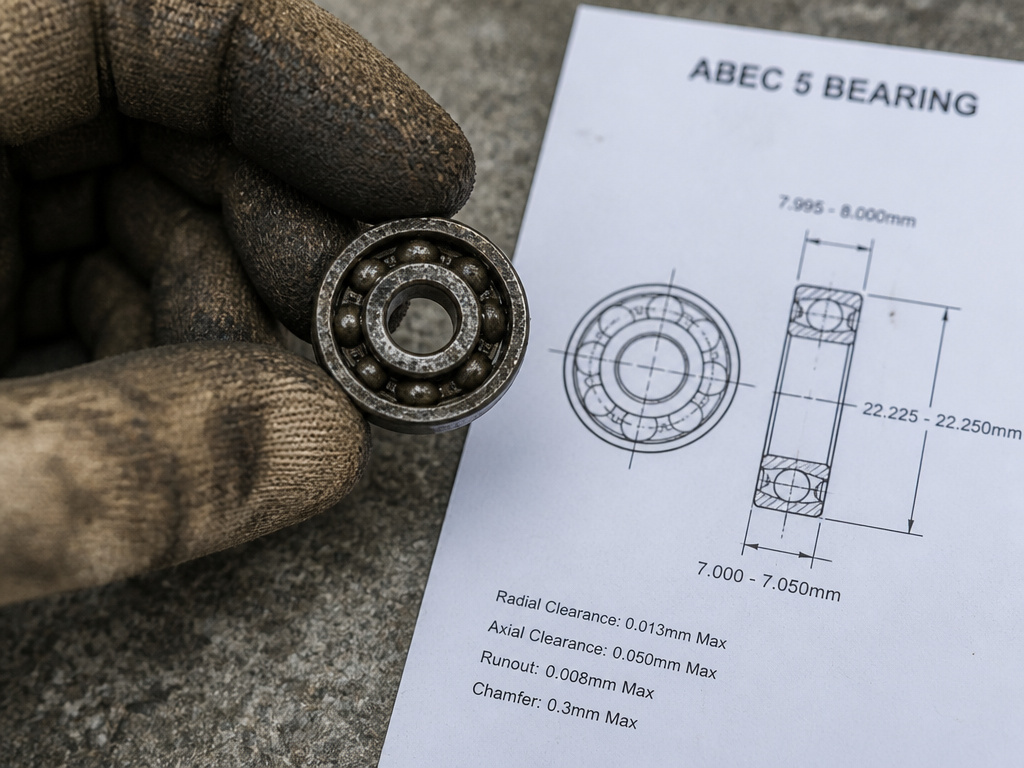
The ABEC rating system measures tolerances for high-speed machinery. It grades “roundness” and dimensional precision. An ABEC 5 bearing, for example, has an inner diameter tolerance between 7.995 and 8.0 mm and a maximum allowable eccentricity of 0.0035 mm.
The ABEC rating system is an industrial tolerance standard not designed for skateboarding. A bearing’s ABEC rating means almost nothing for skate performance.
The problem is context. A skateboard is a violent, dirty, impact-heavy environment. As the guide from VandeM Longboard Shop notes, after a few minutes of riding, the bearing races are microscopically dented and dirty. Those pristine, machine-shop tolerances are gone. The World Speed Record on a skateboard is 91 mph.
This is why brands like Bones developed “Skate-Rated” standards. They prioritize durability against impacts and side loads, not just spin speed. When choosing best skateboard bearings or best longboard bearings, look for reputable skate brands with a history of reliability, not the highest ABEC number on the package.
Bearing Architecture: Traditional vs. Built-In
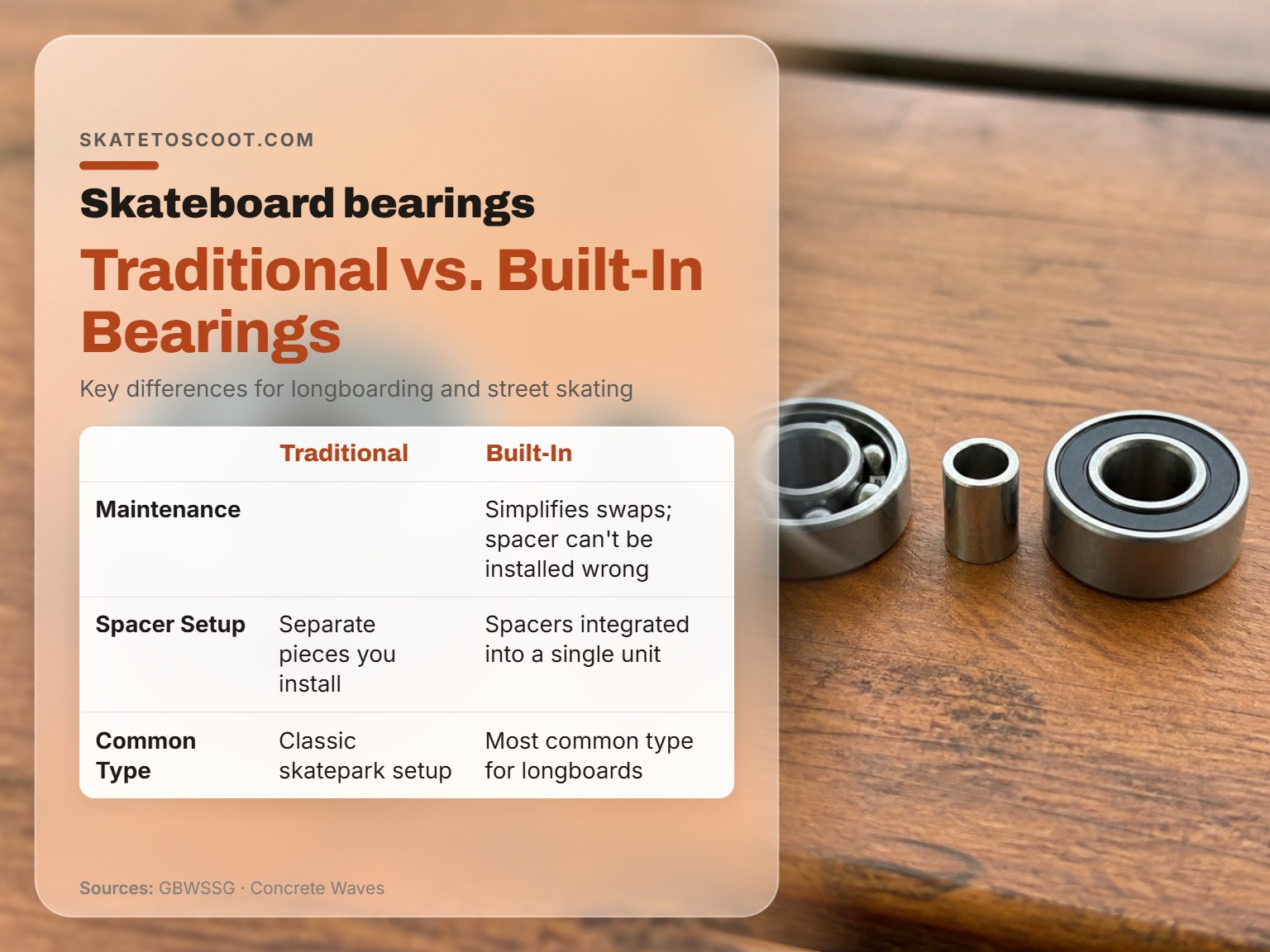
This is where longboard and skateboard bearing needs visibly diverge. You have two main designs.
Traditional Bearings are standalone units. Think Bones Reds or Bronson G2. Spacers and speed washers are separate pieces you install between the bearings and on the axle. This is the classic skatepark setup. It allows for detailed maintenance and part replacement.
Built-In Bearings (e.g., Zealous, Loaded Jehu) have the spacers and often the speed washers molded or integrated into a single unit. They’re the default for a reason: they’re idiot-proof. You pop the old one out, press the new one in. There are no tiny spacers to drop or lose. For longboarding, where wheel hubs are wider and carving puts heavy side loads on the bearings, this integrated design prevents the bearings from being crushed inward or misaligning.
| Type | Best For | Maintenance Impact |
|---|---|---|
| Traditional (e.g., Bones Reds) | Street skating, park, tech sliding | Allows deep cleaning and re-lubrication of individual parts. |
| Built-In (e.g., Zealous) | Longboarding, cruising, downhill | Simplifies swaps; spacer can’t be installed incorrectly. |
For pure longboarding, built-in bearings win. They eliminate a failure point and match the board’s mechanics. For street skating, traditional bearings remain the favorite because they align with that culture’s DIY maintenance ethos.
The Spacer Debate: Necessary or Optional?
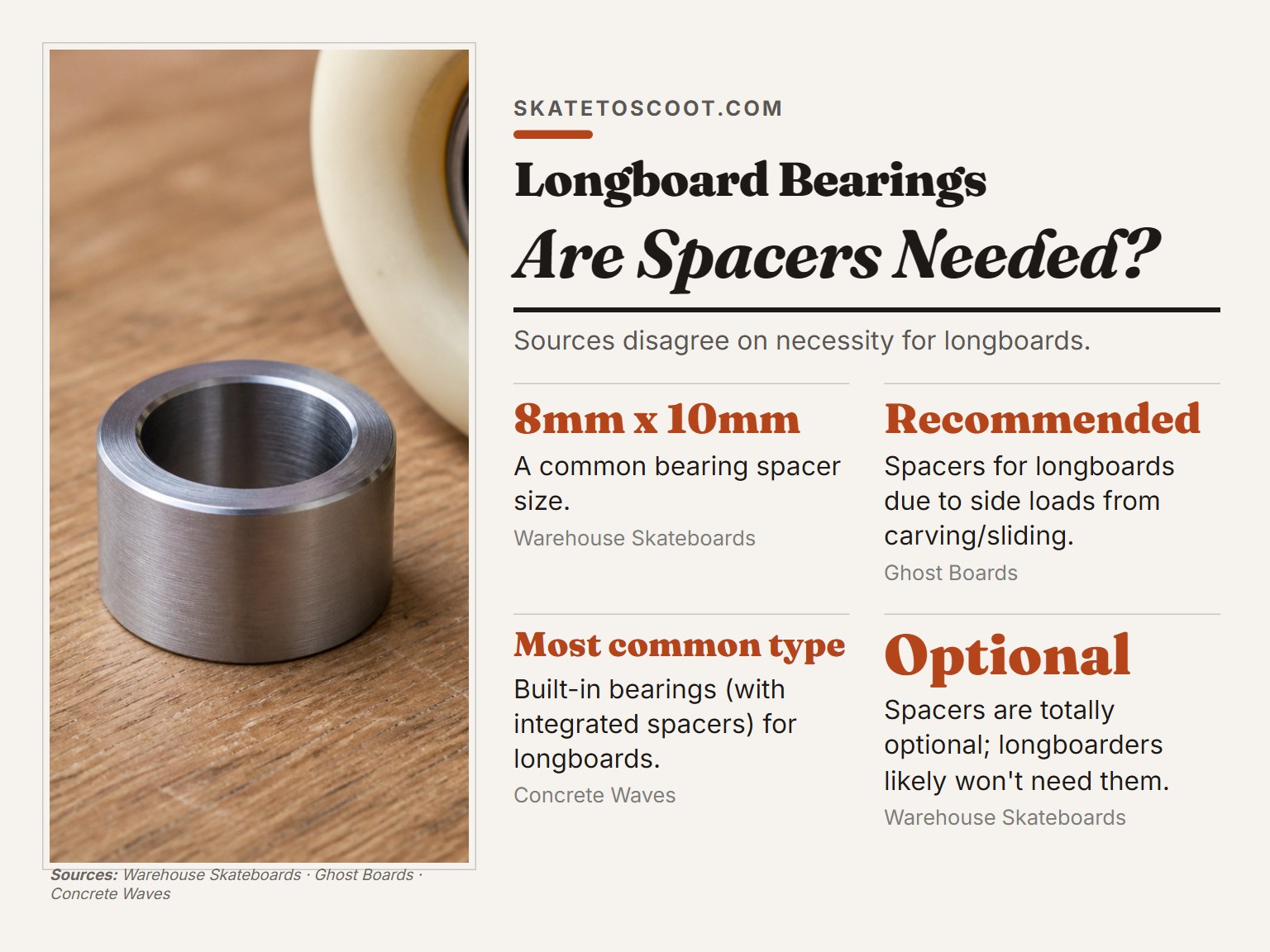
A spacer is a small metal tube that sits inside the wheel between the two bearings. Its job is to transfer the axle-nut’s clamping force to the inner bearing races, not the outer races pressed into the wheel. This prevents the bearings from being squeezed sideways and binding.
On a standard skateboard, where tricks involve impacts and landings that can momentarily misalign the wheel on the axle, spacers are a smart add-on. For longboarding, the consensus shifts. The wider hub of a longboard wheel and the sustained side pressure from deep carves make spacers more important.
Where sources disagree: Ghost Boards states spacers are recommended for longboards to prevent rapid wear and race deformation. Concrete Waves notes built-in bearings (with integrated spacers) are the most common type for longboards. Warehouse Skateboards suggests longboarders “likely won’t put enough pressure on their boards to ever need them.”
Here’s the practical take: if your bearings have built-in spacers, you’re set. If you’re using traditional bearings on a longboard, adding spacers is cheap insurance. It’s one of those things you only notice when you don’t have it and your wheels start developing a gritty, inconsistent roll.
Maintenance: The Great Bearing Divide
This is where manufacturer instructions and real-world practice clash directly. The manual for the S+S Sportartikel GmbH longboard states plainly: “you should never take the bearings apart!”
Meanwhile, every community guide, from cleaning bearings tutorials to lubricating bearings steps, is built on taking them apart, cleaning them, and re-lubing them. Who’s right?
The manufacturer’s warning is about liability. Taking apart a sealed bearing risks damaging the shield, letting in more dirt, or reassembling it incorrectly. For a casual rider, a damaged bearing is a safety issue. The community’s practice is about performance and economy. Cleaning and re-lubricating can extend a bearing’s life for years.
My rule? For built-in, factory-lubed bearings like Zealous, I ride them until they feel gritty or slow, then I replace them. The cost is low and the swap takes two minutes. For premium traditional bearings I’ve invested in, I’ll clean and re-lube them. Knowing how many bearings a board needs, always a total bearings on a longboard, means you can keep a fresh set on hand for when maintenance day comes.
Matching Bearings to Your Ride Style
So, are they the same? Physically, yes. Functionally, you choose based on your discipline.
- Street/Park Skating: Prioritize impact resistance. A traditional, “skate-rated” bearing from a brand like Bones or Bronson is the move. Spacers are recommended. ABEC is irrelevant.
- Longboard Cruising/Distance: You want reliability and low maintenance. Built-in bearings like Zealous are the default for a reason. The integrated spacer handles the wider hub, and the factory lube lasts ages.
- Downhill/Speed: This is where details matter. You might explore precision-built traditional bearings with custom lubrication. Some riders still prefer the control of separate components. This is also the only realm where the 10mm axle exception might appear.
- Commuting: Durability against weather is key. Either quality steel bearings you commit to maintaining, or hybrid ceramics for their rust resistance. Built-in bearings simplify the frequent wheel changes commuters often do.
The bearings themselves don’t know what board they’re in. But the forces that board experiences should dictate what’s inside them.
Do bearings or wheels matter more for speed?
While high-quality bearings are nice to have, they are a minor factor for speed compared to your wheel choice. The vast majority of friction a bearing experiences comes from its internal grease and the dust shields, not the precision of its internal parts. Even ceramic bearings, which are harder than steel, do not provide a meaningful increase in speed. For real gains in roll speed and momentum, focus first on selecting the right wheel size and hardness for your riding surface. A set of standard 608 bearings will perform nearly identically to expensive ones in most street and cruising scenarios.
Frequently Asked Questions
Do I need different bearings for my longboard versus my skateboard?
No, you can use the same 608 bearings in both. The better question is should you? For a longboard, bearings with built-in spacers (like Zealous) are more convenient and better suited to the wider wheels and carving forces. For a skateboard, traditional bearings (like Bones Reds) are the standard and work perfectly.
What bearings do most skaters use?
For skateboarding, Bones Reds are the perennial, ubiquitous choice. For longboarding, Zealous bearings have become the default due to their built-in spacer and reliable factory lubrication. Both are considered the benchmark in their respective categories.
Are ceramic bearings worth the money?
Only if your primary concern is corrosion resistance and you tend to neglect maintenance. Ceramic balls are harder and won’t rust, which can extend bearing life in wet conditions. They do not make your board roll faster or significantly reduce friction, despite the marketing claims.
How often should I clean or replace my bearings?
When they start to feel slow, sound gritty, or visibly rust. Listen to your board, a rough, rumbling roll is the bearing telling you it’s time for attention.
The Bottom Line
The 608 bearing makes the answer simple: yes, they are physically the same. That’s the commodity fact every article repeats.
The non-commodity insight is that your riding style dictates everything else. A downhill racer and a street skater might use the same physical bearing, but their ideal versions of it look completely different. One values integrated simplicity and spacer alignment; the other values impact-resistant construction and the ability to be taken apart.
For many riders, the choice is simpler. Skateboarders should grab a set of Bones Reds. Longboarders should grab a set of Zealous. That decision, more than any ABEC number or material debate, is what actually matters. It puts a bearing on your board that’s designed for the job it will actually do, not just the axle it fits on.
The rest, the cleaning debates, the spacer discussions, the ceramic questions, are refinements for after you’ve logged the miles. Start with the right bearing for your discipline, and you’ll spend less time thinking about them and more time riding.
