Can You Get a DUI on a Longboard? State Laws Explained
This post contains affiliate links. As an Amazon Associate, we earn from qualifying purchases.
You can get a DUI on a longboard if it is motorized and your state’s DUI law defines “vehicle” or “motor vehicle” broadly enough to include it. On a traditional, human-powered longboard, a standard DUI charge is legally impossible in most states, but you can still face lesser charges like public intoxication or disorderly conduct. The specific outcome depends entirely on your state’s statutes, how your board is powered, and the officer’s discretion.
That “motorized vs. Non-motorized” line isn’t just a technicality, it’s the fulcrum the entire legal question balances on. A common query in this context is: can you get a dui on a longboard? States like California have carved out a specific, lesser charge for “electrically motorized boards,” while others lack clear laws, creating a gray area where a cop’s decision in the moment can dictate whether you face a misdemeanor or just get a warning.
What follows is a breakdown of the exact legal thresholds, the state-by-state statutes that matter, and the concrete consequences, from fines to license suspensions, that can follow a bad decision. By the end, you’ll be able to look up your own state’s code and know exactly where you stand.
Key Takeaways
- The core legal distinction is motorized vs. Non-motorized. A traditional longboard almost never qualifies for a DUI; an electric one might.
- In California, operating an “electrically motorized board” while impaired is a separate charge from a DUI, with lower penalties, but can still trigger a driver’s license suspension if you’re on DUI probation.
- States like Arizona and Illinois explicitly exclude “devices moved by human power” from their DUI laws, making a DUI on a traditional longboard impossible there.
- Even where a DUI is off the table, you can still be charged with public intoxication or disorderly conduct, which typically carry fines but not jail time.
- If you are stopped, your behavior matters. Drawing attention through reckless riding increases the odds of any charge, DUI or otherwise.
The Core Legal Distinction: Motorized vs. Non-Motorized
This isn’t about skateboard culture or wheel size. It’s about watts and statute books. The law draws a bright, mechanical line between something you push and something with a battery. Cross that line, and you cross into a different legal universe.
A traditional longboard is, in the eyes of state codes like Arizona’s and Illinois’s, a “device moved by human power.” That phrase is your legal shield. For instance, the Arizona Revised Statutes and the Illinois Vehicle Code both explicitly exclude such devices from their definitions of “vehicle” for DUI purposes. Washington’s Court of Appeals set a precedent in the 1995 case City of Montesano v. Wells, ruling that DUI laws do not apply to nonmotorized devices like bicycles, a logic that directly extends to traditional skateboards and longboards.
An “electrically motorized board” under California law has a deck no longer than 5 feet, is less than 18 inches wide, has a propulsion system averaging less than 1,000 watts, and cannot exceed 20 mph on level ground. If your board fits this spec, California treats it differently.
An electric longboard, however, is a wild card. Its classification hinges entirely on how your state’s law defines “motor vehicle” or “vehicle.” Some states have no definition at all for these new devices, leaving a gap where police and prosecutors have to make a call. This is where the real risk lives. A cop seeing you weave down a street on a powered board has to decide: is that a toy, a bicycle, or a motor vehicle? Their training, your behavior, and local attitudes will shape that decision more than any clearly written law.
State-by-State Breakdown: Where You Can (and Can’t) Get a DUI
Laws don’t just vary by state; they vary by how the state’s legislative body decided to write a sentence twenty years ago. You need to know the wording, not just the general rule. We will examine a few key states to show how the same action leads to wildly different outcomes.
California is the prime example of a state that saw this coming and wrote a specific rule. The California Vehicle Code creates a category called an “electrically motorized board.” It’s unlawful to operate one while impaired by alcohol or drugs. Crucially, this is a different charge than a standard DUI and carries much lower penalties. However, if you are already on court-ordered probation for a prior DUI and are caught on one of these boards with a blood alcohol content of 0.01% or greater, the California DMV will suspend your driver’s license for one year. Refuse the test, and it’s a two-year suspension.
Arizona, Illinois, New York, and Texas all use the “motor vehicle” hook. Their DUI laws require the operator to be in control of a “motor vehicle.” Since a traditional longboard has no motor, it’s excluded. As the Texas Penal Code states, a DUI charge specifically requires a “motor vehicle.” These states offer the clearest protection for riders of traditional boards.
Washington State shows what happens when the law is broad and unclear. The state’s DUI statute defines “vehicle” broadly, which could include e-scooters and e-boards. However, as noted in a Washington Law Review article, the legislature delegates regulatory authority to local governments, creating a confusing patchwork. You might face no liability in one town and full DUI penalties in the next. This uncertainty is a risk in itself.
| State | Law Cited | Traditional Longboard | Electric Longboard |
|---|---|---|---|
| California | Vehicle Code § 313.5 | No DUI charge possible. | Separate “electrically motorized board” charge; not a standard DUI. |
| Arizona | Revised Statutes § 28-101.77 | DUI impossible (“device moved by human power” excluded). | Likely treated as a motor vehicle; DUI possible. |
| Washington | Court of Appeals Precedent / Broad Statute | DUI unlikely based on precedent. | Gray area; depends on local regulations and officer discretion. |
| New York | Vehicle and Traffic Law | No DUI (excludes human-powered vehicles). | DUI possible if classified as a motor vehicle. |
The pattern is clear: the more specific the statute, the more predictable the outcome. If your state isn’t listed here, your first step is to search for “[Your State] vehicle code DUI definition.” Search for the phrases “motor vehicle” and “device moved by human power.”
Penalties: From Fines to License Suspension

So what happens if you’re charged? The consequences split into two very different tiers: the world of alternative charges and the severe category of actual DUI penalties.
For riders of traditional longboards, you’re looking at public intoxication or disorderly conduct. These are typically misdemeanors. The penalty is usually a fine and maybe a night in jail until you sober up. It’s a hassle and a financial hit, but it doesn’t come with the multi-year shadow of a DUI. You won’t lose your driver’s license over a public intoxication charge alone. However, if you cause an accident, these charges can escalate to reckless endangerment, and you’ll be financially liable for any damage or injury.
For those on electric boards that get tagged with a DUI, you enter the standard DUI penalty matrix. This is serious. Connecticut serves as an example of standard DUI procedure. According to the Connecticut DMV, an arrest leads to a summons and a court date. A conviction brings mandatory license suspension from the DMV, separate from any court fines or jail time.
In California, the DMV’s administrative penalties for those on DUI probation are stark and automatic:
- BAC of 0.01% or greater: 1-year license suspension.
- Refusal or failure of a chemical test: 2-year suspension.
- Two or more prior DUI convictions and a test refusal: 3-year license revocation.
Common mistake: Assuming an electric longboard is “just a skateboard.” In the eyes of the law in many states, its motor makes it a potential “motor vehicle,” unlocking the full, severe penalty structure of a DUI, fines, jail, license suspension, and a permanent criminal record.
These administrative actions are independent of criminal court. You can fight the DUI charge in court and win, but if you lost the separate DMV hearing, your license stays suspended. This dual-track system is what catches people off guard.
Other Charges and Practical Risks
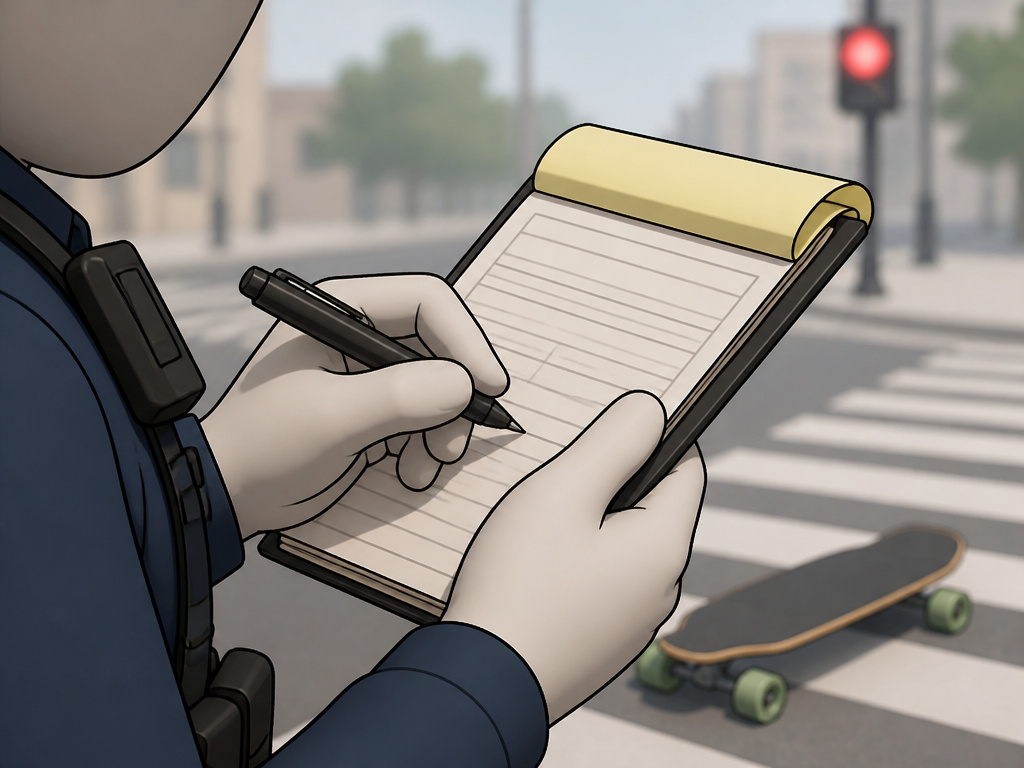
Even when the DUI statute doesn’t apply, the encounter doesn’t end with a warning. Police have other tools, and your actions dictate which ones they use.
Public intoxication and disorderly conduct are the go-to charges when you’re on a traditional board but clearly impaired. They’re less about what you’re riding and more about how you’re behaving in public. Swerving, falling, yelling, any behavior that draws attention to your impaired state gives an officer grounds. The legal threshold here is often “a danger to yourself or others” or “causing a public disturbance.”
The real-world risk often isn’t the letter of the law, but the officer’s discretion. As one rider on a Reddit forum noted, if you’re not drawing attention and riding safely, you’ll likely be ignored. But if you “bust your ass in front of a cop,” you’re inviting scrutiny. Another user was more blunt, claiming, “You will 100%, without a shadow of a doubt, get a DUI/DWI if you are impaired when stopped by Law Enforcement on an e-scooter,” while others suggest the risk is lower if you don’t draw attention. Both observations are true; the outcome depends on the situation you create.
Here’s a quick list of what increases your risk of any charge, DUI or otherwise:
- Running traffic signals or signs. This is a moving violation that gives an officer a clear reason to stop you.
- Riding without proper lights at night. Many local ordinances require front and rear lights on wheeled devices after dark.
- Reckless or erratic riding. Swerving, speeding in pedestrian areas, or losing control makes you a clear hazard.
- Being obviously impaired. Slurred speech, inability to balance, or the smell of alcohol are immediate red flags.
If you are stopped, be polite and provide identification if asked. You are not required to perform field sobriety tests, and refusing them cannot be used against you in court for a non-DUI charge. However, anything you say can be used. Your goal is to de-escalate and get through the interaction without giving the officer a reason to upgrade the stop.
DUI on Other Wheeled Devices: A Comparative Look
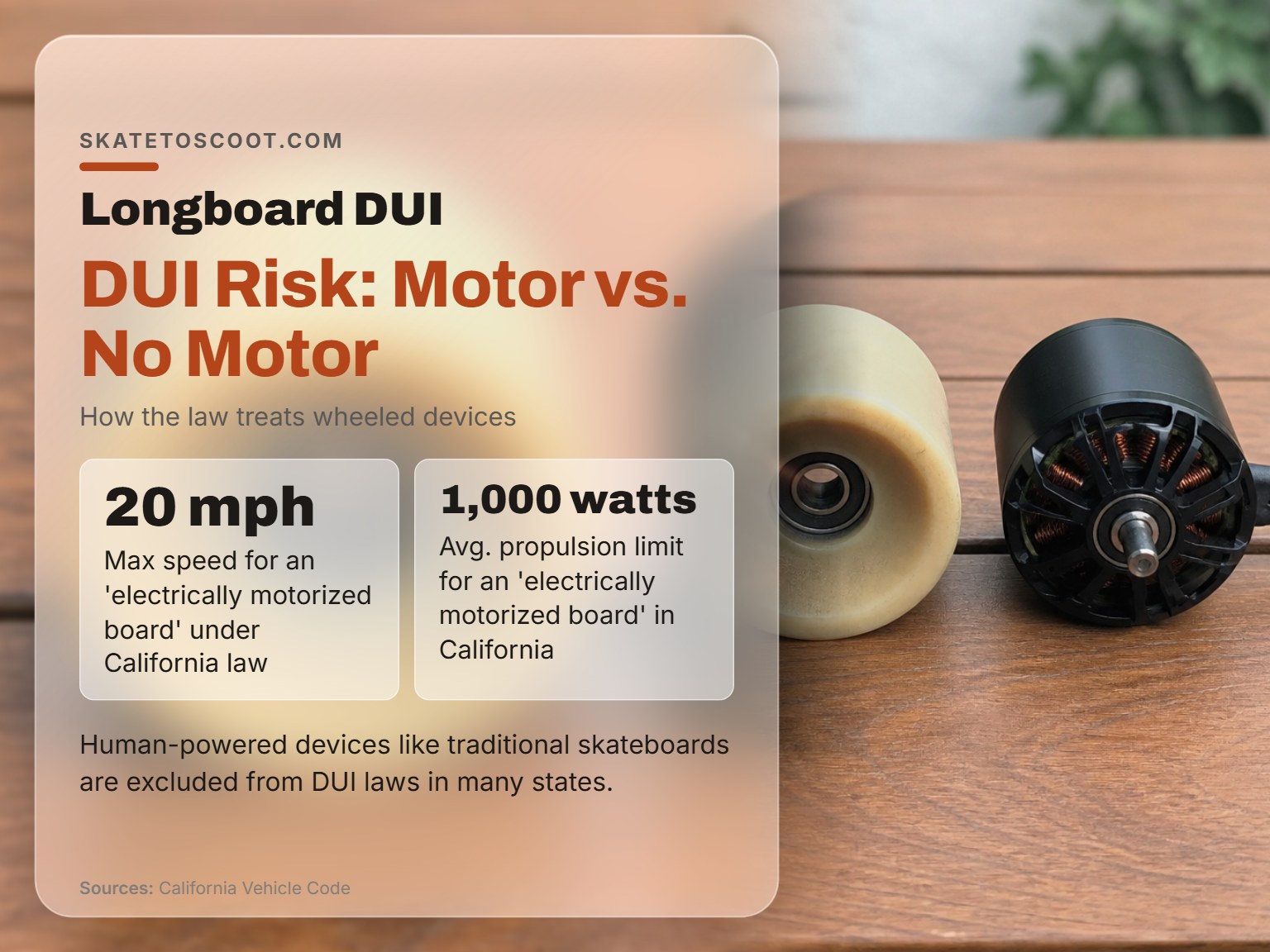
The can you get a dui on a longboard question isn’t unique to longboards. Understanding how the law treats similar devices helps frame your own risk. The common thread is the presence of a motor and the legal definition of “vehicle.”
| Device | Typical Legal Classification | DUI Risk | Notes |
|---|---|---|---|
| Bicycle | Device moved by human power. | Very Low in most states. | Some states (e.g., Wisconsin post-2019 E-Bike Act) explicitly exclude bicycles and e-bikes from “motor vehicle” definition. |
| Electric Scooter | Often a gray-area “motor vehicle.” | High. | Frequently targeted by police in urban areas; often falls under broad “vehicle” definitions. |
| Hoverboard | Motorized personal transporter. | Moderate to High. | Lacks clear statutory category; likely treated similarly to electric skateboards. |
| Rollerblades | Human-powered device. | None for DUI. | Like traditional skateboards, excluded from DUI statutes; subject to public intoxication laws. |
| Horse | Animal-drawn conveyance. | Yes, in many states. | Demonstrates the breadth of “vehicle” definitions; if a horse can count, an e-board certainly can. |
This table shows the slippery slope. From rollerblades with zero DUI risk to electric scooters with high risk, the difference is a motor and a few words in a legal code. Your longboard road legality depends on this same classification. If you’re unsure about your local longboard road rules, checking the laws for bicycles and e-scooters in your area will give you a strong indication.
Frequently Asked Questions
Can I get a DUI on a regular skateboard?
No, you cannot get a standard DUI on a traditional, human-powered skateboard in states like Arizona, Illinois, California, New York, and Texas, based on the statutes reviewed. State laws like Arizona’s and Illinois’s explicitly exclude “devices moved by human power” from the definition of “vehicle” for DUI purposes. You can, however, be charged with public intoxication, disorderly conduct, or reckless endangerment.
Does a longboard count as a skateboard legally?
For the purposes of DUI law, yes. The legal distinction is based on propulsion (human vs. Motor), not deck length or wheel style. A traditional longboard is a “device moved by human power” just like a standard skateboard. The legal principles governing a skateboard DUI apply identically to a longboard.
What state is toughest on DUI?
California has some of the most stringent and complex DUI penalties in the nation, especially for repeat offenders. Its administrative penalties for those on DUI probation, like the automatic one-year license suspension for any detectable BAC, are particularly severe and apply to operating “electrically motorized boards” as well.
Is 2 beers enough for a DUI?
Potentially, yes, if you are operating a motor vehicle. For a standard DUI, states set a legal Blood Alcohol Concentration (BAC) limit. Depending on your body weight and metabolism, alcohol can raise your BAC. For context, California’s “zero tolerance” rule for those on DUI probation is a BAC of just 0.01%, virtually any amount of alcohol.
Before You Go
Consider the stakes. On a traditional longboard, the worst-case scenario is usually a fine and a night in the drunk tank. On an electric board, the worst-case scenario is a full DUI on a scooter-level charge: thousands in fines, a suspended license, and a permanent mark on your record. The difference isn’t academic; it’s the difference between an expensive mistake and a life-altering legal battle.
Your single most important takeaway from the can you get a dui on a longboard analysis is this: know your state’s specific statute. Don’t rely on forum anecdotes or articles like this one as final legal advice. If you ride an electric board, search for your state’s vehicle code and check the definitions of “vehicle,” “motor vehicle,” and any mention of “electric” or “motorized” boards. That document is the only source that matters.
Finally, the smartest choice is always the simplest: if you’ve been drinking, walk. The mechanics of a perfect carve are beautiful, but they require a clear head and precise control. Impaired riding, regardless of the legal outcome, sacrifices that control. It’s a risk to yourself, a nuisance to others, and it undermines the respect we’re all trying to build for skating as legitimate transportation. Keep it clean, keep it safe, and keep rolling.
