How Fast Does an Off Road Hoverboard Go? Safety and Limits
This post contains affiliate links. As an Amazon Associate, we earn from qualifying purchases.
An off-road hoverboard’s top speed typically ranges from 8 to 15 kilometers per hour (5 to 9 miles per hour). Real-world speed depends on the specific model, terrain, rider weight, and battery level. Manufacturers often recommend a safe operating speed below the advertised maximum, and many boards emit warning beeps as you approach their limit.
That gap between the advertised number and the safe, usable speed is where most buyer confusion lives. The GYROOR Y1 Pro manual lists a max speed of about 16 km/h, but it also specifies a “moderate speed” of 3-10 km/h for uneven ground. The Denver HBO-6620 is rated for 14 km/h, yet its manual explicitly says not to exceed 12 km/h. A common question is how fast does an off road hoverboard go.
What follows is a breakdown of the specs from six major models, the mechanical reasons speed drops off-road, and the safety systems, like continuous beeping and speed reduction on low battery, that keep the real-world pace in check.
Key Takeaways
- Off-road hoverboard speeds cluster in an 8-15 km/h (5-9 mph) range, with most models peaking around 12 km/h.
- Manufacturers like Denver and GYROOR publish a recommended safe speed that is lower than the rated maximum, often by 2-3 km/h.
- Terrain and battery charge are the biggest real-world speed reducers; a board that hits 15 km/h on pavement might manage only 8 km/h on thick grass with a half-depleted battery.
- Continuous beeping alarms (like on the Jetson Stereofly and NS8 models) activate near max speed as a built-in safety warning to slow down.
- Motor power influences climbing ability more than top speed; a stronger motor maintains speed on a slight incline but won’t necessarily make the board faster on flat ground.
The 8-15 km/h Range and What “All-Terrain” Actually Means
Open any product page for an all-terrain model and you’ll see a speed claim addressing how fast does an off road hoverboard go. The Huvtron Off-Road Hummer advertises 8-12 MPH. The Jetson X2 claims a top speed of 12 mph. The NS8 Off-road Hoverboard lists 12 to 15 km/h. These numbers aren’t wrong, but they’re measured under ideal conditions: a smooth, flat surface, a rider at the lower end of the weight limit, and a full battery.
The GYROOR Y1 Pro manual is one of the few that quantifies “all-terrain” performance with strict limits: traversable slopes ≤30°, obstacles under 1 cm, and gaps under 3 cm. Exceed those, and you’re not riding, you’re crashing. Its manual also states that top speed will reduce as the battery life drops, a performance degradation that happens on every model but isn’t always advertised.
Common mistake: Chasing the highest advertised speed number. The Denver HBO-6620 manual rates its max speed at 14 km/h but then recommends not exceeding 12 km/h. The NS8 board beeps an alert at 12 km/h despite a max of 12-15 km/h. The safe, controllable speed is almost always 2-3 km/h lower than the ceiling.
How Model Specifications Compare
Not all off-road boards are built for the same pace or grade. The climbing angle, a key spec for off-road use, varies widely (from 10° to 30° among different models) and directly impacts the speed you can maintain on a hill.
| Model | Advertised Max Speed | Max Incline | Key Speed Limiter |
|---|---|---|---|
| GYROOR Y1 Pro | ~16 km/h (10 mph) | 30° | Speed reduces with low battery; manual recommends 3-10 km/h on bumps. |
| Jetson X2 | 12 mph | 20° | |
| Speedio Offroad | 15 km/h | 25° | System automatically limits speed to 15 km/h. |
| NS8 Off-road | 12-15 km/h | 15° | Speed alert beeps at 12 km/h. |
| Hover-1 Matrix | 11.3 km/h (7 mph) | 10° | Lower power and incline limit reduce off-road speed quickly. |
| Denver HBO-6620 | 14 km/h | Not specified | Manufacturer recommends not exceeding 12 km/h. |
The table shows a clear split. Models like the GYROOR Y1 Pro (≤30°) and Speedio Offroad (25°) are engineered for steeper terrain than models like the Hover-1 Matrix (10°), but they govern their top speed. The Jetson X2 aims for a higher flat-speed ceiling. The Hover-1 Matrix, with its 10° incline limit, is better suited for gentle paths than true off-roading.
Why Your Real-World Speed Is Slower Than the Advertised Number
You charge your new board, step onto smooth pavement, and lean forward. It accelerates smoothly to its promised 15 km/h. Then you take it onto the lawn. The sensation is immediate: the board labors. The motors whine at a higher pitch, and forward progress feels hesitant. You’re experiencing the three main factors that cut advertised speed by a third or more.
Terrain resistance is the biggest drain. Grass, dirt, and gravel create rolling resistance that the motors must overcome. The GYROOR Y1 Pro manual acknowledges this, advising a “moderate speed of 2-6 mph (3-10 km/h)” on uneven ground. Pushing beyond that doesn’t make you go faster; it risks overloading the motors and triggering a shutdown.
Battery voltage drop is a less obvious but predictable factor. The GYROOR manual states plainly: “Top speed will reduce when remaining battery life drops.” A board at 50% charge cannot deliver the same peak power as a full battery. On demanding terrain, this effect is magnified. Your speed drops, and your range plummets.
Rider weight and riding style round out the trio. Heavier riders demand more torque from the motors, which are now also fighting the terrain. Leaning aggressively to accelerate, as the GYROOR manual warns against (don’t lean more than 5° or accelerate faster than 2.5 mph/s), can cause a sudden draw that saps speed and risks a cut-out.
The Safety Systems That Actively Govern Your Speed
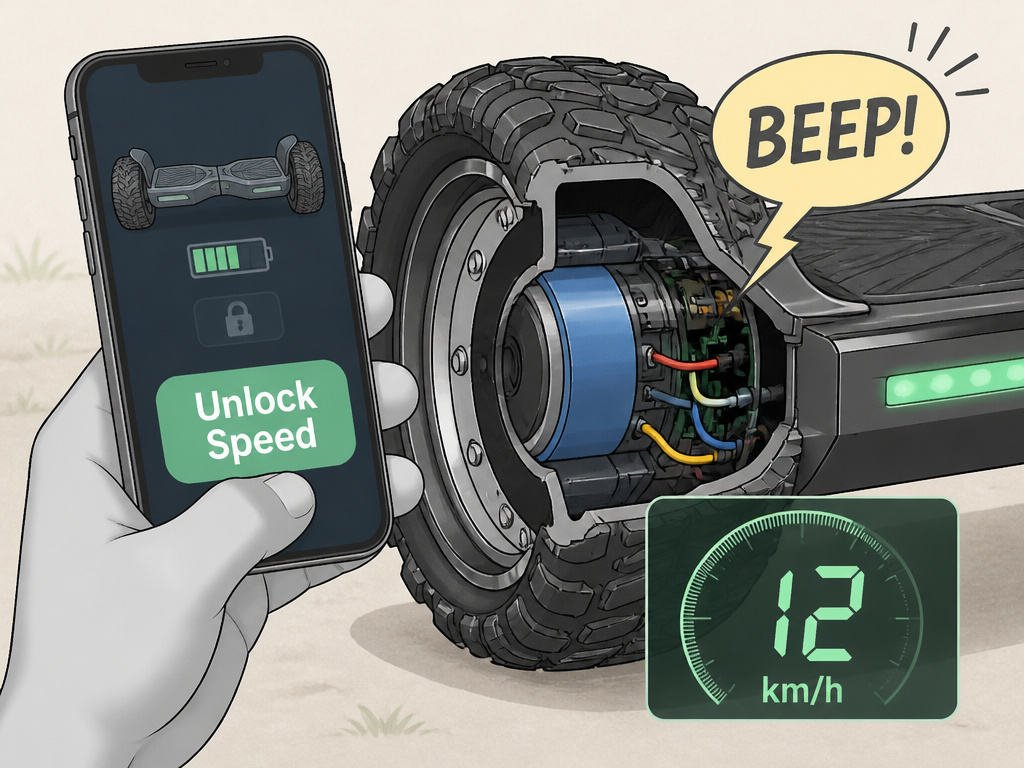
These boards aren’t dumb motors. They have firmware that acts as a governor.
The Jetson Stereofly user guide says it clearly: “When the hoverboard is traveling near or at max speed, it will start beeping continuously as a warning to slow down.” The NS8 Off-road Hoverboard beeps its alert at 12 km/h. The Denver HBO-6620 emits a warning signal when approaching max speed.
Some models, like the Jetson Stereofly, also start in a default ‘Beginner’ speed mode. You need a companion app to access higher speeds. This isn’t a marketing gimmick, it’s a liability-aware design choice. The system is trying to prevent falls caused by exceeding the board’s or rider’s limits.
Can You Increase an Off-Road Hoverboard’s Speed?
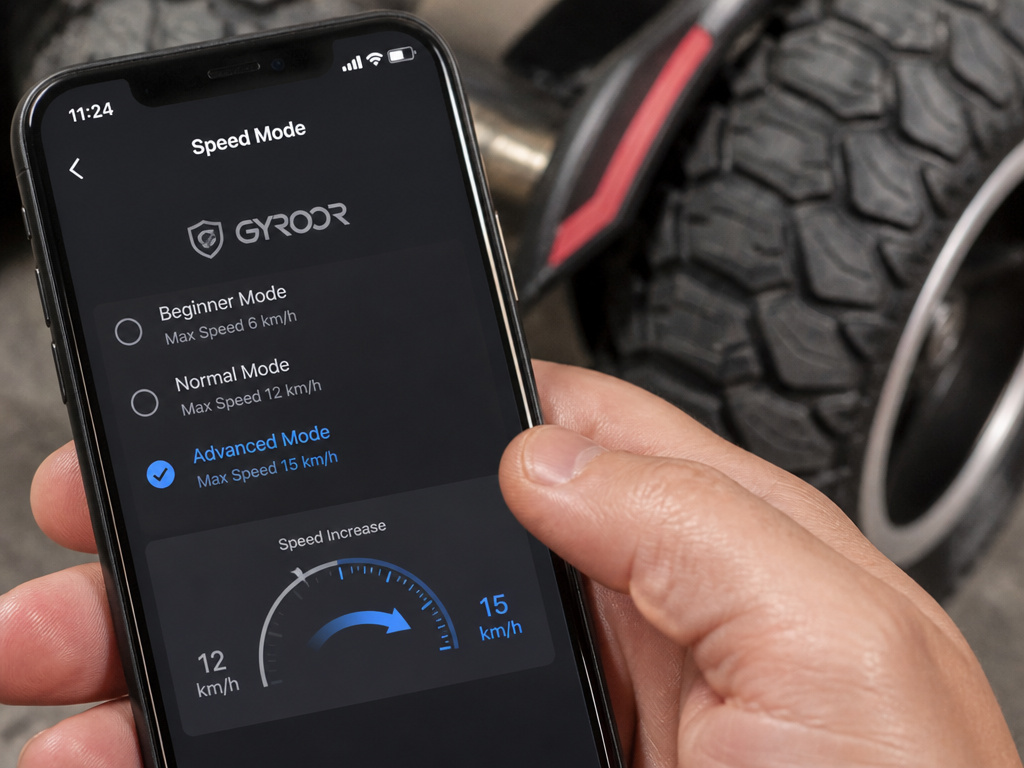
The short answer is: not safely, and not by much. Unlike a petrol scooter, you can’t tweak a carburetor. These are integrated electric systems with hard-coded limits.
Speed modes, available through apps for models like the Jetson Stereofly, are the only manufacturer-approved method. Switching from ‘Beginner’ to ‘Advanced’ might grant a few extra km/h. However, the physical limits of battery output and motor thermal capacity remain. Push past them, and you hit the next layer of protection.
Motor overload protection will stop you. The Jetson Stereofly guide warns that if the board is pushed beyond its capacity, the motors may enter protection mode and automatically power off. You’re left standing on a dead board, which is a great way to fall.
Where this goes sideways: Trying to modify the board’s electronics or firmware. This instantly voids the warranty and, more importantly, disables the thermal and battery management systems. An overloaded, modified motor doesn’t just shut off, it can overheat to the point of failure. The GYROOR Y1 Pro will flash red lights and sound an alarm if internal temperature exceeds 50°C (122°F). Bypassing those safeguards is how you start a fire.
The pursuit of more speed is better directed at choosing the right tool for the job, once you understand the answer to how fast does an off road hoverboard go. If you consistently need to travel faster than 15 km/h on rough ground, you’re looking at the wrong vehicle class. An electric dirt bike or a high-powered electric scooter with large pneumatic tires is the next step up.
How Speed Affects Battery Range Off-Road
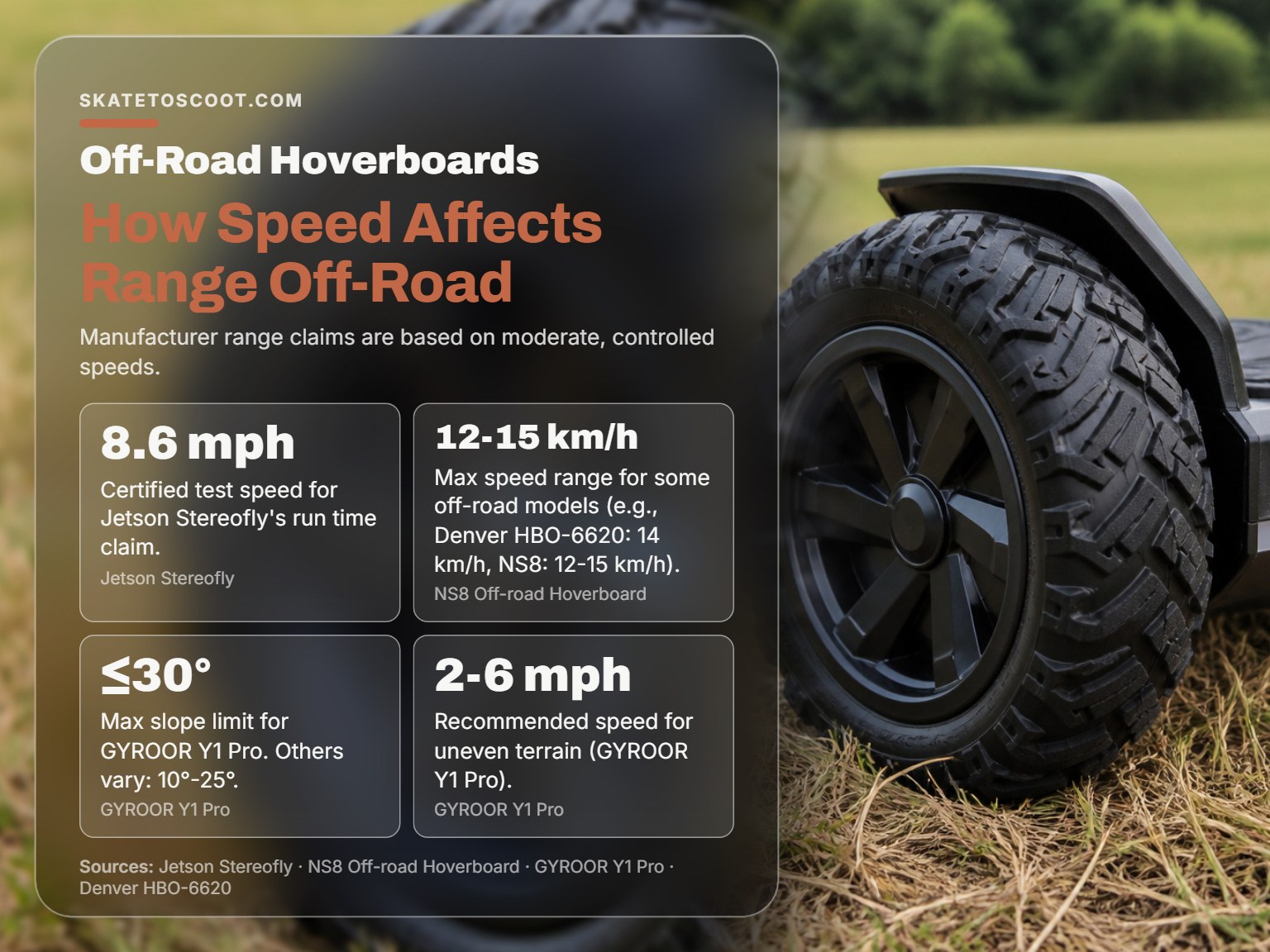
This is the trade-off nobody talks about until they’re pushing their board home. Speed and range are inversely related, and off-road conditions strain the relationship.
The certified test conditions for the Jetson Stereofly’s run time are revealing: a 220 lb rider, 77°F temperature, and a speed of 8.6 mph (13.8 km/h). That’s a controlled, moderate pace on presumably flat ground. Now imagine that same rider on grass at the board’s max speed of, say, 12 mph. The range estimate on the website? Cut it by 40%. Maybe more.
The reason is physics. Higher speed requires more power per minute. Rough terrain requires more power per meter. Combine them, and the battery’s watt-hours are consumed at a dramatically higher rate. A hoverboard’s weight, often 12-14 kg for off-road models, also means you’re hauling a heavier battery, but the efficiency gains are wiped out by the terrain.
For practical planning, take the manufacturer’s range claim, like the Huvtron Off-Road Hummer’s 8-12 miles, and halve it if you plan to ride on grass or dirt at a moderate speed. That gives you a safe radius from your charging point.
The Terrain/Speed/Range Decision Loop
This creates a simple decision matrix every time you ride:
- High speed on smooth terrain: Maximizes range but is often outside safe operating recommendations.
- Moderate speed on rough terrain: The GYROOR-recommended 3-10 km/h. Preserves some range and control.
- High speed on rough terrain: The quickest path to a dead battery and a long walk back. The motors will sound stressed, and the battery gauge will drop visibly.
The best all-terrain hoverboards are those with larger batteries (like the 36V 4Ah in the NS8) and efficient motors, but they still obey this law. There’s no free speed.
Safety and Legal Speed Limits for Outdoor Use
The manufacturer’s recommended speed isn’t just about preserving the board. It’s about keeping the rider upright. At 15 km/h (9.3 mph), a sudden stop or a hidden root can project an adult rider forward with enough force to cause injury. Wrist guards and a helmet are essential at that pace.
Legally, the picture is murkier. Most user manuals advise against using hoverboards on public roads. They are not typically street-legal vehicles. Their use is restricted to private property or, where local bylaws allow, parks and paths.
Before you start: Public paths often have implied speed limits based on pedestrian safety. A board moving at 15 km/h is much faster than walking pace and can startle others. The safe, courteous speed in shared spaces is often closer to a fast jog, around 10 km/h max. This aligns neatly with many manufacturers’ “recommended” speeds.
The built-in warnings are your best guide. If your board is beeping continuously, it’s telling you, and everyone around you, that you’re at its operational limit. Listening to that beep is the first rule of riding outdoors safely. Ignoring it is an invitation to a crash.
How does an off-road hoverboard’s speed compare to walking or a scooter?
An off-road hoverboard’s top speed is faster than a brisk walk but generally slower than an electric scooter. For example, the Denver HBO-6620 has a rated maximum of 14 km/h, and A typical walking pace is about 5 km/h, so a hoverboard can more than double that speed. However, most electric scooters can easily reach speeds of 15 to 20 mph, putting them in a faster category. The practical speed of a hoverboard on rough terrain is often lower than its maximum rating, as manufacturers recommend slower speeds for safety on bumps. This makes a hoverboard a middle-ground vehicle, offering more zip than walking but with less outright speed than many scooters, trading velocity for its unique maneuverability and off-road capability.
Frequently Asked Questions
Is 7 mph fast for a hoverboard?
For an off-road hoverboard, 7 mph (11.3 km/h) is a mid-range, practical speed. It’s the max speed of the Hover-1 Matrix. At this pace, you have more time to react to terrain changes than at 12 mph, and battery drain is more manageable. For most recreational off-road use, it’s perfectly adequate.
Is there a hoverboard that can go 30 mph?
No mainstream, UL2272-certified off-road hoverboard reaches 30 mph (48 km/h). That speed territory belongs to electric scooters and electric motorcycles. Hoverboard physics, small wheels, a low platform, and a standing rider, become dangerously unstable at such high speeds. Claims of such speeds should be treated with extreme skepticism.
How to increase hoverboard speed?
The only safe method is to use the manufacturer’s official app (if available) to switch from a beginner to an advanced speed mode, as with the Jetson Stereofly. Any hardware or firmware modification risks fire, injury, and voiding your warranty. The performance gain is minimal, a few km/h at most.
Can you ride a hoverboard go-kart attachment off-road?
Some hoverboards can power go-kart attachments, but the top off-road hoverboards for grown-ups that work with them are not designed for rough terrain in that configuration. The added weight and strain would likely exceed the motor’s capacity, triggering overload protection on the first hill. Stick to pavement for go-kart use.
The Bottom Line
Forget the headline speed number. The real metric for an off-road hoverboard is the speed it can sustain on grass or dirt with a typical rider, which is usually 8-11 km/h (5-7 mph). Models like the GYROOR Y1 Pro and Jetson X2 are built to handle that environment, but they govern their top end for safety.
Your first move after unboxing should be to find the safe, recommended speed in the manual, not the max spec on the box. Then, respect the beep. That audible warning is the board telling you its limits, which are in place to protect both the machine and you. If you need to travel faster than 15 km/h off-road, a different class of electric vehicle is the right answer. For cruising trails and backyards, a well-chosen off-road hoverboard operating within its designed parameters offers a unique blend of fun and mobility.
