How to Fix Electric Scooter Shut Down While Riding
This post contains affiliate links. As an Amazon Associate, we earn from qualifying purchases.
To fix an electric scooter that shuts down while riding, you must diagnose one of five core failures: a battery suffering from thermal shutdown or voltage sag, loose or corroded wiring connections, an overheating or failed speed controller, overloading beyond the scooter’s weight or incline limits, or a faulty safety switch like the kickstand sensor. The fix ranges from a simple connection check to a component replacement, but diagnosis always starts with the symptoms and a multimeter.
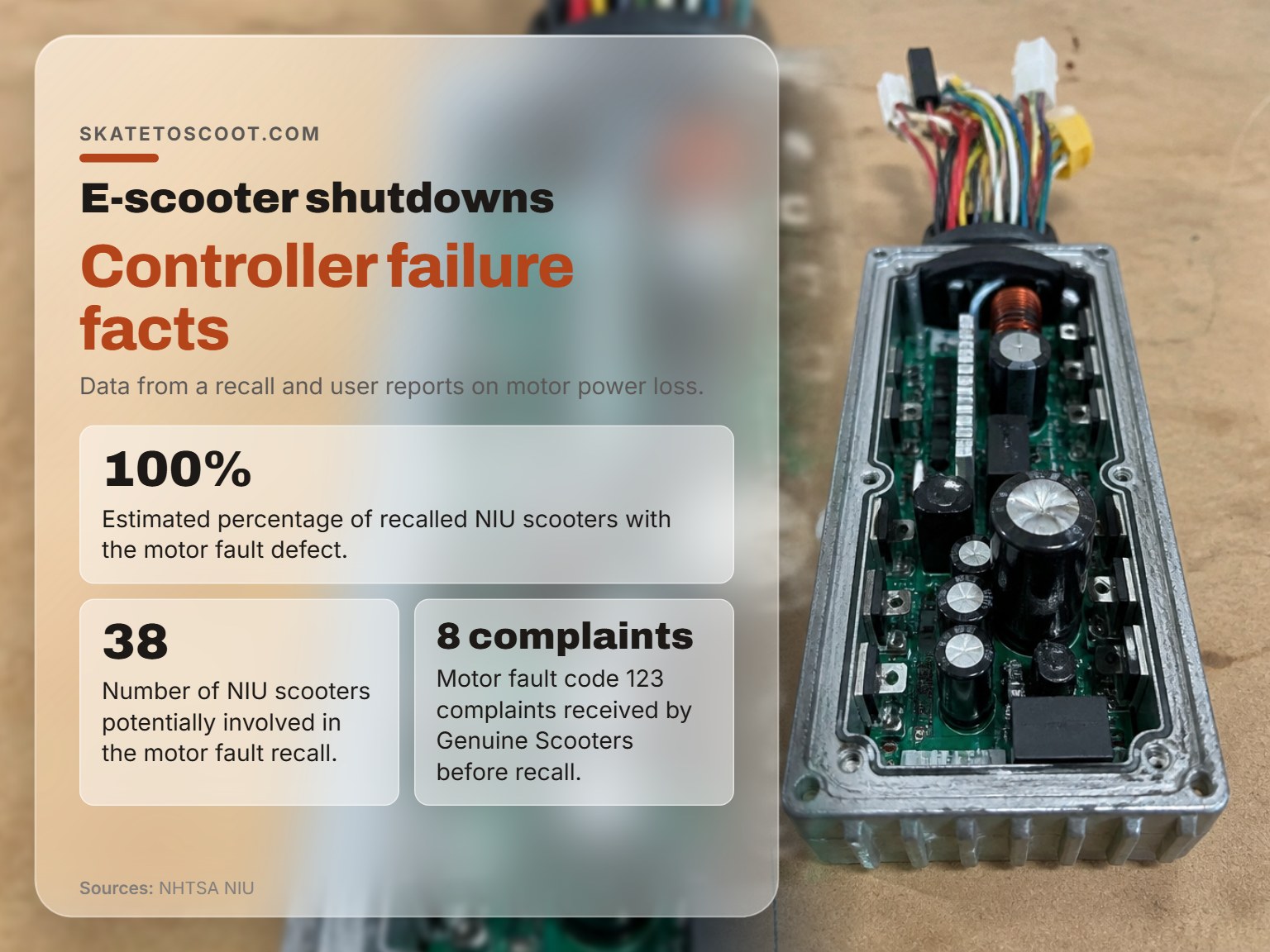
That list isn’t just a guess. It’s compiled from official recall documents, OEM troubleshooting guides, and repair logs that show which failures actually leave riders stranded. The National Highway Traffic Safety Administration (NHTSA) has documented scooters, such as the NIU MQiGT EVO, losing power without warning due to a motor fault. Manufacturer manuals and recall documents list specific error codes, such as motor fault code 123, which are essential to know when learning how to fix electric scooter shut down while riding.
What follows is a mechanic’s walkthrough of the how to fix electric scooter shut down while riding problem: how to match your scooter’s shutdown pattern to the most likely culprit, the tools you need to confirm it, and the fix that gets you rolling again. This guide explains the step-by-step diagnostic process, when a problem is beyond a DIY fix, and the simple maintenance that prevents most of these failures.
Key Takeaways
- Thermal shutdown is the most common cause in hot climates; the scooter runs for 10-20 minutes then dies, working again after a 15-minute cooldown.
- Always check connections first; vibration and heat cycles loosen wires, causing intermittent power loss that feels random.
- A multimeter is essential for diagnosis; you need to measure battery voltage under load to confirm voltage sag or a failing battery.
- Exceeding the scooter’s weight or incline limit triggers protective cutoffs that mimic a more serious electrical fault.
- Error codes on the display are direct messages from the scooter’s brain; an E3 code on a Razor model, for instance, points specifically to motor overload.
The 5 Core Causes of a Mid-Ride Shutdown
Your scooter didn’t just decide to quit. It reacted to a measured parameter, voltage, temperature, current, or a broken signal, exceeding a safe limit. The trick is to listen to what it’s telling you before it fully fails.
I learned this the hard way not on a scooter, but on a high-performance skate setup. I’d upgraded my bearings but reused old, cracked shields. For a week, everything was faster. Then, during a complex line, one wheel seized mid-grind. The failure wasn’t the bearing; it was the shield letting in grit that the upgraded part couldn’t handle. A scooter’s electrical system is the same. One weak point, like a single corroded connector, can disable the entire machine.
The causes below are listed in order of both likelihood and severity. Start at the top and work down.
1. Battery Issues: Thermal Shutdown & Voltage Sag
This is the king of scooter shutdowns, especially in summer. Your battery isn’t just a tank of electrons; it’s a chemical system that hates heat and strain.
Thermal Shutdown happens when the Battery Management System (BMS) detects unsafe temperature levels. The Ionic Ride repair blog notes the classic pattern: the scooter runs fine for 10-20 minutes, then cuts power completely. After cooling for 10-15 minutes, it works again. This is the BMS preventing a fire. Riding at 2 PM in July, as the blog states, is asking for it. Morning (before 10 AM) or evening (after 6 PM) have 10-15°C lower temps.
Voltage Sag is different. When you demand high current, full throttle up a hill, the battery’s voltage can temporarily drop below the controller‘s low-voltage cutoff. The scooter dies even though the battery meter showed 40% charge. The fix is to keep the battery above 30% charge for regular use and ease into acceleration instead of slamming the throttle.
Where this goes sideways: Treating a thermal shutdown by immediately plugging in the charger. You’re pouring more energy into an already overheated battery pack, accelerating cell degradation. Let it cool to the touch first.
| Battery Failure Mode | Key Symptom | Immediate Action | Long-Term Fix |
|---|---|---|---|
| Thermal Shutdown | Works then dies after 10+ mins in heat; recovers after cooling. | Move to shade, let battery cool for 15+ mins. | Ride in cooler hours; pulse throttle (10 sec on, 5 sec off). |
| Voltage Sag | Sudden loss of power under hard acceleration or hill climbs; power returns after stopping. | Ease off throttle, reduce load. | Keep charge >30%; test battery health with multimeter under load. |
| Aged/Degraded Cells | Reduced range, shutdowns occur at higher charge levels (e.g., 50%). | Diagnose with multimeter (check individual cell voltages if possible). | Battery replacement. |
2. Loose, Corroded, or Damaged Wiring
Vibration is a wire’s worst enemy. Every pothole and curb strike shakes connections loose over months. A wire that looks fine can have a broken strand inside the insulation, making contact only sometimes.
The diagnostic sign here is inconsistency. The scooter shuts off on bumps but works on smooth pavement. It dies when you wiggle the handlebars. Owners on Reddit describe this exact pattern: a scooter cutting out mid-ride with a full battery, then working again after sitting, with no clear cause.
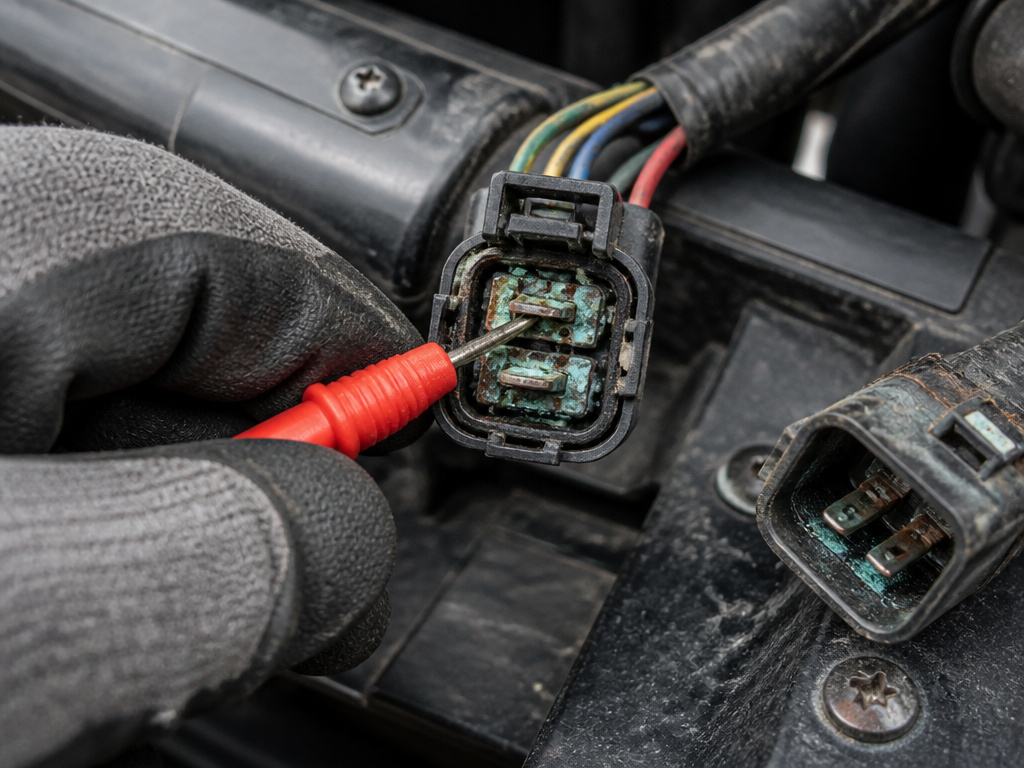
Your first tool is your eyes and hands. Check every connection you can find: battery terminals to controller, controller to motor, display to controller. Look for green corrosion (a white or bluish powder), pins that are bent or pushed out, or plugs that don’t snap firmly together. A thorough visual inspection can solve more problems than you think.
3. Controller Overheating or Failure
The controller is the scooter’s brain. It takes your throttle input and tells the motor how fast to spin. It also monitors system health. If it gets too hot or detects a fault (like a sudden current spike), it shuts everything down to protect itself.
An overheating controller shares symptoms with battery thermal shutdown, a cooldown period brings it back. However, a failed controller often won’t recover. You might smell a faint, sharp ozone smell or see a swollen capacitor if you open the deck.
The Ionic Ride blog points out a key upgrade path when you compare a how to fix electric scooter shut down while riding: budget scooters often use 15-20A controllers. If you’re over 100kg or carry cargo, that’s not enough. Upgrading to a 30A+ controller can solve shutdowns under load. This isn’t a casual DIY job; it requires matching motor voltage and phase timing.
4. Overloading: Exceeding Weight or Incline Limits
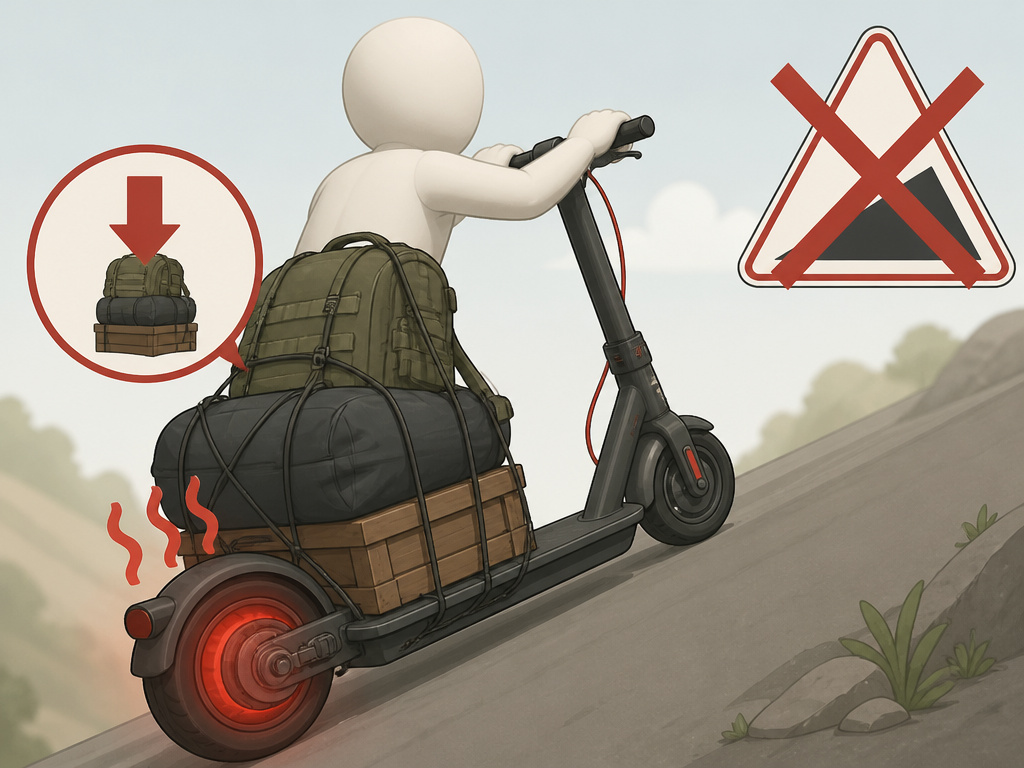
This cause is often misunderstood as an electrical fault. Every scooter has a maximum weight rating and a gradeability limit. Exceeding these limits doesn’t just slow you down; it forces the motor and controller to draw more current than they’re rated for.
The result is a protective cutoff. It feels identical to a voltage sag or thermal shutdown. The scooter struggles, then dies, especially when starting uphill. The fix is simple but required: reduce the load. That means checking your total weight (rider + backpack + cargo) against the manual’s spec and avoiding steep hills.
The part nobody mentions: Riding a scooter at its absolute weight limit on a hot day combines the worst of causes 1, 3, and 4. The battery sags, the controller overheats, and the motor strains. It’s a guaranteed shutdown recipe.
5. Faulty Safety Switch or Kickstand Sensor
Modern scooters have safety cutoffs to prevent you from riding with the kickstand down. A faulty sensor can think the kickstand is deployed when it’s not, cutting power to the motor. The same goes for brake lever sensors that cut power when you pull the brake (some systems malfunction and send the signal constantly).
The symptom is distinct: the scooter drives fine for a moment, then cuts power as if you’ve hit the brake or put the kickstand down, often accompanied by a beep or error light. Sometimes, hitting a bump triggers it. You can test this by manually holding the sensor switch in the “ride” position (often with a zip-tie or tape) for a short, cautious test. If the shutdowns stop, you’ve found the culprit.
Step-by-Step Diagnostic Process
Don’t just start swapping parts. Follow this logical sequence to isolate the problem. You’ll need a multimeter, a $20 tool that is essential.
Step 1: Replicate and Observe. When does the shutdown happen? During acceleration? After 15 minutes? On bumps? Write it down. Does the display show any error codes (like E3 or E7)?
Step 2: The Connection Inspection. Power off the scooter. Open the deck. Visually inspect every plug and terminal. Tug gently on wires. Look for corrosion, cracks, or burn marks. Reseat every connection firmly. This solves many “ghost” problems.
Step 3: Battery Health Check with a Multimeter.
- Set your multimeter to DC Volts (20V or 200V range, depending on scooter voltage).
- With the scooter OFF, measure the battery’s resting voltage at its terminals.
- Now, test voltage under load. Prop the scooter up so the wheel spins freely. With the multimeter probes still on the terminals, apply full throttle. Watch the voltage. If it dips dramatically and the scooter cuts out, you have severe voltage sag or a weak cell group.
Step 4: Component Isolation. If the battery tests fine, you need to check if the controller or motor is the issue. This often requires a spare known-good component to swap in, which is where many DIYers hit a wall. If you smell burnt electronics from the controller or see discolored, melted solder inside the motor, the diagnosis is clear.
Step 5: Sensor Check. If electrical tests show good power to the controller, suspect the safety sensors. Bypass the kickstand sensor temporarily (carefully, and only for testing in a safe area) to see if the problem persists.
When to Seek Professional Help
Some problems are not meant for the kitchen table. If your diagnostics point to a motor fault, like the motor fault code 123 documented in the NHTSA recall for the NIU MQiGT EVO, you need a dealer. A software bug that causes “loss of motor power… Without warning” can’t be fixed with a soldering iron.
Likewise, if you’ve performed all the basic checks, connections are tight, battery voltage is solid, no error codes, and the scooter still dies randomly, the fault is likely deep within the controller or BMS. The Ionic Ride blog estimates professional diagnostics at 50-100 AED, with fixes ranging from 100 AED to 650 AED. That’s a worthwhile investment before you buy a $300 part you don’t need.
Preventive Maintenance Schedule
Breakdowns are predictable. This schedule prevents most of them.
| Interval | Task | Why It Prevents Shutdowns |
|---|---|---|
| Before Every Ride | Quick visual check: tire pressure, loose body panels, brake function. | Catches obvious physical damage that could lead to electrical shorts. |
| Monthly | Inspect and clean battery terminals & main wiring connectors. | Prevents corrosion and ensures solid electrical contact. |
| Every 3 Months | Check and tighten all motor, controller, and deck mounting bolts. | Stops vibration from loosening critical connections. |
| Seasonally (Before Summer) | Deep-clean scooter, ensure battery compartment is dust-free for cooling. | Maximizes heat dissipation to fight thermal shutdown. |
| Annually | Professional check-up if heavily used, including brake sensor calibration. | Catches subtle wear on sensors and components before they fail. |
Why Does My Scooter Shut Off From Overcurrent?
Your scooter’s controller monitors the current flowing to the motor. If a sudden demand, like accelerating up a steep hill or a motor fault, draws more power than the system is rated for, a protection circuit will trip. This is a safety feature to prevent damage from overheating wires or components. It can feel like a sudden, complete loss of power. In some documented cases, a specific motor fault code triggered this kind of shutdown without warning. To reduce the chance of tripping this protection, avoid constant full throttle on demanding terrain. Instead, pulse the throttle by applying full power for short bursts and then easing off. This gives the system a moment to manage the electrical load.
Frequently Asked Questions
Why does my electric scooter shut off while riding?
Your scooter shuts off because a safety system, the Battery Management System (BMS), the speed controller, or a circuit breaker, detected an unsafe condition. This is most commonly due to battery overheating (thermal shutdown), loose wiring connections, or the scooter being overloaded beyond its weight or incline rating. The system cuts power to prevent damage or a fire.
Why did my scooter suddenly stop while driving?
Sudden stop with no warning is often tied to a loose connection that finally lost contact or a firmware glitch. The NHTSA recall for the NIU MQiGT EVO cites a firmware issue causing “loss of motor power… Without warning.” If it’s not a recalled model, a main power wire vibrating loose is the next most likely cause.
Why is my electric scooter turning on and off?
Rapid cycling on and off points directly to a poor electrical connection or a failing power button. The current flows just enough to boot the display, then a bump breaks the circuit, shutting it off. Focus your inspection on the battery main terminals, the controller power plug, and the internal switch behind the power button.
Why is my electric scooter turning on but won’t go?
If the display lights up but the motor doesn’t engage, you have a problem in the drive circuit. The three main suspects are a faulty throttle, a failed speed controller, or a tripped safety sensor (kickstand or brake sensor). A multimeter can test throttle output voltage; bypassing the safety sensors (temporarily) can rule them out.
The Bottom Line
Fixing a scooter that dies mid-ride is a process of elimination, grounded in what the machine is physically telling you. Start with the simple, free checks: inspect every connector, ensure you’re not overloading it, and note if shutdowns correlate with heat or bumps. Arm yourself with a multimeter to move past guesswork into measurement.
If you take away one thing, let it be this: the vast majority of these failures are predictable. A monthly connection check and avoiding peak heat rides will sidestep many problems. For the remaining 20%, the deep firmware bugs or internal BMS failures, recognize the limit of DIY. A professional diagnostic fee is cheaper than buying an unneeded replacement part.
Your scooter isn’t failing to annoy you. It’s failing because a component reached its breaking point. Find that point, and you’ll find the fix.
