Is a Pintail Longboard Good for Beginners? How to Choose
This post contains affiliate links. As an Amazon Associate, we earn from qualifying purchases.
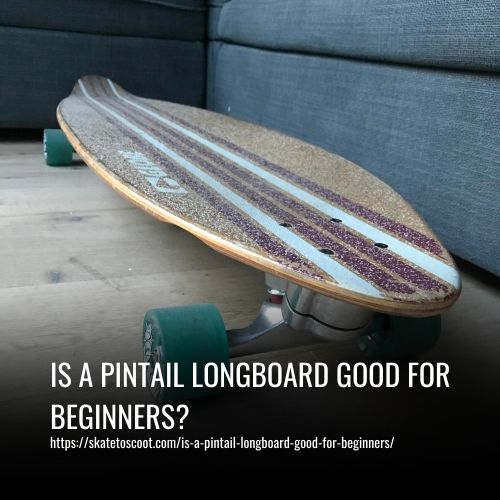
A pintail longboard is good for beginners who want a stable, predictable board for cruising and carving on flat to gently sloped terrain. Its classic teardrop shape provides a comfortable, wide foot platform and natural wheel clearance, making it forgiving for balance and turning. However, its higher top-mount design and typical lack of a kicktail make it less ideal for learning tricks, slides, or riding at higher speeds compared to drop-through or drop-down shapes.
That last clause is the one most guides gloss over. They’ll tell you pintails are “classic” and “great for cruising,” which is true, but they skip the part about how your height affects control. A pintail sits you higher off the ground than a drop-through deck. That extra inch or two changes how you push, how you turn, and, crucially, how stable you feel when you’re just starting out and your legs aren’t yet skate-strong. A common question is: is a pintail longboard good for beginners?
What follows isn’t just a list of pros and cons. It’s a breakdown of the key specs, wheelbase, concave, truck width, that actually decide if a specific pintail will work for you. We’ll look at real models like the Yocaher VW Series and the Globe Pintail 44“, compare them to other shapes, and give you the setup tweaks that make a pintail more beginner-friendly. By the end, you’ll know exactly what a pintail can and cannot do for a new rider.
Key Takeaways
- Pintails excel at cruising and carving but are poorly suited for downhill speed or technical sliding due to their flex and high center of gravity.
- For most beginners, a 40-inch deck with a 24- to 26-inch wheelbase offers the best blend of stability and maneuverability; the Yocaher Pintail VW Series (40″, 24.5″ wheelbase) is a prime example.
- Look for reverse kingpin trucks (180mm width for a 9-10″ deck) and soft, large wheels (70mm, 78a durometer) to maximize stability and smooth out rough pavement.
- The biggest trade-off is height: pintails are top-mounted, making pushing slightly harder than on a lower drop-through board, which can fatigue new riders faster.
- Spend between $100 and $150 on a complete pintail from a brand like Yocaher, Globe, or Magneto to ensure quality components; cheaper boards often have trucks that won’t turn properly or bearings that seize.
What a Pintail Longboard Actually Is
Forget the surfboard comparisons for a second. Mechanically, a pintail is a top-mounted longboard with a distinctive tapered shape, wide at the trucks, narrowing to a point at the tail. This isn’t just for looks. That taper is the original solution to wheel bite, the dreaded moment when a turning wheel contacts the deck and throws you off. By pulling the deck material away from the wheel path, pintails let you run larger, softer wheels without needing cutouts or complex drops in the deck.
The result is a straightforward platform. You stand directly on top of the trucks, which gives you immediate, direct feedback when you lean to turn. There’s no mechanical isolation. This directness is why they’re described as “carvy” or “surfy.” Your weight shift translates directly into a turn.
The pintail teardrop-shaped deck is the most suitable for beginners. The shape prevents the wheel from contacting with the board while still providing ample footspace. . Yocaher manufacturer description
But that top-mount design has a consequence: ride height. Your feet are higher off the ground compared to a drop-through deck, where the trucks are mounted through a hole in the board. Sources like Longboards USA recommend drop-throughs for beginners for this reason, while others, like Yocaher, state pintails are most suitable for beginners, which directly answers the is a pintail longboard good for beginners question. It’s a subtle leg-ache difference that adds up.
Pintail vs. Drop-Through: The Beginner’s Trade-Off
This is the decision that defines your first few months. Most expert guides, like the one from Longboards USA, point beginners toward drop-through decks when considering the is a pintail longboard good for beginners debate. Their reasoning is sound: a drop-through puts you closer to the ground. This lower center of gravity feels more stable, and the reduced distance to the pavement makes pushing less of a leg-lift chore. It’s objectively easier on your stamina.
So why would anyone suggest a pintail? Responsiveness. When you’re standing on top of the trucks on a pintail, you have greater direct control over them. A small lean produces a more noticeable turn. This can make learning the feel of carving more intuitive for some people. The trade-off is that this same sensitivity can make the board feel less stable at higher speeds or if your stance is off.
Here are the actual measurements. The Yocaher Pintail VW Series has a 24.5-inch wheelbase. A typical drop-through board in the same 40-inch length class might have a different wheelbase. That shorter wheelbase on the pintail makes it turn quicker, while the longer wheelbase on the drop-through adds longitudinal stability.
| Feature | Pintail (Top-Mount) | Drop-Through | Better for Beginner Because… |
|---|---|---|---|
| Ride Height | Higher (e.g., ~5-6″ off ground) | Lower (e.g., ~4-5″ off ground) | Drop-through is easier to push and feels more stable. |
| Turning Feel | Direct, responsive, carvy | Stable, dampened, predictable | Pintail gives clearer feedback; drop-through forgives errors. |
| Primary Use | Cruising, carving, flat-ground flow | All-around cruising, commuting, mild downhill | Drop-through is more versatile for an unknown riding future. |
| Wheelbite Prevention | Shape-based taper (or sometimes wheel wells) | Deck cutouts and/or drop design | Both work; pintail’s method is simpler but less adjustable. |
The community split is real. On Reddit, you’ll find old threads where seasoned riders dismiss pintails as “beginner traps” because they limit progression into sliding or downhill. You’ll also find riders who learned on a pintail and loved it for exactly the carvy, casual feel those experts dismiss. One critical point is often missed: your first board’s job is to get you riding consistently. If you love how it looks and feels, you’ll take it out more. For some, that’s a sleek pintail.
The Key Specs That Make or Break a Beginner Pintail
You can’t just buy any pintail. Its specific measurements determine whether it will feel stable and forgiving or twitchy and awkward. These are the numbers you need to match to your body and goals.
Deck Length and Width: Your height is a good starting point. General guidelines suggest riders under 5’6″ look at boards from 32 to 38 inches, riders 5’6″ to 5’10” look at 38 to 42 inches, and riders over 5’10” consider 40 to 46 inches. More important than height, honestly, is shoe size and comfort. A deck needs to be wide enough for your feet to stand comfortably. If you wear a size 9 or larger, choose a deck at least 9 inches wide. The Globe Pintail 44″ is 9.75 inches wide, that’s a lot of room. The Yocaher VW Series is 9 inches wide, which is the sweet spot for most adults.
Wheelbase: This is the distance between the inner mounting holes for your trucks. It’s the engine of stability. A longer wheelbase (like the Globe’s 32.25 inches) feels planted and resists speed wobbles. A shorter wheelbase (like the Yocaher’s 24.5 inches) makes the board turn quicker and feel more nimble. For a beginner focused on cruising and learning basics, Longboards USA recommends a wheelbase between 20 and 26 inches as ideal, while specific pintail models like the Globe Pintail 44″ have a wheelbase of 32.25 inches.
Concave and Flex: Here’s where manufacturers disagree, and it changes the feel underfoot. The Globe Pintail 44″ has a mild concave of .125 inches, giving your feet subtle pockets to lock into. The Yocaher VW Series has no concave, it’s completely flat. The Magneto Pintail Series has a subtle progressive concave. Flex matters too. The Yocaher has a medium flex, which absorbs vibration from rough pavement. The Magneto Pintail Series is stiff, which provides a more precise, powerful push. Beginners often benefit from a little flex; it’s more forgiving.
Where this goes sideways: Choosing a pintail that’s too long or too flexy for your weight. A heavy rider on a flexy 44-inch board will experience “deck slap”, the board bouncing off the ground mid-push, which kills momentum and feels unstable. Match the board’s flex rating to your weight.
Setting Up Your Pintail for Stability (Your First 10 Minutes)
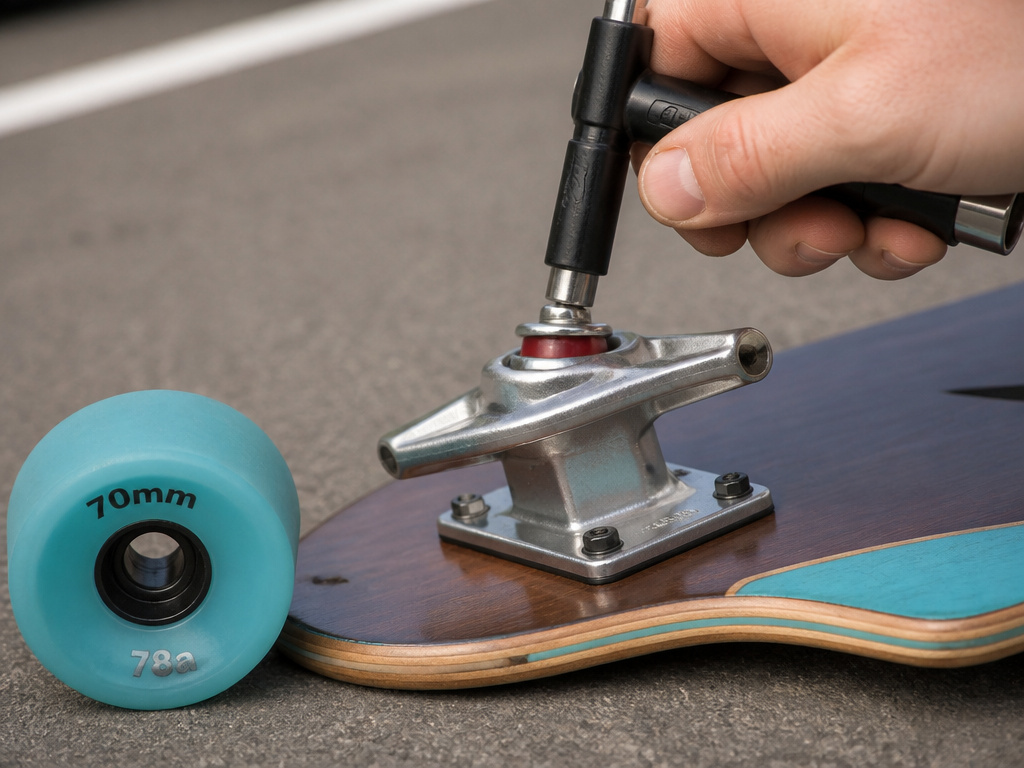
The board you buy is only half the equation. How you set it up decides the rest. Most completes come assembled, but the factory settings are a generic middle ground. A few tweaks tailor it to a novice’s need for stability.
Trucks: They should be reverse kingpin style, not the traditional kingpin style used on street skateboards. Reverse kingpin trucks turn more predictably at cruising speeds. They’ll likely come with a baseplate angle between 44 and 50 degrees, a higher angle (50) is more responsive, which can actually help beginners see the results of their weight shifts. Start with them moderately tight. You want to be able to turn by leaning, but not so loose that the board wobbles under your normal standing weight. A simple test: stand on the board and shift your weight side to side. If the trucks turn so easily that you feel you might tip over, tighten them slightly.
Wheels: This is the most important choice. Look for wheels between 65 and 75mm in diameter, with a durometer (hardness) of 78a to 83a. Softer wheels (lower a-number) grip the road better and smooth out cracks and pebbles. The standard on many completes, like the Globe and Yocaher, is 70mm, 78a wheels. That’s the sweet spot. Larger wheels roll over obstacles easier and maintain speed longer, which means less pushing for you.
Bearings: The minimum you want is ABEC-7. Don’t get hung up on the ABEC rating beyond that; it’s a tolerance rating for speed, not a durability score. What matters more is that they spin freely out of the box. A common issue, noted in a 2022 review of the Globe Pintail 44″, is that boards can “arrive with a busted bearing.” Before your first ride, spin each wheel by hand. They should all spin smoothly for several seconds. One that stops immediately or grinds needs replacing.
Common Beginner Mistakes on a Pintail (And How to Avoid Them)
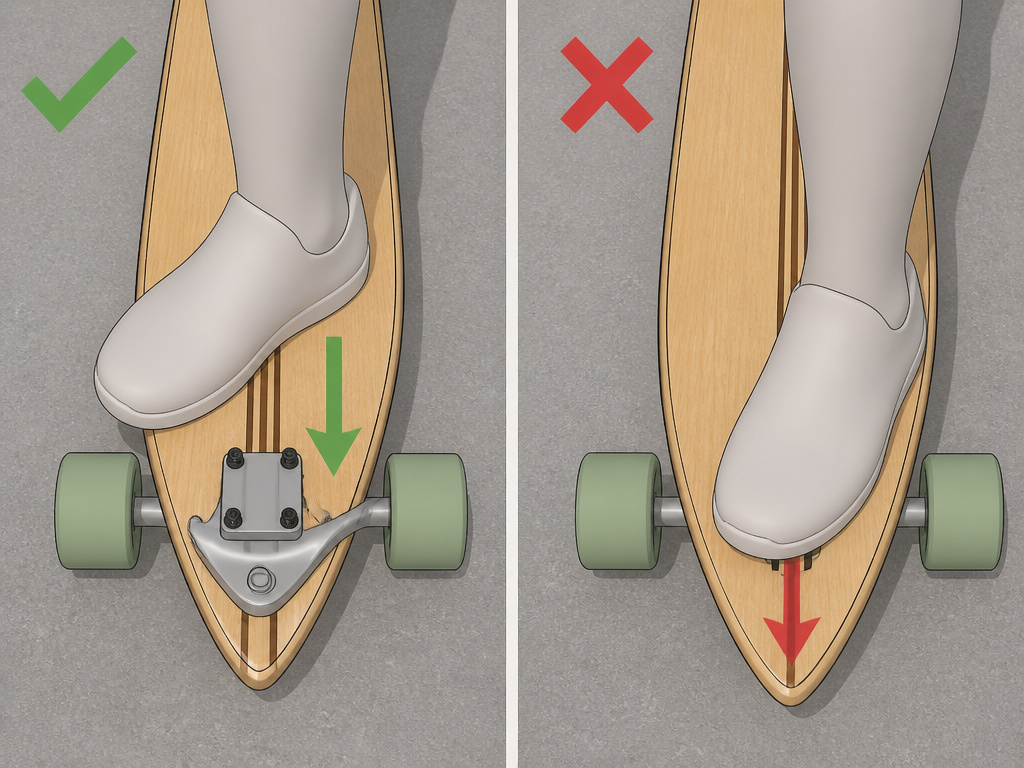
I’ve taught enough lessons to see the same errors crop up. On a pintail, they’re accentuated by the board’s specific design.
Foot Placement Too Far Forward: The wide nose is inviting, but standing on it shifts your weight toward the front truck, making the board overly responsive and twitchy. Your front foot should be positioned just behind the front truck bolts, perpendicular to the deck. This is your anchor point.
Pushing with Your Whole Body: Because the board is higher off the ground, there’s a temptation to bend deeply at the waist to reach the pavement. This kills your balance. Keep your torso mostly upright and push from the knee and ankle of your kicking leg. It feels smaller, but it’s far more stable.
Ignoring the Push-Off Point: On a drop-through, you can often push from the middle of the board. On a pintail, you must push from the tail. Pushing from the side of the deck, especially near the wider nose, can cause the board to rotate away from you. Step off with your back foot near the pointed tail, push, then return your foot to the deck near the rear truck.
Fighting the Carve: Pintails want to turn. Beginners often stiffen up and try to keep the board perfectly straight, which is exhausting. Let the board follow a gentle, wide “S” path down the road. This uses its natural design and actually helps you maintain speed with less pushing.
Common mistake: Overtightening the trucks to combat nervousness. This locks the board into a straight line, but it also makes turning impossible without a major weight shift. You learn to ride a rigid plank, not a longboard. Loosen them slightly and practice in a wide-open lot.
When You Might Outgrow a Pintail
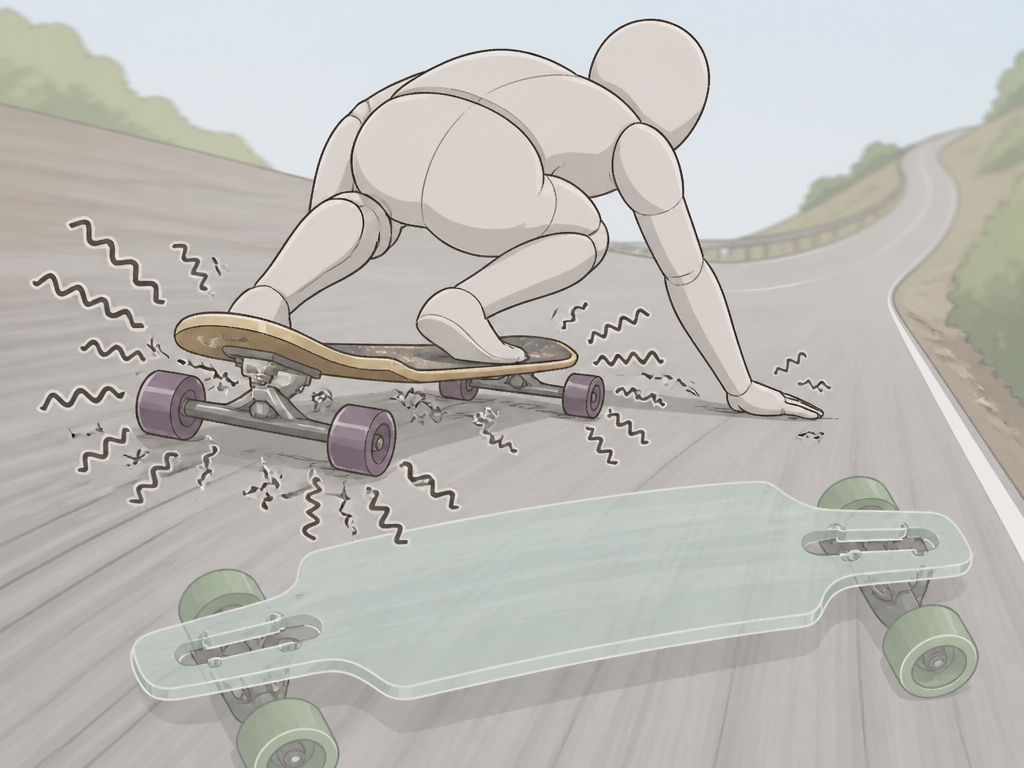
A pintail is a fantastic teacher for a specific curriculum: balance, carving, and the simple joy of rolling. There will come a point, though, where it starts to say “no” to what you want to do next.
The first sign is a curiosity about speed. Pintails, especially flexy ones, are not built for downhill stability. As you pick up pace, the higher platform and flex can combine to generate speed wobbles, a rapid, uncontrollable shaking of the trucks. If you find yourself wanting to ride steeper hills comfortably, you’ve bumped into the pintail’s limit.
The second sign is a desire to slide or do basic tricks. The classic pintail has no kicktail. You cannot lift the front wheels to pivot, pop over a curb, or initiate a slide by kicking out the tail. If you’re watching videos of riders doing gentle coleman slides or manualing over cracks, your pintail is holding you back.
What should you move to? That depends. For more speed and stability, a stiff drop-through or top-mount downhill board with a longer wheelbase is the next step. For freeriding and slides, a board with a kicktail and symmetrical shape (like a double kick) opens up new techniques. The progression isn’t linear. You don’t “graduate” from a pintail; you add a different tool to your quiver for a new purpose.
Specific Pintail Models for Beginners
Now, applying these specs and setup advice, we can examine actual boards. These are models where the manufacturer’s choices align well with beginner needs.
Yocaher Pintail VW Series: This is the archetypal beginner pintail. At 40 inches long with a 24.5-inch wheelbase and a flat, 9-inch wide deck, it hits the recommended size targets perfectly. The medium flex absorbs shock, and the complete comes with 70mm, 78a wheels and 180mm reverse kingpin trucks. It’s a coherent, well-thought-out package for cruising. Check current reviews on Amazon to see how the latest batches are holding up.
Globe Pintail 44″ Complete: For a taller rider (over 5’10”) or someone who wants maximum foot space, the Globe is a contender. Its 44-inch length and 32.25-inch wheelbase make it feel very stable in a straight line. The mild concave (.125 inches) gives some foot lock-in. Be aware that the longer wheelbase makes it less nimble for tight turns, and the 7-ply construction might be stiffer than the Yocaher. It’s a quality board, but verify the bearings upon arrival.
Magneto Pintail Series: Magneto offers a 40-inch by 9.25-inch option with a stiff flex and “subtle progressive concave.” This is a good pick if you’re a heavier rider or want zero flex for maximum push efficiency. They explicitly market it for cruising and carving, noting their carbon fiber board is better for downhill. That honesty is refreshing.
The Flybar 36″ Pintail and Krown Pintail are other valid entries. The Flybar is shorter (36″), which can be great for smaller riders or easy carrying, but its width varies from 9.6″ to 7″. Krown emphasizes wheel wells to prevent wheel bite, a useful feature if you decide to try slightly larger wheels later.
Frequently Asked Questions
Are pintail longboards good for beginners?
Yes, for a specific type of beginner. If your primary goals are relaxed cruising, learning to carve, and riding on flat bike paths or smooth streets, a pintail is a good, straightforward choice. Its simple design and predictable handling are assets. If you think you might want to try hills, slides, or tricks early on, a drop-through longboard is a more versatile first buy.
What is a pintail longboard good for?
Pintail longboards are good for cruising, carving, and commuting on flat to gently sloped terrain. Their shape provides inherent wheel clearance for comfortable wheels, and their top-mount design offers a responsive, “surfy” turning feel. They are not designed for high-speed downhill, technical sliding, or street tricks.
What’s the difference between a cruiser and a pintail longboard?
“Cruiser” is a broad category that includes many shapes (pintails, kicktails, mini-cruisers) designed for comfortable, everyday riding. A pintail is a specific shape within the cruiser category, characterized by its tapered teardrop design. All pintails are cruisers, but not all cruisers are pintails. Some cruisers have kicktails for tricks, which pintails typically lack.
Is a 40-inch pintail too big for a beginner?
No, a 40-inch pintail is often an ideal size for most beginner adults. It provides a stable, comfortable platform for learning balance and foot placement while remaining manageable to carry. The Yocaher Pintail VW Series is 40 inches, and it’s explicitly marketed as suitable for beginners. Taller riders may prefer something slightly longer, like a 42 or 44-inch board.
Can you learn to slide on a pintail longboard?
It is very difficult to learn to slide on a traditional pintail. They lack a kicktail to initiate the slide, and their flexy construction and high ride height make it hard to break the wheels’ traction in a controlled manner. While not impossible for an expert, it is an unnecessary hurdle for a beginner. If sliding is a goal, choose a different board shape designed for it.
How much should a beginner spend on a pintail longboard?
Aim to spend between $100 and $150 for a complete pintail longboard from a reputable brand. This price range typically ensures you get functional reverse kingpin trucks, decent 78a wheels, and ABEC-7 or better bearings. Spending less often means compromising on component quality, which makes learning harder. Spending more is unnecessary for a first board.
Before You Go
Your first board should be a gateway, not a barrier. A pintail longboard, chosen with an eye for wheelbase and set up for stability, can be exactly that for the right rider, one who values smooth carves and casual rides over technical ambition from day one.
Match the board to your body. If you’re over 5’10”, that 44-inch Globe might feel right. If you have size 9 shoes, seek out that 9-inch width. And please, loosen those trucks a touch from factory tight. Let the board teach you how to turn.
One final, contrarian stance: if you’re truly on the fence between a pintail and a drop-through, buy the drop-through. It’s the more forgiving, versatile tool. But if you’ve always wanted that classic, flowing pintail ride and you’ll practice more because you love how it looks, get the pintail. Passion beats perfect specs every time. Now go find a smooth parking lot and put in the miles. The board only gets you to the starting line; your time on it does the rest.
