What Is a Drop Through Longboard? The Lowdown
This post contains affiliate links. As an Amazon Associate, we earn from qualifying purchases.
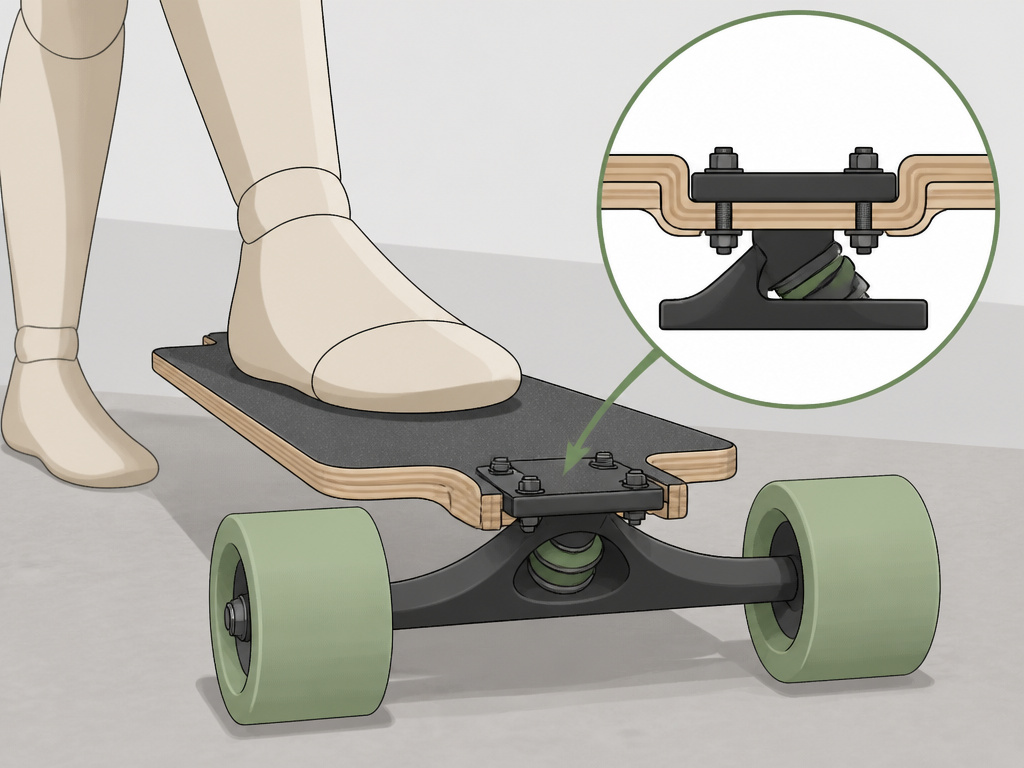
A drop-through longboard is a board where the truck baseplates are mounted on top of the deck through pre-cut holes, lowering the riding platform closer to the ground. This design increases stability, makes pushing easier, and is a popular choice for beginners, commuters, and downhill riders. Unlike a top-mount, you must fully disassemble the trucks to mount them on a drop-through deck.
That “must disassemble” clause is the procedural trap. It’s not just a different look; it’s a different assembly process that trips up a lot of first-time builders. This is a key difference when considering what is a drop through longboard. The Decathlon support manuals are blunt about it: “You cannot mount your trucks without disassembling them.”
What follows is a walkthrough of why this design exists, who it actually serves, and the real-world trade-offs you feel under your feet. This section details the specs beginners should look for, the mounting steps you can’t skip, and when you might outgrow a drop-through for something else.
Key Takeaways
- Drop-through decks require full truck disassembly for mounting, a critical step that differentiates them from top-mount setups.
- For stability and ease, beginners should choose a deck with Reverse King Pin (RKP) trucks and 70mm, 78A wheels.
- Reverse King Pin (RKP) trucks are strongly recommended over standard street trucks, which can turn poorly and drop the board too low.
- The design reduces your direct control over the trucks, resulting in a slower, more stable turning feel compared to a top-mount.
- Proprietary mounting patterns exist, like the Lush Adjustable Drop-Through Mount, which only works with specific truck brands.
What Defines a Drop Through Longboard?
Look at the nose and tail of the board. If you see symmetrical cutouts where the trucks are bolted down, you’re looking at a drop-through. The baseplate of the truck sits on top of the deck, with the kingpin and hanger dangling through that hole.
The point is to get you closer to the pavement. A lower center of gravity is a fundamental stability hack. It’s why sports cars are low-slung and why a wide stance feels solid. On a board, that stability translates directly to confidence when you’re learning to push, when you pick up a bit of speed on a gentle hill, or when you’re just cruising a long, straight path.
Drop-through decks have a hole cut where the truck goes, and usually feature big cutouts for the wheels to avoid wheelbite. The trucks are mounted through the deck instead of being bolted under it.
This isn’t just about comfort. That lower platform reduces the leg strain of pushing, because you don’t have to lift your foot as high off the ground for each stride. For commuting or distance pushing, that efficiency adds up over miles.
Anatomy of a Drop Through: Deck, Trucks, and Compatibility
A drop-through deck isn’t a universal part. The hole pattern matters. Most use a common 6-hole or 4-hole pattern, but some manufacturers, like Lush Longboards, use their own.
The Lush Adjustable Drop-Through Mount, for example, offers 20mm of adjustment per truck but only works with specific brands: Sabre, Paris (6-hole), Gunmetal, Caliber, Aera, Surf Rodz, Kahalani, Gullwing, Munkae, Bear (CNC), Plasma, and Road Rider. It has a non-adjustable fit for Randal, Paris (4-hole), Holey, Revenge, and Bear (Die-Cast), and is incompatible with Seismic and Original Crail trucks.
This is the first warning: check the deck’s mounting pattern before you buy new trucks. A generic RKP truck will fit most standard drop-through holes, but proprietary systems lock you into their ecosystem.
Speaking of trucks, the type is critical for performance. Lush Longboards puts it plainly: “We strongly recommend a proper longboard (‘RKP’) truck rather than a regular ‘Street Style’ truck.” Regular Street trucks don’t turn enough for a drop-through, and often they make the board too low.”
An RKP truck, or Reverse King Pin truck, has the kingpin facing outward, which creates a different steering geometry better suited to the drop-through’s lower mounting point. A complete board like the Atom Drop-Through Longboard uses RKP trucks with a 50-degree baseplate angle and 245mm axles.
Drop Through vs. Top Mount: A Side-by-Side Look

This is the choice that defines how your board will feel, which is central to the what is a drop through longboard question. It’s not about one being universally better; it’s about which one serves the job you need done today.
On a top-mount, your feet are directly over the trucks. You have direct control over the trucks. When you lean to carve, the board responds quickly and sharply. It’s a direct, connected, and, for many, more engaging feel. This direct control also helps with advanced techniques like sliding, where you need to break the wheels’ traction with precise foot pressure.
On a drop-through, your feet are slightly inboard of the trucks. You have less direct control over the trucks. The turn initiation feels slower and more gradual. It’s stable, predictable, and forgiving. For a new rider, that predictability is a safety net. For a downhill racer, that stability at high speed is a tool.
| Aspect | Drop-Through Longboard | Top-Mount Longboard |
|---|---|---|
| Ride Height | Lower, easier to push | Higher, more leg effort required |
| Stability | High (lower center of gravity) | Lower (requires more active balance) |
| Turning Feel | Gradual, stable, less leverage | Direct, responsive, high leverage |
| Best For | Beginners, commuting, distance pushing, stable downhill | Carving, pumping, freeride/sliding, technical downhill |
| Assembly | Requires full truck disassembly | Trucks mount fully assembled |
The feeling is tangible, and understanding this distinction is key to what is a drop through longboard. On a top-mount, you steer the board. On a drop-through, you guide it. One isn’t inherently better, but they excel at different tasks. If your goal is to ride a drop-through comfortably for miles on end, the drop-through wins. If your goal is to ride comfortably for miles on end, the drop-through wins. If you want to throw quick carves or learn slides, the top-mount’s feedback is invaluable.
Why Are Drop Through Longboards Good for Beginners?
The short answer is forgiveness. A lower deck is easier to step onto and off of. The stability reduces the frequency of speed wobbles as you learn to manage balance. The easier pushing reduces fatigue, so practice sessions can last longer.
But “good for beginners” is vague. We can be more specific. What should a true beginner look for in a drop-through?
- Length: Around 40 inches. This provides a stable wheelbase without being unwieldy. The Atom Drop-Through Longboard is 41 inches long.
- Trucks: Must be Reverse King Pin (RKP). Avoid any complete board that ships with standard street trucks.
- Wheels: Go for larger, softer wheels. Think 70mm in diameter with a 78A durometer rating, like those on the Atom and Yocaher completes. They roll over cracks and pebbles smoothly.
This combination builds a board that is confidence-inspiring from the first push. It’s why many coaches, myself included, point newcomers toward this style. You can focus on the fundamentals, balancing, pushing, turning, stopping, without fighting the board. You can read a deeper dive on why this setup is recommended for beginners in our dedicated guide for beginners.
The Mounting Process: What Most Guides Leave Out
Here’s where the commodity advice stops and the manual-specified procedure starts. Every other longboard style allows you to bolt on fully assembled trucks. A drop-through does not.
The Decathlon support guide is the canonical source here. Their step-by-step is precise for a reason.
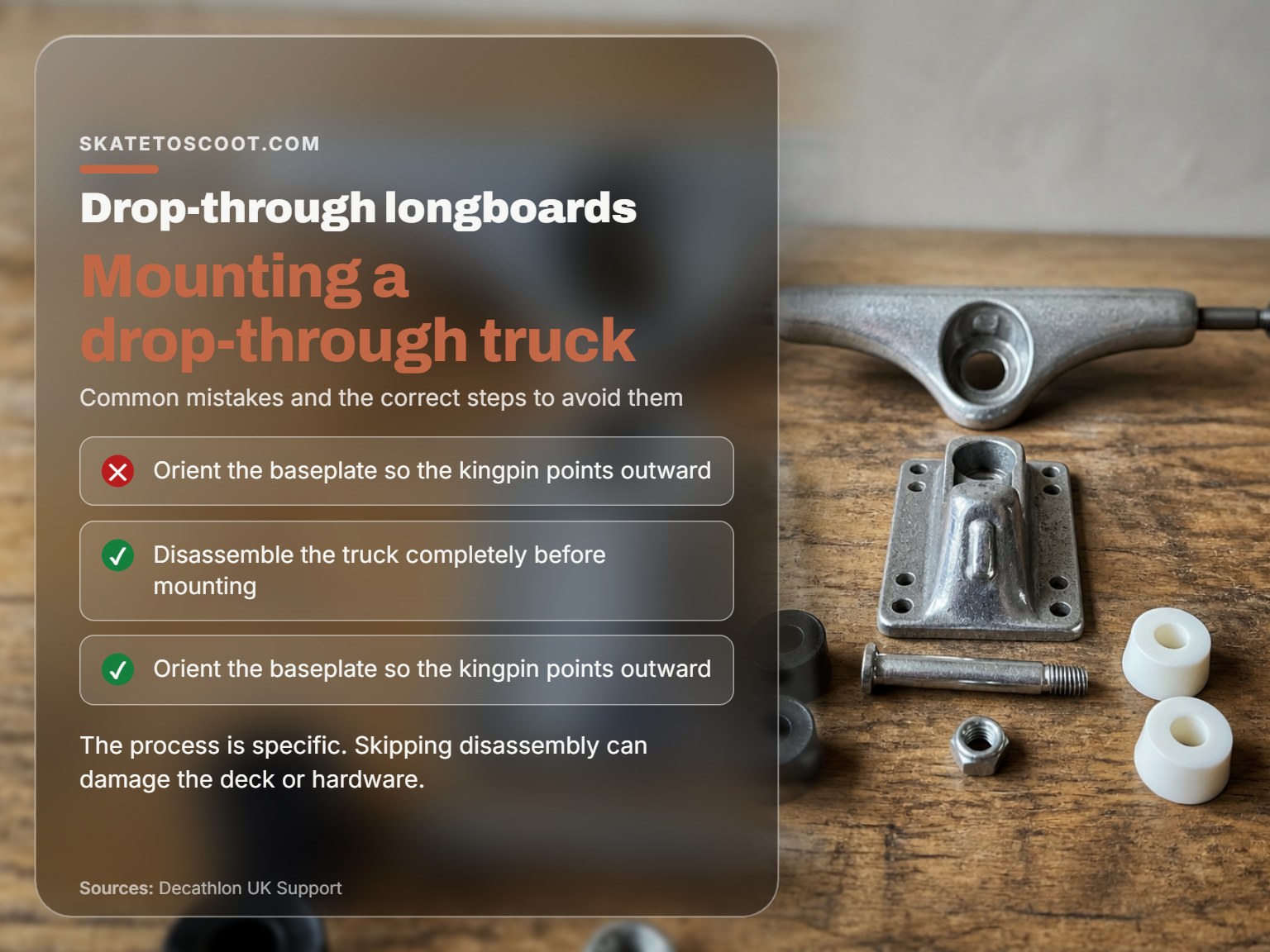
- Disassemble the Truck: Loosen and remove the kingpin nut. Remove the top bushing washer (cone/roadside), then the hanger, then the bottom bushing (barrel/boardside) and its washer. “Be careful not to lose your pivot cup.”
- Orient the Baseplate: Place the baseplate on top of the deck so the kingpin faces the mounting hole. “Keep in mind: the kingpin goes outwards!” This is critical for RKP geometry.
- Secure the Baseplate: “Screw the baseplate onto the deck as this will make everything else easier.” Do one truck fully before moving to the other.
- Reassemble in Order: From the base of the kingpin upward: 1) baseplate, 2) pivot cup, 3) boardside bushing, 4) hanger, 5) roadside bushing, 6) washer, 7) kingpin nut.
- Seat the Hanger: “Be sure to properly situate the hanger’s pivot in the baseplate pivot cup.” You’ll feel it snap into place.
- Tighten Correctly: “Only tighten the lower bushing nut until there is no play in the hanger. You can gauge by leaving one or two screw threads visible.” Overtightening here kills the truck’s ability to turn.
Common mistake: Mounting the baseplate with the kingpin facing inward. If the kingpin isn’t pointing outward through the deck hole, your RKP trucks will not turn correctly and the geometry is ruined.
This process isn’t hard, but it’s specific. Skipping disassembly and trying to force the assembled truck through the hole is a sure way to damage the deck’s laminate or cross-thread the hardware.
Drop Through vs. Drop Down: Untangling the “Drop” Confusion
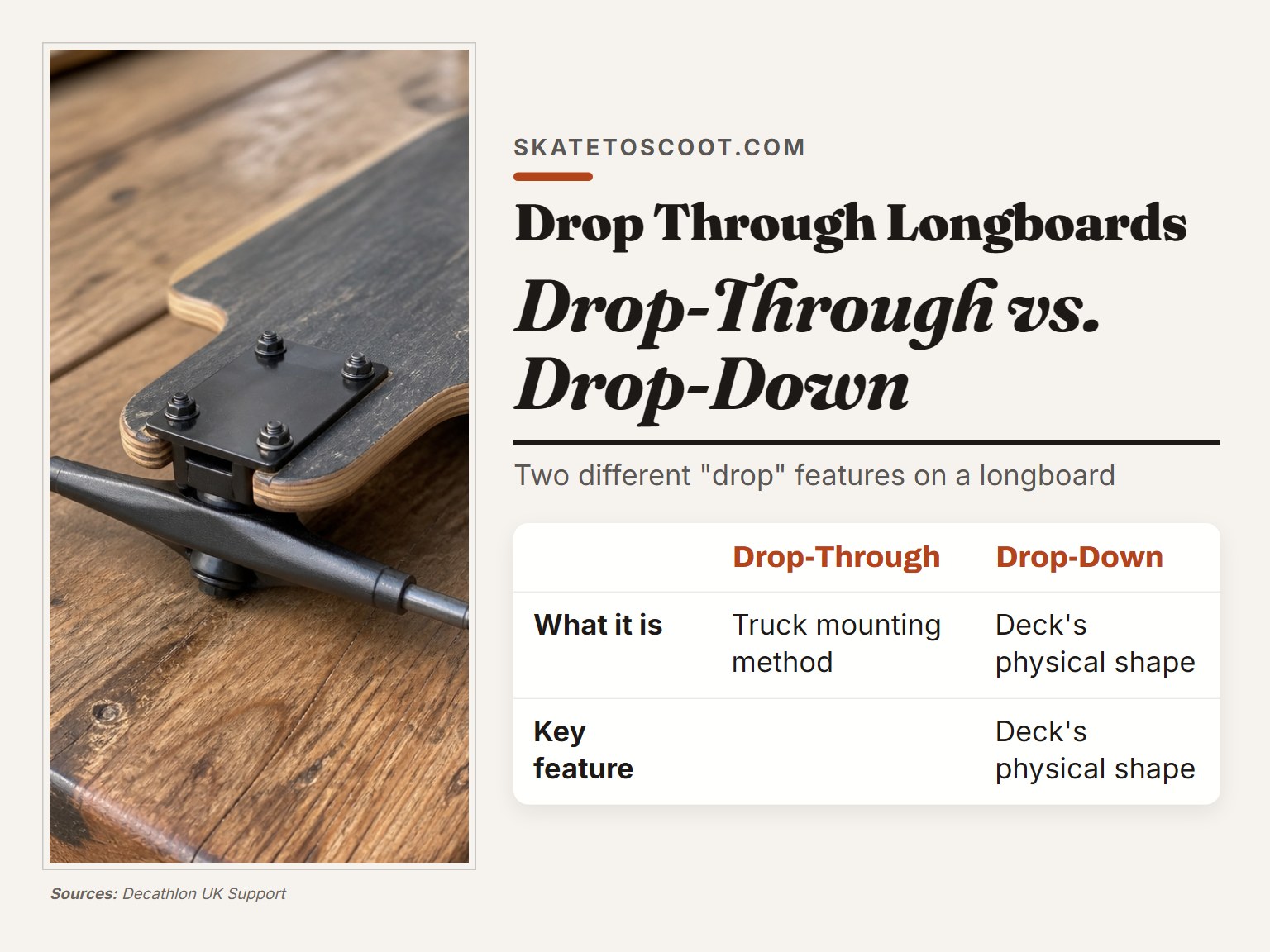
This is a rampant point of confusion. The terms sound similar, but they describe different parts of the board.
- Drop-Through: Refers to the truck mounting method (through the deck).
- Drop Down (or Drop Deck): Refers to the deck’s physical shape, where the standing platform is lowered between the trucks via a concave drop.
A board can be one, the other, or both. A board that is both is called a double drop longboard. It combines the lowered mounting of a drop-through with the lowered platform of a drop-down, creating the absolute lowest possible ride height.
Think of it this way: a drop-through lowers the trucks. A drop-down lowers your feet. A double-drop lowers both. The Landyachtz Drop Cat is a classic example of a drop-down deck that uses a drop-through mount, a double-drop.
This matters because the feel is different. A pure drop-through deck is often flat between the trucks. A drop-down deck has foot pockets that lock you in, which is great for pushing but can feel restrictive if you like to move your feet around for carving or dancing.
Limitations and When to Move On
The drop-through’s stability is its greatest strength and its primary limitation. That lower mounting point means you have to work harder to initiate deep carves or break into a slide. The board feels less “surfy” and more “planted.”
For freeriding or technical downhill, where quick, precise turns and controlled slides are key, that planted feeling becomes a handicap. The feedback loop between your feet and the wheels is dampened. This is why most advanced riders in those disciplines eventually migrate to top-mounts.
The transition isn’t about one board being worse. It’s about your skills evolving to demand different tools. You start on a drop-through to build confidence and fundamental balance. Once that’s automatic, you might seek a top-mount for its sharper handling and greater potential for tricks on a drop-through or, more aptly, tricks that are easier on a top-mount.
I’ve seen riders get frustrated with their progression on a drop-through, not realizing the board itself was the limit. They’d practice slides endlessly with minimal results. Switching to a top-mount with the same wheels and bushings often made the technique click within a session. The board gave them the direct control they needed.
Frequently Asked Questions
Are all longboard trucks compatible with drop-through decks?
Sources disagree on this. Lush Longboards states that in theory, drop-through decks work with any skateboard trucks, but they strongly recommend RKP trucks. Other sources imply standard compatibility without a specific truck type warning. Standard street trucks (TKPs) will not turn effectively and can make the board dangerously low. Always check the deck manufacturer’s compatibility list, especially for proprietary mounts like the Lush system.
Can you convert a top-mount deck to a drop-through?
No. Converting a top-mount deck to a drop-through would require cutting large holes through the structural plies of the deck, critically weakening it. The mounting patterns are also different. You buy a deck designed for one mounting style or the other.
Is wheelbite a concern with drop-throughs?
It’s less of a concern than on a top-mount, but not impossible. The large wheel cutouts are designed to prevent it. However, if you use excessively loose trucks or the wrong combination of wheel size and bushing softness, wheelbite can still occur. The Decathlon Portugal manual warns that loosening the kingpin too much raises the “risk of wheel bite… Blocking it immediately.”
What is the best wheel size for a drop-through longboard?
For general cruising and commuting, 70mm wheels are a standard, safe choice. They balance speed, smoothness, and clearance. Softer durometers (78A-80A) absorb vibration better. For a list of complete setups with proven components, see our roundup of the best drop-through longboards.
The Bottom Line
A drop-through longboard is a tool for a specific job: stable, efficient, confidence-building riding. It’s the board you learn on, commute on, and use to explore without drama.
Start with a proven complete setup from a reputable brand, it eliminates compatibility guesswork. Pay attention to the mounting process; doing it wrong ruins the geometry. And understand that its greatest strength (stability) is also its ceiling. When you find yourself wanting quicker turns, deeper carves, or easier slides, that’s your signal to look at a top-mount or a specialized drop-through deck built for performance.
The goal isn’t to stay on a drop-through forever. It’s to use it as the solid foundation it is, so when you step onto something more responsive, you have the balance and confidence to handle it.
