Are Electric Skateboards Safe? Injury Statistics Explained
This post contains affiliate links. As an Amazon Associate, we earn from qualifying purchases.
Electric skateboards are not categorically safe or unsafe; their risk is a product of three specific, measurable variables: the rider’s protective gear and skill, the riding environment’s hazards, and the board’s own design and certification status. Official data shows at least four reported deaths and dozens of serious injuries linked to specific self-balancing models, creating a clear distinction between general electric skateboards and those under active federal warnings.
That distinction, between a generic risk and a documented, named hazard, is where most casual advice falls short. The conversation extends beyond wearing a helmet to knowing which boards have been recalled for suddenly stopping, which lack proper electrical certification, and what the manufacturer says versus what the federal regulator mandates. A core question for any rider is: are electric skateboards safe?
What follows is a breakdown of the three-layer safety framework, the hard data behind current warnings, and the mandatory protocols that separate a calculated risk from a preventable injury.
Key Takeaways
- Always wear a certified bicycle helmet, official data links at least three of four reported Onewheel deaths to riders not wearing one.
- Verify board certification before purchase by checking for a legitimate UL 2272 mark; some boards, like certain Ether models, have been found with unauthorized certification labels.
- Stop using boards under federal “stop use” warnings, this includes all Onewheel models (per the CPSC, which urges consumers to stop using them) and Floatwheel models, regardless of manufacturer counter-claims. Note that Future Motion, the maker of Onewheel, states the boards are safe when operated following basic safe riding principles and sees no reason for riders to stop using their boards.
- Practice falling and bailing at low speed, most serious injuries happen when riders tense up and absorb the full impact; learning to roll disperses the force.
- Never charge a lithium-ion battery unattended, the CPSC explicitly warns against charging while sleeping or away from home due to fire risk.
The 3-Layer Safety Framework: Rider, Environment, Machine
Forget the binary “safe or not” question, which is often how the are electric skateboards safe debate is framed. Real safety is a stack. A failure in any one layer can cause a crash, but managing all three is how you minimize real risk.
The rider layer is about what you control directly: your gear and your skill. The environment is everything outside your control, from pavement cracks to car doors. The machine layer is the board itself, its engineering, its maintenance, and its sometimes-hidden flaws.
Before you start: Riding without a helmet on an electric skateboard carries a documented risk of fatal head trauma. The CPSC reports that in at least three of the four Onewheel death incidents, the rider was not wearing a helmet. A certified helmet is your single most effective piece of safety equipment.
Layer 1: The Rider’s Gear and Skill Set
Protective gear functions as a kinetic energy management system. A helmet protects against sudden deceleration of the brain. Wrist guards transfer impact from small bones to a sliding plate. Knee and elbow pads turn a shredding abrasion into a harmless slide.
The skill part is less about tricks and more about failure management. Can you comfortably foot-brake to a stop if the electronic brake fails? Have you practiced jumping off a moving board at 10 mph onto grass? These aren’t advanced maneuvers; they are emergency procedures. The single biggest skill gap for new riders is learning how to fall correctly to avoid a collarbone or wrist fracture.
Mechanically speaking, when you fall stiff-armed, the force travels straight up the arm, often snapping the smaller bones in the wrist or the clavicle. Tucking and rolling converts that linear force into a rotational one, spreading the impact across your padded back and shoulder. It’s the difference between a broken bone and a dusty jacket.
Layer 2: The Riding Environment and Its Hazards
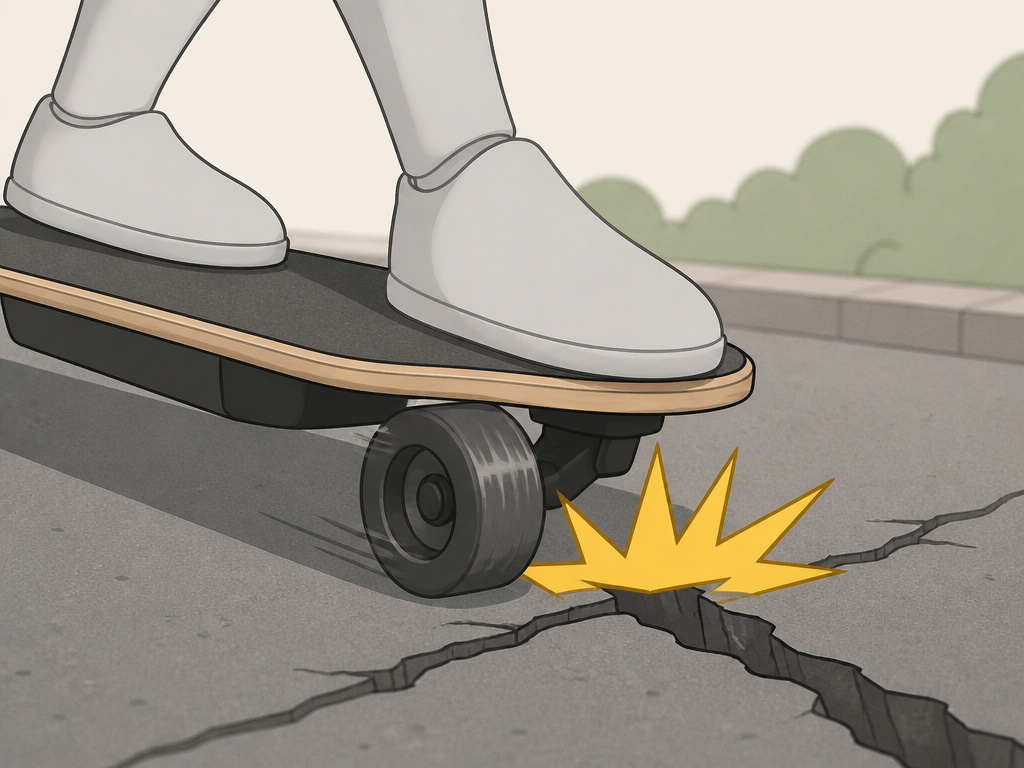
Your board’s small wheels turn every pebble, crack, and seam into a potential launch ramp. Wet leaves or morning dew on asphalt can drastically reduce tire traction. These aren’t theoretical concerns; they are daily physics.
The most critical environmental rule is simple: never outride your sightline. If you can’t see a hazard in time to react, a pothole, a parked car’s opening door, a pedestrian stepping out, you are going too fast for that path. This is why dedicated bike lanes or smooth, empty parking lots are the best locations for where to ride practice. Mixing with car traffic, especially without the high-visibility and legal status of a bicycle, multiplies your risk exponentially.
| Common Riding Hazard | Why It’s Dangerous | Mitigation Strategy |
|---|---|---|
| Wet Surfaces | Drastically reduces wheel grip, causing loss of control during turns or braking. | Avoid riding after rain. If the board gets wet, dry components thoroughly before next use. |
| Road Debris (Sand, Gravel) | Can lock a wheel instantly, throwing the rider forward. | Scan the path well ahead. Ride slowly over debris patches, keeping weight centered. |
| Uneven Pavement Transitions | A sudden lip or drop can catch a wheel, causing a high-side fall. | Approach perpendicularly at a reduced speed, or dismount and walk over the obstacle. |
| Car Doors & Intersections | Drivers often don’t see low-profile riders, leading to right-of-way conflicts. | Assume you are invisible. Make eye contact with drivers. Never assume a stopped car will stay stopped. |
Layer 3: The Machine Itself: Design, Certification, and Recalls
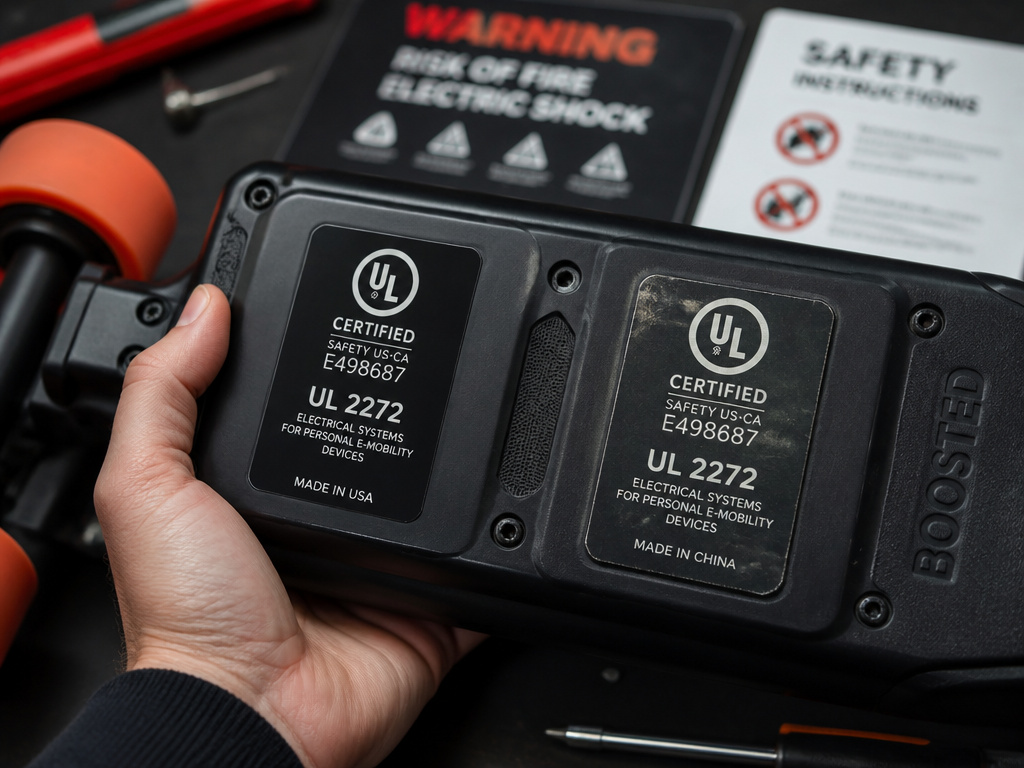
This is the layer most riders never investigate when they ask are electric skateboards safe, and it’s where the official data gets stark. Not all electric skateboards are created equal, and some have inherent design flaws that no amount of rider skill can fully mitigate.
The CPSC and groups like UL Solutions set voluntary safety standards. The key standard for electrical systems is UL 2272. A board bearing that mark has been tested for electrical and fire safety. However, UL Solutions has issued warnings about products like the Ether e-Skateboards (Cruiser, Dual, Lite models) bearing unauthorized UL Certification Marks. This means the board appears certified but has not been evaluated, creating a critical gap in trust.
The federal stance is clear: the CPSC “reminds consumers to use micromobility devices and batteries that have been designed, manufactured, and certified for compliance with the applicable voluntary safety standards.” Choosing an uncertified board means you’re accepting risks that have not been independently assessed.
Board Failures: When Safety Systems Don’t Work
Sometimes the machine itself is the primary hazard. Two high-profile cases illustrate how mechanical and software failures can lead to direct federal intervention.
The Onewheel “Ejection Hazard” and Recall
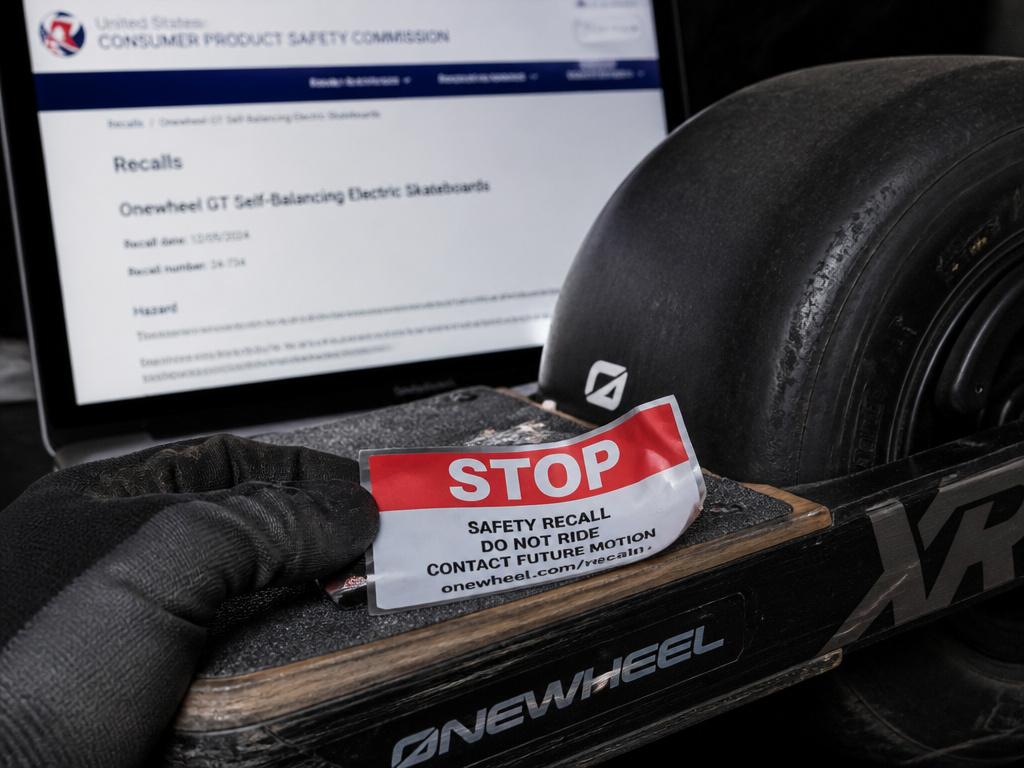
In 2023, the CPSC issued an urgent warning: “CPSC urges consumers to immediately stop using all Onewheel models.” Their investigation found the boards “can cause the rider to be ejected,” citing at least four reported deaths between 2019 and 2021 and multiple serious injuries.
The manufacturer, Future Motion, objected. They stated the boards are safe when following “basic safe riding principles” and saw “no reason for riders to stop using their boards.”
This direct conflict between regulator and manufacturer is rare and significant. It wasn’t resolved until September 2023, when a formal recall of 300,000 Onewheel Self-Balancing Electric Skateboards was announced. The hazard: the boards “can stop balancing the rider if the boards’ limits are exceeded.”
The remedy was a firmware update to add a “Haptic Buzz” alert, a buzzing sensation and sound warning riders they are nearing the board’s limits. For the original Onewheel and Onewheel+ models, the remedy is a pro-rated refund upon confirmation of disposal. The recall notice is a primary source every rider should review: the CPSC Onewheel ejection hazard warning.
The Floatwheel “Sudden Stop” Warning
In May 2024, the CPSC issued another “stop use” warning, this time for Floatwheel Adv and Adv Pro models. The hazard: they “can suddenly stop or stop balancing the user.” The company refused the CPSC’s recall request and refused to supply information. The CPSC also advised that imports may be subject to enforcement action at U.S. Ports.
These cases show a pattern: a specific failure mode (sudden loss of balance/braking) leading to ejection, with the regulatory response escalating from warning to recall when cooperation fails. For a rider, the takeaway is concrete. If you own one of these boards, the official federal guidance is to stop riding it immediately.
Essential Safety Gear: What You Actually Need
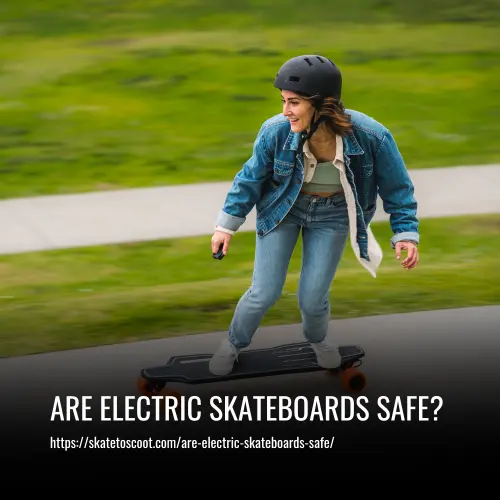
Discussions about gear often devolve into a list of everything you could possibly wear. Here is what matters most, listed in order.
- Helmet (Non-Negotiable): Use a certified bicycle or skate helmet. Full-face helmets like the TSG Pass are excellent for higher speeds, as they also protect the jaw and teeth. The CPSC’s guidance is unambiguous: “Always wear a bicycle helmet when riding to protect your head.”
- Wrist Guards (Critical): Your instinct in a fall is to put your hands out. Wrist guards with a rigid splint and palm slider prevent the hyperextension that breaks wrists and scaphoid bones. They are more effective than gloves alone.
- Knee & Elbow Pads (Highly Recommended): These turn a high-impact, abrasive crash into a slide. They are especially crucial for learning or when riding on harder surfaces like concrete.
- Appropriate Footwear: Closed-toe shoes with flat, grippy soles (like skate shoes) are essential for board control and safe bailing.
Common mistake: Buying a motorcycle helmet for electric skateboarding. They are heavier, limit peripheral vision needed for navigating pavement cracks, and are designed for different impact profiles. A quality skate or downhill longboard helmet is a better fit for the activity.
Battery Safety and Fire Prevention
The lithium-ion battery pack is the most energy-dense and potentially hazardous component on your board. The CPSC’s micromobility safety information center provides specific, mandatory rules that have been cited in recalls like the 2017 Boosted battery fire incident.
- Use only the manufacturer’s charger. Third-party or universal chargers can deliver incorrect voltage, leading to battery damage and thermal runaway.
- Never charge unattended. The CPSC explicitly states: “Always be present when charging micromobility products. Never charge them while sleeping or when you are not at home.”
- Inspect batteries regularly. Look for swelling, dents, or leaks. A puffy battery is a failing battery and should be disposed of properly immediately.
- Dispose of lithium batteries properly. Never throw them in the trash. Take them to a designated battery recycler or hazardous waste center.
The Boosted electric skateboard fire recall of approximately 3,200 2nd Generation Boosted Dual+ electric skateboard battery packs (Model B2SR) was initiated after two reports of packs overheating and smoking. It’s a documented precedent that underscores why these rules exist.
How Do Electric Skateboards Compare to Other Sports?
Is an electric skateboard more dangerous than a traditional skateboard or a bicycle? The data isn’t perfect for direct comparison, but the logic is clear.
A traditional skateboarder’s speed is limited by their push power and terrain. An electric skateboard can deliver high speed instantly, without the rider having developed the equivalent muscle memory or bail-out reflexes. This mismatch is a key risk factor. Also, a bicycle has a larger wheelbase, bigger tires that handle debris better, and a lower center of gravity. It’s a inherently more stable platform.
That said, a skilled rider on a well-maintained electric skateboard, wearing full gear and riding defensively, can manage their risk profile effectively. The danger spikes when any element of the three-layer framework is ignored, especially when riders graduate to higher speeds before mastering low-speed control and emergency stops. Understanding your board’s electric skateboard speed capabilities is the first step in respecting those limits.
Learning to Ride Safely: A Step-by-Step Approach
If you’re new, your initial practice should have zero focus on top speed. Here’s a safer progression.
- Find a Perfect Practice Zone: A smooth, flat, empty parking lot or tennis court. No traffic, no slopes, no distractions.
- Master Stance and Balance (Power Off): Simply stand on the board in your riding stance. Rock side-to-side. Get comfortable with the board’s flex and the feeling of being on wheels.
- Learn the Basic Controls (Low Speed): In a safe zone, practice starting, gentle turning, and most importantly, stopping. Learn how your board’s brake feels, whether it’s regenerative or physical, and how much pressure is needed to stop smoothly.
- Practice Emergency Dismounts: At walking speed, practice jumping off the board with both feet, landing in a slight crouch, and letting the board roll away. This builds the muscle memory to bail safely if something goes wrong.
- Gradually Increase Complexity: Only after you’re utterly comfortable with steps 1-4 should you introduce gentle slopes, slight increases in speed, or basic carving. Rushing this process is how most early injuries occur.
For many, choosing from the right beginner boards with speed limiters and softer acceleration modes can make this learning curve far more manageable and answer the question of whether they are hard to ride.
What are the injury statistics for electric skateboards?
Specific data on electric skateboard injuries is limited, but official recalls and warnings highlight serious risks. For one model of self-balancing electric skateboard, there have been at least four reported deaths. The manufacturer has received dozens of incident reports. In at least three of the fatal incidents, the rider was not wearing a helmet. A separate recall for a footpad component on another model cited 11 injury reports (bruises, friction burns, twisted ankle) prior to the Aug 2022 recall. These figures underscore that while complete national statistics may not be published, real and severe injuries do occur.
Frequently Asked Questions
How safe are electric skateboards for beginners?
They are high-risk for absolute beginners with no board sport experience. The combination of unfamiliar balance and instant power is a significant hazard. A beginner should commit to the step-by-step learning approach above, on a board with beginner-friendly modes, and never skip protective gear.
Can you ride an electric skateboard in the rain?
It is strongly discouraged. Water can damage the electronics, motor, and battery, leading to corrosion or short circuits. It also drastically reduces tire traction on pavement. If you must ride in damp conditions, ensure your board has a high waterproof rating and dry it thoroughly afterward.
Do electric skateboards have brakes?
Yes, all electric skateboards have a braking system, but the type varies. Most use regenerative braking, where the motor resists rotation to slow the board and recharge the battery slightly. Some have additional physical brake pads. Understanding your board’s specific braking system and practicing controlled stops is a fundamental safety skill.
Are electric skateboards illegal to ride on roads?
The legal status of electric skateboards varies by city, state, and country. Many places classify them similarly to electric scooters, restricting them from sidewalks but allowing them in bike lanes. Some prohibit them entirely on public roads. Always check your local regulations before riding in public spaces.
How does their safety compare to a longboard?
An electric skateboard can be more dangerous than a traditional longboard for a novice because it provides power beyond the rider’s skill. However, for an experienced rider using both responsibly, the risk profiles converge. The core risks of falls and impacts are similar; the electric board just adds complexity (battery, electronics) and often higher potential speed. Our analysis of longboard safety covers common injury mechanisms shared by both.
The Bottom Line
Electric skateboarding carries inherent and documented risks. The safety equation is solved by a deliberate, three-part protocol: wearing certified protective gear (especially a helmet), honestly assessing and managing your riding environment, and critically vetting the machine you choose to stand on, including heeding official federal warnings and recalls.
The data from the CPSC is not scare tactics; it’s a measurable record of what happens when those layers fail. Your safety hinges on building each layer as strong as you can. Start with the gear, progress through the skills patiently, and know that the board under your feet has a history you can look up. That’s the difference between assuming you’ll be okay and knowing what you’re doing.
