Hoverboard vs Electric Skateboard Whats the Difference
This post contains affiliate links. As an Amazon Associate, we earn from qualifying purchases.
Hoverboards and electric skateboards are both personal electric vehicles, but they work on completely different principles. A hoverboard is a self-balancing scooter you steer by leaning, while an electric skateboard is a powered longboard you control with a handheld remote. The hoverboard’s gyroscopes keep you upright, and the skateboard’s remote triggers the motors.
That distinction in control isn’t just a technicality. It dictates everything from how you learn to where you can ride safely. Leaning to steer feels intuitive until you need to stop suddenly on a crowded path. A remote gives precise command over speed, but it adds a layer of complexity between your brain and the board’s movement. A common question is hoverboard vs electric skateboard whats the difference.
What follows is a breakdown of the hoverboard vs electric skateboard whats the difference question, built on manufacturer specs, safety recalls, and owner reports. This section examines control, stability, terrain, speed, and the practical realities of ownership that most comparison charts miss. By the end, you’ll know which device fits your balance, your commute, and your local pavement.
Key Takeaways
- Control defines the experience. A hoverboard steers by leaning, which feels natural but offers no hand controls. An electric skateboard uses a handheld remote for acceleration and braking, requiring more initial coordination but giving precise command.
- Always verify the
UL 2272mark on any hoverboard you consider, a direct result of the CPSC’s recall of over 500,000 units for fire risk. Modern electric skateboards have different failure modes, like remote disconnection. - Real-world range is 20-30% lower than the advertised max for both devices. The Segway Ninebot S claims 13.7 miles; expect closer to 10. Rider weight, hills, and temperature eat into the battery.
- Small wheels hate cracks. A hoverboard’s 8.5-inch solid wheels (like on the Razor Hovertrax 2.0) stall on pavement gaps that a skateboard’s larger, softer wheels roll right over.
- Your first hour dictates safety. On a hoverboard, practice falling sideways off the platform. On an electric skateboard, practice braking at low speed before you ever hit top speed.
Control Method: Remote vs. Body Lean
You don’t ride these two devices. You command one and negotiate with the other.
An electric skateboard puts a wireless remote in your hand. Thumb a wheel forward to go, pull it back to brake. It’s a direct, mechanical link. The board doesn’t care how you stand; it just responds to the remote’s signal. This is why experienced skaters often prefer them, the control is explicit, like driving a car with a gas pedal and brake.
A hoverboard has no remote. You steer by shifting your weight. Lean your right foot forward to turn right, your left foot to go left. To stop, you center your weight. The board’s gyroscopes and sensors interpret your lean and adjust the wheel motors accordingly. It feels more like skiing or surfing once you get it.
This 50–60 word, third-person, pronoun-free technical snippet covers the core operational difference: Electric skateboards utilize a handheld remote transmitter to control acceleration and braking via a wireless link to the board’s motor controller. Hoverboards, or self-balancing scooters, employ internal gyroscopic sensors and inertial measurement units (IMUs) to detect rider weight distribution, translating subtle foot pressure into differential wheel speed for direction and propulsion.
The learning curve splits here. The hoverboard’s self-balancing feels magical for the first five minutes. Then you need to turn sharply to avoid a curb. Leaning hard feels like committing to a fall, and new riders often jump off. The skateboard remote feels awkward at first, you’re managing speed with your thumb while balancing on a moving plank. But that thumb control becomes your safety net. A sudden obstacle? You can brake without changing your stance.
I’ve seen this common mistake a hundred times. Someone gets a hoverboard, masters the basic forward glide, and takes it onto a bike path. They approach a junction and panic, leaning back abruptly to stop. The board interprets that as a reverse command, and they shoot backwards off the platform. On a skateboard, the parallel mistake is squeezing the throttle too hard on the first try. The board rockets out from under you, leaving you standing where you started. Both failures are about control language. One is implicit, the other explicit.
Stance, Stability, and the Learning Curve
Your feet tell the story. On a hoverboard, they face forward, side-by-side, on a single small platform. On an electric skateboard, they are in a skateboard stance, one foot forward, one foot back, angled across the deck.
The side-by-side stance on a hoverboard looks stable, but it’s an illusion. The platform is narrow. Your balance is managed by the board’s motors constantly correcting, which you feel as a faint, high-frequency vibration underfoot. It’s like standing on a vibrating plate that’s trying to keep you centered. For some, this feels secure. For others, it feels like the ground is subtly alive and untrustworthy.
The skateboard stance is inherently stable for forward motion, a lesson from centuries of board design. Your forward foot steers, your back foot manages power and balance. You have a longer wheelbase and a wider deck to plant your feet on. You’re not fighting a machine to stay upright; you’re working with its geometry.
| Aspect | Hoverboard | Electric Skateboard |
|---|---|---|
| Primary Balance | Managed by the board’s gyroscopes and motors. | Managed by the rider; the board is passive. |
| Stance | Feet parallel, facing forward on a single platform. | Feet in a forward/back skateboard stance, angled across the deck. |
| Feeling of Stability | Artificially maintained; can feel “floaty” or “nervous” on uneven ground. | Physically grounded; feels solid and predictable when rolling. |
| Best for Beginners Who… | Have good core balance and want the board to handle upright stability. | Are willing to learn a traditional board stance and use a remote. |
Sources disagree on which is safer to learn. Consumer Reports and the CPSC highlight hoverboard fall injuries due to their instability. Consumer Reports and the CPSC highlight hoverboard fall injuries, while specialized review sites argue that for an absolute beginner on flat ground, a hoverboard’s self-balancing can prevent initial tumbles. One critical point is that both are dangerous if you don’t respect the learning phase. The hoverboard’s danger is deceptive stability that fails when you need it most. The skateboard’s danger is the remote’s instant power.
Where this goes sideways: Assuming a hoverboard’s self-balancing makes it safer for a complete novice. The board keeps you upright until it doesn’t, like when you hit a small bump at speed. The gyros can’t compensate, and you fall from a fully upright position, which often means landing directly on your tailbone or wrists.
Terrain Handling & Wheel Size
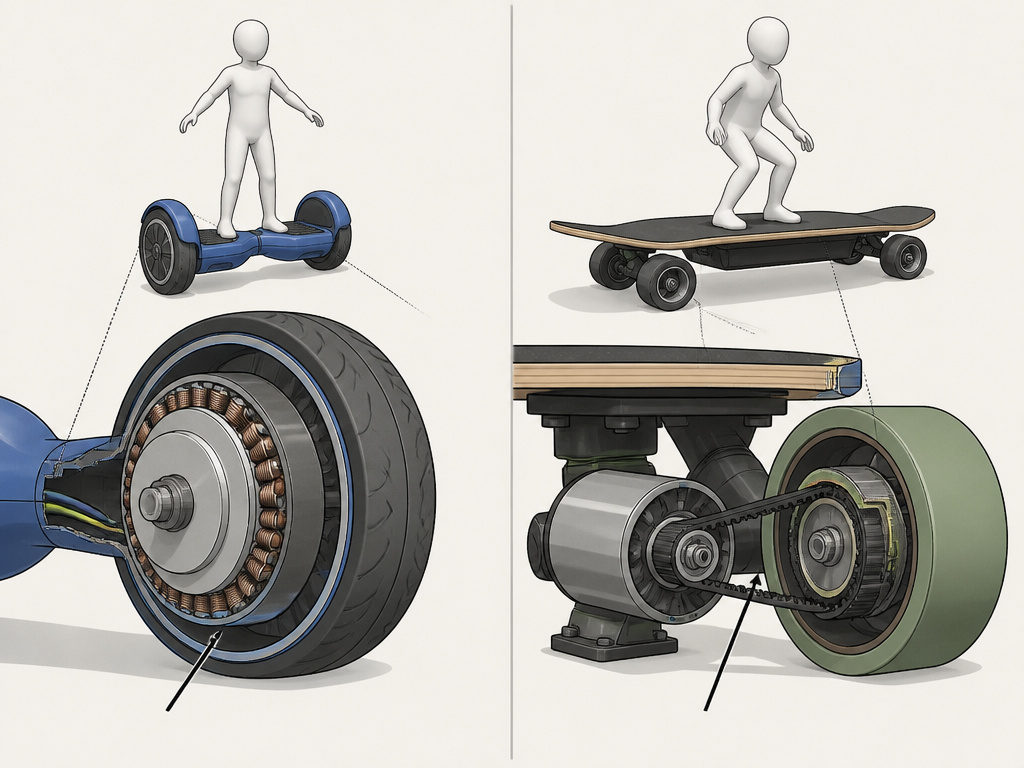
This is where specs meet the sidewalk, and the numbers from the fact sheet become real. Look at the tire size: the Segway Ninebot S uses 10.5-inch pneumatic tires. The Swagtron T6 uses 10-inch air-filled tires. The Razor Hovertrax 2.0 uses 8.5-inch solid wheels.
Now look at a typical electric skateboard wheel: it’s usually 80mm to 100mm (3.1 to 4 inches) in diameter, made of a soft, grippy polyurethane. The size difference is visual, but the material is the real story. Pneumatic tires absorb shocks. Solid and polyurethane wheels transmit them directly to your legs and spine.
A hoverboard’s larger pneumatic tires are marketed for “all-terrain” use. Manufacturers market these as ‘off-road,’ but owner forums report they are best for packed dirt, smooth grass, and gravel driveways, not trails with roots, rocks, or soft sand. The small platform and weight distribution make it prone to getting stuck. An electric skateboard with traditional wheels is strictly for smooth pavement. However, specialized off-road electric skateboards exist with true 6-inch pneumatic tires and high ground clearance, these are a different category entirely and can handle mild trails.
The practical limit comes down to the wheel’s contact patch and the device’s clearance. A hoverboard tire is wide but the deck hangs low. A sharp rock or a deep crack can stop it dead. I’ve watched a hoverboard with “off-road” tires meet a standard sidewalk crack. The front edge of the plastic deck dug into the concrete, and the rider pitched forward. An electric skateboard’s longer wheelbase and higher deck often glide over the same obstacle.
Common mistake: Taking an “all-terrain” hoverboard onto an actual hiking trail. The motors lack the torque for steep inclines, the batteries aren’t sealed for mud, and the plastic shell cracks on impact with a hidden root. The ride ends with a walk back, carrying a 30-pound board.
Speed, Power, and Real-World Range
Manufacturer specs give you a ceiling, not a forecast. The Segway Ninebot S hits 10 mph. The Swagtron T6 claims 12 mph. A typical commuter electric skateboard often has a higher top speed than most hoverboards. Speed on paper is one thing. How it delivers that speed is another.
Hoverboard motors (like the Segway’s 400W x 2) provide torque for acceleration and hill climbing. They are usually hub motors, built into the wheels. Electric skateboards use either hub motors or belt-drive systems (like the legacy Boosted Board‘s 1000W x 2 belt-drive). Belt-drive offers more torque and easier wheel maintenance, but it’s louder.
The noise level is a subtle but real difference. A hoverboard’s direct-drive hub motors whine like a high-pitched vacuum cleaner. An electric skateboard with belt drives adds a distinct gear-whine and the sound of the belt slapping. For commuting in quiet neighborhoods or campuses, this matters.
Now, range. The fact sheet says the Segway Ninebot S goes 13.7 miles. The Swagtron T6 goes 12 miles. The Razor Hovertrax 2.0 has a max range of 60 minutes of continuous use. Electric skateboards often advertise a range greater than that of many hoverboards. Here is the universal truth from owner communities: real-world range is 20-30% lower. Always.
Why? Rider weight is the biggest factor. The Swagtron T6’s impressive 420 lb max load rating doesn’t mean a 420 lb rider will get 12 miles. They’ll get half that. Hills, stop-and-start riding, and cold weather (which reduces battery efficiency) slash range further. If your commute is 5 miles one way, you cannot rely on a 10-mile advertised range. You’ll be pushing it home one day.
| Device (Example Model) | Advertised Max Range | Real-World Expectation (180 lb rider, flat terrain) | Primary Range Killers |
|---|---|---|---|
| Hoverboard (Segway S) | 13.7 miles | ~10-11 miles | Rider weight over 200 lbs, frequent stops, cold weather |
| Hoverboard (Swagtron T6) | 12 miles | ~9 miles | Using “turbo” mode, hill climbs |
| Electric Skateboard (Mid-tier) | 15 miles | ~11-12 miles | High speed (above 15 mph), uphill sections, headwind |
Safety, Certification, and Failure Modes
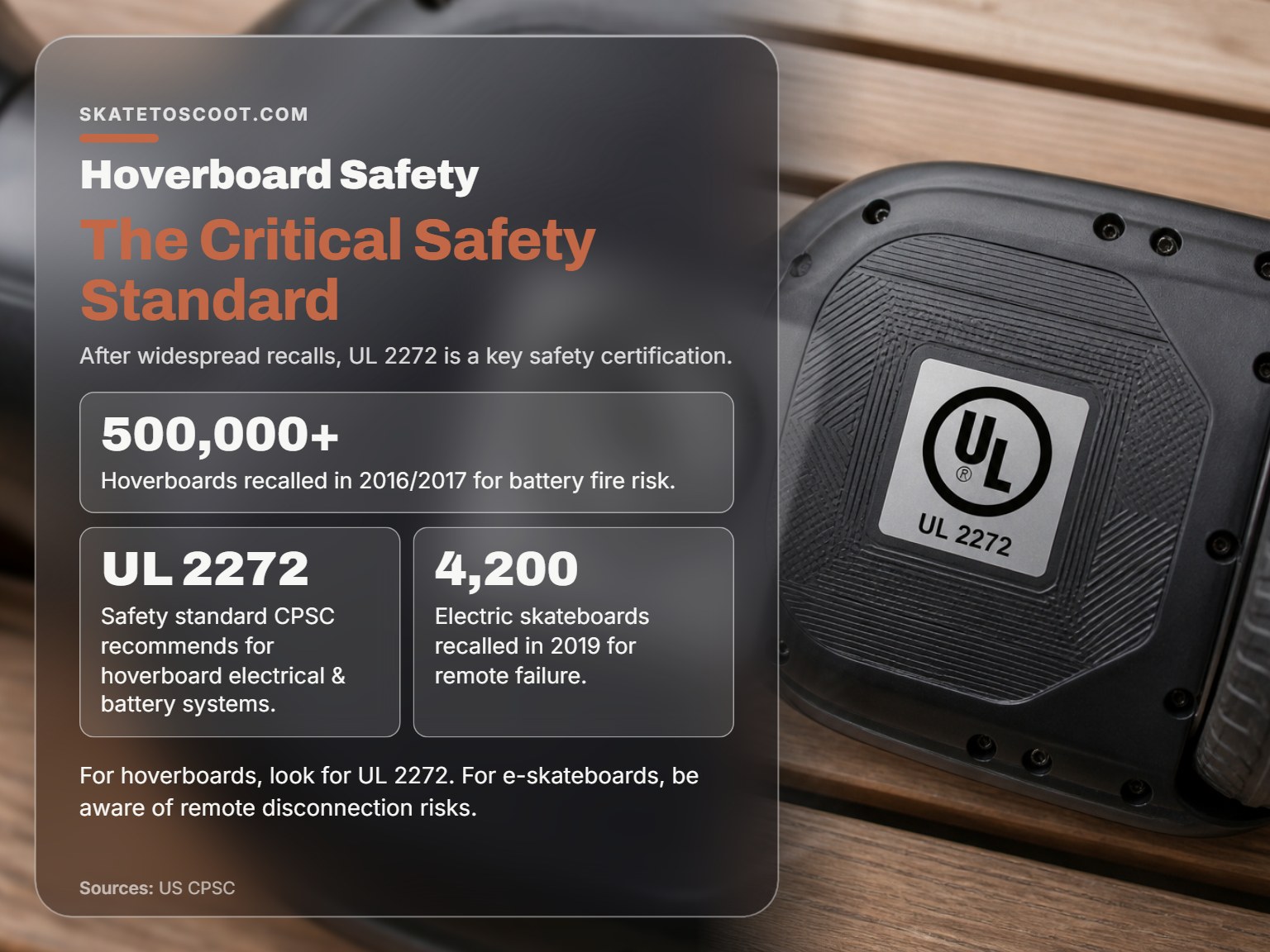
Safety isn’t a feature list. It’s a history of what has broken, burned, or recalled. For hoverboards, that history is dominated by one phrase: UL 2272.
In 2016-2017, the U.S. Consumer Product Safety Commission (CPSC) recalled over 500,000 hoverboards from various brands due to lithium-ion battery packs overheating, smoking, catching fire, or exploding. The root cause was faulty battery design and manufacturing. The response was the creation of the UL 2272 safety standard for “self-balancing scooters.” The CPSC now explicitly recommends consumers “look for the mark UL 2272” when purchasing. This certification covers the entire electrical system and battery. Never buy a hoverboard without it. It is the bare minimum for hoverboard safety.
Electric skateboards have a different safety profile. Their major documented failure mode isn’t fire; it’s electronic or mechanical. The CPSC also recalled approximately 4,200 Boosted Boards in February 2019 due to remote disconnection issues that could cause unexpected acceleration or braking. The failure was a low-voltage condition in the remote.
This highlights the second critical safety layer: the communication link. A hoverboard’s controls are built into your feet. A skateboard’s controls are in a wireless remote. If that remote loses power or connection, the board may coast uncontrollably or apply the brakes suddenly. Modern boards have safeguards, but the risk exists.
Before you start: Wear a helmet, wrist guards, and knee pads for both devices. For hoverboards, practice stepping off sideways at low speed, don’t jump backwards. For electric skateboards, practice emergency braking in a safe, open area before riding near traffic or pedestrians. A low-speed fall is a lesson; a high-speed fall is a hospital visit.
Portability, Weight, and Carrying Method
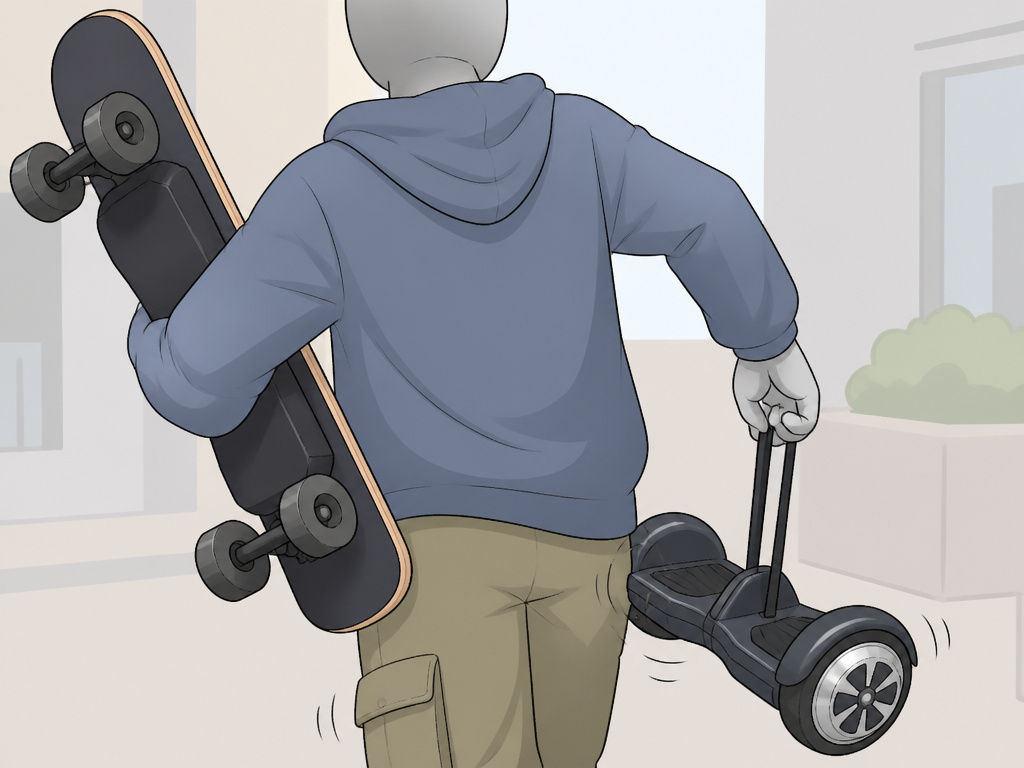
You will carry these devices more than you think. You’ll carry them from your car to the pavement, up stairs, into a store, or onto public transit.
A Razor Hovertrax 2.0 weighs 25 lbs. A Segway Ninebot S is 28 lbs. A Swagtron T6 is 30 lbs. Many electric skateboards are lighter than hoverboards. The weight difference is noticeable, but the shape is the real challenge.
A hoverboard is a single, dense lump with a handle that usually pops out of the top. Carrying it by this handle is awkward; the board swings and bangs against your legs. Some models have built-in trolley handles, letting you roll it like luggage, a fantastic feature if you commute.
An electric skateboard is long and flat. You can tuck it under your arm, but it’s cumbersome. There’s no built-in trolley option. For last-mile commuting, this is a major practical point. Dragging a 30-lb hoverboard on wheels through an office building is simple. Hauling a 20-lb skateboard under your arm for four city blocks is a chore.
Consider where you’ll need to go. If your journey involves a train, a bus, and a short walk, the hoverboard’s trolley feature wins. If you’re just going from your garage to the park and back, the skateboard’s lighter weight might win.
Hill Climbing Ability and Maneuverability
Torque meets topography here. Both devices can climb hills, but their approach and limits differ sharply.
Hoverboard motors, like the 400W dual motors in the Segway Ninebot S, provide decent low-end torque. They can handle moderate inclines (around 15-20 degrees) reliably. The Swagtron T6, with 300W x 2 motors but a more aggressive tire tread, might tackle similar grades. The limitation isn’t always power; it’s traction and platform angle. On a steep hill, you have to lean forward significantly to climb. This shifts your weight toward the front of the small platform, reducing rear wheel traction and making you feel like you’ll tip over backwards.
Electric skateboards, especially belt-drive models, are torque monsters. They are built to accelerate quickly and climb steep hills (some claim 30% grades). The power delivery is controlled by your thumb, so you can apply it smoothly as you ascend. The longer wheelbase and lower center of gravity also feel more stable on an incline.
Maneuverability is the inverse. A hoverboard can spin 360 degrees in place by turning one wheel forward and the other backward. This makes it incredibly nimble in tight spaces, like navigating through a crowded plaza or making a sharp turn on a sidewalk. An electric skateboard has a much larger turning radius. You can’t pivot on the spot; you need space to carve a wide arc.
So, which is better for hills? For steep, sustained climbs, a powerful electric skateboard is the clear winner. For navigating a flat but cluttered environment with lots of tight turns, the hoverboard’s zero-turn-radius agility is unmatched.
Maintenance and Common Issues
These are machines, not magic. They break.
For a hoverboard, the most common issues are tire-related. The pneumatic tires on models like the Segway Ninebot S and Swagtron T6 can puncture. Repair involves removing the entire plastic shell to access the wheel hub, a tedious process with a dozen tiny screws. Solid wheels, like on the Razor Hovertrax 2.0, avoid punctures but wear down and can become uneven, causing vibration.
The other hoverboard weak point is the battery compartment seals. While the Swagtron T6 boasts IPX4 water resistance (protection from splashes), but many hoverboard models lack such certification. Riding through a puddle can let water into the electronics, leading to corrosion and failure. Manufacturers may claim water resistance, but owner forums are filled with warnings to avoid all wet conditions.
Electric skateboard maintenance revolves around the drivetrain and remote. Belt-drive systems require periodic belt tension checks and replacement (belts snap). Hub motors are lower maintenance but can overheat on long climbs. The remote is a consumable item, its battery degrades, the throttle wheel wears out, and it can be dropped. A lost or broken remote often means you cannot ride the board at all.
Both devices share the same critical component: the lithium-ion battery. Over time, all batteries lose capacity. After 2-3 years of regular use, expect your range to be half of what it was when new. Replacement batteries are expensive and sometimes difficult to source for older models.
Cost and Value Over Time
Consider value honestly. It’s not about the sticker price; it’s about the cost per mile of enjoyment and utility before the device fails or becomes obsolete.
Hoverboards from reputable brands like Segway and Swagtron with UL 2272 certification sit in a mid-range price bracket. You’re paying for the self-balancing technology, the certification, and the brand’s warranty. They are often marketed as toys or recreational devices. Their value depreciates quickly as newer models with slightly better batteries or Bluetooth speakers appear.
Electric skateboards are often positioned as commuting vehicles. The initial cost is higher, but the build quality and performance reflect that. They hold value better in the enthusiast market because components like decks, trucks, and wheels can be upgraded or replaced.
The long-term cost is hidden in parts and repairs. A hoverboard with a fried control board is often a total loss, repair costs can approach a new board. An electric skateboard is modular. You can replace the battery, the motors, the remote, and the deck independently. This makes it a more sustainable investment if you’re willing to learn basic maintenance.
The part nobody mentions: The second-hand market is a minefield. Used hoverboards without UL 2272 certification are a fire hazard and should be avoided entirely. Used electric skateboards may have heavily degraded batteries or worn-out drivetrain parts that cost hundreds to replace. Buying used only makes sense if you can test the battery’s true range and inspect the hardware thoroughly.
Frequently Asked Questions
What is better than a hoverboard?
“Better” depends on your goal. For commuting with a backpack, an electric scooter or electric skateboard is better, they have higher speeds, longer range, and more stable handling. For recreational fun in a park or indoor space, a hoverboard’s intuitive controls and tight turning can’t be beat. For pure stability and ease of use, an electric scooter with a wide deck and handlebars is often the best choice for beginners.
What type of skateboard is best for beginners?
Choose a remote with a gentle, progressive throttle. Avoid high-torque belt-drive boards marketed for speed, they are unforgiving. Your first goal is learning to balance and brake safely, not hit top speed.
Is an electric skateboard worth it?
Yes, if you have a practical use for it and a safe place to learn. For a 1-5 mile commute on smooth bike paths or campus sidewalks, an electric skateboard is a fantastic investment that saves time and is enjoyable. It is not worth it if you only plan to ride it occasionally in a parking lot, if your local roads are cracked and uneven, or if you are unwilling to wear safety gear every single time.
Is a hoverboard a skateboard?
No. By definition, a skateboard has a deck, trucks, and wheels and is propelled by pushing or, in this case, a motor. A hoverboard is technically a “self-balancing scooter.” It has two motorized wheels side-by-side on a single platform and uses gyroscopes to stay upright. They share the “board” name, but their mechanics, controls, and intended use are completely different.
Can you ride a hoverboard on the road?
Legally, it depends on your local regulations. Practically, it is a terrible idea. Hoverboards have a low top speed (8-12 mph), small wheels vulnerable to road debris, and low visibility to cars. They belong on sidewalks, bike paths, parks, and other controlled pedestrian environments. Always check your city’s bylaws regarding “personal electric mobility devices.”
Before You Go
The choice between a hoverboard and an electric skateboard isn’t about which is objectively better. It’s about which one matches your body, your environment, and your patience for learning.
If you want intuitive, playful motion in flat, smooth areas and don’t mind a shorter range, a UL 2272-certified hoverboard from a brand like Segway is a solid pick. Its self-balancing is a great party trick, and its portability with a trolley handle is genuinely useful.
If you see this as a practical commuter vehicle, have some basic board-sport balance, and want higher speed and range, an electric skateboard is the right tool. The remote control is a hurdle at first, but it becomes an extension of your will.
One rule most guides skip: your first ride should be in an empty parking lot or a stretch of smooth grass. Practice stopping. Practice falling. Practice what happens when the battery dies. That hour of deliberate, slow rehearsal is worth more than any spec sheet. It turns a purchase into a skill.
The pavement doesn’t care about your new gadget. It just is. Your job is to pick the machine that negotiates with it best.
