Where to Ride Electric Skateboard: Law, Manual, and Gear
This post contains affiliate links. As an Amazon Associate, we earn from qualifying purchases.
You can ride an electric skateboard wherever local law permits, which typically includes bike lanes, multi-use paths, and residential streets. Your exact legal options depend on a patchwork of city and state rules, the type of board you have, and your skill level. The wrong choice isn’t just illegal; it can void your warranty or get you hurt.
That legal framework is your starting map, but the real riding happens within its boundaries. Manufacturers like ONSRA and Evolve spell out exactly where their boards are designed to go, flat, dry pavement for most, with some all-terrain models venturing further, and where they are absolutely not meant to be, which is often the same places the law forbids. Your manual isn’t just suggestions; it’s the engineering limits of your gear, and it is a key resource for determining where to ride electric skateboard.
What follows: the hard rules from OEM manuals on where you can and cannot ride, how to find those spots in your area, the gear that keeps you legal and safe, and the one community trick for discovering the best routes nobody posts online.
Key Takeaways
- Your local bike lane and multi-use path laws are the primary legal guide; riding on sidewalks or busy roads is often prohibited and always dangerous.
- Check your OEM user manual first, brands like Evolve and Razor specify approved riding surfaces, and ignoring them can void your warranty.
- For long-term battery health, store your board according to your brand’s guidelines: Evolve recommends 40–50% for a month or more, ONSRA recommends 40–60% for a month or more, while Razor recommends fully charging the battery before storage.
- A helmet must have no more than a two-finger gap above your eyebrows, per the Evolve Hadean manual’s CPSC-standard fit check.
- Use Google Maps in satellite view to scout paved trails and quiet neighborhoods; it’s the most reliable tool for finding new, legal routes.
Where the Law Says You Can Ride
The law doesn’t care about your board’s top speed or range. It cares about vehicle classification. In most jurisdictions, electric skateboards fall under the same rules as electric personal mobility devices or bicycles. This typically grants you access to bicycle lanes and multi-use paths. Riding on sidewalks is frequently banned outright, and riding on roads with high-speed traffic is often illegal or ill-advised.
Major manuals, from ONSRA to Evolve, place the onus on the rider to know and follow local laws, though the exact wording differs. This isn’t legalese. I’ve seen riders get ticketed on paved park paths because they missed a small “No Skateboards” sign. The enforcement is inconsistent, but when it happens, the fine and the confiscation threat are very real.
Common mistake: Assuming “electric” means “anywhere.” Local ordinances change block by block in some cities. A street legal for bikes might prohibit motorized boards.
Your first stop should be your city’s transportation or parks department website to research the where to ride electric skateboard question. Look for codes on “motorized scooters,” “electric personal assistive mobility devices (EPAMDs),” or “micromobility.” If the language is vague, the safe assumption is that you follow bicycle rules. When in doubt, call. A five-minute call beats a $150 citation.
How to Actually Find Those Legal Routes
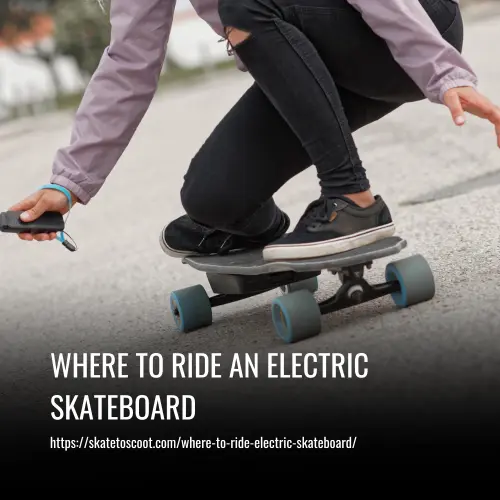
You know the law. Now, where are the actual pavement, hills, and smooth trails? You don’t find them by wandering. You use a systematic scout.
The Reddit community’s go-to method is straightforward: fire up Google Maps, switch to satellite view, and look for paved bike paths and large parking lots. Paved bike paths show up as thin, winding lines, often parallel to rivers or through parks. Zoom in on large parking lots of churches, schools, or corporate campuses, these are goldmines for practice, especially on weekends. As one rider noted, “Churches in well off areas any day other than Sunday. Typically very empty, grounds and pavement are well maintained.”
The next step is a test ride. Pick a short loop. Go early on a Sunday morning when traffic is minimal. Your goal isn’t distance; it’s surface assessment for your where to ride electric skateboard plan. Is the asphalt cracked every six feet? Are there sandy patches after every rain? This reconnaissance is essential. A route that looks smooth on satellite can be unrideable in person.
| Location Type | Best For | Key Risk If Overlooked |
|---|---|---|
| Empty Church/School Parking Lots | Beginner practice, skill drills | Security may ask you to leave; always have a backup route. |
| Paved Bike Paths / Greenways | Commuting, long distance rides | Pedestrian traffic on weekends; slow down and announce passes. |
| Quiet Residential Streets | Street riding practice, testing board modes | Hidden driveways and children; ride defensively, not assertively. |
| Multi-Use Paths in Parks | Scenic cruising, group rides | May have specific “No Skateboard” signage; check posted rules at entrances. |
This table is a priority ladder, not just a list. Start in the parking lot until your start and stop are muscle memory. Then graduate to the quiet street to learn how to scan for cars. The path is for when you can reliably control your speed around others.
What Your Electric Skateboard Manual Actually Allows
Your board is not a mountain bike. Its warranty and engineering tolerances are built for specific conditions, plainly laid out in the manual you probably skimmed. Ignoring these isn’t rebellion; it’s a one-way ticket to a broken board and a voided warranty.
Most standard street boards, like the RazorX Cruiser or Acton Blink S, are designed for one environment: “flat, dry surfaces, such as pavement or level ground.” The RazorX Cruiser manual explicitly rules out “mud, ice, puddles or water.” The Acton Blink S manual is blunter: “AVOID WATER” and states the board is not water-proof. Riding through a puddle isn’t just about getting wet; it’s about water seizing bearings and shorting motor controllers. The damage often doesn’t show up until two days later, long after you’ve forgotten the ride.
All-terrain (AT) boards with pneumatic tires, like the Evolve GTR, open up more possibilities. The Evolve GTR manual states it “can climb hills of up to 25-degree gradient” and recommends keeping “All Terrain tyres between 30-45 PSI.” But it draws a hard line at abuse, warning against actions that can damage the electronics. The electronics are fragile. A hard landing from a curb doesn’t just scratch the deck; it can crack a battery cell weld. You’ll smell the burnt electronics before the board fully dies.
The 40–50% Rule for Battery Storage
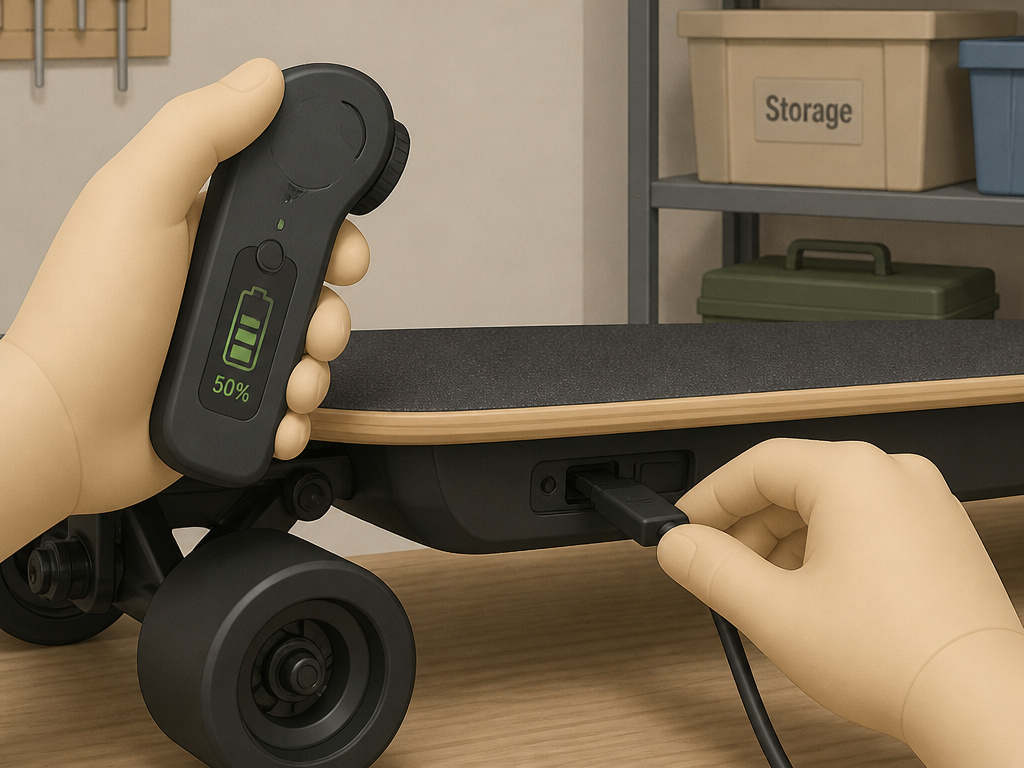
Here’s where the manuals disagree, and you need to know which team your board is on. For long-term storage (one month or more), the consensus is to avoid full charge or deep discharge. But the ideal target varies by brand.
- Evolve (Hadean & GTR): Store between 40 and 50% charge. The Hadean manual specifies this for “a prolonged period of 1 MONTH OR MORE.” The Evolve GTR manual recommends storing the battery between 40 and 50% for a prolonged period of 3 months or more.
- ONSRA: Recommends storing between 40–60% if unused for one month or more.
- Razor: Takes the opposite stance. The RazorX Cruiser manual instructs users to “fully charge battery before storing for extended periods of time.”
Why does this matter? Storing a lithium battery at 100% charge for months stresses the chemistry, reducing its total capacity over time. Storing it near 0% risks letting the voltage drop so low the battery management system (BMS) can’t revive it. The 40–50% range is recommended by Evolve and ONSRA, but Razor recommends full charge for storage. If you own a Razor, follow its manual, their BMS may be calibrated differently. For everyone else, plug in, charge to halfway, and store in a cool, dry place.
The Gear and Mindset for Road Sharing
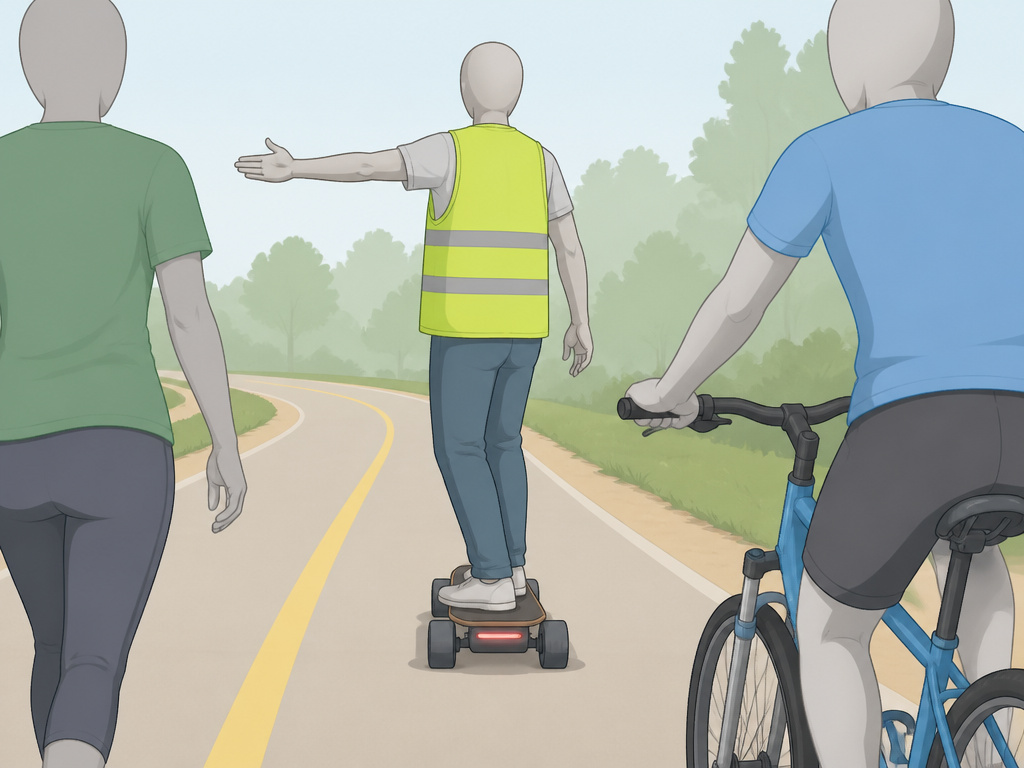
Riding a bike lane is a legal right in many areas. Doing it safely is a skill. The core principle is simple: behave like a predictable, visible vehicle. This means using hand signals for turns, wearing high-visibility clothing, and having front and rear lights if you ride near dusk. The Acton Blink S manual emphasizes the need for safety gear but does not specify the function of its LEDs.
The bigger challenge is etiquette. Multi-use paths are shared with walkers, runners, and cyclists. The Evolve Hadean manual shouts it: “ALWAYS RESPECT PEDESTRIANS!!!” This is a matter of collision avoidance, not just politeness. Announce yourself with a friendly “On your left!” well before passing. Slow down to walking speed when passing dogs or children. The goal is to be invisible and predictable, not fast and intimidating.
Where this goes sideways: Passing a pedestrian too closely without warning. Even if you don’t touch them, the sudden surprise can cause them to jump into your path. Give a full board’s width of space.
Cars are a different beast. Most manuals, including the RazorX Cruiser’s, advise you to “keep safely away from cars and motor vehicle traffic at all times.” Evolve Hadean states “DO NOT RIDE ON BUSY ROADS WITH LINE MARKINGS,” while ONSRA gives a similar warning, and Razor advises staying away from traffic. Your board’s top speed is your limit. If the street has a speed limit significantly higher than your board’s top speed, you are a moving chicane. Drivers get frustrated and make risky passes. Stick to roads where you can comfortably match the flow of traffic, or better yet, stick to dedicated bike infrastructure.
The Helmet Fit That Actually Works
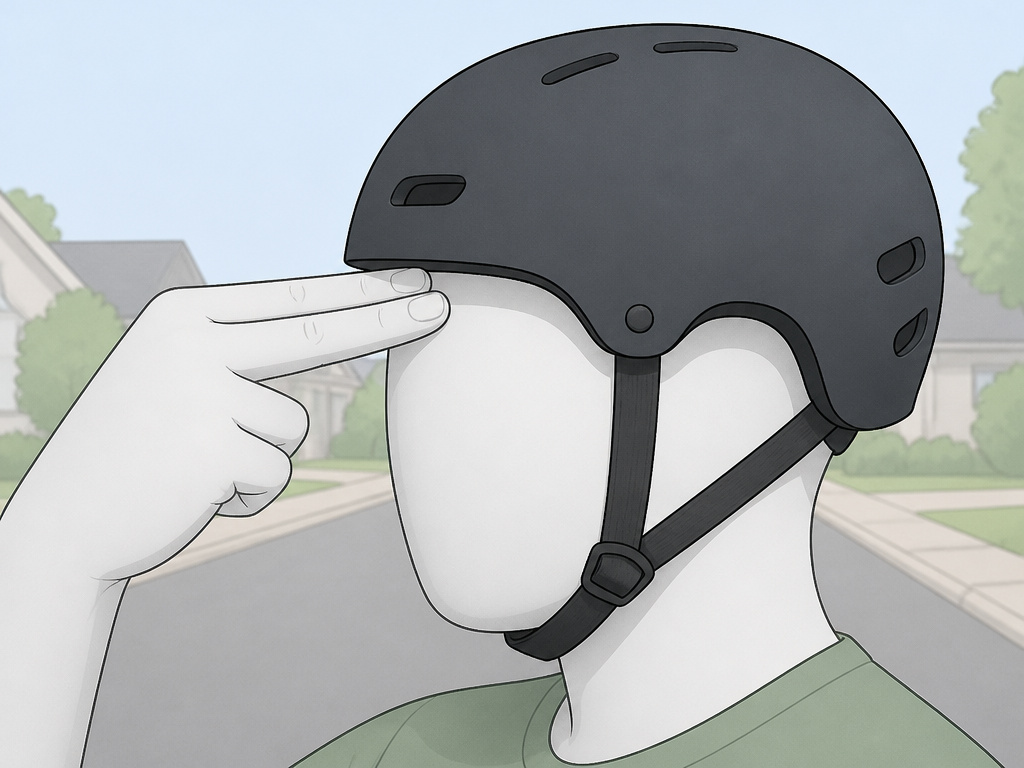
You know you need a helmet. But a loose helmet is almost as bad as none at all. The Evolve Hadean manual provides a precise, mechanical fit check that applies to any CPSC-certified helmet:
- The helmet should sit level on your head, protecting your forehead.
- There should be no more than a 2 finger gap from your eyebrows to the helmet’s front rim.
- Adjust the side straps so the sliders sit just below and in front of your ears.
- Buckle the chin strap. Adjust it so no more than two fingers fit between the strap and your chin.
A helmet that rocks back when you look up, or shifts side-to-side when you shake your head, has failed the test. This isn’t about comfort; it’s about the helmet staying in the correct position during an impact. A common mistake is buying a helmet that’s too large because it feels “less tight.” That extra space is where concussion happens.
Finding Your People: Group Rides and Communities
Riding solo is fine. Riding with others teaches you more. Group rides force you to maintain a consistent pace, communicate hazards, and navigate as a unit. They’re also the fastest way to learn about hidden local spots, the smooth parking garage, the perfect hill for carving, the café that doesn’t mind a dozen boards parked outside.
Online communities are the starting point. Subreddits like r/ElectricSkateboarding have local threads and meet-up announcements. Don’t just browse; post your city and ask. You’ll be surprised how many lurkers are waiting for an organizer. The conversation often reveals the real local knowledge: “I ride around the bay, mostly around the google campuses, since they got all these new bike trails Nobody uses because of the whole work from home thing.”
Group dynamics vary. Some are casual cruises. Others are speed runs. Be honest about your skill level before you show up. Showing up to an advanced ride on a beginner board is a sure way to have a miserable, exhausting day. Start with a “no-drop” ride where the group waits for everyone.
Can You Ride an Electric Skateboard in the Rain?
Manufacturer manuals are unanimous and absolute: no. The Acton Blink S states it is “not water-proof.” The RazorX Cruiser manual warns against riding on wet surfaces. Water wrecks bearings, corrodes motor connections, and can short the battery pack, leading to a failure that might not happen until your next ride. The risk isn’t just to the board; wet pavement offers drastically less traction. A carve you make every day on dry asphalt can become a high-side fall when the wheels slip on a wet manhole cover.
Some experienced riders in online forums advocate for all-terrain wheel setups on wet grass or light gravel, directly contradicting OEM warnings. This is a risk calculation they make with their own gear. For a new rider, or anyone relying on their board for daily transport, the OEM line is the only safe one. Water damage is almost never covered under warranty. A new motor or battery costs more than a rideshare home on a rainy day.
Frequently Asked Questions
Are electric skateboards hard to ride?
They are easier to learn than a traditional push skateboard because the motor provides stability and propulsion. However, mastering safe control, especially braking and emergency maneuvers, takes dedicated practice in a safe area. Most beginners can become comfortable riding in a straight line within a few hours, but road-ready skills take weeks.
Can I ride my electric skateboard on the sidewalk?
This is almost always illegal and is discouraged by every major manufacturer. Sidewalks are for pedestrians. The higher speed of an electric skateboard creates a significant hazard. You should use bike lanes or multi-use paths where legal, or quiet residential streets where you can ride predictably with traffic.
Where is the best place to practice riding a skateboard?
Start in a large, empty, paved parking lot, a school lot on a weekend is ideal. This gives you unlimited space to practice starting, stopping, turning, and falling without traffic or obstacles. Once you are completely confident there, graduate to a quiet cul-de-sac or a smooth bike path with minimal other users.
Do you need a permit for an electric skateboard?
Generally, no. Electric skateboards are not typically registered or licensed like motor vehicles. However, some cities or states may have age restrictions, helmet laws, or require lights for night riding. The responsibility is on you to know the specific rules and regulations for electric skateboards in your area.
How do I find local groups to ride with?
Online communities are the best tool. Check the regional discussion threads on forums like r/ElectricSkateboarding or Facebook groups for “PEV riders” in your city. Be specific in your post: name your city, your board type, and your riding style (casual vs. Speed). Often, group rides are informally organized through these channels.
Before You Go
The perfect riding spot is a blend of three things: it’s legal, it’s suitable for your board’s design, and it matches your skill level. You can find the first two by reading your local laws and your board’s manual. The third one you earn in an empty parking lot.
Your next step is to open Google Maps, find the nearest large, paved, empty space, and spend an hour there. Practice stopping from half speed. Practice a tight turn. Feel what the board does when you lean. That hour of deliberate, boring practice is what makes every ride after it both fun and predictably safe. The open road is a reward, not a right. Earn it first.
