How Many Calories Do You Burn Longboarding?
This post contains affiliate links. As an Amazon Associate, we earn from qualifying purchases.
That 300-calorie figure gets thrown around a lot. It’s a decent estimate, but it hides the real story, the one written in oxygen uptake data and metabolic equivalent tables. The difference between a casual cruise and a focused skate-poling session is the difference between a brisk walk and a hill sprint, calorie-wise. A key question for many is: how many calories do you burn longboarding?
What follows is a breakdown of the actual numbers from the labs, not the marketing blogs. We’ll look at the studies, explain what METs are and why they matter, and show you exactly which variables turn your board from transport into a serious workout tool.
Key Takeaways
- Trust the peer-reviewed data: studies like Board et al. (2014) show longboarding at typical speeds burns ~41.8 kJ/min (~10 kcal/min) and hits ~8.5 METs, solidly in the vigorous exercise zone.
- Your propulsion method is everything. Longboard skate poling (using a pole) burns a mean of 14.1 kcal/min per Thomas et al. (2026), that’s nearly 40% more than standard leg-pushing.
- Your weight directly scales the burn. A 125-pound person might burn ~300 calories in an hour, while a 185-pound person under the same conditions burns closer to 450.
- Longboarding satisfies the American College of Sports Medicine (ACSM) guidelines for vigorous exercise, meaning regular sessions can contribute to improved cardiorespiratory fitness.
- For accurate tracking, understand that fitness apps often guess. The 2024 Adult Compendium of Physical Activities is the gold standard for MET values, but it’s a starting point, not a precise personal calculator.
The Calorie Burn Rates You Can Actually Trust
Forget the generic “300-400 calories per hour” you see on commercial sites. We’ll examine the data collected in a lab.
A 2014 study published in PubMed had 15 experienced longboarders skate at slow, typical, and fast speeds on a closed course. At their typical cruising speed of 4.5 m/s, the mean rate of energy expenditure was 41.8 kilojoules per minute. Converted, that’s right around 10 calories per minute. The study concluded the gross metabolic cost was greater than cycling but about 50% smaller than walking, and the average intensity was ~8.5 METs.
The 2014 Board et al. Study found the gross metabolic cost of longboarding at a typical speed (4.5 m/s) was ~2.2 J kg⁻¹ m⁻¹, with an energy expenditure of 41.8 kJ/min and an intensity of ~8.5 METs, classifying it as vigorous exercise.
Another piece of research, a 2004 University of Hawai’i thesis, estimated metabolic responses in skateboarders. During a 30-minute field test, the mean caloric expenditure was 10.3 ± 1.3 kcal per minute. That extrapolates to 309 calories for a half-hour session. The author noted that fatigue in the support leg was often the limiting factor for how long subjects could continue, which tells you something about the muscular demand.
Here’s where it gets interesting. A 2026 study examined “longboard skate poling,” where riders use a pole for propulsion like a Nordic walker. This method significantly ups the ante. The mean energy expenditure jumped to 14.1 ± 1.2 kcal per minute. In just 20 minutes, participants burned 309.5 ± 27.8 kcal at a crushing 12.0 ± 1.6 METs. Your technique isn’t just about style; it’s a direct dial on your calorie furnace.
| Study / Activity | Calories per Minute | Total Calories (Session) | METs | Intensity |
|---|---|---|---|---|
| Board et al. (2014) – Typical Speed | ~10 kcal/min | , | 8.5 | Vigorous |
| Hunt (2004) – Skateboarding Field Test | 10.3 ± 1.3 kcal/min | 308.6 ± 37.9 kcal (30 min) | , | Vigorous |
| Thomas et al. (2026) – Skate Poling | 14.1 ± 1.2 kcal/min | 309.5 ± 27.8 kcal (20 min) | 12.0 ± 1.6 | Very Vigorous |
| Electric Skateboard (2020 Study) | 12.5 kcal/min | , | 10.5 | Vigorous |
Why Your Weight, Speed, and Style Change Everything
The numbers above are averages, but your personal answer to how many calories do you burn longboarding hinges on three levers you control.
First, body weight. Calories burned are a function of the mass you’re moving. A Hamboards blog post, not a study, offers an illustrative example, suggesting a 125-pound person burns about 300 calories in an hour, while a 185-pound person burns 444. The physics checks out: more mass requires more energy to accelerate and maintain speed.
Second, speed and terrain. The Board et al. Study showed a direct, positive relationship: faster speed meant higher oxygen consumption and energy expenditure. Going uphill? That’s resistance training on wheels. Your heart rate will spike, and you’ll feel it in your quads and glutes almost immediately. Research on heart rate during skateboarding confirms that uphill portions can push you well into the vigorous intensity zone (>60% of heart rate reserve).
Third, propulsion style. This is the biggest swing factor most people miss. Are you just pushing with your back leg? That’s the baseline. Are you incorporating a pole? That’s the 14.1 kcal/min powerhouse from the 2026 study. Even riding an electrically powered skateboard isn’t a free pass; a 2020 study on a specific model found it still demanded a mean of 12.5 kcal/min because of the constant balance and lower-body micro-adjustments required.
Common mistake: Assuming a leisurely push around the block equals a workout. Without sustained effort or varied terrain, your heart rate won’t hit the zones needed for significant caloric burn.
How Longboarding Stacks Up Against Other Cardio
Is it better than running? It’s different. We should make an honest comparison.
That Reddit user’s Under Armour app estimated 60 calories per mile skateboarding versus 140 calories per mile running. Apps can be off, but the principle is sound: running engages more muscle mass more violently, demanding more energy per unit of distance. A point often overlooked is that sticking with an activity matters more than its pure efficiency. If you hate running but will happily log 10 miles on a longboard, the board wins for your long-term health every time.
The 2024 Adult Compendium of Physical Activities provides standardized MET values that can serve as a starting point for comparison. Longboarding’s ~8.5 METs sits in a interesting space:
The real advantage isn’t just in the calorie column. Longboarding is a skill-based, low-impact activity. It builds leg and core strength, improves balance, and, crucially, is fun enough that you might actually do it consistently. That’s a sustainable path to health benefits that a chore-like treadmill session can’t match.
Turning Your Board Into a Weight-Loss Tool
Knowing the numbers is one thing. Applying them to lose weight longboarding is another. It comes down to structure.
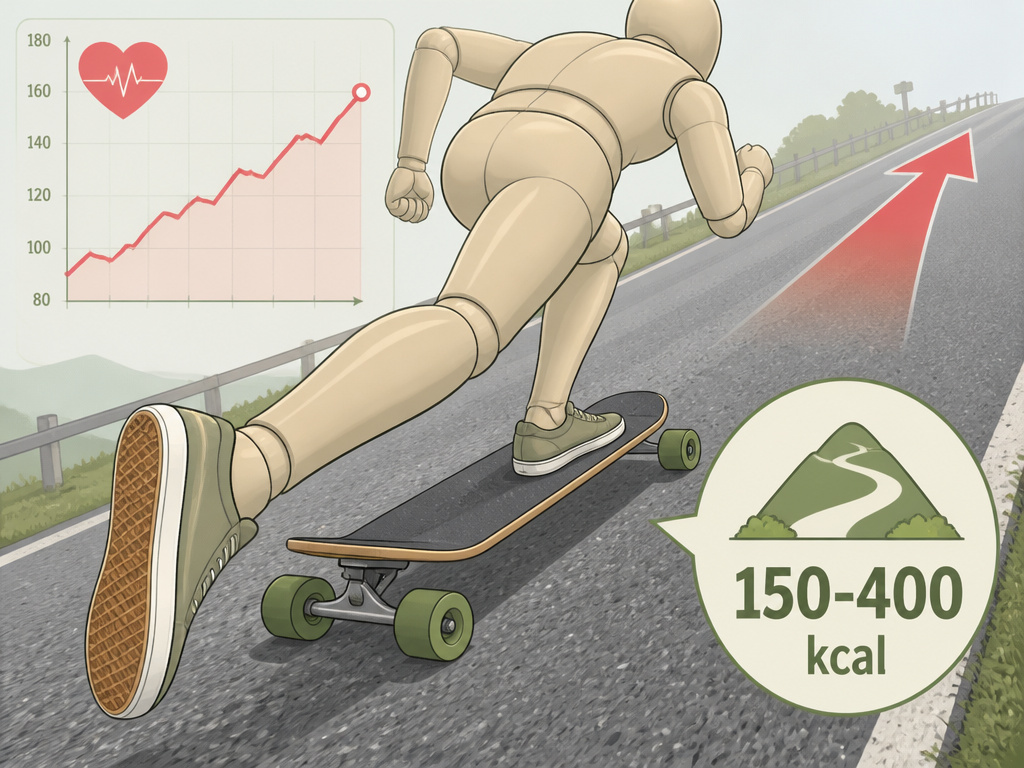
The American College of Sports Medicine recommends accumulating 150 to 400 kcal per day through physical activity for health benefits. A solid 30-45 minute longboarding session can contribute significantly toward that daily target. For weight loss, you need a consistent calorie deficit. Here’s how to engineer your sessions for maximum burn:
- Seek Hills. Interval training is king. A route that forces you to push hard uphill and then control your descent works your cardiovascular system and legs intensely. The uphill grind is your work interval; the downhill is active recovery.
- Extend Duration. Calorie burn is cumulative. A one-hour session will burn roughly twice what a 30-minute session does, assuming similar intensity. Don’t just go around the block once.
- Incorporate Skate Poling. If you’re serious about the workout, consider a pole. The data doesn’t lie; it dramatically increases energy expenditure by engaging your upper body and core.
- Track Consistently. Use a heart rate monitor. Aim to keep your heart rate within the 40-85% of your heart rate reserve range for the duration of your session to align with ACSM guidelines for improving aerobic fitness.
This isn’t about turning joy into drudgery. It’s about recognizing that your board is a versatile piece of fitness equipment. A casual cruise is good exercise for mental health and light activity. A focused, terrain-aware session is a legitimate, vigorous workout that can absolutely support skateboarding weight loss goals.
The Wild Card: Electric Skateboards and Calorie Burn
You’d think a motor does all the work. The science says otherwise.
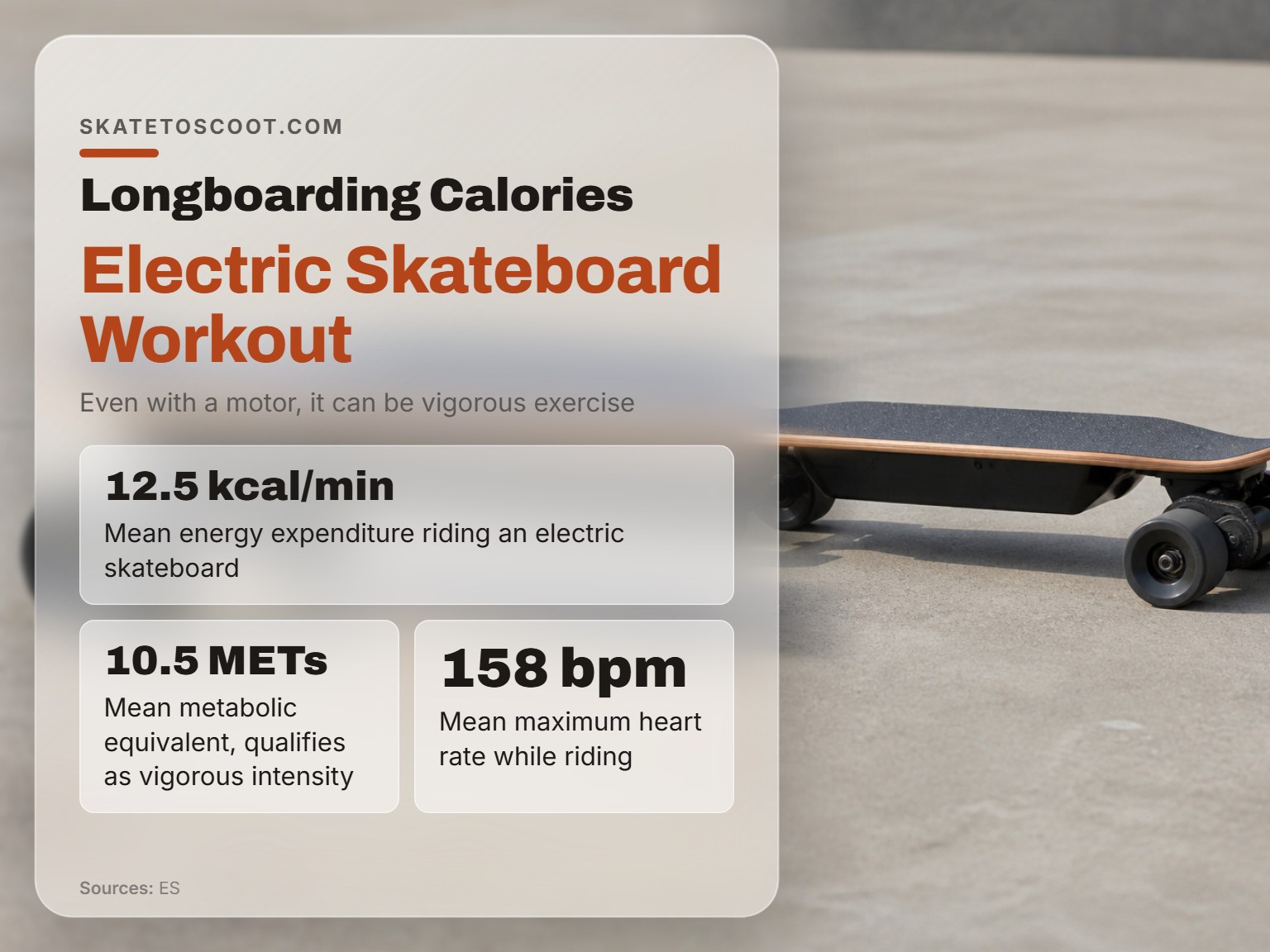
A 2020 study on a specific electrically powered skateboard (the Summerboard) measured a mean energy expenditure of 12.5 kcal/min and a mean maximum heart rate of 158 bpm. That’s a 10.5 MET value, which still qualifies as vigorous intensity. The researchers concluded that riding this board for 30 minutes three times per week would satisfy the 75–150 minutes of vigorous exercise recommendations.
The mechanism is all in the balance and control. Riders are constantly making micro-adjustments, leaning into turns, and engaging their legs to maintain stability, especially during carves. It’s less about propulsive power and more about isometric and dynamic stabilization. So, while an electric board might get you up the hill without pushing, it doesn’t turn your legs into passive cargo. You’re still burning calories, just through a different physiological pathway.
Frequently Asked Questions
Does longboarding burn more calories than running?
Per minute, the available data suggests running often burns more calories than standard leg-push longboarding, but vigorous longboarding methods like skate poling can yield comparable rates. However, longboarding can burn a comparable amount per hour if done at a vigorous pace (like skate poling or on hilly terrain), and you’re more likely to stick with an enjoyable activity longer, which is the ultimate key for fitness and weight management.
How accurate are fitness app estimates for longboarding?
They are estimates, often based on generalized MET values. The 2024 Adult Compendium of Physical Activities provides the standardized MET values these apps use, but it warns that the compendium is a starting point and “does not reflect precise individual EE values.” Your actual burn depends on your weight, efficiency, speed, and terrain. An app is useful for tracking trends, not for claiming exact numbers.
Can you lose weight just by longboarding?
Yes, if it creates a consistent calorie deficit. Longboarding is a legitimate form of vigorous cardio that can burn several hundred calories per session. Combined with mindful eating, regular longboarding can absolutely be the centerpiece of a weight-loss plan. Consistency is more important than the absolute per-session burn.
What burns more calories: downhill or uphill longboarding?
Uphill, without question. Downhill longboarding is primarily about balance and control, with little propulsive effort. Uphill requires intense, sustained muscular work from your legs and glutes, dramatically increasing your heart rate and energy expenditure. The climb is where the real workout happens.
Before You Go
The headline number, 300 calories an hour, is a useful shorthand, but it’s the details that let you harness longboarding as a real fitness tool. The takeaway isn’t a single digit; it’s the understanding that your burn rate is a dial you control with weight, speed, terrain, and technique.
If your goal is general health, any riding is beneficial. If your aim is weight loss or improved cardiovascular fitness, you now know the levers to pull: seek hills, extend your time, and consider upping the ante with a pole. The peer-reviewed metabolic research gives you the blueprint. Your job is to apply it, safely, on the pavement. And if you want to get better at longboarding to make those workouts more effective, that’s a virtuous cycle worth riding.
