How to Tighten a Longboard: Step-by-Step (Without Damage)
This post contains affiliate links. As an Amazon Associate, we earn from qualifying purchases.
To tighten a longboard, you adjust the kingpin nut (usually with a 9/16″ socket or skate tool) clockwise to compress the bushings, making the board more stable and less turn-responsive. You also check wheel tightness by ensuring there’s no side-to-side play but the wheel still spins freely. The four bolts securing the truck baseplate to the deck must always remain fully tight.
That’s the direct answer, but the real work starts with knowing which bolt does what. Most of the confusion I see in coaching comes from riders mixing up the kingpin nut with the hardware holding the truck on. One adjusts your ride; the other holds your ride together. Getting them backwards is how you end up with a wobbly board that’s also trying to fall apart. Understanding this difference is fundamental to learning how to tighten a longboard correctly.
What follows: the exact tools you need (and why a skate tool often isn’t enough), the manufacturer splits on wheel adjustment, the one physical test that tells you when your trucks are tight enough, and the specific torque numbers that keep an electric board’s steering from failing mid-hill.
Key Takeaways
- Use a 9/16-inch socket or skate tool on the kingpin nut for the main adjustment; a 3/8-inch wrench secures the truck mounting bolts.
- Tighten wheels until no lateral play remains, but stop before the wheel seizes, the exact method varies by brand (MBS says tighten fully then back off 1/4 turn; Yocaher says find the “sweet spot”).
- A telltale sign of correct truck tightness is when you can lean on the stationary board and it tilts smoothly without the truck baseplate shifting under the deck.
- For electric boards like the Linn Power ONE, apply fresh Loctite 243 to the kingpin screw and torque it to 10–12 N·m, then wait 24 hours before riding.
- Overtightening the kingpin crushes and deforms soft bushings within a few weeks, turning a stable ride into a unpredictable one.
The Kingpin Nut: Your Main Control
The big bolt sticking up through the center of your truck is the kingpin. The nut on top of it is your primary tuning dial. Tightening it clockwise compresses the urethane bushings, a cone on top, a barrel below, inside the truck hanger. This compression is what fights against your lean, adding stability and reducing the board’s willingness to turn.
The kingpin nut tool size varies; Yocaher recommends a 9/16-inch socket, while Linn Power specifies torque for an M5 kingpin screw. A ratchet and socket makes this adjustment trivial, but a quality skate tool with a 9/16” socket will work. The tool size for truck bolts varies; Yocaher recommends a 3/8-inch wrench or socket for the nut, while MBS uses a 4mm hex key for its Matrix II hanger screws.
You don’t start by cranking it down. The Decathlon guide offers one baseline: tighten the kingpin nut only until there’s no play in the hanger, gauged by leaving one or two screw threads visible. Linn Power, however, specifies a torque of 10–12 N·m with Loctite 243. That’s your neutral starting point. From there, small quarter-turn increments let you dial in the feel. A common new-rider mistake is judging tightness by how many threads are showing. Different trucks have different kingpin lengths, so this metric is useless. The feel is everything.
Where this goes sideways: Overtightening the kingpin nut, especially on softer bushings. The Decathlon guide warns this can damage the surrounding bushing bands. In practice, an overtightened soft bushing will develop permanent flat spots and lose its rebound. The board will feel dead and unresponsive, and you’ll be leaning harder for less turn.
The One Test for “Tight Enough”

Stand next to your board on a flat surface. Place your hand on the deck near a truck and lean your weight into it, making the board tilt onto its edge. Watch where the truck meets the deck. If the entire truck assembly rotates against the deck, if the baseplate itself moves, your truck mounting bolts are loose. That’s a hardware problem, not a tuning issue. If the truck doesn’t shift but the board tilts stiffly, your kingpin is too tight. The sweet spot is a smooth, progressive tilt without any clunking or shifting of the baseplate.
Wheel Tightness: The Two-School Problem
Your wheels must be tight enough to eliminate slop but loose enough to spin. This is where manufacturers don’t agree, and pretending there’s one rule sets you up for failure.
The MBS manual for their ATS trucks is explicit: tighten the 5/8-inch axle nut until it stops, then loosen it approximately a quarter-turn so the wheel spins freely. It’s a preset, mechanical method. The Yocaher guide takes a different, more tactile approach. It says to tighten the 1/2-inch axle nut until the wheel has no side-to-side shake, then spin the wheel by hand. If it comes to a sudden halt and rolls back slightly, it’s too tight. Loosen the nut in tiny increments, spinning each time, until the wheel comes to a gradual stop. That’s the “sweet spot.”
| Manufacturer | Tool | Method | Goal |
|---|---|---|---|
| MBS (ATS Trucks) | 5/8″ (16mm) spanner | Tighten fully, then back off 1/4 turn | Predictable clearance |
| Yocaher | 1/2-inch wrench/socket | Iterative tighten-spin-test until gradual stop | Eliminate play without bearing bind |
| Oxelo (Decathlon) | Skate tool | Loosen slightly so wheel turns but doesn’t fall off | Prevent detachment |
Why the difference? Mountainboards like MBS deal with higher impacts and grit; their method prioritizes a consistent mechanical gap. Street and longboard brands like Yocaher focus on bearing performance. The Yocaher guide on how to tighten a longboard makes a critical point new skaters often get backwards: a wheel that spins freely by hand when the nut is loose is actually slower under load. The bearing’s inner race needs to be firmly pressed by the axle nut and washer to transfer force efficiently. A loose nut allows the inner race to slide on the axle, which creates friction when you stand on the board.
Tools You Actually Need (Beyond the Skate Tool)
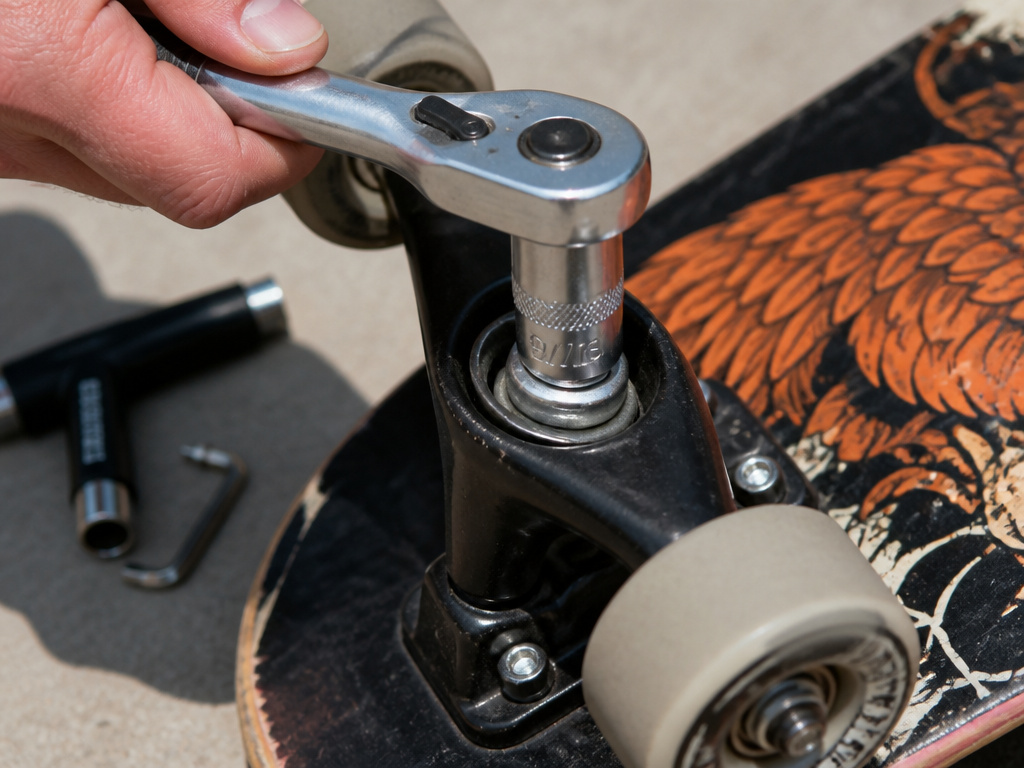
A basic skate tool is a great start, but it often falls short. This kit will help you handle every fastener without stripping anything.
- 9/16-inch Socket & Ratchet: For the kingpin nut. This gives you real torque control and is faster than a skate tool.
- 3/8-inch Wrench or Socket: For the nuts on the four truck mounting bolts. A wrench often fits the cramped space better.
- 4mm Hex Key (Allen Wrench): For the independent resistance screws on the underside of MBS Matrix II truck hangers, and for many truck bolt heads.
- 1/2-inch Wrench: For Yocaher-style wheel adjustment.
- Torque Wrench (for electric/longboard): If you own a performance board like the Linn Power ONE, you need a torque wrench set to 10–12 N·m for the kingpin screw.
I learned the hard way that a skate tool’s 9/16” socket can round off a soft kingpin nut if you’re really cranking on it. The metal is thin, and the leverage is poor. A proper six-point socket from a ratchet set grips fully and won’t slip. It’s the difference between a five-minute adjustment and a trip to the hardware store for a replacement nut.
Gather these before you start. Fishing for the right tool mid-adjustment is how you lose track of your starting point.
Tightening for Different Riding Styles
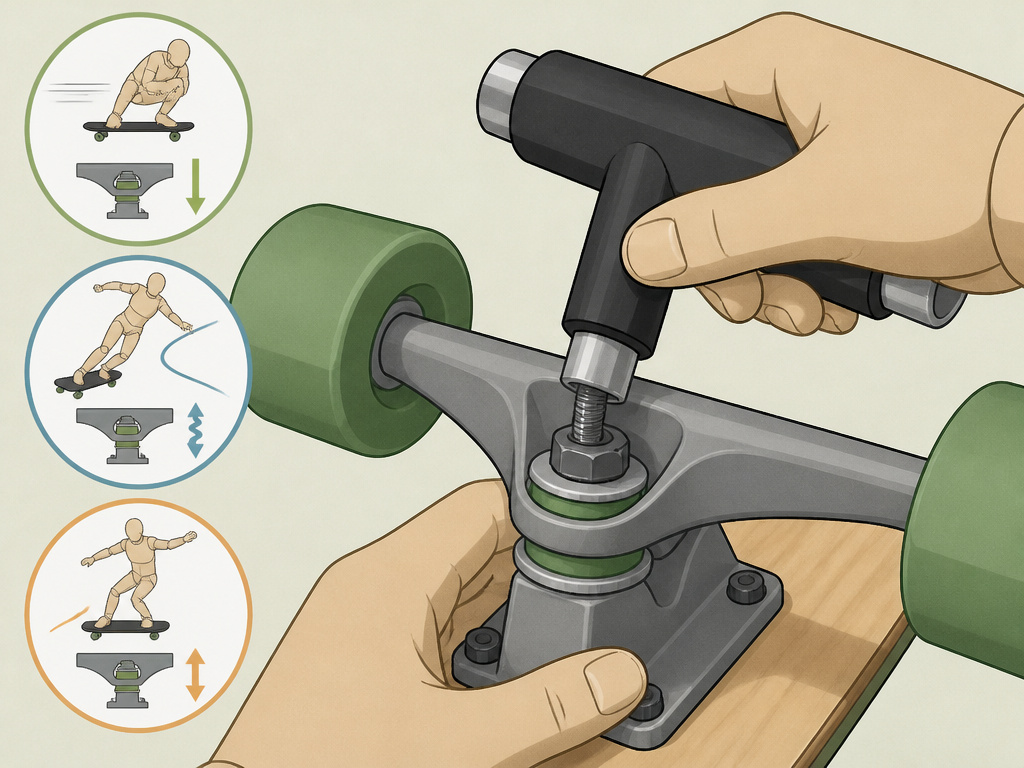
Not all trucks should be equally tight, and your front and rear trucks don’t always need the same setting. This is where you move from basic maintenance to real tuning.
- Downhill / Speed: Tighter trucks. This minimizes turn initiation for high-speed stability, helping to prevent speed wobbles that start from over-correction. The rear truck is often tightened more than the front for stability.
- Carving / Cruising: Looser trucks. This maximizes responsiveness for flowing, surf-like turns. Both trucks are typically set equally loose, just shy of causing wheel bite.
- Freestyle / Dancing: A middle ground. You need stability for landing tricks but enough turn for board manipulation. Many riders prefer a slightly tighter rear truck for control during pushes and spins.
Anecdotal sources disagree on truck tightness preference in the debate on how to tighten a longboard: some downhill riders prefer tight trucks for stability, while some carving and freestyle riders prefer looser setups for responsiveness. Your weight and bushing hardness are the other variables. Heavier riders or softer bushings will feel tighter at a given kingpin setting.
When to Replace Bushings, Not Tighten
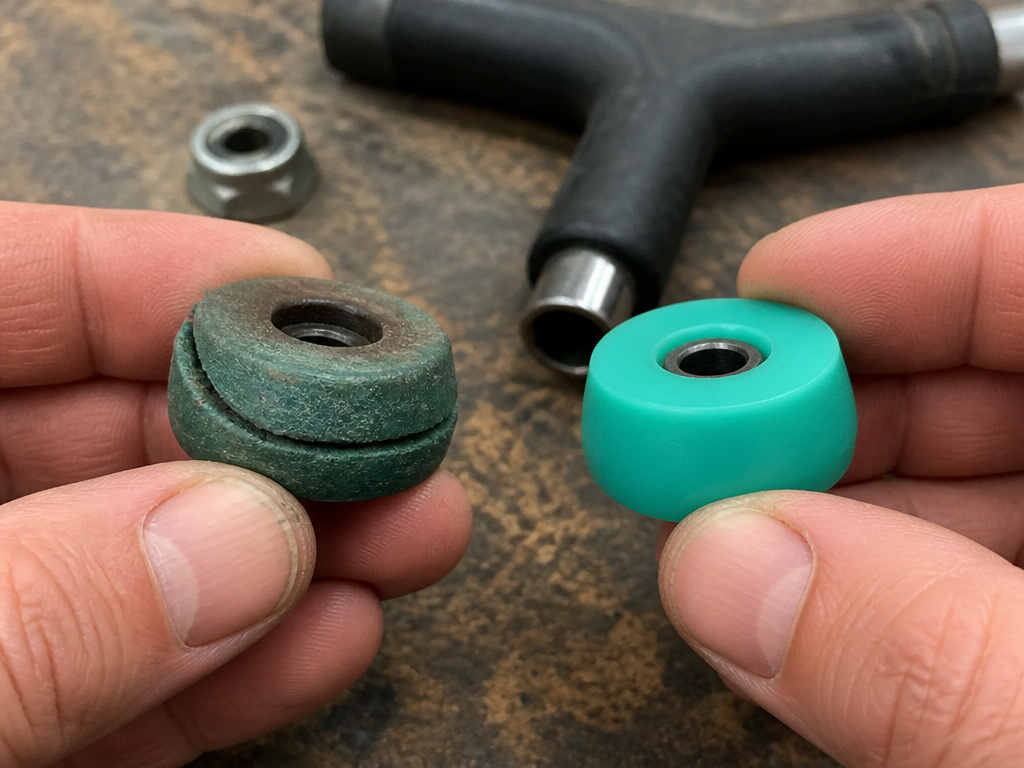
Bushings are wear items. If you find yourself constantly tightening the kingpin nut to combat a new, vague feeling in your turns, the bushings are likely shot. Overtightening old, softened bushings is a dead end. You’ll crush them into a misshapen lump, and the board will feel both sluggish and unpredictable.
Here’s how you know:
- Visual: Remove the kingpin nut and top washer. If the bushing is cracked, heavily deformed, or has taken a permanent flat set, replace it.
- Feel: The board feels “dead” or “mushy” in turns, even with a tight kingpin. There’s no springy return to center.
- Timeline: Standard urethane bushings are wear items and will eventually need replacement. Softer duros (78A-85A) wear faster than harder ones.
Replacing bushings is a five-minute job and the single most impactful cheap upgrade for your board’s feel. Match the bushing shape (cone/barrel) to your existing setup, and choose a durometer based on your weight and desired responsiveness.
Special Cases: Mountainboards & Electric Longboards
Standard longboard advice breaks down with specialty gear. The manuals for MBS mountainboards and the Linn Power ONE electric longboard prove it.
For MBS boards with shock blocks, tightening isn’t about the kingpin. It’s about setting a gap between the shock and the truck hanger. The manual specifies a “Minimum Compression” (most maneuverable) setting with no gap, and a “Maximum Compression” (most stable) setting with a 1/4″ gap. It warns in all caps: “BOTTOM SURFACE OF SHOCK MUST NOT RISE ABOVE TOP SURFACE OF HANGER CHANNEL.” Ignoring this and just cranking the kingpin can damage the shock block system.
For the Linn Power ONE, the process is precise engineering. After cleaning old threadlocker, you apply fresh Loctite 243 to the M5 x 16mm kingpin screw, torque it to 10–12 N·m, and then, this is critical, allow approximately 24 hours for the threadlocker to cure before riding. This isn’t a suggestion. On an electric board, a loose kingpin screw under motor torque can lead to catastrophic steering failure.
The Safety Check Everyone Skips
After any adjustment, perform this three-point check before you roll away:
- Kingpin Nut Security: With your fingers, try to turn the kingpin nut. It should not move. If it’s loose, the nut isn’t secure. Tighten it until you feel firm resistance.
- Baseplate Bolt Check: Grab the truck hanger and try to twist it forcefully relative to the deck. You should hear and feel nothing. Any movement or creaking means the four mounting bolts need tightening with your 3/8-inch wrench.
- Wheel Roll Test: Lift the board and spin each wheel. Listen. A healthy, properly tightened wheel spins freely. A grinding noise or immediate stop means the axle nut is too tight or the bearing is damaged.
Skipping this is how axles shift, nuts vibrate off, and baseplates work loose. It takes 30 seconds.
How to Adjust Your Wheels and Bearings
Getting your wheels to spin right is a balance. If the axle nut is too loose, the wheel will slide sideways on the axle. The nut and washer must push against the inner race of the bearing, not just slide on the axle. If it’s too tight, a wheel spun by hand will come to a sudden halt and may even roll back slightly. The goal is a wheel that spins freely and comes to a gradual stop. Check by gripping each wheel and trying to shake it; if it wobbles laterally, tighten the nut a little. If it stops abruptly, loosen it slightly until the spin is smooth.
Frequently Asked Questions
How do I make my longboard less wobbly?
Tighten the kingpin nut on both trucks, starting with quarter-turn increments. Ensure your wheels are properly tightened (no lateral play) and your weight is centered over the board. Speed wobbles often start from a combination of loose trucks and a tense, unbalanced stance.
Should longboard trucks be tight or loose?
It depends on your riding style. For downhill and high-speed stability, tighter is better. For carving, cruising, and freestyle, looser is preferred for responsiveness. Begin with the trucks just tight enough to eliminate hanger play, then adjust based on feel.
Can you overtighten longboard trucks?
Yes. Overtightening the kingpin nut crushes the bushings, degrading their performance and rebound. It can also damage the bushing seat in the hanger. On cheaper trucks, overtightening can strain the kingpin itself. Tighten only until the desired stability is achieved, not until you can’t turn the wrench.
Why does my longboard still feel loose after tightening the kingpin?
If the kingpin nut is tight but the truck still feels vague, your bushings are likely worn out and need replacement. Also, check that the four truck mounting bolts are tight, if the whole baseplate shifts, tightening the kingpin does nothing.
How tight should longboard wheels be?
They should have no side-to-side shake, but still spin freely. The exact method varies: MBS says tighten fully then back off 1/4 turn; Yocaher says find the “sweet spot” where the wheel spins down gradually. Avoid methods that cause bearing bind or allow lateral play.
Before You Go
Tightening a longboard isn’t about maxing out a torque setting. It’s about matching three things: the tool to the fastener, the method to your board’s brand, and the final feel to your riding style. The kingpin nut controls stability; the axle nuts control rolling efficiency; the mounting bolts control everything. Mix them up, and you’re not tuning, you’re guessing.
One final rule that overrides all brand disagreements: if any part of the truck assembly, kingpin, bushings, hanger, or baseplate, feels gritty, cracked, or permanently deformed, stop adjusting and start replacing. No amount of tightening will fix a broken component. Your board’s feedback is its primary language; learn to listen to it before you speak back with a wrench.
