How to Make Longboard Wheels Spin Longer: Step-by-Step
This post contains affiliate links. As an Amazon Associate, we earn from qualifying purchases.
To make longboard wheels spin longer, you need to address three things: bearing condition, axle nut tightness, and wheel selection. A clean, lubricated bearing set should spin freely for about 60 seconds. For wheel choice, a harder durometer (like 83a) and a larger core will resist wear and maintain spin better than soft, coreless options.
The 60-second benchmark comes from the iFixit repair guide. It’s a concrete target, not a vague goal. Hitting it means your bearings are free of the grit and dried lubricant that create drag, which is a key part of how to make longboard wheels spin longer. Missing it means you’re pushing against hidden friction every time you roll.
What follows is the full breakdown of how to make longboard wheels spin longer: a diagnostic test, a cleaning method you can do at home, the hardware adjustments that matter, and the wheel specs that actually extend your coast. By the end, you’ll know exactly where your setup is losing speed and how to get it back.
Key Takeaways
- A new or cleaned bearing set should allow for roughly 60 seconds of uninterrupted free-spin, per the iFixit guide.
- For longer-lasting spin, choose wheels with a harder durometer (83a+) and a large, exposed core; soft, thane-heavy wheels like the 78a Hawgs Tracers can wear out in a week of sliding.
- Sources disagree on rotation patterns: Warehouseskateboards recommends a simple X-pattern, while Polyboards recommends a more complex, stance-specific pattern to address uneven wear.
- Free-spin time alone is misleading; a wheel that spins long in your hand can still bog down under your weight if the bearings are gunked up or the wheels are too soft for the pavement.
The 60-Second Free-Spin Test
Start here. Pick up your board and give a wheel a firm spin with your hand. Time it.
According to the iFixit Repair Guide, a new or properly cleaned and lubricated bearing set should allow for roughly 60 seconds of uninterrupted free-spin. If a wheel spins for less than thirty seconds, it will detriment the quality of your motion.
That’s your baseline. A spin under 30 seconds means you have a problem. Between 30 and 60 seconds, there’s room for improvement. Hitting 60 means your bearings are in top shape. This test isolates the bearing and wheel assembly from your weight and pushing technique. It tells you what’s happening at the axle.
Now, a critical caveat from the Reddit forums: free-spin time isn’t a perfect indicator of how your board will roll when you’re on it. A wheel can spin fine in the air but still feel sluggish under load. Why? Because the test doesn’t account for bearing seals packed with thick grease, or for wheels that are too soft and deform under pressure. The free-spin test is your starting diagnostic, not your final grade.
Common mistake: Oiling dirty bearings without cleaning them first. Adding oil to grit creates a grinding paste. You’ll hear a gritty, sandy noise, and the spin time will drop again within a few rides.
Step-by-Step Bearing Cleaning
If your spin test failed, cleaning is your next move. You’ll need a skate tool, a small container, isopropyl alcohol (90%+), a rag, and lubricant like Bones Speed Cream or a light sewing machine oil. WD-40 is not a lubricant, it’s a solvent and water-displacer that will dry out your bearings.
Here’s the process, distilled from the iFixit guide and common practice.
- Remove the wheels. Use your skate tool to loosen the axle nuts. Slide each wheel off.
- Pry off the bearing shields. Insert a thin blade or pin between the rubber seal and the metal bearing casing. Twist gently to pop the shield out. Some bearings have non-removable shields; for those, you can try flushing with solvent, but a full clean is harder.
- Soak and agitate. Place the bearings in your container and cover them with isopropyl alcohol. Swirl them around for a minute or two. The alcohol dissolves old, gummy lubricant and floats out dirt.
- Dry thoroughly. Remove the bearings and pat them dry with a clean, lint-free rag. Let them air-dry completely for 10-15 minutes. Any leftover moisture will cause rust.
- Lubricate sparingly. Add one small drop of lubricant to each bearing, directly onto the ball bearings inside. Spin the bearing to work the oil in. Wipe away any excess, more oil just attracts more dirt.
- Reinstall the shields and press them back into place with your fingers.
- Remount the wheels, but don’t tighten the axle nuts all the way yet.
I used to skip the drying step. The result was a faint rust bloom inside the bearing race within two days, and a soft grinding feel returned. Now I wait.
| Step | Tool/Material | Skip-It Consequence |
|---|---|---|
| Remove shields | Thin blade/pin | Can’t reach dirt trapped under seal; cleaning is superficial. |
| Soak in alcohol | 90%+ Isopropyl Alcohol | Old grease isn’t dissolved; grit remains and new lube can’t circulate. |
| Dry completely | Lint-free rag | Residual moisture causes rust, which permanently scores bearing races. |
| Lubricate sparingly | Speed Cream/light oil | Over-lubrication attracts dirt, creating a grinding paste that wears bearings fast. |
The goal is to restore the smooth, metal-on-metal interface inside the bearing. A proper bearing cleaning makes a dramatic difference in both free-spin time and the actual rolling feel underfoot.
Adjusting Axle Nut Tightness
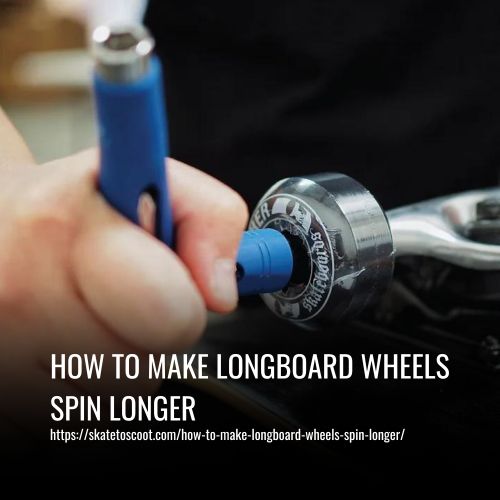
This is the simplest fix with the biggest immediate payoff. After cleaning your bearings and sliding the wheel back on the axle, you need to set the nut correctly.
The wheel should have a tiny bit of lateral play. That play is intentional. It ensures the inner bearing race isn’t being pinched against the axle spacer or the truck hanger.
If the nut is cranked down tight, it compresses the bearing internals. This creates drag, sometimes called “binding.” The wheel might still spin, but it fights you. It feels slow, and you’ll wear out your pushing leg faster. The fix takes ten seconds per wheel with a skate tool.
The right tightness is a balance. Too loose, and the wheel will wobble excessively, which is unsafe and feels unstable. Too tight, and you kill your spin. The sweet spot is “snug but not tight.” No movement means it’s too tight. More than a couple of millimeters means it’s too loose.
For a deeper dive on this specific adjustment, our guide on how tight longboard wheels should be walks through the nuances.
Choosing Wheels for Longer Spin
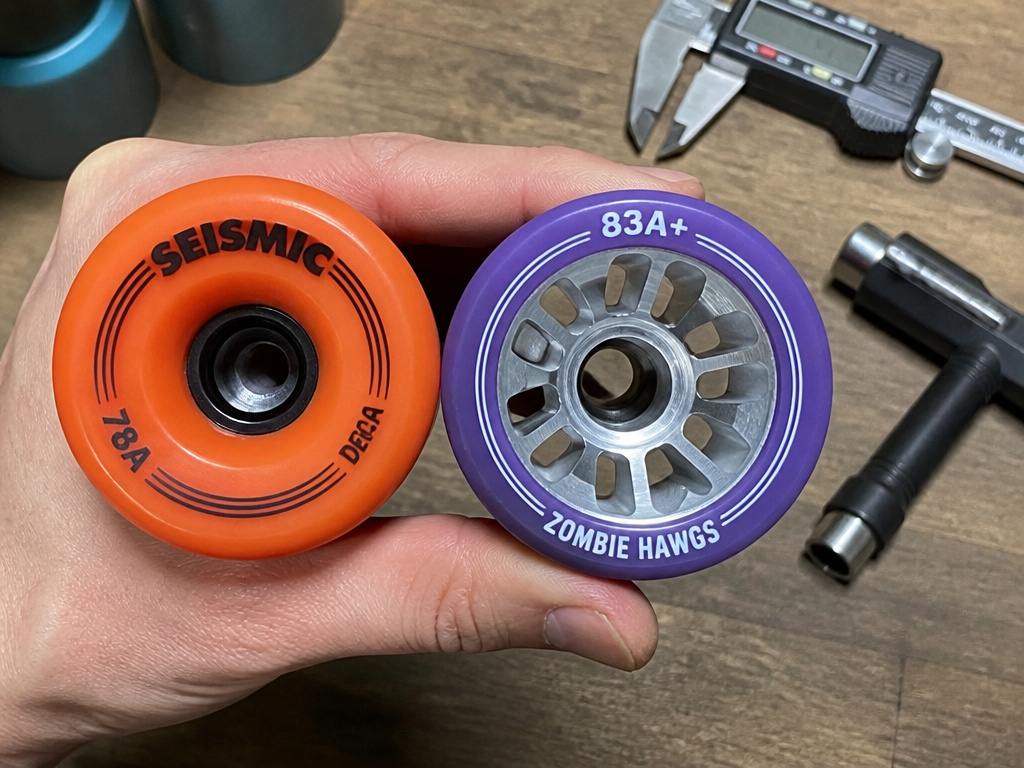
Your bearings can be perfect and your axle nuts perfectly set, but the wrong wheels will still cut your coast short when you consider how to make longboard wheels spin longer. Wheel choice isn’t just about grip and slide, it directly impacts how long and freely they spin. Three specs matter most: durometer, core design, and size.
Durometer (Hardness): Measured on the A scale. Longboard wheels typically range from 78a (very soft) to 85a (hard). According to Lush Longboards, the sweet spot for most riding is 78-82a. However, if your goal is maximum spin time and longevity, especially for sliding, harder is better.
- Soft wheels (78a-80a): Grip well and smooth out rough pavement. But they deform more under your weight, creating a larger contact patch and more rolling resistance. They also wear faster. The Motion Boardshop notes a 78a 67mm Hawgs Tracers wheel “will last you less than a week of consistent sliding until they’re completely dead.”
- Harder wheels (83a+): Create less friction against the ground. They maintain their shape better, offering a smaller, more consistent contact patch for less drag. The same source states an 83a 69mm Orangatang Kilmer “will last you months upon months of consistent sliding.”
Core Design: This is the plastic or aluminum hub inside the urethane.
- Large, Exposed Cores: A wheel with a big core, according to Lush Longboards, is “more likely to stay spinning when sliding sideways, so it’ll stay round for much longer than a coreless wheel.” Exposed cores also dissipate heat from the bearings better, preventing a dangerous failure called “puking,” where the urethane melts around an overheated core.
- Centerset Cores: These can be flipped on the axle for more even wear, extending the wheel’s life. A symmetrical wheel that wears evenly will spin truer and longer than a coned or unevenly worn one.
Wheel Size: Larger wheels have a higher top speed but slower acceleration. Smaller, lighter wheels often slide better than larger, heavier wheels.
| Wheel Characteristic | Better for Long Spin | Why |
|---|---|---|
| Durometer | Harder (83a+) | Deforms less under load, creating less rolling resistance and slower wear. |
| Core | Large, Exposed | Dissipates heat, stays rounder during slides, supports urethane better. |
| Size | Larger (70mm+) | Rolls over rough surfaces more easily, maintaining momentum. |
| Profile |
If you’re in the market for new wheels, pairing them with the right best longboard bearings is the next logical step. Quality bearings, properly installed, will let a wheel perform to its potential.
Maintenance Routines for Sustained Spin
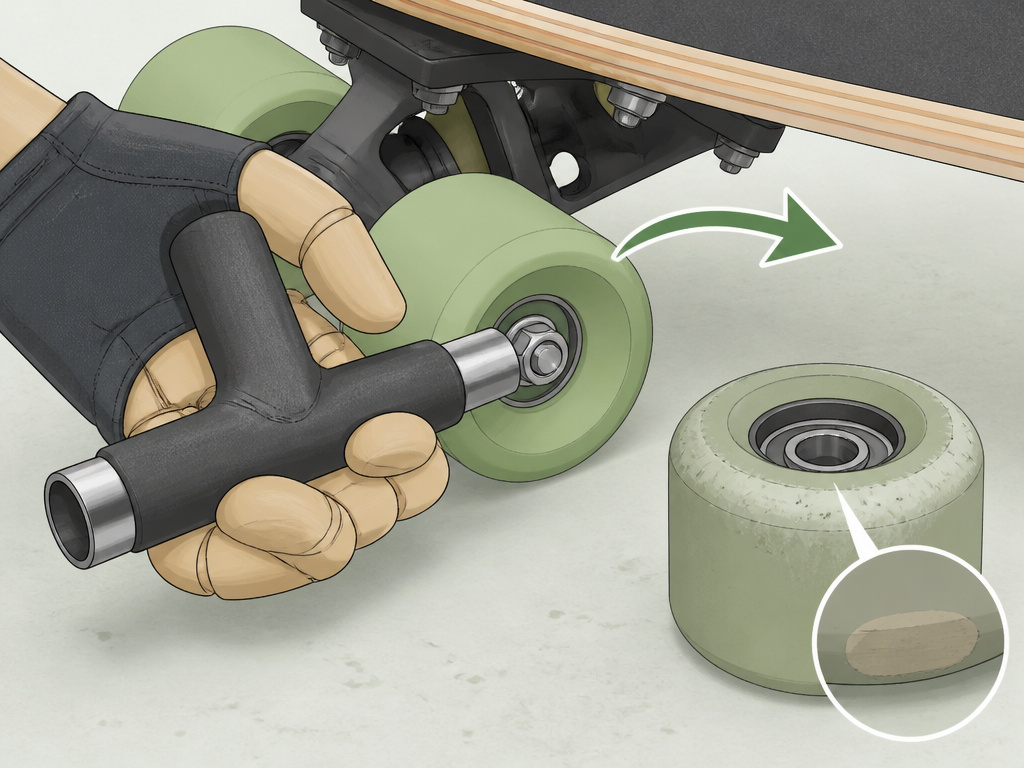
Making your wheels spin longer isn’t a one-time fix. It’s a habit. Here are the routines that keep your roll fast.
Regular Wheel Rotation: Your back wheels, especially on your dominant slide side, wear faster. Rotating them evens out the wear, preventing coning and flat-spots that make rolling noisy and inefficient. Sources disagree on rotation patterns: Warehouseskateboards recommends a simple X-pattern, while Polyboards recommends a more complex, stance-specific pattern to address uneven wear. Do this every few weeks if you skate regularly.
Flat-Spot Prevention and Correction: A flat-spot is a section of the wheel that’s been ground flat because the wheel stopped spinning during a slide. It feels like a rhythmic thump-thump-thump when you roll.
- Prevention: Keep your slides under 90 degrees. As the Motion Boardshop advises, “keep your shoulders and feet pointed down the hill while sliding.” This keeps the wheels rotating.
- Correction: For minor flat-spots, you can sometimes “roll them out” by doing a series of fast, shallow slides (like Coleman slides) on the opposite side. The goal is to wear down the high points around the flat spot.
Bearing Check-Ups: Every month or two, or after riding in wet conditions, perform the 60-second free-spin test again. A sudden drop in spin time tells you it’s time for another bearing maintenance session. Catching grit early prevents it from grinding away your bearing races.
A quick visual inspection when you rotate your wheels is also wise. Look for rust on the bearing surfaces or cracks in the urethane. Feeling for gritty resistance when you spin the wheels by hand after you loosen your wheels can alert you to problems before they ruin a session.
How to check if your trucks are slowing your wheels
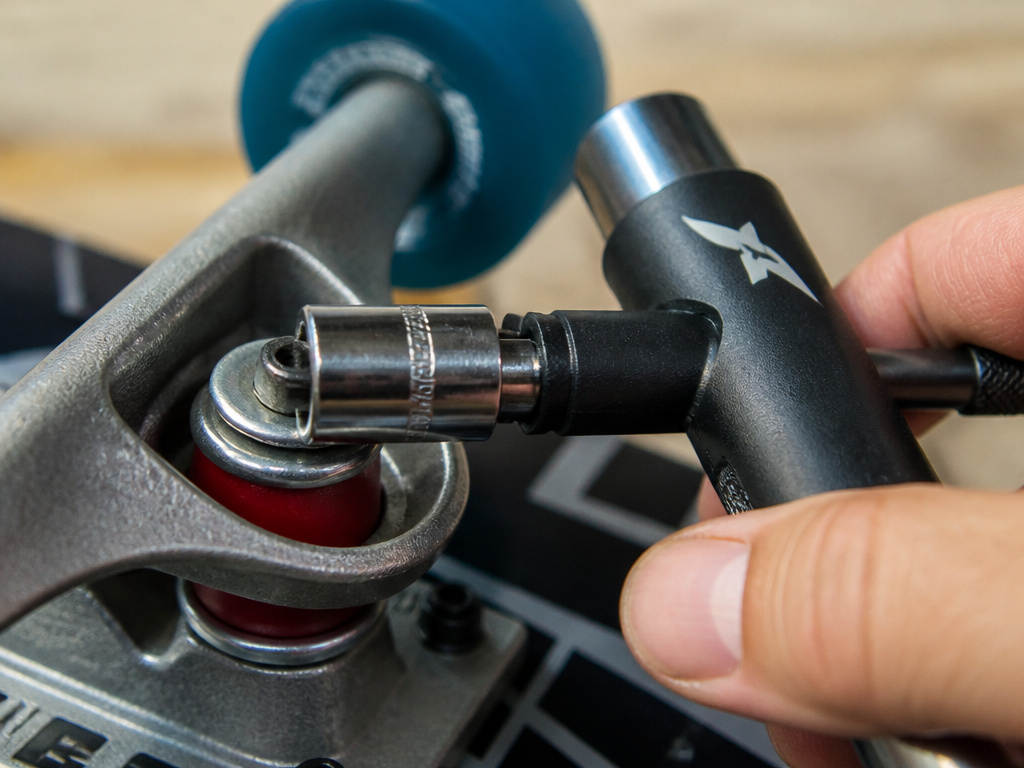
Your trucks and bushings can create drag on your wheels even if your bearings are perfect. This happens when the kingpin nut is overtightened, squeezing the bushings so much they can’t pivot freely. This stiffness transfers to the axle, putting sideways pressure on the inner bearing races and slowing the wheel’s spin. To check, remove a wheel and see if the hanger moves smoothly. If it’s stiff or jerky, loosen the kingpin nut a quarter-turn at a time until the truck moves without play but without binding. A properly adjusted truck removes this source of friction, letting your wheels spin freely.
The right way to use wheel spacers
Wheel spacers are small cylinders that sit on the axle between your bearings. Their main job is to prevent the inner bearing races from being squeezed when you tighten the axle nut. Without a spacer, overtightening the nut can pinch the bearings, creating massive internal friction that kills your spin. Always use a spacer that fits snugly inside the wheel’s core. When installing, tighten the axle nut until it’s firm against the spacer, not the wheel itself. You should be able to feel a tiny bit of side-to-side play in the wheel when it’s not under your weight; this play disappears when you stand on the board, confirming the bearings aren’t being pinched.
Frequently Asked Questions
How do I make my skateboard wheels spin longer?
The principles are the same: clean and lubricate the bearings, ensure the axle nuts are not over-tightened, and choose wheels appropriate for your surface. Harder wheels (99a-101a for street skating) will generally spin with less resistance on smooth concrete than soft wheels.
Is 99A too hard for street skating?
For traditional street skating on smooth concrete or skatepark surfaces, 99a-101a is the standard. It provides the right balance of speed, slide, and pop. It would be too hard and slippery for rough asphalt or long-distance pushing on a longboard.
Do hard or soft longboard wheels go faster?
On perfectly smooth surfaces, harder wheels can be faster due to less friction. On real-world rough pavement, softer wheels (78a-82a) often maintain speed better because they deform over bumps instead of bouncing, which wastes energy. For overall “faster feeling” including acceleration and vibration dampening, most longboarders prefer mid-range durometers.
How can I make my bearings spin faster?
You can’t make bearings spin faster than their design allows, but you can remove impediments. Clean them to remove dirt and old grease, lubricate them with a light oil (not grease), and ensure they are not pinched by over-tightened axle nuts. After a proper bearing lubrication, they will spin as freely as possible.
The Bottom Line
The search for longer spin comes down to reducing friction in three places: inside the bearing, at the axle nut, and between the wheel and the ground. Start with the 60-second test. If you fail, clean your bearings. If you pass but your board still feels slow, check your axle nut tightness and then look at your wheels.
If you only do one thing, adjust your axle nuts. It’s the thirty-second fix that solves half of all slow-rolling problems. If you’re ready to upgrade, invest in wheels with a harder durometer and a large core, they’re the foundation of durable, fast-rolling performance. Everything else, fancy bearings, perfect pavement, is secondary.
Finally, remember that maintenance is cumulative. A clean bearing today spins longer tomorrow. A rotated wheel this month is still round next month. The board that rolls farthest isn’t always the most expensive one; it’s the one that’s been looked after.
