Are Longboards Faster Than Skateboards?
This post contains affiliate links. As an Amazon Associate, we earn from qualifying purchases.
Longboards are faster than skateboards in downhill and cruising scenarios due to their longer wheelbase, larger wheels, and more stable truck geometry, which reduce rolling resistance and dampen instability at speed. On flat ground with no push, a skateboard can accelerate quicker from a stop, but a longboard maintains higher speeds once moving. The professional downhill speed record is over 80 mph, set on a longboard.
That’s the short, direct answer to the are longboards faster than skateboards question. The long one is about where those speed advantages actually show up for a real rider on real pavement. The difference isn’t just about picking a faster board; it’s about matching the board’s design to the terrain you’re riding and your own skill level.
What follows is a breakdown of the specific design features that affect speed, the real-world speed ranges you can expect from peer-reviewed studies, and the critical safety considerations that come into play when you start pushing past 20 mph. By the end, you’ll know which is faster, when that speed matters, and when a skateboard’s agility might be the better choice.
Key Takeaways
- Downhill, longboards win. Their stability at high speeds allows them to reach and maintain velocities a standard skateboard cannot safely handle. The longboard speed record exceeds 80 mph.
- On flat ground, rider power is king. A study in the European Journal of Applied Physiology found experienced riders’ self-selected “fast” speed averaged just 11.4 mph on flat ground.
- Wheel size is the primary speed lever. Larger wheels (common on longboards) have lower rolling resistance. Going from standard 52mm skateboard wheels to 70mm longboard wheels is like switching from road tires to touring tires on a bike.
- Stability trades for agility. A longboard’s longboards vs skateboards design prioritizes straight-line stability, making it less maneuverable for tricks or tight turns.
- Speed increases injury risk. A 2014 study in Injury journal found longboarders sustained traumatic brain injuries at more than double the rate of skateboarders, correlating with higher typical speeds.
The Design Factors That Actually Drive Speed
Forget brand hype. The physics of how a board rolls boils down to three things you can measure: wheel diameter, truck geometry, and deck length. Each one trades something for speed.
Wheel Diameter: The Rolling Resistance Rule
Larger wheels roll over cracks, pebbles, and rough asphalt with less effort. According to the FHWA, traditional skateboard wheels are 52mm to 60mm (2.05 to 2.36 inches). Longboards commonly use larger wheels than skateboards. That bigger contact patch and diameter reduces the energy loss per revolution. It’s the single biggest mechanical reason a longboard will coast farther and faster on the same hill.
Common mistake: Using hard, small skateboard wheels for commuting. They transmit every bump straight to your feet and sap your momentum, forcing you to push constantly. Softer, larger bigger longboard wheels maintain speed over imperfect pavement.
Truck Geometry: Tipping the Stability Scale
Most skateboards use traditional kingpin (TKP) trucks, which are highly responsive for turning and tricks. Many longboards use reverse kingpin (RKP) trucks, which are often wider, typically 150mm to 180mm. RKP trucks are designed to dampen sudden turns, making the board feel less “twitchy” at high velocity. This stability is what allows a rider to stay on at 30 mph instead of being thrown off by a minor weight shift.
Deck Length and Wheelbase: The Pendulum Effect
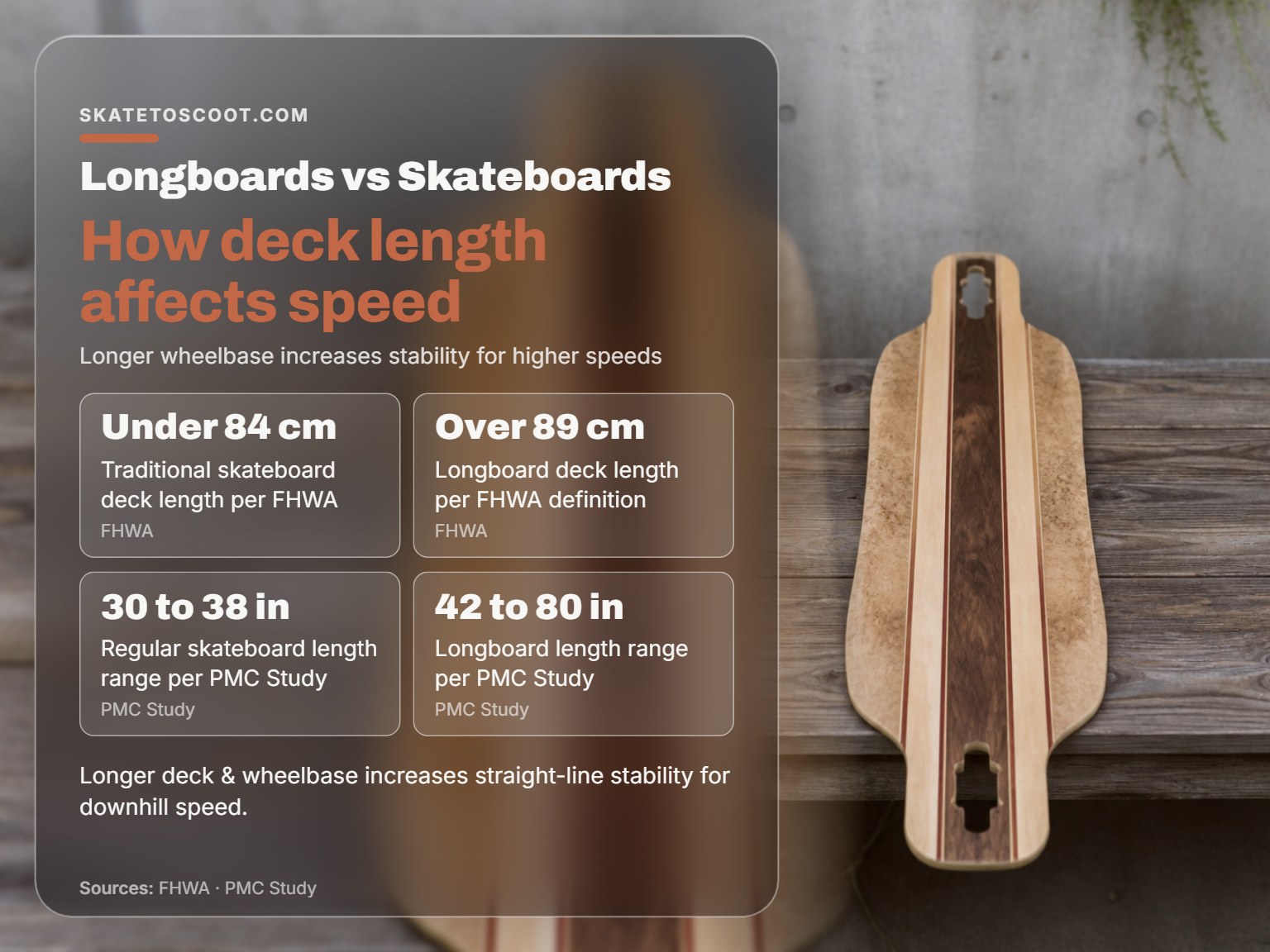
A longer deck, and thus a longer distance between the trucks (wheelbase), increases stability. The FHWA defines a longboard as over 89 cm (35 inches), while other sources use longer ranges; a traditional skateboard is under 84 cm (33 inches) per FHWA. That extra length gives you a wider, more comfortable stance, which lowers your center of gravity and makes the board less prone to speed wobble. It’s harder to kick and flip, but it’s a stable platform for carrying speed.
| Design Feature | Skateboard Typical Spec | Longboard Typical Spec | Effect on Speed |
|---|---|---|---|
| Wheel Diameter | 52–60 mm | 65–75+ mm | Larger diameter = lower rolling resistance, maintains speed better. |
| Truck Type | Traditional Kingpin (TKP) | Reverse Kingpin (RKP) | RKP provides stability at high speed, preventing uncontrollable wobble. |
| Deck Length | Under 84 cm (33 in) | Over 89 cm (35 in) | Longer wheelbase increases straight-line stability for downhill runs. |
The Real-World Speed Numbers (From 8 mph to 80+ mph)
Abstract claims about speed are useless. You need real numbers to understand what “fast” means. The data paints a clear picture: casual riding is slower than you think, but the performance ceiling is astronomically high.
Casual and Commuting Speeds (Flat Ground)
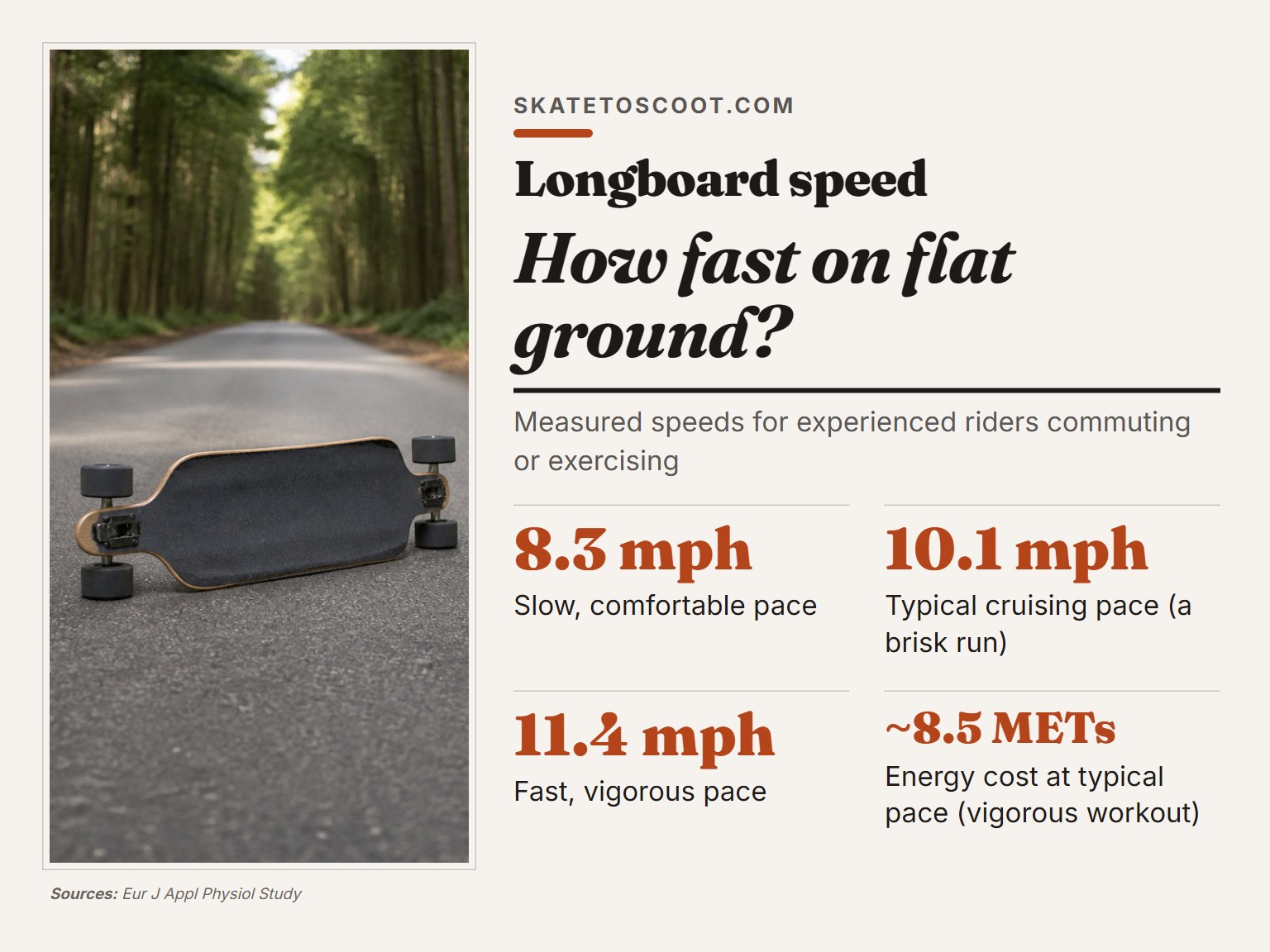
Forget downhill for a moment. How fast does someone actually go when using a board to get around town or exercise? A 2014 study published in the European Journal of Applied Physiology gives us a rare, measured look. Researchers had 15 experienced longboarders ride at their self-selected slow, typical, and fast paces on flat ground.
- Slow pace: 3.7 m/s (8.3 mph)
- Typical pace: 4.5 m/s (10.1 mph)
- Fast pace: 5.1 m/s (11.4 mph)
That’s the reality of how fast longboards go under human power on flat terrain, about the speed of a brisk run. This is crucial context. The study also found this typical pace required an energy expenditure of about 8.5 METs, a “vigorous intensity” workout.
Downhill and Performance Speeds
This is where longboards separate themselves in the are longboards faster than skateboards debate. The same study’s “fast” pace is a casual cruise for a downhill rider. A 2014 review in PMC notes that while professionals chase records, “lay longboarders may reach speeds up to 30+ mph depending on the terrain.” The current verified world record, cited in multiple sources, is 80.74 mph, set on a longboard in 2012. But it defines the upper limit of what’s mechanically possible.
A 2014 review in PMC (Injury journal) found that 57.5% of skateboarding-related accidents in their study involved longboards, compared to 42.5% for skateboards. They directly linked this to the “higher speeds” and “downhill travel” associated with longboarding.
When a Skateboard Might Feel Faster
Acceleration isn’t the same as top speed. Its agility can also make it faster through a technical, turn-filled course where a longboard’s stability becomes a hindrance. For pure point-A-to-point-B speed on a straight line, especially on a decline, the longboard’s advantages are overwhelming.
Stability at Speed: The Wobble Factor

You can’t talk about speed without talking about control. Every board has a critical speed where its natural frequency matches the rider’s inputs, leading to a feedback loop of increasingly violent oscillations, speed wobble.
A longboard’s longer wheelbase and dampening RKP trucks push that critical speed threshold much higher. This is why downhill riders always choose longboards; the stability is a requirement to stay alive at 40+ mph.
The part nobody mentions: Speed wobble often starts in the feet, not the board. A tense, locked stance transmits micro-vibrations directly into the trucks. The fix isn’t just a better board; it’s learning to relax your ankles and knees to act as shock absorbers, a technique crucial for longboard safety.
This isn’t just gear; it’s a skill.
Rider Skill and Terrain: The Great Overlooked Variables
Two riders on the same hill with identical boards will not go the same speed. One study on heart rate during longboarding casually noted that “different people had different boards with different components so some boards were faster than others.” This highlights the massive variable: the rider.
- Pushing Technique: Efficient, powerful pushes are how you build and maintain speed on flat ground. Poor form wastes energy. This is a learnable skill, detailed in guides on how to push faster.
- Aerodynamics: At anything over 15 mph, wind resistance becomes your main enemy. A rider who knows how to tuck, crouching low to minimize their profile, will dramatically outpace someone riding upright.
- Line Choice: On a hill, the fastest line isn’t always straight down. A skilled rider will “carve” across the road, converting vertical drop into controllable speed and scrubbing off excess velocity before a corner, a technique explored in speed techniques for longboarding.
- Terrain: Smooth, fresh asphalt feels like a magic speed boost. Rough, chip-seal roads or bike paths with constant cracks will slow any board, demanding larger wheels to maintain comfort and momentum.
Safety Considerations When Chasing Speed
Higher potential speeds come with higher consequence crashes. The data doesn’t lie.
The 2014 Injury journal study provided a stark comparison: longboard-specific traumatic brain injury (TBI) incidence was 30.6%, compared to 12.7% for skateboard-specific injuries. When skull fractures were included, the rates were 38.6% for longboards versus 12.9% for skateboards.
The gear and mindset must match the activity. Downhill skating without a full-face helmet, slide gloves, and leathers is irresponsible. The safety of longboards is directly tied to the rider’s respect for the speed and proper preparation.
Essential High-Speed Gear:
- Full-Face Helmet: A standard skate helmet is insufficient for impacts over 20 mph. A full-face helmet protects your chin and jaw.
- Slide Gloves: These have hard plastic pucks on the palms, allowing you to safely touch down and slide to slow yourself or bail during a wobble.
- Knee and Elbow Pads: High-impact pads designed for skateboarding or motorcycle use.
Frequently Asked Questions
What goes faster, longboard or skateboard?
On a downhill or for maintaining speed over distance, a longboard is faster. Its design reduces rolling resistance and increases stability. On perfectly flat ground from a standstill, a skateboard may accelerate quicker for the first few feet, but the longboard will quickly overtake and maintain a higher cruising speed with less effort.
Is a longboard harder than a skateboard?
They require different skills. A longboard is generally easier for beginners to ride in a straight line and push for transportation because it’s more stable and comfortable. A skateboard is harder to balance on initially but is designed for the specific, technical skills of street skating like ollies and kickflips. One isn’t universally harder; they’re different.
Is 20 mph on a skateboard fast?
Yes, 20 mph is very fast on any skateboard. At that speed on a traditional skateboard, the margin for error is tiny, and a fall will likely cause serious injury. On a longboard, 20 mph is within the performance range of an intermediate rider on a moderate hill, but it still requires protective gear and controlled conditions. It’s a speed where dedicated downhill equipment and training start to become necessary.
How fast do longboards go?
Longboard speeds exist on a massive spectrum. Casual riders on flat ground average 8-12 mph. Commuters or fitness riders might hit 15-20 mph on mild declines. Dedicated downhill riders regularly reach 30-50 mph on appropriate hills. The absolute world record, representing the extreme limit of the sport, is over 80 mph.
Before You Go
So, are longboards faster than skateboards? For downhill and speed maintenance, unequivocally yes. The combination of larger wheels, stable trucks, and a longer platform gives them a decisive physical advantage that shows up in both lab data and record books.
But the more useful question is: what kind of speed are you after? If you want to carve hills, commute efficiently, or push for personal fitness over distance, a longboard’s design is engineered for that. Look for a stable model with wheels over 60 mm in diameter from our list of best longboards. If your goal is technical tricks, park riding, or ultra-short trips where portability and pop matter more than top speed, a skateboard is your tool.
Whichever path you choose, match your protection to your ambition. The thrill of speed is real, but so is the pavement. Start slow, gear up, and respect the physics, they’re the one thing you can’t outride.
