Can You Ride a Hoverboard in the Mall? Key Takeaways
This post contains affiliate links. As an Amazon Associate, we earn from qualifying purchases.
You cannot legally ride a hoverboard inside a shopping mall. Mall policies universally prohibit riding any personal transportation device on their private property for safety and liability reasons. Beyond the rules, the CPSC explicitly warns consumers to never purchase a hoverboard from a mall kiosk due to the high risk of fire hazards from non-compliant units.
That “no” is anchored in a documented history of fires, injuries, and federal warnings that specifically link mall-sold hoverboards to catastrophic failures. The smooth floors might look perfect, but the stakes are concrete: property damage, personal injury, and legal liability.
What follows is a breakdown of why the rule exists, the specific hazards you’re up against, and the practical steps for navigating this space, whether you’re trying to transport your board or looking for a legitimate place to ride.
Key Takeaways
- Malls are private property, and their posted rules banning riding are legally enforceable; security can escort you out or issue a trespass warning.
- The U.S. Consumer Product Safety Commission (CPSC) directly warns: “Never purchase a hoverboard from a kiosk” due to the proven fire risk of non-compliant units sold there.
- From 2015 to 2018, hoverboard incidents caused over $9 million in property damage, including six destroyed homes, from fires that often started while charging.
- If you are stopped, stop riding immediately, dismount, and be prepared to carry the device; arguing or refusing dramatically increases the chance of a permanent ban.
- Your homeowner’s or renter’s insurance likely won’t cover damage or injury you cause while illegally riding a motorized device on private commercial property.
The CPSC’s Direct Warning Against Mall Hoverboards
This isn’t a matter of store managers being strict. The federal agency charged with product safety has drawn a straight line between mall retail environments and demonstrable danger.
Never purchase a hoverboard from a kiosk.. CPSC Hoverboard Safety Alert
That sentence appears verbatim in the official hoverboard safety alert from the U.S. Consumer Product Safety Commission. It’s not a suggestion. It’s a directive based on incident data. The agency is aware of more than 300 self-balancing scooter incidents related to fires or overheating, according to one CPSC alert.
Why single out kiosks? A 2016 recall provides the evidence. The CPSC announced a recall of approximately 70,000 Powerboard model #PB-001 hoverboards. The recall notice specifies these units were sold “at mall kiosks operated by Hoverboard LLC at 35 locations nationwide.” There were 27 reports of these specific boards overheating, sparking, and smoking. This official recall for fire hazard directly ties a known hazardous product to the exact retail environment you find in malls.
The core issue is compliance with the UL 2272 safety standard. Kiosks and pop-up sellers are notorious for moving older stock or units that bypass proper certification. The agency warns that sellers may claim individual parts are “UL-compliant,” but UL 2272 covers the entire system, battery, charger, BMS, and frame together. A cheap price at a kiosk is a major red flag.
What Happens If You Try to Ride a Hoverboard in a Mall?
I’ll describe the scenario. You roll through the main entrance. The floors are smooth, the aisles are long. It feels like the perfect test track.
Within minutes, sometimes seconds, a security officer will approach you. This isn’t a guess; it’s their primary job function, to mitigate liability and prevent accidents on the property. Your interaction will follow a predictable pattern.
- The Verbal Warning. The officer will ask you to stop riding immediately. They’ll cite the mall’s code of conduct, which you agreed to by entering the private property. This is not a negotiation.
- The Escort. If you comply, you’ll likely be asked to dismount and may be escorted toward an exit. The expectation is that you will carry your hoverboard or wheel it beside you, not ride it.
- The Escalation. If you refuse or argue, the situation escalates. Security can issue a formal trespass warning, banning you from the property. In many jurisdictions, refusing to leave after being trespassed is a misdemeanor offense. They may also confiscate your device until you leave the premises.
The legal footing here is solid. A mall is not a public street; it’s private property open to the public. By entering, you implicitly agree to their rules. Posting “No Skateboarding, Rollerblading, or Hoverboards” signs grants them the authority to enforce those terms. Your defense of “I wasn’t hurting anyone” is irrelevant to their liability calculus.
Where this goes sideways: Arguing with security that “it’s not a hoverboard, it’s a self-balancing scooter.” The policy language is deliberately broad to cover all personal electric mobility devices. This semantic debate only convinces them you’re a problem they need to remove faster.
Your goal should be de-escalation. Stop. Dismount. Apologize briefly. Carry your board. You keep your access, and they complete their duty. Anything else turns a minor interruption into a permanent record.
Safety and Liability: The Real-World Consequences
The ban on riding is about managing profound physical and financial risks. The incident data from the CPSC isn’t theoretical.
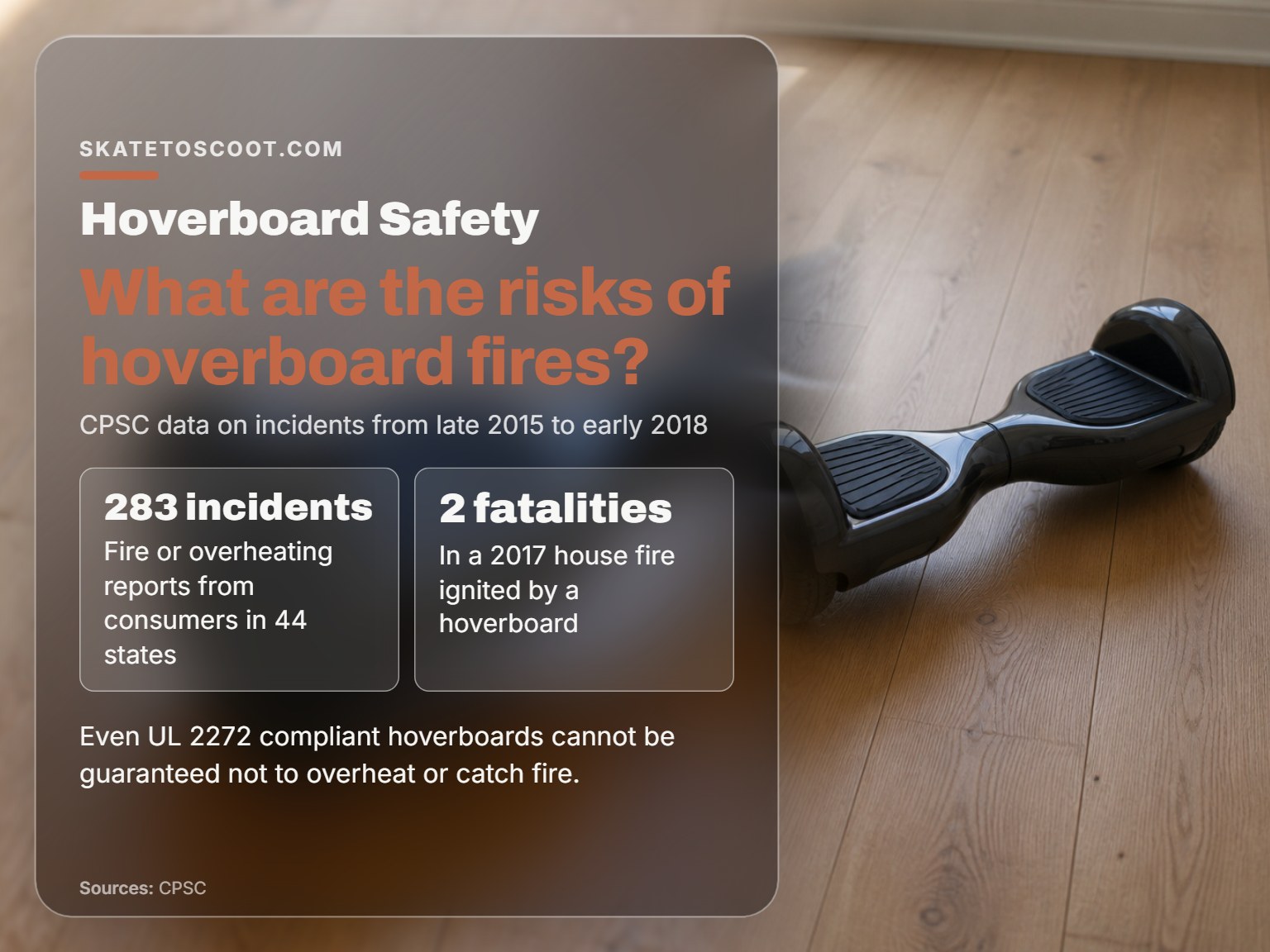
These resulted in 15 burn injuries, 7 smoke inhalation injuries, and over $9 million in property damage, including the destruction of six homes and two automobiles. In March 2017, a house fire ignited by a charging hoverboard killed a 2-year-old girl and her 10-year-old sister in Harrisburg, Pennsylvania.
Now, place that risk inside a mall. The consequences of a lithium-ion battery thermal runaway, a fire that erupts with intense heat and toxic fumes, in a crowded, carpeted, merchandise-filled indoor space are catastrophic. The mall’s prohibition is a direct, rational response to this documented hazard.
Your personal liability is the other half. If your hoverboard malfunctions and causes damage or injury while you’re riding it in violation of posted rules, you are almost certainly personally at fault. Your homeowner’s insurance will likely deny a claim because you were engaged in an excluded activity (illegal operation of a motorized vehicle on private property). You would be on the hook for the mall’s repair costs, lost revenue from store closures, and any medical bills for injured parties.
| Risk Scenario | Probable Consequence | Timeline |
|---|---|---|
| Riding in a crowded corridor | Collision with a pedestrian, causing injury | Immediate |
| Battery overheats/fires while riding | Evacuation, property damage, potential injury | Can occur suddenly, even during use |
| Security confiscates your device | Loss of property until you leave (or permanently) | During the incident |
| You receive a trespass order | Permanent ban from the mall and its stores | During the incident |
How to Legitimately Check a Specific Mall’s Policy
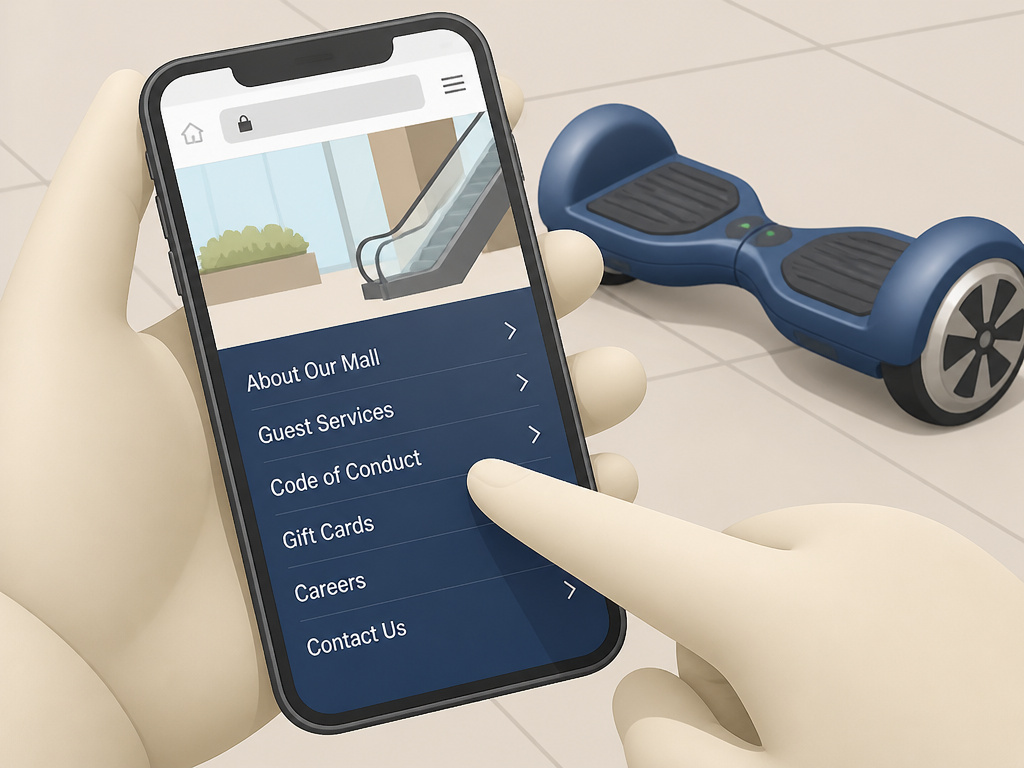
You need to know the rule for your local mall, which starts with the can you ride a hoverboard in the mall question. Don’t assume. The process is straightforward but requires a tiny bit of effort.
First, visit the mall’s official website. Look for a “Guest Services,” “Code of Conduct,” or “Mall Rules” page. These are almost always listed in the footer menu. Scan for keywords: “skateboards,” “scooters,” “rollerblades,” “personal electric vehicles,” or “hoverboards.” If the page is vague, the default assumption is that riding is prohibited.
Second, call the mall’s management office. This is more effective than calling general information. Ask directly: “What is your policy on riding personal electric mobility devices, like hoverboards or electric skateboards, inside the mall?” Get a clear yes or no. If they say no, ask if you are allowed to carry the device while you shop. Many malls will permit the latter as long as the wheels are not touching the ground.
Third, look for physical signage. Next time you visit, check the main entrances. Rules are often posted on doors or pillars. A sign that says “No Skateboards” is generally interpreted to include all wheeled personal transport.
This proactive check of the can you ride a hoverboard in the mall rule saves you the embarrassment and hassle of a confrontation. It also informs your decision on whether to even bring the device to the mall. For more on finding legal riding locations for similar devices, the principles of due diligence are the same.
Carrying vs. Riding: A Practical Loophole
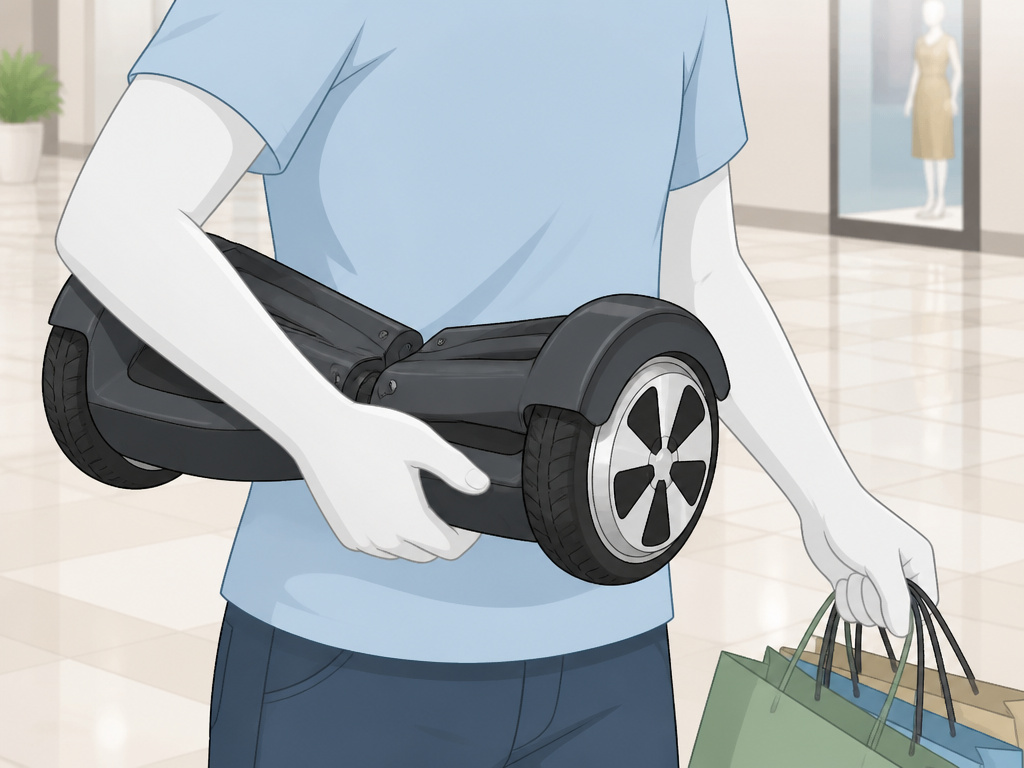
Here’s a compromise that often works: carry it. Don’t ride it.
Many mall policies that forbid riding do not explicitly forbid possessing or carrying a folded or powered-down device. Your hoverboard becomes a bulky parcel, not a vehicle. The key is that the wheels must not be engaged on the floor. Carry it under your arm, use a carry strap, or push it along beside you like a handcart (with the power off).
This serves a practical purpose. If you use your hoverboard for daily transportation to get to the mall, you need a way to bring it inside while you shop. Carrying it respects the “no riding” rule while acknowledging its utility as your transport to the door.
Before you do this, apply the check from the previous section. Call and ask: “Can I bring my hoverboard inside if I carry it and don’t ride it?” If they say yes, you’re in the clear. If they say no, you need to plan for secure locking outside or choose a different way to travel. Never assume this is allowed, some malls prohibit the devices entirely due to the underlying safety risks they associate with the lithium-ion batteries, even when powered off.
Hoverboards vs. Skateboards vs. E-Scooters in Malls
You might wonder if the rules differ for other devices. From a mall management perspective, they usually don’t.
| Device | Typical Mall Policy | Primary Reason for Ban |
|---|---|---|
| Hoverboard | No Riding | Fire hazard, rider instability, collision risk |
| Electric Skateboard | No Riding | Speed, collision risk, same fire hazard |
| Manual Skateboard | No Riding | Damage to floors/rails, collision risk, “loitering” image |
| Electric Scooter | No Riding | Speed, trip hazard when parked, collision risk |
| Rollerblades | No Riding | Collision risk, damage to floor finishes |
The unifying factor is liability and property damage. All these devices can cause a pedestrian to fall, can damage interior surfaces, and create a perception of disorder that deters other shoppers. The specific hoverboard dangers related to battery fires add another layer, but the foundational rule is about controlling the environment.
This is why you’ll see blanket bans. It’s easier and legally safer to prohibit all such devices than to create a complex matrix of which motorized wheeled thing is allowed on which day. For the rider, the distinction is moot. The rule is “no riding.”
Where Can You Ride a Hoverboard?
If malls are off-limits, where should you go? The focus shifts to spaces designed for or tolerant of personal mobility.
Your best bets are private property with explicit permission. This could be a smooth, empty warehouse floor (with the owner’s OK), a marked basketball court in a deserted park, or your own driveway. The key is you have the legal right to be there and are not violating any terms of use.
Public bike paths or multi-use trails are often allowed, but you must check local UK hoverboard laws or municipal ordinances first. Many cities classify hoverboards similarly to electric skateboards, which may be restricted from sidewalks but allowed on bike lanes. Always yield to pedestrians and cyclists.
Empty parking lots after business hours can work, but beware of private security patrols. Your goal is smooth, paved, open spaces with low pedestrian traffic and clear lines of sight. The ideal surface is clean, dry pavement or concrete. Avoid gravel, sand, or wet surfaces that can cause a loss of traction.
The common thread is research and respect. Just as you would check a mall’s policy, you need to verify the legal status and rules for any public space. When in doubt, choose a location so empty that your riding affects no one else and damages no property. For a deeper look at outdoor riding surfaces and etiquette, the principles of choosing low-impact locations are consistent.
Where can you ride a hoverboard instead of a mall?
If mall riding is off the table, look for private, controlled environments with smooth, flat surfaces and ample space. Empty parking lots after business hours, paved park paths, or private driveways can be suitable, provided you have permission and the area is free of significant pedestrian traffic. Always prioritize surfaces that are dry and clear of debris to maintain control. Remember, even in these alternative locations, you must follow the same critical safety practices for charging and storing your board to prevent fire hazards. The risks associated with these devices don’t disappear just because you’ve moved to a more open area.
Frequently Asked Questions
Can I ride my hoverboard in Walmart or Target?
No. Large retail stores have the same, if not stricter, policies as malls. Aisles are narrower, merchandise is closer, and the risk of a collision causing injury or knocking over displays is high. Stores like Walmart and Target explicitly prohibit riding any personal transportation device on their premises. You can expect to be stopped by store staff very quickly.
Can you ride a hoverboard on the street?
This depends entirely on local and state laws. In most U.S. Jurisdictions, hoverboards lack required safety equipment like lights, turn signals, and a license plate, making them illegal on public roads. They may be permitted on sidewalks, but many cities are now restricting motorized devices from sidewalks for pedestrian safety. You must check your specific city’s municipal code.
Is a typical hoverboard speed too fast for indoor use?
For indoor contexts, absolutely. 7 mph (about 11 km/h) is a slow jogging pace. In a crowded, confined space like a mall corridor, that speed is excessive and dangerous. At that rate, you cannot stop quickly enough to avoid a suddenly turning pedestrian or a child stepping out from behind a rack. For outdoor use on a clear path, 7 mph is a reasonable cruising speed.
What should I do if mall security takes my hoverboard?
Comply. Do not physically resist. Ask for the security officer’s name and a contact for the mall’s management office. Politely state that you will retrieve the device on your way out. Then, leave the mall immediately and contact the management office to arrange pickup. Arguing or refusing to leave will likely result in police being called and potential trespass charges. Your priority is to de-escalate and recover your property through official channels later.
The Bottom Line
The question concerns risk management, both the mall’s and your own. The federal data shows these devices can fail catastrophically, and indoor, crowded spaces are the worst possible venue for that failure. Mall policies exist to prevent the collisions, injuries, and fires that come with introducing a personal vehicle into a pedestrian retail environment.
So, can you ride a hoverboard in the mall? The clear, evidence-based answer is no. Not legally, not safely, not without accepting enormous personal liability.
Your practical path is to use your hoverboard where it’s designed and welcomed: on open, paved outdoor surfaces. Transport it to the mall if you must, but carry it inside. Know the rules before you go. That’s the difference between being a rider with a problem and a rider who avoids them. Everything else is just waiting for the moment something goes wrong, and the data tells us exactly how that ends.
