How Much Does It Cost to Rent a Knee Scooter?
This post contains affiliate links. As an Amazon Associate, we earn from qualifying purchases.
Renting a knee scooter typically costs between $14.75 and $60 per week, but the final price depends on your location, the model you need, and whether you pay extra for delivery or a security deposit. Nationwide online services like Knee Scooter USA offer standardized weekly rates, while local medical suppliers often have tiered pricing and add substantial delivery fees.
That price range directly results from two completely different rental systems competing for your business. One is the streamlined, online model built on volume and auto-renewing weekly contracts. The other is the traditional local medical equipment shop, where personalized service comes with distance-based delivery charges and sometimes a credit card hold. A common first question is how much does it cost to rent a knee scooter.
What follows is a breakdown of both, complete with the exact numbers from current provider websites. You’ll see the advertised weekly rates, the real cost of getting the scooter to your door, and the one question you must ask about insurance before you hand over a credit card, even after you’ve answered how much does it cost to rent a knee scooter.
Key Takeaways
- Standard weekly rates vary by provider, with Knee Scooter USA starting at $14.75, Wishing Well Medical charging $60, and KS Scientific implying a rate around $25.
- Always ask about the security deposit or credit card hold; some providers require a $200 hold, while others like Knee Scooter USA require none.
- Rental contracts often auto-renew weekly; you’re charged each week until you return the scooter, with no fixed end date.
- For recoveries longer than 4-6 weeks, buying a knee scooter often costs less than continuing to rent, with anecdotal purchase prices ranging from $90 to $350.
- Non-profits like Lions Clubs or local “loaner closets” may provide free, short-term rentals, especially for seniors or those with financial need.
The Standard Weekly Rate Range
Open any rental website and you’ll see a weekly price. That number is your starting point, but it’s meaningless without knowing which billing model it represents.
Knee Scooter USA lists its Standard model at $14.75 per week and its All-Terrain model at $19.75 per week. Their system is built on an auto-renewing weekly contract, you pay for one week, and the rental automatically renews for another week unless you return it. There’s no deposit and no final due date. Wishing Well Medical in Los Angeles charges $60 per week (or $120 per month) for its Nova knee scooter, representing a more traditional local supplier rate. KS Scientific’s KneeRover Economy Steerable Knee Scooter is listed for rental (implied rate from product page URL), and requires a $200 cash deposit or credit card hold.
Common mistake: Comparing only the weekly rate. A $15/week rental with a $75 delivery fee costs more upfront than a $60/week rental with free store pickup. The total cost to get the scooter to your doorstep is the only number that matters.
| Provider | Weekly Rate | Deposit/Hold | Billing Model |
|---|---|---|---|
| Knee Scooter USA (Standard) | $14.75 | None | Auto-renewing weekly |
| Knee Scooter USA (All-Terrain) | $19.75 | None | Auto-renewing weekly |
| Wishing Well Medical | $60.00 | Credit Card on File | Weekly or Monthly |
| KS Scientific | ~$25.00 (implied) | $200 Cash/Card Hold | Daily ($15) or Weekly |
The disparity here is structural. The low, auto-renewing rate is designed for simplicity and volume. The higher local rate often includes the option for in-person fitting, service, and sometimes more flexible return terms. Neither is inherently better; your choice depends on how much hands-on help you want versus how much you want to minimize recurring cost.
Delivery, Pickup, and Hidden Fees
The advertised rate is just the ticket price. The delivery fee is the surcharge that decides whether you can actually afford the show.
This is where costs diverge wildly based on your zip code. Hieline Medical in Plano, Texas, charges $45 for delivery within 15 miles of their store. Go beyond that radius, and they add $20 for every additional 10 miles. Need it today? Their same-day rush delivery is $75. Kerring Group in Austin charges a $75 flat fee for a 0-20 mile radius. For someone in a suburban or rural area, these fees can double the first week’s cost.
Where this goes sideways: Assuming delivery is free or a flat fee. These distance-based fees mean a rental that looks affordable online can become prohibitively expensive once you enter your address. Always get a delivery quote in writing before you commit.
Your alternatives are store pickup or relying on a friend for transport. Most knee scooters fold and fit in a standard car trunk. If you can manage the pickup, you erase the single largest variable cost from the equation.
Security Deposits and Credit Card Holds

Some rental companies use a deposit to ensure the equipment comes back in good condition. Others skip it entirely, relying on your credit card as a form of security.
KS Scientific requires a $200 cash deposit or credit card hold for its rentals. This is a common practice among smaller or local providers, it’s a guarantee against damage or loss. In contrast, Knee Scooter USA explicitly states it requires no deposit. Wishing Well Medical and Hieline Medical typically just require a credit card on file for the rental charges, not necessarily a separate hold.
The type of deposit matters. A credit card hold is temporary; it reduces your available credit but isn’t an actual charge unless there’s a problem. A cash deposit is money out of your pocket until you return the scooter. Always clarify which it is and what conditions trigger its forfeiture. A scratched frame from normal use shouldn’t cost you $200.
Insurance, Medicaid, and How to Get Reimbursed
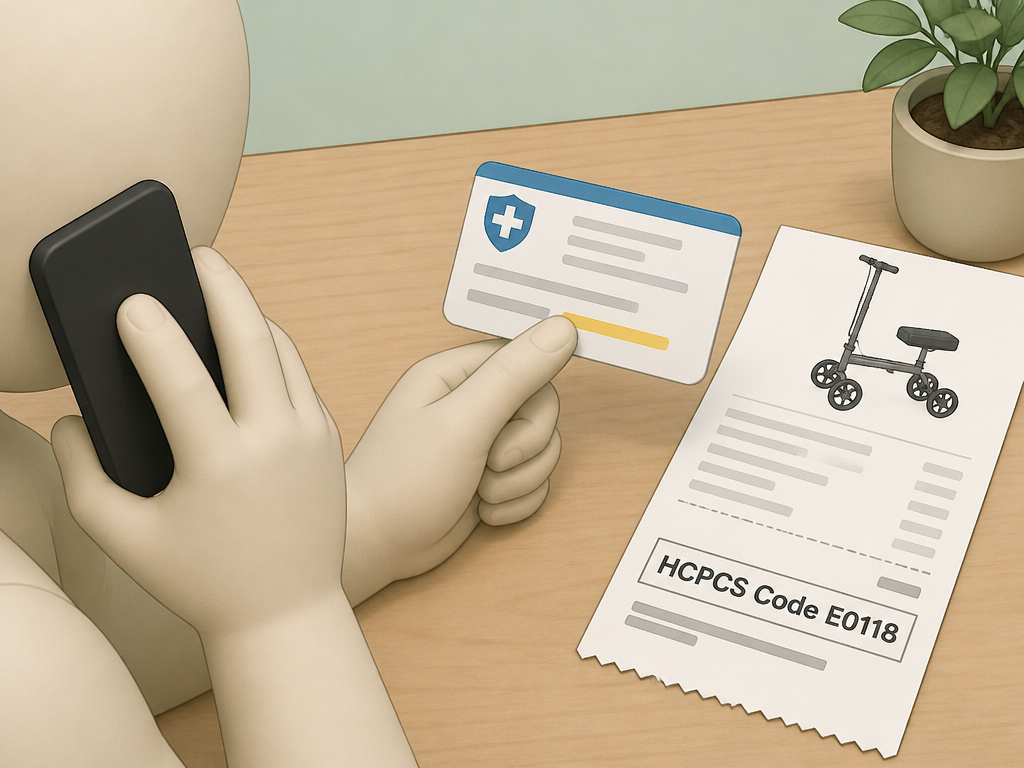
This is the most confusing part for most people. Will your insurance pay for this? The short answer is maybe, but you’ll likely have to pay upfront and seek reimbursement yourself.
Medicaid, as noted in a Reddit user’s struggle, often does not cover knee scooter rentals for non-hospital use. Private insurance is a mixed bag. The key is documentation. Knee Scooter USA provides an HCPCS code receipt upon return, which is the standard form for submitting medical equipment claims to insurance. You submit this with your claim; reimbursement depends on your plan’s deductible, co-insurance, and whether they consider it “medically necessary.”
To check your coverage, follow these steps: 1) Call the number on your insurance card. 2) Ask, “Does my plan cover the rental of a knee walker (HCPCS code E0118) for a non-weight-bearing lower extremity injury?” 3) Ask what documentation they require (often a doctor’s note/prescription and a detailed receipt). 4) Ask if they require pre-authorization. Get the representative’s name and reference number for your records.
Don’t assume coverage. I’ve seen too many students in my coaching years get stuck with bills they thought would be covered. The burden of proof is on you, not the rental company. Some medical suppliers may bill insurance directly, but that’s the exception, not the rule.
Rent vs. Buy: When Does Owning Make Sense?

The rent-versus-buy calculation boils down to a simple timeline. Break that timeline, and the math flips.
Reddit anecdotes consistently point to a purchase price range of $90 to $350 on Amazon or Marketplace. Compare that to renting. At $60 per week, you could quickly exceed the anecdotal purchase price of a basic scooter (reportedly $90-$150). At $14.75 per week, it would take multiple weeks to match the cost of purchasing a scooter, which anecdotal reports price from $90 to $350.
| Recovery Duration | Rental at $60/week | Rental at $14.75/week | Recommended Action |
|---|---|---|---|
| Less than 2 weeks | < $120 | < $30 | Rent |
| 2-4 weeks | $120 – $240 | $30 – $60 | Consider rental; buying is borderline |
| 4-6 weeks | $240 – $360 | $60 – $90 | Buying becomes financially sensible |
| 6+ weeks | > $360 | > $90 | Almost always buy |
Buying has a clear secondary benefit: no time pressure. Your recovery might take longer than expected. A purchased scooter also has resale value; you can often recoup 30-50% of your cost by selling it online when you’re done. Renting offers zero equity, you’re paying for temporary access, nothing more.
Model Types, Weight Limits, and Getting the Right Fit
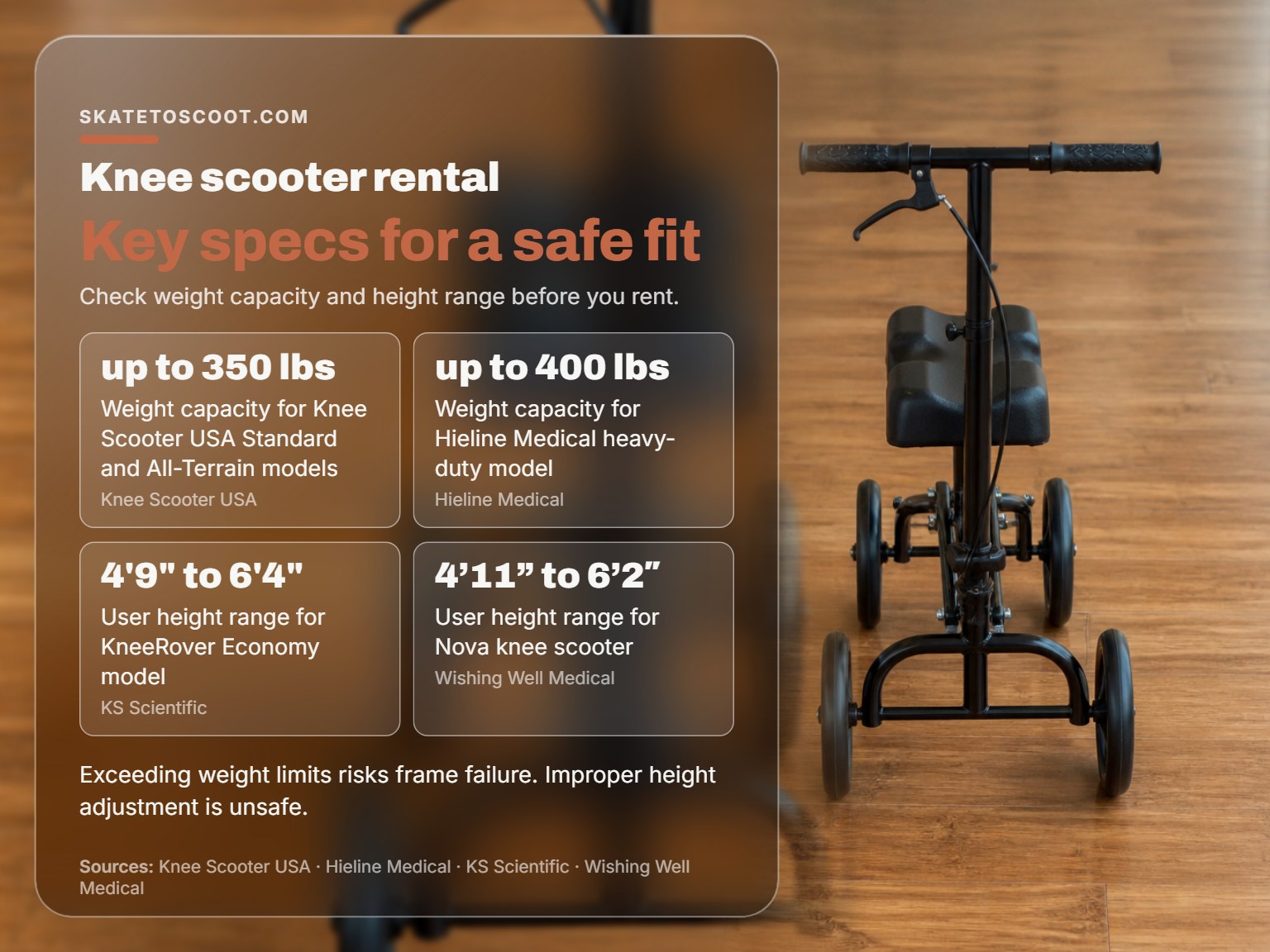
Not all knee scooters are the same, and the wrong fit can turn a helpful aid into a wobbly hazard.
Weight capacity varies by model: Wishing Well Medical’s Nova and KS Scientific’s KneeRover support 300 lbs, while Knee Scooter USA models support up to 350 lbs, and Hieline Medical offers a heavy-duty model rated for 400 lbs. Knee Scooter USA lists its models at up to 350 lbs. Hieline Medical offers a heavy-duty model rated for 400 lbs. Mobility Hire’s Budget Knee Walker is rated at 133.4 kg (294 lbs). These numbers are engineering limits, not marketing figures. Exceed them, and you risk frame failure or unstable handling.
Height adjustment is the other critical spec. The KneeRover Economy fits users from 4’9″ to 6’4″. The Nova scooter fits 4’11” to 6’2″. An improperly adjusted scooter, where your injured knee is bent too sharply or your good leg is cramped, is uncomfortable and unsafe. If you’re renting online, carefully check the height range. If you’re renting locally, insist on adjusting it in the store before you leave.
Finding Free or Low-Cost Rentals
For those who can’t swing even a modest weekly fee, there are community resources that operate on a loaner system, not a rental one.
Organizations like some Lions Clubs run “loaner closets” that may loan medical equipment like knee scooters for free, often requesting only a donation if you’re able. Similar programs exist through other Lions Clubs, Knights of Columbus chapters, local churches, or community health centers. These are typically geared for short-term need (a few weeks to a couple of months) and rely on donated inventory, so availability isn’t guaranteed.
Facebook “Buy Nothing” groups or local marketplace listings are another avenue. People who have purchased scooters often want to pass them on after their recovery. As one Reddit user offered, “You can have mine!” The price here is usually free or very low, but you are responsible for pickup and there’s no warranty or sanitization guarantee. For a tight budget, it’s a viable path.
Knee Scooter Rental Costs from Specific Companies
Rental prices vary significantly by provider. Knee Scooter USA advertises a Standard model for $14.75 per week and an All-Terrain model for $19.75 per week, with an auto-renewing weekly contract and no deposit. Wishing Well Medical charges $60 per week or $120 per month for its Nova knee scooter. KS Scientific’s KneeRover Economy Steerable Knee Scooter is available for rental and requires a $200 cash deposit or credit card hold. Anecdotal reports mention other providers, like Norco, renting for around $100 per month, while a senior reported a one-month rental costing $75.
Frequently Asked Questions
Will insurance pay for a knee scooter rental?
Maybe, but don’t count on it. Private insurance may reimburse you if you submit a receipt with an HCPCS code (like E0118) and a doctor’s note stating medical necessity. Medicaid rarely covers rentals for outpatient use. You will almost always have to pay the rental company upfront and then seek reimbursement from your insurer separately.
What is the average cost to rent a knee scooter for a month?
There is no true average due to varying rates and fees. Based on sourced rates: Wishing Well Medical charges $120 for a month. Anecdotal reports mention $75 and $100 per month from other local suppliers. With an online provider like Knee Scooter USA at $14.75/week, a 4-week month would cost about $59, but this is an auto-renewing weekly charge, not a monthly package.
Is it better to buy or rent a knee scooter?
It depends on your recovery timeline. For recoveries expected to last longer than 4-6 weeks, buying a scooter (available for $90-$350) is almost always cheaper than continuing to rent. For short-term needs under 2-3 weeks, renting is more economical and avoids the hassle of reselling.
What should I check when I pick up a rental knee scooter?
Test three things before you leave the store or accept delivery: 1) Brakes: Squeeze the hand levers. They should engage smoothly and hold the scooter still when you try to push it. 2) Steering: The front wheel should turn left and right freely without sticking. 3) Adjustments: Ensure the knee pad and handlebars lock securely at a height that feels stable and comfortable for you. A wobbly clamp is a failure point.
Before You Go
Your final cost is the weekly rate plus the delivery fee, any deposit, and minus whatever your insurance might pay back later. That’s the real math.
For a recovery under three weeks, find a local loaner closet or a cheap online rental and eat the delivery fee if you must. For anything longer, buy a mid-range scooter outright, the financial break-even point comes fast, and you’ll own a piece of equipment you can sell or donate when you’re back on your feet. The most expensive rental is the one you keep for a month longer than you planned because you didn’t run the numbers first. Do the math now, before your leg is in a cast.
