How to Hang a Longboard on the Wall: Step-by-Step
This post contains affiliate links. As an Amazon Associate, we earn from qualifying purchases.
To hang a longboard on the wall, choose a method that matches the board’s weight, your wall type, and whether you want to display a complete board or just the deck. The three proven paths are: commercial mounts rated for 30+ lbs, DIY rigs using fishing line or padded hooks, and direct mounting with screws through the truck holes. A complete longboard weighs 8-12 lbs; your wall fasteners must hold at least triple that for safety.
That 30-pound safety margin isn’t a suggestion. It’s the buffer between a clean display and a board that crashes down because a drywall anchor failed or a knot slipped. The difference between a method that works for a 7-pound deck and one that holds a 12-pound complete cruiser comes down to the fasteners you pick and where you place them, which is the core of how to hang a longboard on the wall.
What follows: the exact specs for two commercial mount systems, a head-to-head comparison of where to hang the board (deck vs. Trucks) when you compare a how to hang a longboard on the wall, and the step-by-step breakdown for three reliable DIY methods. By the end, you’ll know which screws, anchors, or hooks to buy for your specific wall and board.
Key Takeaways
- Always use hardware rated for at least 30 lbs per mount point.
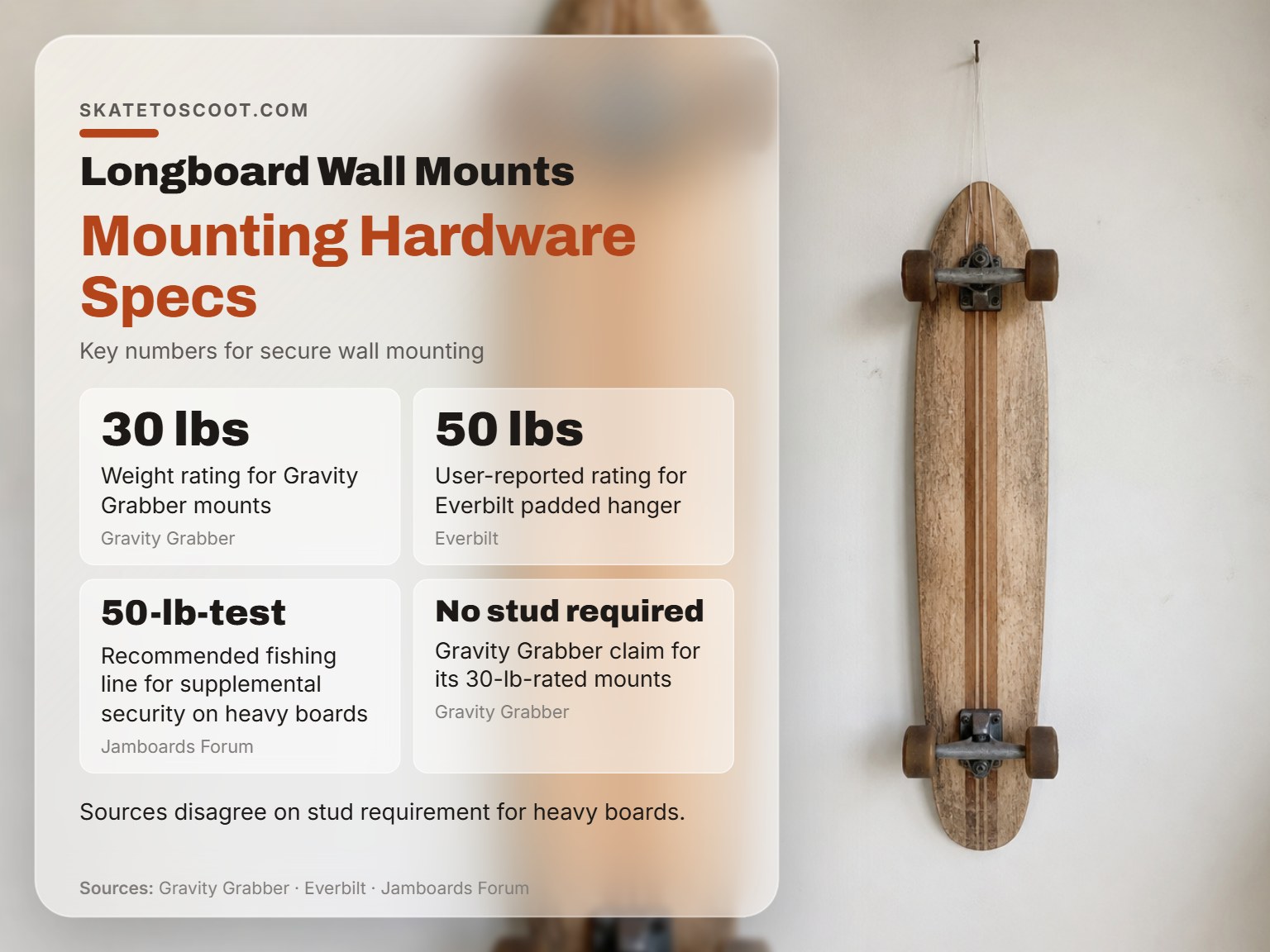
- Sources disagree on whether a stud is required: Gravity Grabber states ‘No stud required’ for its 30-lb-rated mounts, while a Jamboards Forum user recommends using a stud for heavy longboards.
- Commercial mounts like the Gravity Grabber clamp the deck edge, while the ModWall Sport cradles the wheels, the choice changes how the board sits on the wall.
- The “String Theory” method with fishing line is cheap and invisible, but the line can saw into truck holes over years if not padded.
- Always pad the contact points between hardware and your board with felt or rubber to prevent scratches and graphic wear.
Tools & Hardware Needed
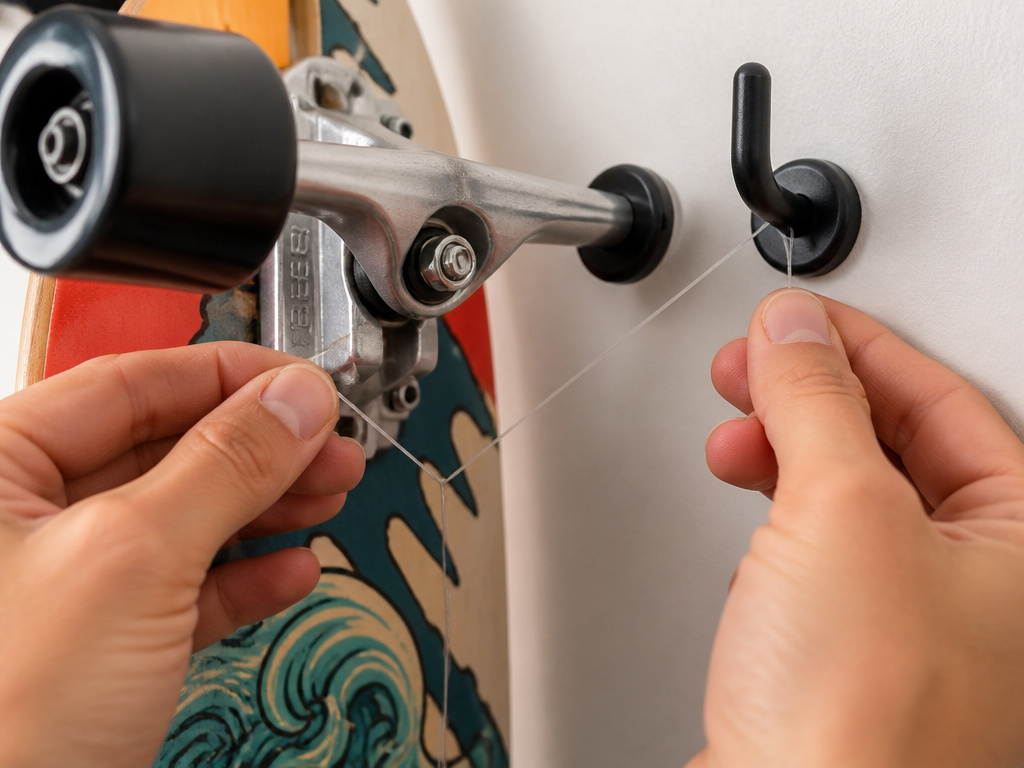
You don’t need a workshop. For most methods, a basic home toolkit covers it. The drill is the one item you can’t skip, a hand-driven screw won’t get deep enough into a stud or set a drywall anchor properly.
Start with this core list: – Power drill with drill bits (for pilot holes and setting anchors) – Stud finder (magnetic ones are cheap and foolproof) – Tape measure – Level – Pencil – Screwdriver (often just the drill with a screwdriver bit) – Wall anchors (rated for your board’s weight, more on this next) – Screws (length depends on your wall)
Worth knowing before you start: Drywall anchors have a weight rating printed on the package, but that rating assumes perfect installation in undamaged drywall. If you overtighten the screw, you crush the anchor’s plastic wings and cut its hold by half. If you miss the center of the stud, the board hangs crooked. The tool that matters most isn’t the drill; it’s the stud finder.
Art of Skateboarding notes that for decks with steep noses and concave, longer fasteners are needed to reach the wall. If your board has pronounced concave, have some longer screws on hand.
The 30-Pound Rule: When a Wall Stud is Non-Negotiable
Here’s where sources disagree, and the disagreement costs people their drywall. Gravity Grabber states “No stud required” for its 30-lb-rated mounts, relying on drywall anchors. A user on the Jamboards forum insists that for heavy longboards, mounting into a stud is “the most important thing.”
Both are right, but for different boards. The 30-pound rating on a Gravity Grabber Mini is for the mount itself, engineered to distribute the load across three anchors. A generic hook from a hardware store does not have that engineering. For a complete longboard, board, trucks, wheels, you’re dealing with 8-12 pounds of dynamic weight. Bump the wall, grab the board to take it down, and you’ve just added another 5-10 pounds of force.
If you must mount into drywall alone, you need anchors rated for the total load, not the board’s static weight. This table breaks down the minimum specs.
The math is simple: one anchor fails, the whole board falls, which is a key principle in how to hang a longboard on the wall. Two anchors sharing a 12-lb load need to be rated for 6 lbs each, but you never load them perfectly evenly. So you double it. Then you add a safety margin because drywall gets brittle. That’s how you land on 30 lbs as the floor for a longboard.
Where this goes sideways: Using a single drywall anchor rated for 30 lbs to hold a 10-lb board. The anchor might hold the weight, but the leverage from the board’s length creates a twisting force (torque) on the single point that the anchor isn’t designed to resist. The board pivots, the anchor loosens, and within a week you’ll hear a creaking sound every time the furnace kicks on. Then it lets go.
So, how do you find a stud? A magnetic stud finder detects the nails holding the drywall to the studs. Mark the edges of the stud. Your screw must go into the center of that width. If you can’t hit a stud, you must use a heavy-duty toggle bolt anchor, not a plastic expansion anchor.
Commercial Mounts: Specs & Choices
If DIY feels like a gamble, a commercial mount gives you a rated product and instructions, and you can even explore a mount subscription service for recurring delivery. You’re buying the engineering. Two brands dominate the conversation: Gravity Grabber and ModWall Sport. They solve the same problem from opposite angles.
Gravity Grabber’s design clamps the deck edge between two spring-loaded arms. The screws go into the wall, not the board. The company warns that hanging a board by its trucks allows the deck to swing against the wall. Their mounts are their own 30-lb system.
ModWall Sport’s mount is sculpted to hang the board by the wheels, cradling the truck axle. It’s made from High-Density Polyethylene (HDPE) and comes in two sizes keyed to truck width.
| Mount Model | Key Spec | Weight Rating | Mounting Point | Best For |
|---|---|---|---|---|
| Gravity Grabber Mini | Opening width: 1.5 in; Width: 4.66 in; 3x 1.25-in screws | 30 lbs | Deck Edge | Standard skateboards, tight spacing |
| Gravity Grabber OG | Opening width: 1-7/8 in; Width: 8 in; 6x 1-in screws | 30 lbs | Deck Edge | Longboards, wider spacing |
| ModWall Sport V-375 | For trucks 3.75 in wide; HDPE construction | Not specified (mfr) | Wheels/Trucks | Cruisers, carvers, drop-throughs |
| ModWall Sport V-600 | For trucks 6.00 in wide; HDPE construction | Not specified (mfr) | Wheels/Trucks | Downhill longboards, wide trucks |
The choice between deck-clamp and wheel-cradle changes the board’s profile on the wall. A Gravity Grabber holds the board vertically on edge, graphics facing out. A ModWall Sport holds it parallel to the wall, wheels resting in the cradle.
For a clean, multi-board display, a row of Gravity Grabber Minis is hard to beat, but for other ideas, see our guide on proper longboard storage. For a single statement piece where you want to see the full deck shape, the ModWall Sport V-600 delivers. Check the truck width on your board before you pick.
DIY Method 1: The “String Theory” Fishing Line Hang
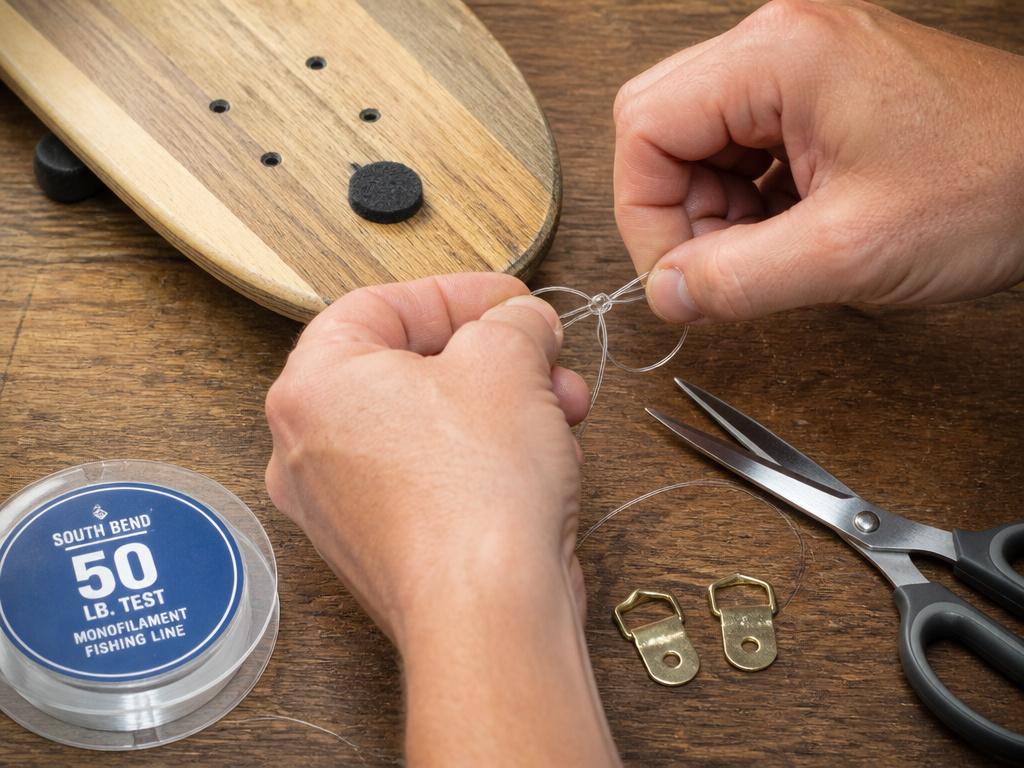
This is the classic, nearly invisible method documented by the Art of Skateboarding community. You run fishing line through the truck holes and hang it on a wall hook. It costs about five dollars and works for boards you still ride.
What You’ll Need:
- 50-lb-test fishing line (a Jamboards forum user recommends this for a “nose and tail security wrap” on heavy boards)
- Two small picture-hanging hooks or a single screw-in hook
- Scissors
- Optional: small felt pads
Step-by-Step:
- Thread the line. Cut a 3-foot section of fishing line. Feed one end through a front truck hole from the outside, then bring it back through the adjacent hole. Pull it tight to form a loop.
- Tie it off. Use a double overhand knot or a square knot. Pull it as tight as you can by hand. The goal is a loop that won’t slip.
- Repeat for the rear truck. Do the same for the back truck, but make this loop slightly shorter than the front one. This tilts the board back slightly, which looks more dynamic.
- Install the wall hook. Using a stud finder, locate a stud and drive a screw or picture hook into it. If no stud, use a heavy-duty anchor. The hook should be rated for at least 30 lbs.
- Hang and adjust. Place the loops over the hook. Step back and check the level. You can adjust the tilt by re-tying one of the loops.
Common mistake: Skipping the felt pad on the hook. The Art of Skateboarding source warns that vibration can cause the deck to rub against the mounting hardware, causing deep scratches over time. A tiny adhesive felt dot on the hook prevents this.
Why does this work? The fishing line distributes the weight across two truck holes, and the knot tension keeps the board from shifting. It fails if the knot slips or the line saws through the truck hole edge after years of use. That’s why the 50-lb-test line matters, it’s thicker and more resistant to abrasion.
DIY Method 2: Padded Arm Hangers or Conduit
For a more industrial look or for heavier boards, you can adapt generic hardware. The Everbilt Heavy Duty Padded Arm Hanger (Home Depot #18042) has a user-reported weight rating of 50 lbs per bar. A Jamboards user describes using 3/4-inch black iron conduit with flanges screwed into wall studs.
This approach is less about subtlety and more about absolute security. It’s for garages, basements, or rooms where you don’t mind seeing the hardware.
How to set up padded hangers:
- Find two studs. Measure the distance between your board’s trucks. This determines where your hangers go.
- Mount the arms. Screw the flanges or the hanger brackets directly into the center of the studs. Use the screws provided.
- Pad the arms. The Everbilt arms come padded. For conduit, wrap the pipe in foam pipe insulation or hockey tape.
- Rest the board. Simply place the trucks onto the arms. The board sits horizontally.
The conduit method is more permanent and custom. You cut the conduit to the length you want (extending beyond the board’s width), screw the flanges into studs, and then slide the conduit pipe into the flanges. It holds the board completely off the wall, which is great for airflow and looks.
The part nobody mentions: These wide arms hold the board by the trucks, which Gravity Grabber warns against because the deck can swing. That’s only a problem if the arms are too short. If the arms extend well past the board on each side, the board can’t pivot enough to hit the wall. Measure for overhang.
DIY Method 3: Screws Directly Through Truck Holes (The “Screw It” Method)
This is the most permanent-looking DIY method. You remove two bolts from each truck, drive longer screws through the holes into the wall, and then re-tighten the trucks. The board appears to float flat against the wall.
The Art of Skateboarding source notes that for displaying a complete board, any method can be used by removing two truck bolts to access the holes. This is that method.
Tools & Steps:
- Disassemble partially. Using a skate tool or wrench, remove the two inner bolts from each truck. Leave the outer bolts tight.
- Position the board. Hold the board against the wall in the desired spot. Use a level on the deck.
- Mark the holes. Push a pencil through the empty truck holes to mark the wall.
- Drill pilot holes. At each mark, drill a pilot hole slightly smaller than your screw’s diameter. If hitting a stud, drill deep enough for the screw. If using drywall anchors, drill the size specified on the anchor package and insert the anchor.
- Drive the screws. Use screws long enough to go through the truck hole and penetrate at least 1 inch into the stud or anchor. For drywall with an anchor, use a screw long enough to go through the truck hole and penetrate securely into the anchor.
- Reattach the trucks. Line up the truck holes with the screws protruding from the wall. Slide the board on, then replace and tighten the two bolts you removed onto the screws.
This method locks the board in place. It’s not coming down without a tool. That’s also its downside, it’s not quick-release. Use this for boards you don’t ride often or for a retired deck meant as pure art.
Protecting Your Board and Your Wall
A hanging board is a static object until it isn’t. A door slams, the house settles, a cat jumps, vibration happens. Without protection, you get two kinds of damage: scratches on your board’s graphic or deck edge, and holes/gouges in your wall.
For the board, apply soft material anywhere metal or hard plastic touches it.
- Felt pads (self-adhesive) on hook contact points.
- Rubber sleeves on screw shafts where they pass through truck holes.
- Hockey tape or electrical tape wrapped around the fishing line where it loops through the truck hole.
For the wall, the risk is from the board’s ends or wheels bumping it. Leave a gap. If your mount holds the board close to the wall, add a clear bumper (like a small adhesive furniture pad) to the wall where the nose or tail might touch.
One Redditor in the r/supremeclothing thread mentioned using clear vinyl over the deck’s graphic for extra protection while displayed. That’s the nuclear option for a prized collectible.
How to hang a longboard without drilling
For a truly removable setup, you have fewer options due to a longboard’s weight and size. Heavy-duty adhesive hooks rated for significant weight can work on smooth, clean walls, but their capacity must far exceed your board’s weight for safety. Freestanding floor stands are a solid alternative, letting you display a board anywhere without touching the wall. These stands cradle the deck or base of the wheels. Be cautious with methods that hang the board by its trucks, as this can let the deck swing and bump the wall.
How to display multiple longboards on a wall
To show off a collection, plan your layout on the floor first. Space mounts evenly, considering the board’s length and width so they don’t touch. Using a consistent mounting method creates a clean look. For boards with trucks, you can use the same hardware by temporarily removing two truck bolts to access the mounting holes. If stacking boards close together, be mindful that vibration can cause decks to rub against hardware over time. Ensure your wall fastening strategy is robust enough for the combined weight of all boards.
Frequently Asked Questions
Can you hang a longboard without drilling into the wall?
You can, but the options are limited and weight-sensitive. Heavy-duty adhesive hooks rated for significant weight exist, but their performance depends entirely on your wall surface and temperature stability. Most adhesive fails over time with weight load. For a light deck only, it might work. For a complete longboard, drilling is the reliable choice.
What’s the best way to hang a longboard horizontally?
Horizontal display shows off the full deck shape. The most secure ways are: 1) Using two padded arm hangers (like the Everbilt) mounted into wall studs, or 2) Using the “Screw It” method with screws through the front and rear truck holes. Both require drilling into studs for safe support across the board’s length.
How do you hang a skateboard deck without trucks?
It’s easier because you’re dealing with less weight (3-5 lbs). The fishing line method works by threading line through the mounting holes on the deck itself. Commercial deck mounts, like simple floating shelf brackets, also work well. You can use smaller anchors and have more placement flexibility.
Is it bad to hang a skateboard by the trucks?
Sources disagree: Gravity Grabber advises against hanging a board by its trucks, ModWall Sport cradles the board by the wheels, and Art of Skateboarding describes a method using fishing line through truck holes. The real issue is control. If the hang point is secure and the board can’t pivot to slam the deck into the wall, hanging by the trucks is fine. If it’s a single hook allowing swing, you risk damage.
How much weight can drywall anchors hold?
It varies by anchor type and size. Plastic expansion anchors might hold 10-30 lbs in perfect conditions. Toggle bolts or mollies can hold 50-100 lbs. The rating on the package is the maximum static pull-out force in lab conditions. For a dynamic object like a board, use an anchor rated for at least double the board’s weight. When in doubt, find a stud.
The Bottom Line
Your board’s weight decides the method. Under 10 lbs, you have options, fishing line, commercial mounts, sturdy hooks. Over 10 lbs, your first move is to find the studs in your wall. A Jamboards forum user recommends that for heavy longboards, mounting into a stud is ‘the most important thing’.
If you want one answer and you have a standard complete longboard: buy a pair of Gravity Grabber Minis or a ModWall Sport V-600 (match it to your truck width), install them into studs using the included screws, and sleep soundly. That’s the difference between a display and an accident waiting to happen.
Everything above assumes a standard drywall or plaster wall. If you’re mounting on brick, concrete, or paneling, the hardware changes but the principle doesn’t: weight determines everything. Start with the stud finder, then choose the mount.
