How to Reset an Electric Scooter: Step-by-Step Fixes
This post contains affiliate links. As an Amazon Associate, we earn from qualifying purchases.
To reset an electric scooter, you must match the reset type to the problem: a 30-second power cycle fixes glitches, a calibration reset fixes sensor readings, and a full factory or battery-disconnect reset clears stubborn errors. The exact button sequence varies by brand. Xiaomi uses a 7-second three-button hold, while Hover-1 uses a specific charger-and-button sequence for a dead display.
That distinction between a quick reboot and a deep reset is where most guides stop. They don’t tell you that picking the wrong one wastes your time or, in some cases, can lock the scooter further. A factory reset on a locked Xiaomi scooter, for instance, simply won’t work, the manual says so. This is why you need a reliable source for how to reset an electric scooter.
What follows is a four-tier framework for how to reset an electric scooter, from the simplest reboot to the most invasive electrical reset. This guide explains the brand-specific sequences for Xiaomi, Hover-1, and others that actually work, the one safety step everyone skips before a battery disconnect, and how to know when a reset won’t fix your problem at all.
Key Takeaways
- For Hover-1 scooters, a power button reset involves waiting 30 seconds; for other brands, consult your manual.
- A calibration reset requires a completely flat, level surface to work, even a slight slope throws the gyroscopes off.
- For a scooter that won’t turn on at all, try the Hover-1 Eagle wake-up procedure: plug in the charger, lift the wheel off the ground, then set it down for a full charge.
- Never attempt a factory reset if your scooter is locked or in motion; on Xiaomi models, the system will simply refuse the command.
- If all resets fail, the issue is likely hardware; next steps involve checking the speed controller or scooter battery.
The 4-Tier Reset Framework (From Soft to Hard)
Think of the process for how to reset an electric scooter like rebooting a computer. You don’t pull the power cord for a frozen mouse cursor, you try closing the program first. The same logic applies here, moving from least to most invasive.
Soft Reset / Power Cycle: Turn the scooter off, unplug any charger, wait 30 seconds for capacitors to discharge, then turn it back on. This clears temporary memory in the controller and is the first step for any erratic behavior.
This basic step resolves what a guide for Hover-1 scooters claims are 30-40% of Hover-1 scooter issues. It’s the fix for a throttle that feels laggy, a display showing a random error code, or a scooter that just feels “off.” If the problem returns immediately, you move to the next tier.
Tier 2: The Calibration Reset
When your scooter’s speedometer is lying or it feels unstable at low speeds, the sensors need a fresh baseline. This isn’t a memory clear, it’s a recalibration.
The key is the surface. One guide for Hover-1 scooters specifies a completely flat, level surface. An uneven garage floor or a slightly sloped driveway can skew the gyroscope and accelerometer readings, making the problem worse. Use a spirit level if you have to. Place the scooter upright, kickstand up, and follow your model’s specific calibration sequence (often holding a combination of brake and power buttons). The scooter usually powers on by itself when it’s done.
Tier 3: The Factory Reset
This is the nuclear option for software. It wipes all user data, paired Bluetooth devices, trip odometers, sometimes even speed settings, and restores the original firmware state. Use it when the scooter is stuck in a wrong mode (like pedestrian mode) or won’t pair with any app.
When NOT to do this: The Xiaomi manual for the Scooter 4 Pro is blunt. You cannot perform a factory reset if the scooter is locked or while you’re riding it. The system will ignore your button presses. Always make sure the scooter is on, stationary, and not locked.
The procedure is brand-specific. For the Xiaomi Electric Scooter 4 Pro (2nd Gen), the official method is pressing and holding the brake lever, accelerator, and power button simultaneously for 7 seconds.
Tier 4: The Battery Disconnect (Hard Reset)
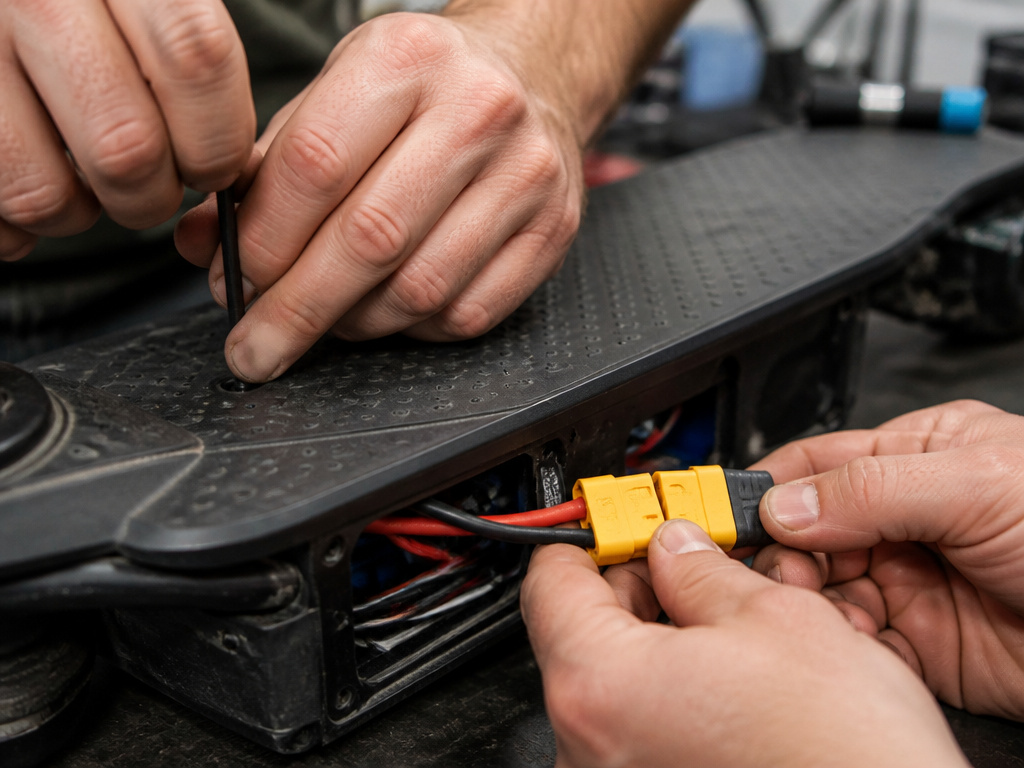
When the scooter is completely dead, no lights, no response to any button, you’re dealing with a deep electrical fault or a safety lockout. This is a hardware-level reset.
Before you start: You’ll be opening the deck to access the battery connector. Have a set of hex keys or screwdrivers that fit your scooter’s screws.
The Hover-1 guide lists two methods: disconnecting the main battery connector for 20-30 minutes, or an alternative battery disconnect reset for 60-90 seconds. Both accomplish the same thing: draining all residual power from the controller and capacitors.
There’s a critical step most people miss, straight from a Reddit user’s advice: after disconnecting the battery, turn the scooter’s power button on. This drains the onboard capacitor. If you skip this, the electronics may retain enough charge to avoid a true reset when you reconnect everything.
When a Reset Is the Right Call (And When It’s Not)
A reset is a software fix. It can’t repair a cracked circuit board or a water-logged motor. Knowing the difference saves an afternoon of frustration.
| Symptom | Try a Reset? | Why It Might Work | If It Fails, Suspect… |
|---|---|---|---|
| Scooter won’t turn on (but battery has charge) | Yes, start with Tier 1 & 4 | Clears a stuck sleep mode or controller lock. | Failing battery or blown fuse. |
| Error code displays (E1, E2, etc.) | Yes, Tier 1 or 3 | Could be a temporary sensor glitch. | Permanent sensor or motor hall fault. |
| Throttle feels unresponsive or laggy | Yes, Tier 2 | Recalibrates the throttle sensor. | Worn throttle potentiometer or damaged wire. |
| Speedometer/battery meter is inaccurate | Yes, Tier 2 | Resets the voltage calibration. | Failing voltage regulator or display. |
| Scooter shuts off while riding | Maybe (Tier 1) | Could be an overheating controller resetting. | Loose wiring, bad speed controller, or battery problems. |
| Physical damage, burning smell, or water exposure | No | A reset does nothing for physical damage. | Immediate inspection and potential scooter repair. |
The part nobody mentions: Resets have a success window. If your scooter got wet and you try a reset two days later, you’re just clearing error logs while corrosion spreads. Address the physical cause first.
Brand-Specific Reset Procedures
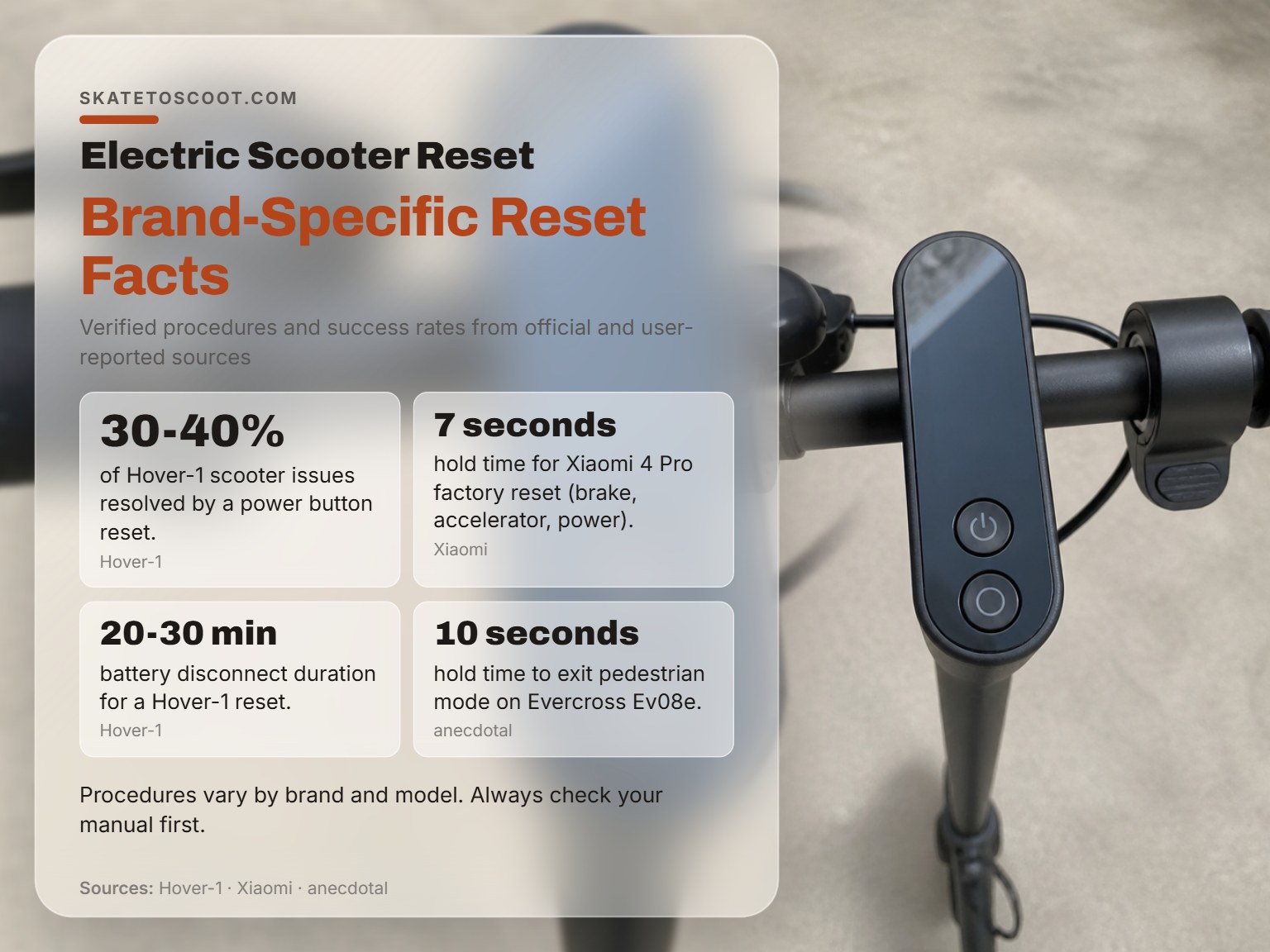
Generic steps get you only so far. Here are the manufacturer-specific sequences verified by official sources or consistent user reports.
Xiaomi Scooter Factory Reset
For models like the Xiaomi Electric Scooter 4 Pro (2nd Generation), the factory reset is a precise three-finger maneuver.
- Make sure the scooter is on and not locked.
- Press and hold the brake lever, the accelerator, and the power button all at once.
- Keep them held for 7 seconds.
- Listen for a confirmation beep. The scooter’s lights may flash.
This process, per Xiaomi’s official FAQ, “completely deletes the data stored on the scooter.” It’s your fix for a scooter that won’t pair with the Mi Home app anymore.
Where sources disagree: Xiaomi’s own device reset page sometimes lists a different 5-press accelerator+power button reset for “resetting.” This appears to be a Bluetooth/pairing-only reset, not a full factory wipe. If the 7-second hold doesn’t work, try the 5-press method, you might just need to clear the pairing table.
Hover-1 Resets: From Power Cycle to Eagle Wake-Up
Hover-1 models like the Alpha, Eagle, and Journey have a documented reset ladder.
Power Button Reset: Turn the scooter off, unplug the charger, wait 30 seconds, turn it on. Simple.
The Eagle’s Special Sleep Reset: If your Hover-1 Eagle display is completely dead, try this.
- Plug the charger cable into the scooter only (not the wall).
- Hold down the power button.
- While still holding the button, plug the charger into the wall outlet.
- Finally, unplug the charger from the scooter (still holding the button).
This quirky sequence forces the controller out of a deep sleep mode. For a more general Hover-1 reset, the battery disconnect is often the most reliable fix.
Community-Discovered Fixes (Evercross, e-twow, Isinwheel)
Without official manuals, owners on forums like Reddit have reverse-engineered their own resets. Treat these as community-sourced, not manufacturer-approved.
- Evercross Ev08e Pedestrian Mode: Owners report toggling pedestrian mode with a quick double-click of the speed button. To exit it, a Reddit user reports holding the speed button down for about ten seconds.
- e-twow GT Sport: For the e-twow GT Sport, user suggestions include holding the power button while pressing the throttle to max for 6-10 seconds, or holding the brake, throttle, and power button simultaneously for 6-10 seconds, looking for an “06” code on the display.
- Isinwheel/5th Wheel Bluetooth Issues: For an Isinwheel/5th Wheel scooter, a user fix for a lost Bluetooth connection involves plugging the scooter into the charger until the display goes completely black, then unplugging and restarting.
What To Do If Your Scooter Won’t Turn On At All
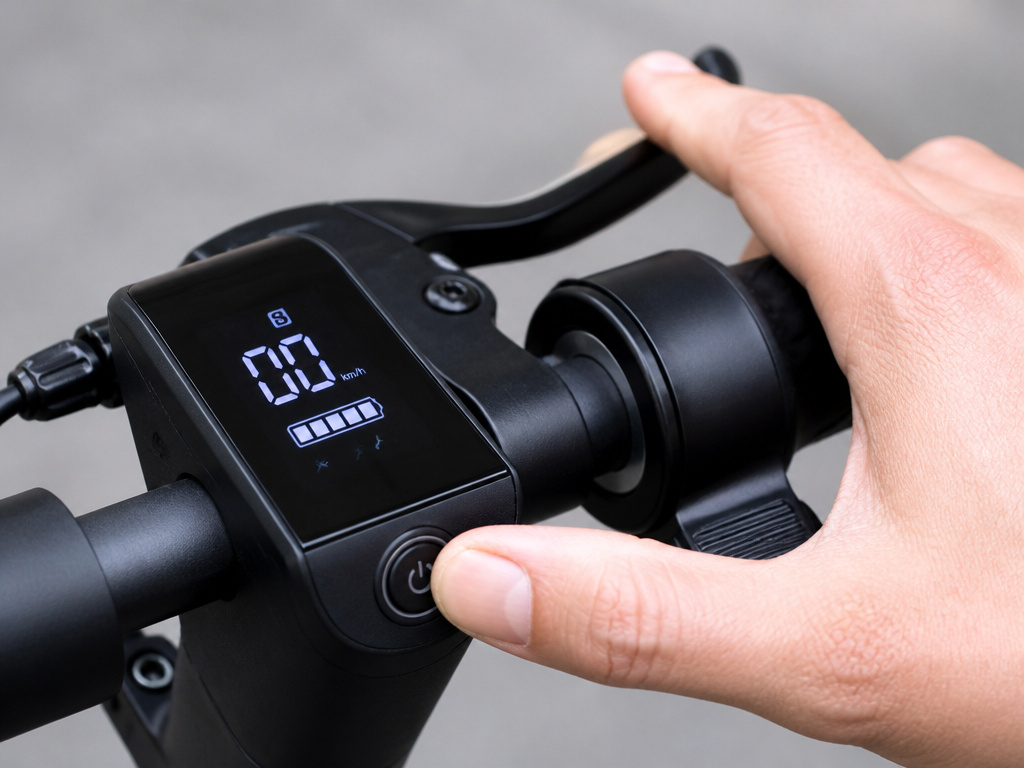
A totally unresponsive scooter is a panic moment. Follow this sequence before you assume the worst.
- Check the Obvious: Is it charged? Use a voltmeter on the charger port if you can. Is the power button held long enough (some need a 2-3 second press)?
- Try the Hover-1 Wake-Up: Even if you don’t have a Hover-1, the principle works for many lithium batteries. Plug in the charger. Lift the scooter so the motorized wheel is off the ground. Set it down and let it charge fully. This can trick a battery management system out of protection mode.
- Battery Disconnect Reset: This is your main move. Access the battery, disconnect it for 20+ minutes, and remember to press the power button while it’s disconnected to drain capacitors.
- Inspect for Physical Issues: Look for loose wires around the reset button location, the power button, or the throttle. Check for water damage or blown fuses near the battery.
If it powered on after a ride through rain, a reset might help, but the real fix is drying it out completely, a reset on a wet board is temporary at best.
Physical Reset Button Location
Most electric scooters do not have a dedicated physical reset button. Instead, a ‘reset’ is typically performed by holding a specific combination of the existing controls. Common button combinations involve the power button, the accelerator trigger, and a brake lever. For example, one reset method requires pressing and holding the brake lever, accelerator, and power button simultaneously. Another method might use just the power and accelerator buttons. These combinations are designed to be difficult to trigger accidentally while riding. Always start by checking your scooter’s manual for the exact sequence, as pressing the wrong buttons won’t harm the scooter but won’t reset it either.
Frequently Asked Questions
How do I perform a hard reset on an electric scooter?
True hard reset means physically disconnecting the main battery for an extended period (20-30 minutes). This cuts all power to the controller, draining any residual charge from capacitors. It’s the final step when a simple power cycle or factory reset fails, especially for a scooter that won’t power on.
Why did my electric scooter suddenly stop working?
Sudden stops are usually electrical. It could be a loose connection that jiggled loose, a speed controller overheating and shutting down, or the battery management system triggering a safety lockout. A reset can clear the lockout, but if the scooter shuts off while riding repeatedly, you have a hardware problem that needs fixing.
Will resetting my scooter delete the mileage/odometer?
It depends on the reset type. A basic power cycle won’t. A full factory reset, like the 7-second hold on a Xiaomi, often will. Community reports suggest some scooter odometers are stored in the display unit itself; replacing the display can also reset the mileage.
My scooter got wet. Will a reset help?
Not directly. A reset can clear error codes triggered by water shorting connections. However, if water is inside the deck, the priority is to dry it thoroughly with silica gel or rice before attempting to power it on or reset it. Powering on a wet circuit board can cause permanent damage.
I’ve tried all resets and nothing works. What now?
You’ve likely exhausted the software solutions. The next step is hardware diagnostics. Start with a visual inspection for damaged wires, then test the battery output with a multimeter. Common failure points are the scooter battery, the speed controller, and the motor. At this stage, consulting a detailed troubleshoot scooter problems guide or a professional is your best bet.
The Bottom Line
Start simple. Ninety seconds for a power cycle could save you ninety minutes of deeper work. Match the reset tier to the symptom: glitches get a reboot, sensor lies get a calibration, and stubborn software locks get the factory reset.
The one rule that overrides all others comes from the manuals themselves: you can’t reset what you can’t access. A locked scooter or one moving at 15 mph won’t accept a factory command. Make sure the scooter is ready to listen.
When nothing works, that’s your cue. The problem isn’t in the code anymore; it’s in the physical parts. That’s when you move from resetting to repairing, from software to the actual wires, boards, and batteries that make it roll.