Can You Get a DUI on a Skateboard? What Actually Happens
This post contains affiliate links. As an Amazon Associate, we earn from qualifying purchases.
You can get a DUI on a skateboard, but it depends almost entirely on two things: whether your board has a motor and which state you’re in. A traditional, human-powered skateboard is explicitly excluded from DUI laws in states like California, Arizona, and New York. An electric skateboard, however, can trigger a DUI charge in states like Delaware and California, where it’s treated as a motor vehicle. The real risk isn’t just the DUI statute, it’s the alternative charges (public intoxication, disorderly conduct) and the drastically higher odds of injury.
That motor is the legal line in the sand. It turns a piece of wood on wheels from a pedestrian device into something the law scrutinizes. States are all over the map on this, from Delaware’s explicit prohibition to Washington’s ambiguous gap, making the answer to can you get a dui on a skateboard highly location-dependent. And while you might dodge a DUI, a 2022 study in Craniomaxillofac Trauma & Reconstruction found riders under the influence had over four times the odds of a serious facial injury.
What follows: a breakdown of the human-powered versus motorized divide, a state-by-state table showing where the law stands, the specific penalties and alternative charges you’d actually face, and the concrete safety data that should make you think twice before riding impaired, regardless of the legal technicalities.
Key Takeaways
- The human-powered vs. Motorized divide is the single biggest legal factor, traditional boards are mostly exempt, electric boards can be treated as vehicles.
- State law is everything. Delaware and California explicitly prohibit DUI on motorized boards; Arizona and Texas do not. Your local city ordinance might be stricter.
- You are 4.16 times more likely to suffer a craniofacial injury if you ride a skateboard or scooter under the influence, per a peer-reviewed 2022 study.
- Even if a DUI charge doesn’t stick, police can arrest you for public intoxication, disorderly conduct, or endangerment based on your behavior.
- A skateboard DUI conviction will not add points to your driver’s license in most states, but it can appear on background checks and affect insurance.
The Human-Powered vs. Motorized Skateboard Divide
The central problem is this. The law doesn’t see a skateboarder. It sees a device, and it asks one question: does it have a motor? Your answer decides everything.
A traditional skateboard, powered by your push, is legally grouped with bicycles and rollerblades in most states. The California Vehicle Code excludes “human-powered vehicles” from its definition of a “motor vehicle” for DUI purposes. New York and Texas limit their DUI statutes to “motor vehicles.” The principle is consistent: if you’re the engine, you’re not driving a vehicle under these laws.
Flip the switch on an electric board, and the entire legal framework shifts. You’re no longer pushing; you’re operating. Delaware Code Title 21, Section 4198N(d) doesn’t mince words: it prohibits operating a motorized skateboard or scooter while under the influence on public property, applying full DUI penalties. California also makes it unlawful to operate an “electrically motorized board” upon a highway while impaired.
The part nobody mentions: This distinction means the same physical act, riding a board while intoxicated, is a legal non-issue in one scenario and a criminal charge in another, based solely on a component you didn’t build.
Why does the law care? Momentum and mass. A 200-pound person on a motorized device moving at 15-20 mph carries kinetic energy comparable to some slow-moving vehicles. The risk to pedestrians and the rider’s own control diminishes significantly. It’s a public safety calculation, not a moral judgment on skateboarding.
Where This Gets Murky: The “Vehicle” Definition
Some states cast a wider net. Florida Statutes define a “vehicle” as “every device in, upon, or by which any person or property is or may be transported or drawn upon a highway.” Oregon law uses similar broad language. In theory, this could include a traditional skateboard. In practice, prosecutors almost never pursue it, the public intoxication charge is simpler and carries less legal baggage. But the theoretical possibility creates a gray zone you don’t want to test.
State-by-State Breakdown: Where a Skateboard DUI Is Possible
You need to know your local code. Relying on a general rule is how people get surprised. This table summarizes the stance of key states, drawn directly from their statutes and legal analyses.
| State | Traditional (Human-Powered) Skateboard | Electric/Motorized Skateboard | Key Statute or Ruling |
|---|---|---|---|
| California | Excluded from DUI law. | DUI possible. Unlawful to operate an “electrically motorized board” while impaired. | California Vehicle Code |
| Arizona | Excluded (“devices moved by human power”). | Excluded from “motor vehicle” definition. Defined as a “motorized skateboard” and excluded, but other charges may apply. | Arizona Revised Statutes 28-101.77, 28-1381 |
| Delaware | Likely excluded. | DUI applies. Explicitly prohibits DUI on motorized skateboard/scooter on public property. | Delaware Code Title 21, § 4198N(d) |
| New York | Excluded (limited to “motor vehicles”). | Unclear. Law limits DUI to “motor vehicles”; classification of electric skateboards is not specified. | New York Vehicle and Traffic Law |
| Texas | Excluded (requires “motor vehicle”). | Unclear. Law requires a “motor vehicle”; classification of electric skateboards is not specified. | Texas Penal Code |
| Washington | Excluded (based on bicycle precedent). | Legal gray area. DUI statute’s “vehicle” definition is ambiguous; local ordinances control. | City of Montesano v. Wells (1995), Washington Revised Code |
| Florida | Theoretically possible under broad “vehicle” definition, but rare. | DUI possible. Likely qualifies as a motor vehicle. | Florida Statutes |
| Oregon | Theoretically possible under broad “vehicle” definition, but rare. | DUI possible. Likely qualifies as a motor vehicle. | Oregon law |
The Washington Example: A Case Study in Confusion
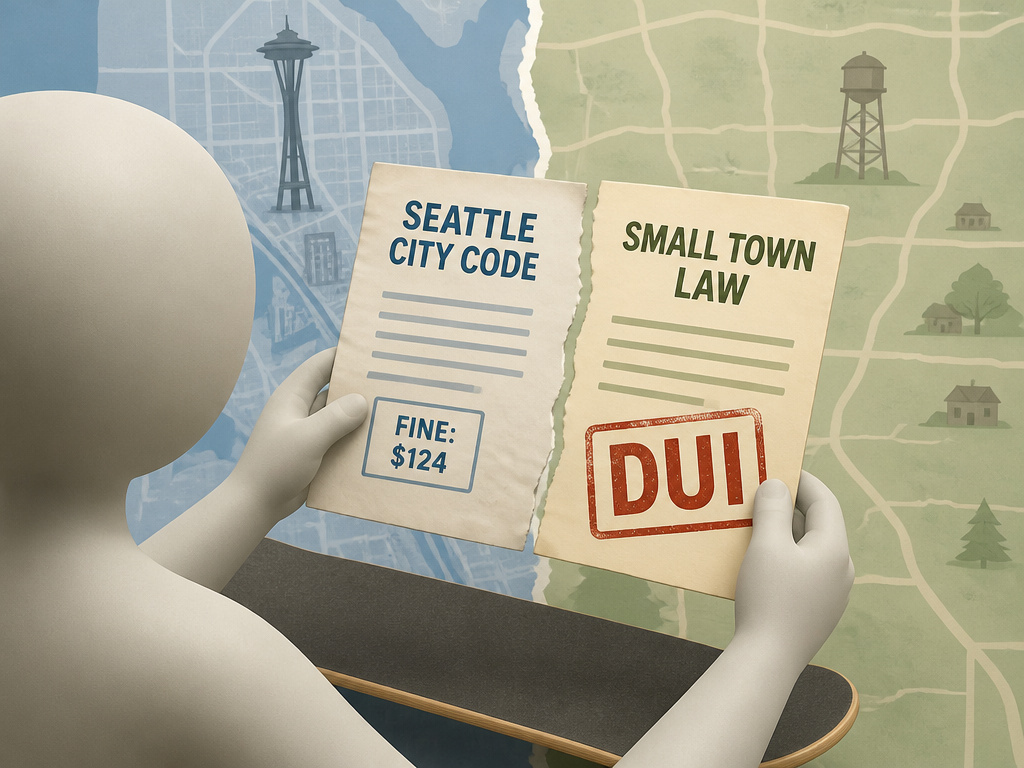
Washington State shows what happens when the law doesn’t keep up. A 1995 court ruling held DUI laws don’t apply to nonmotorized devices like bicycles. But the state’s DUI statute defines “vehicle” ambiguously. As noted in a Washington Law Review article, this creates a gap for electric scooters and skateboards. The result? Authority is delegated to local governments. Your penalty in Seattle could be a civil fine, while in a smaller town it might be a full DUI charge. You’re not just learning state law; you’re learning city code.
Penalties and Alternative Charges (What Actually Happens)
You won’t go to jail for years. Let’s clear that up. A DUI on a longboard or electric skateboard, even where it applies, is typically a misdemeanor. But “just a misdemeanor” doesn’t mean trivial.
Typical DUI Penalties for a Skateboard:
- Fines: Monetary penalties as determined by the court. * Jail Time: Possible incarceration. * Probation: A period of court supervision is possible.
- Driver’s License? This is the most common misconception. A skateboard DUI conviction does not add points to your driver’s license in most states, because you weren’t driving a licensed motor vehicle. However, the conviction will appear on criminal background checks, which can affect employment, housing, and yes, your car insurance rates. Insurers see a DUI as a marker of risk, regardless of the vehicle.
Common mistake: Assuming no license impact means no consequences. The criminal record is the lasting damage.
The More Likely Scenario: Alternative Charges
Police on the street are pragmatic. Proving a DUI on a novel device requires establishing it’s a “vehicle” under state law, that’s work. It’s often easier and just as effective to detain someone for a simpler charge.
- Public Intoxication: This requires you to be a “public nuisance” or danger to yourself/others. Swerving on a board in traffic qualifies.
- Disorderly Conduct: Linked to creating a hazardous condition or unreasonable noise.
- Reckless Endangerment: If your riding put others at risk (e.g., weaving through pedestrians on a crowded sidewalk).
Outcomes can vary, but arrests for riding impaired often lead to fines and other penalties. The arrest and night in jail are the immediate penalty; the fine is the follow-up.
Safety and Liability: The Real-World Consequences
Forget the legal code for a minute. The physical code is less forgiving. A peer-reviewed study published in Craniomaxillofac Trauma & Reconstruction in 2022 analyzed 5396 emergency room visits from skateboard and scooter trauma. The data is stark:
- Riders under the influence of alcohol or drugs had 4.16 times greater odds of suffering a craniofacial injury (fractures, lacerations to the face/head).
- They also had 2.83 times greater odds of being hospitalized from their injuries.
- Of the 1,136 patients with facial injuries, 12% had alcohol or drug use recorded.
The study’s conclusion is a direct quote from the source: “Patients under the influence of alcohol or drugs had greater odds of experiencing a craniofacial injury than those not under the influence.”
This isn’t scare talk. It’s biomechanics. Alcohol impairs balance, reaction time, and risk assessment. A stumble on a board that would normally lead to a rolled ankle becomes a face-first impact with concrete. Your ability to “bail” or fall properly vanishes. The study also noted injured riders under the influence were older on average, suggesting adults might be using these for bar-hopping, emboldened by a false sense of control from a motor.
Liability in an Accident
If you hit someone or cause property damage while riding impaired, the DUI or alternative charge becomes the least of your worries. You are now personally liable for their medical bills, lost wages, and pain and suffering. Your auto insurance won’t cover it. Your health insurance might fight it. The financial hole can be deep and permanent. Compared to that, understanding your local skateboarding sidewalk legality or road legality for longboards is basic preventative maintenance.
Can You Get a DUI on Other Wheeled Devices?
The same legal logic applies. It’s about the device’s classification.
- Bicycles: Treated identically to traditional skateboards in most states (e.g., Arizona excludes “human-powered devices”).
- Electric Scooters: Often explicitly included in DUI statutes as motor vehicles. A DUI on a scooter is a common charge in many cities.
- Hoverboards & EUCs: These self-balancing devices almost always have motors, making a DUI on a hoverboard a real possibility if local law defines them as vehicles.
- Rollerblades/Inline Skates: As human-powered devices, a DUI on rollerblades is extremely unlikely, but public intoxication is not. The same safety risks remain.
The pattern holds. Add a motor, add legal scrutiny. It’s that simple.
Frequently Asked Questions
In what states can you get a DUI on a skateboard?
States with explicit laws against DUI on motorized skateboards include Delaware and California, while Arizona explicitly excludes motorized skateboards from its DUI statute, and Washington’s law is ambiguous. States where it’s theoretically possible due to broad “vehicle” definitions include Florida and Oregon, though it’s rarely charged, while states like California, Arizona, New York, and Texas explicitly exclude traditional skateboards. The risk depends on specific state law: Delaware and California explicitly prohibit DUI on electric boards, Arizona explicitly excludes them, and Washington’s law is ambiguous.
Can you get a DUI with Heelys?
Extremely unlikely. Heelys are shoes with wheels, squarely in the “human-powered” and likely “pedestrian” category. You’d face public intoxication long before any prosecutor tried to stretch a DUI statute to cover them.
Does a skateboard DUI affect your car insurance?
While it typically won’t add points to your license, the criminal conviction will appear on background checks. Car insurers use this information in their risk assessments and can raise your rates or decline to renew your policy. It affects you as a person, not just as a driver.
How would police even test a skateboarder for DUI?
They wouldn’t administer a breathalyzer to determine if the skateboard is a “vehicle.” They would use standard field sobriety tests (walk-and-turn, one-leg stand) and observations (slurred speech, odor of alcohol) to establish impairment for a public intoxication or disorderly conduct arrest. If they are pursuing a DUI, that evidence would be used to establish you were “operating a vehicle while impaired.”
Is it different in the UK or other countries?
Yes, significantly. UK law generally prohibits riding any “mechanically propelled vehicle” on public roads while unfit through drink or drugs. An electric skateboard likely qualifies. Traditional skateboards do not. Always check the specific national and local legislation, as the U.S. State-based model is unique.
Before You Go
The legal answer is a patchwork, but the practical answer is clear: don’t ride impaired. Whether you’re on a $30 yard sale board or a $2,000 electric mountain board, your impairment turns it into a hazard. The law is playing catch-up, but physics and physiology aren’t.
If you take one thing away, let it be this: know your local ordinances. A quick search for “[your city] electric skateboard ordinance” or a glance at your state’s official OUI statutes or similar legal guide is ten minutes well spent. It’s less about gaming the system and more about understanding the real stakes, which include your face, your finances, and your record.
Riding should be about freedom and fun. A night in jail, a court date, and a five-figure medical bill are the opposite of that. Your best move is always to lock up the board and call a ride.
